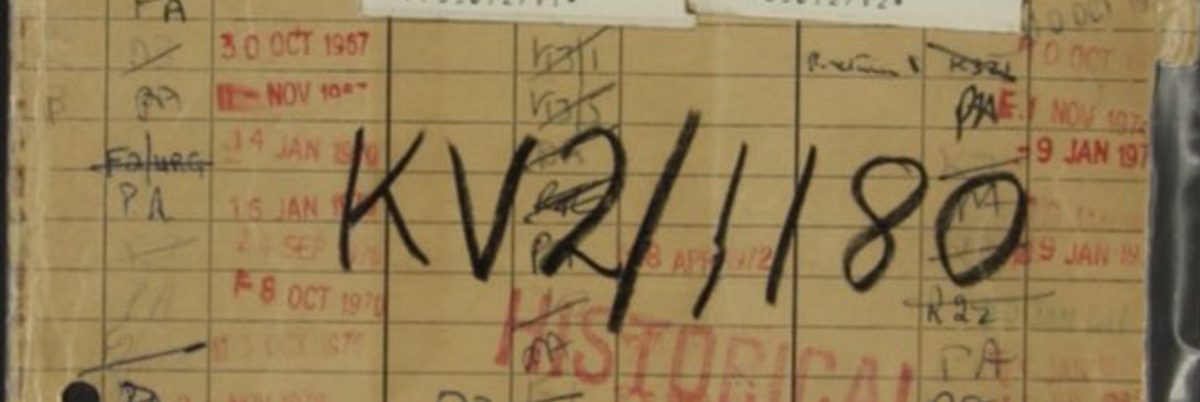
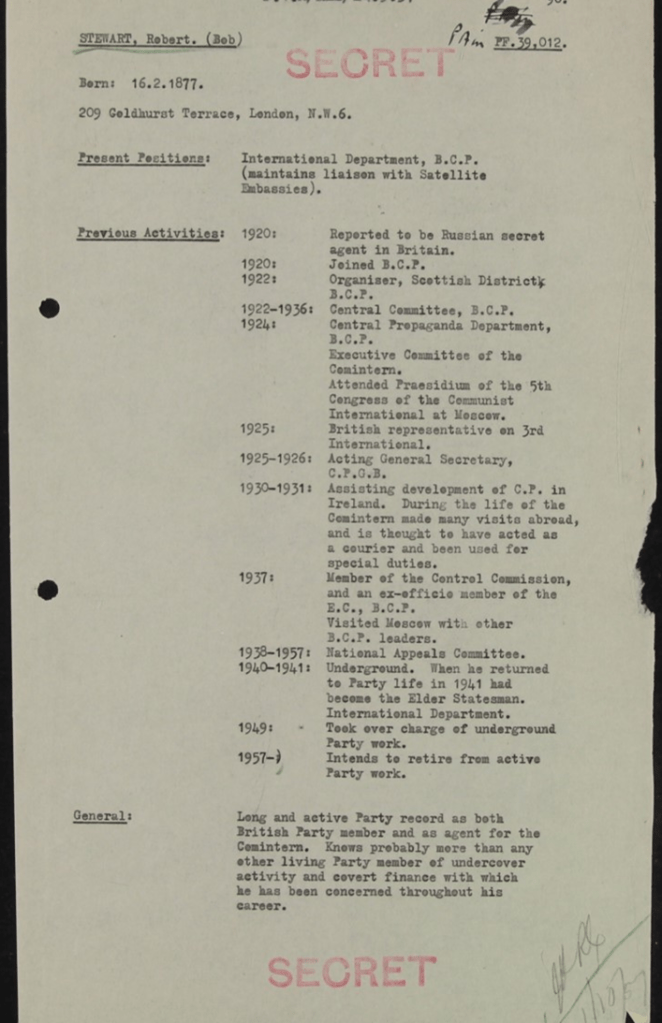
The document above is taken from the MI5 files now held at the National Archives in Kew. It’s from 1957 and gives a pretty comprehensive overview of Bob Stewart’s career in the Communist Party so far. Bob celebrated his eightieth birthday that year and most of the material the security services picked up from tapped telephones and bugged offices at the CPGB HQ in King Street, Covent Garden relate to him aiming to wind down and retire. There’s a decent summary of his professional life at the end.
“A long and active Party record as both British member and as agent for the Comintern. Knows probably more than any other living Party member of undercover activity and covert finance with which he has been concerned throughout his career.”
He’d spent quite a lot of the early years in Moscow, attended Lenin’s funeral and sat in meetings with Stalin. Then he spent time in Ireland trying to start up a Communist Party with the Irish labour hero Jim Larkin but little came of it. At one time, while the rest of the leading British communists were thrown in jail around the time of the General Strike, he became the CPGB’s Acting General Secretary. The Second World War years are a bit of a mystery but by the mid fifties the old man was very much on the security services radar again, though in this run down of activities they miss out his recent visit to China with Harry Pollitt where he met Mao Zedong.
Most of the surveillance work over the immediate years previously had been spent tailing him as he routinely visited satellite embassies and various address in the south of England. This was largely thought to be Bob moving different sums of Moscow cash around in order to keep King Street and The Daily Worker going. The issue of retiring and who he should hand over his responsibilities to was problematic as Bob wrote very little down, preferring instead to keep the details of all his undercover work in his head. There are several times in the transcripts where he is overheard by MI5 that he has been very lucky so far and didn’t want to go to prison at this time of his life. Indeed, at his advanced age he felt his memory was starting to fail and the past year had been exhausting. Revelations of Stalin’s crimes and how it affected his family personally had taken their toll. Eventually, Reuben Falber took over Bob’s work and if you want to find out what happened to the ‘Moscow gold’ just type his name into Google.
I don’t think Bob fully retired. There’s an album of photos from the 22nd Congress of the Communist Party of the Soviet Union in 1961 showing him mingling energetically with the delegates. He published his memoirs, Breaking the Fetters when he was ninety. Sensibly, but frustratingly it contains nothing of his undercover activities and only covers the early period of his life and the Party so there is little reflection on Stalinism. However, what does come through is his tremendous energy. The Communist Party in Britain formed in 1920. Bob was forty-five years old. All of this happened in the last half of his life. Before, there’d been thirty odd years of campaigning for the temperance movement, for trade unionism and against the First World War. The drive he had astonishes me.
Alan Stewart.
 Breaking the Fetters