

At school I passed the fifth standard when I was thirteen and so entered the labour market looking for a full-time job. Following my half time work I first tried the jute mills, and was offered a start on the breaker -can. But when I saw the nature of the work my first thought was to get out, which I did. I picked up my jacket and ran as fast as I could- certainly out of sight and sound of the gaffer, who thought the new start was well on the way to being shown how to tramp the cans.
So I tried another mill and got a job in the spinning flat. Some months later, however, I did do a turn on the breaker-can. in fact, as I passed from mill to mill, I had a turn at most of the jobs.
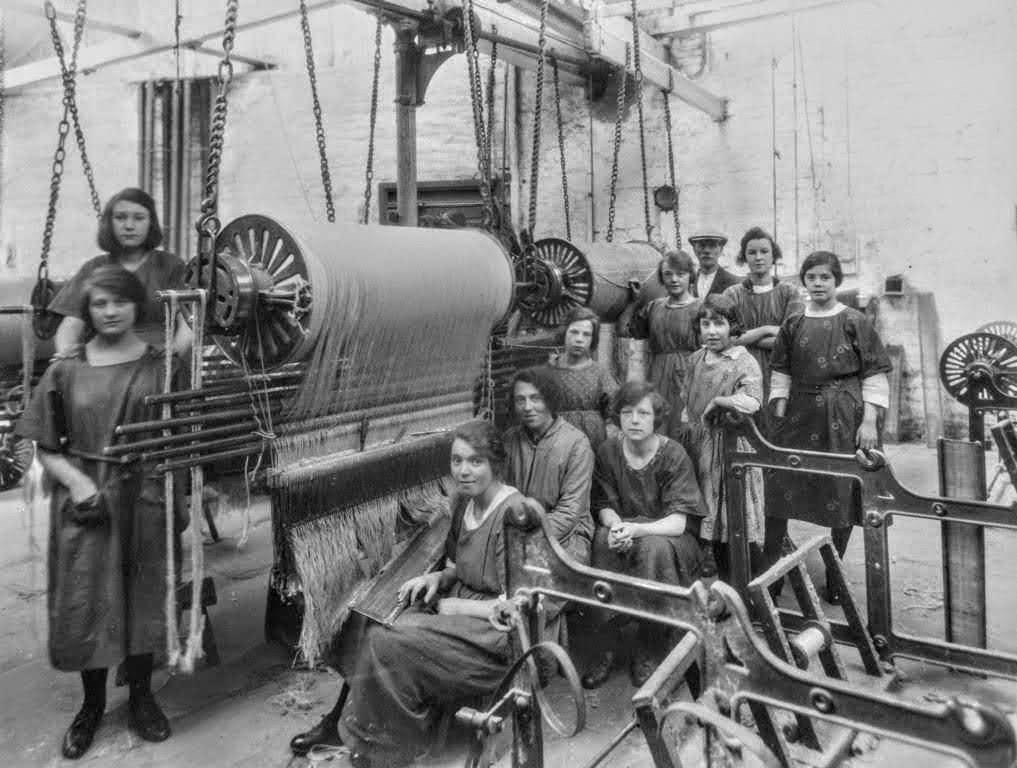
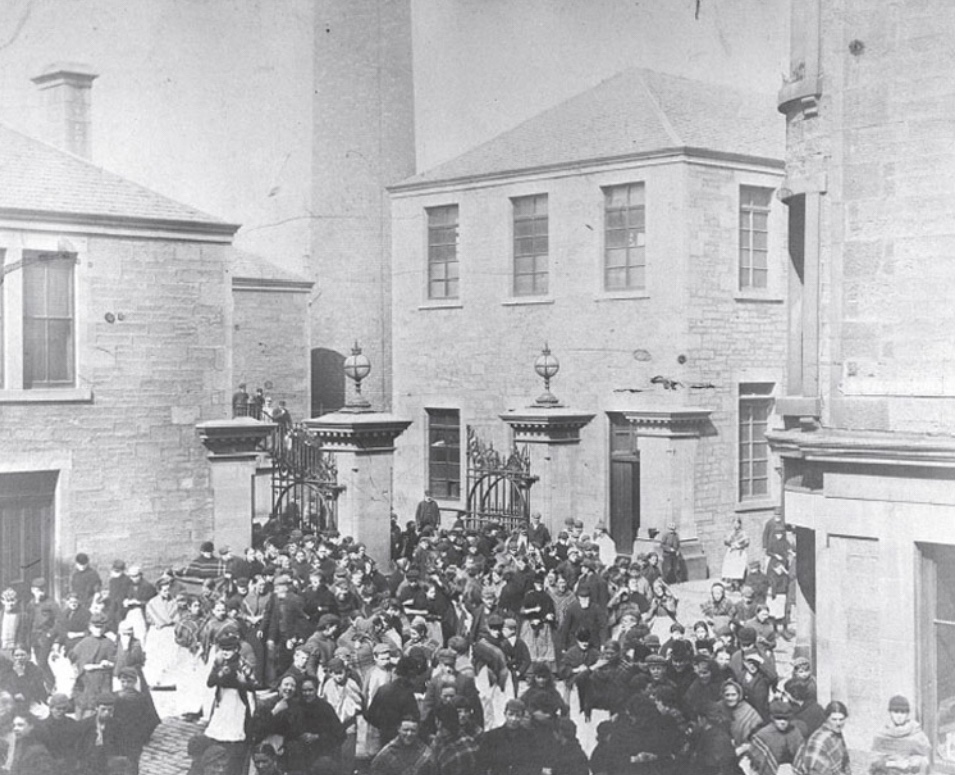
The process of jute manufacture was then as follows. First the jute was broken from the 2 cwt. bales in which it was shipped from India. Then it was impregnated with oil. This was to add resilience to the fibre. (In the old days whale oil was used. Dundee was a main whaling seaport.) After the jute was batched , it was passed through a feeder which had rows of sharp needles called hackles. These ripped the jute fibre into strands before it fell into a breaker-can. Into these cans the boys and girls packed the jute hard with their hands. This was called tramping the cans. The fibre then went through the carding machine, the drawing machine, then to the roving, each process making the jute sliver finer. At the roving, the shifter laddies took the roves off the machine and threw them into barrows, then the roves were barrowed to the spinners where the jute was spun on to bobbins. The bobbins went to winders where the jute yarn was wound on to cops. The cops then went to the factory where the weavers at their looms wove the yarn into the finished cloth.
In many cases the factories were not adjacent to the mills and the cops had to be transported by lorries. To have a job in the factory was considered posh, much better than having a job at the mill as a spinner or a shifter, and the low mill- that is the preparing flats- was considered the lower depths.
Many a song was sung about the work in the mills and factories. There was the Dundee Weaver’s song, the Dundee Spinner’s song, and the Wee Shifter’s song, all of which have made their way one time or another to the top of the folksong charts. There were songs about the batchers and the breaker-cans, but as these came from the low mill I am afraid the language was a little on the strong side for the publishers and their printing machines, and so they remain to this day in the heads of the old mill worlkers, reserved as a special party piece when occasion permits.
It was during this time that I became involved in my first strike. As a matter of fact I was the leader. The object of the strike was none other than William Gladstone, then prime minister in Her Majesty’s government. Gladstone was a great Liberal and frequently visited a small town near Dundee called Blairgowrie which had a large area of wooded countryside around it . When in Blairgowrie, the prime minister took a hand at tree felling, and this gave rise to the cartoon of Gladstone, axe in both hands, and the slogan “Woodman, spare that tree”. Speaking of Blairgowrie, I should not forget to mention that it is also the parental home of the Grimond family who had made their fortune in Dundee jute. From the Grimond family tree came the present leader of the Liberal Party, Jo Grimond. The Grimonds were Liberal in politics but never liberal in paying wages to the Dundee jute workers who were, and still are, among the lowest paid workers in Britain.
However, that day Dundee was en fête for the prime minister, who was to receive the freedom of the city. Now it seemed to me an insult to that worthy person and a slur on the city’s reputation that while the freedom ceremony was being performed we mill workers should be slaving away in the mills. At least that was how I put it to the fellows when I suggested we knock off and go to the freedom ceremony. The proposal was carried unanimously. I can’t remember anything Gladstone said that day so it could not have been important. The important event came m next morning when the gaffer demanded an explanation: and on being told I had suggested stopping work to hear the prime minister I was given the sack on the spot.
I crossed the road to another mill and got a job there. In all, I stayed in the mills until I was sixteen. These three years of mill work and my half-time mill experience had an important effect on shaping my character and my attitude to life. Working long hours for small wages, living daily with injustice and intolerance, sowed the seeds of the desire to see a system which gave justice to the workers. Allied to this was the poverty to be seen everywhere in this jute city. Dundee was considered a town of drunkards, but when I look back with the wisdom of age, I can see that this really arose from the impoverished life of the people. They were so poorly fed that a couple of nips of whisky and a pint of beer was enough to send them into a drunken stupor. The Scottish drink was a nip of whisky, price twopence, and a penny pint of beer. That is still the Scottish drink today, but the prices are somewhat higher. When Scotsmen talk of the Good Old Days they usually refer to drink prices.
The public houses were evil, smelly places. I had first-hand experience because I used to go in them to sell news-papers, another sideline of mine to make an extra penny or two. There was the stench of beer, the sawdust on the floor, the spittoons and the salt fish the publican kept on the counter because it gave the customers a thirst when they chewed it. Most of them would not need the salt fish because those from the mills had enough jute “stoor” (flakes of jute) in their lungs and bellies to give them a thirst that a barrel of beer would not quench.
Dundee on a Saturday night (Saturday was pay day) was bedlam let loose. It used to be said that the workers did more fighting in the Overgate (a street in the city centre) on a Saturday night than the Black Watch did during all of the war. Certainly there were many pitched battles, often family against family. The Molonys against the Mulligans, O’Fees versus the McFarlanes and so on. It is laughable but true that the police used wheelbarrows to cart away the drunks and the casualties after the battles had subsided. The police wisely kept well clear until they could move in for the kill. On Monday morning, as kids, we used to go down to the prison and see dozens at a time being thrown into the Black Maria and taken to the courts. Each successive court appearance meant a higher fine but this did not lessen the number of offenders, nor make the Overgate a more peaceful place on a Saturday night. It brought tragedy to many homes, however. Fortunately my parents did not drink. My father could take an occasional bottle of ale and my mother was a strict teetotaller, a complete abstainer.
All this squalor and degradation, seeing and experiencing the misery of some of my pals who went back on a Saturday night to a home with parents brawling and fighting in a drunken stupor, had a very profound effect on my thinking. Many of my political acquaintances throughout my life have asked me why I spent so many of my early years in the Temperance and Prohibition movement. This was the reason. In fact for many years I had only one way of separating right from wrong. Those who drank were wrong- those who did not drink were right. True, my temperance was always colored with socialist principles and working-class justice, but the real reason why my early political work was done in the I.O.G.T. (Independent Order of Good Templars) was because of my experience in early life in Dundee.
When I was sixteen my life took another turn. My mother, knowing the lot of the labouring classes and not wishing her son to be one of them determined to make me an artisan, But it was by sheer accident that I became a joiner. The tailor who made my father’s clothes came on a periodic visit to get his order for trousers and jacket. When the measurements were done and a chat was taking place over a glass of ale, the subject to a trade for wee Bob came up. It transpired that the tailor had a son who was gaffer to a builder. He “spoke” for me and so I started my time as a joiner apprentice with the firm of Sandy Stewart at 4s. for a 54-hour week. This part of my apprenticeship lasted for over two years. I learned to plane and saw, making doors and windows for whatever jobs we were working on, jobbing or building. But a vast amount of my time was spent on labouring work, Sandy Stewart had a strange idea of how an apprentice should
acquire the skill of his trade. I was worked like a wee Scots donkey. I had to push a barrow from the yard to the docks nearly a mile away, stack the timber on the barrow and push it back, all uphill, a very strenuous job. Worse still, I had to combine brute force with diplomacy. Sandy Stewart was always in debt to the timber merchants, Bell and Sime, and so I had to promise faithfully that the firm would give prompt attention to future payments before I could load the timber on the barrow.
The crunch came in the winter of my second year. The snow was very deep, and thick ice covered everything. The boss sent me up to his house to clear the roof and clean out the gutters. At the end of the week I received my apprentice’s wages, 6s., the second-year rate. I said, “If I do labourer’s work I want labourer’s wages.” “You’ll have to see the boss then.” So in to Sandy Stewart I went. “I did labourer’s work last week and I want labourer’s wages,” I said. “Ye’ll get no labourer’s wages here,” shouted Sandy Stewart, then he went into a rage shouting that I was a lazy good for nothing and so on. “Get out or I’ll put you out that window,” he roared. “You’ll need a new pane of glass then,” I said, “because it’s you who’s going to make that journey. Give me my apprenticeship lines.” I moved towards him, but like most men who shout and bluster their way through life he didn’t need much pressure to cave in. I got my apprenticeship lines with a note saying I had left of my own accord and so my work in Sandy Stewart’s yard came to an abrupt end.
Unemployment in the city was high. The hard winter had closed the building sites and all outside work was at a stand-still. Labour was plentiful, jobs were scarce. After much searching and standing at work gates, I started on the railway, shunting with the hydraulic capstan at the Tay Bridge goods shed. But that did not last long. One day the capstan went faulty and did not stop, the shunting rope and the hook flew off the wagon and twisted around my legs, giving me a bad though not serious injury.
I was off work for many weeks, but the railway was a new experience and there I learned a few more tricks of the workers’ trade. Railwaymen were among the lowest paid workers and always on the look out for ways to supplement their wages. Maybe it was an extra bag of flour on the lorry; there was always a market for that. Or it might be fruit. Apples or pears, particularly in the Christmas season, were always a winner. But the best bet of all was the whisky trade. Broaching the barrel was a railway skill, in fact it was more,
it was an accomplished art, and many a “dab hand’ there was at the game. It was done with a very fine brace and drill. When the tiny hole was made in the barrel and the fine thread of whisky spurted out, every vessel capable of holding liquid was pressed into service- bottles, pails, flasks, the lot. After they had been filled, a very fine sliver of wood was knocked into the hole, a concoction of oil and dirt rubbed over the surface and the barrel proceeded on its way.
Broaching the barrel was so prevalent at the New Year period that special corps of police were drafted in for protection. But these guards were lured away to the bothy on the loading bank for a wee dram, just to keep them warm, and of course while they were having their wee dram another barrel was being relieved of its liquid gold. As one old loader used to say when he had got the special cop out of the way, “Whisky has a greater drawing power than the world’s best
poultice.” In the bothy on the loading bank there was a barrel sunk into the ground. All the time I was there it was never empty. Anyone could drink as much as they wanted. Some did, and were carried home on occasions, but I was never once tempted, which proved conclusively that the temperance movement had one adherent whose lips were sealed to strong liquor.
I was again idle after my accident, but through people in the temperance movement I got a job in Gourlay’s shipyard. Gourlay’s was quite a famous yard; many world-renowned ships left its slipway.
While in Gourlay’s yard, I threw myself heart and soul into building the temperance movement. We had a strong group of Templars in the yard, but most of our work was done in the evenings and on Sundays. Some of the “big” fellows, the Fathers of the Lodges, wanted young people to be, as they said, “good law abiding Christians” to just come to the meetings, listen to speeches about the evils of strong drink and then meekly return home. I fought against this attitude. I thought the lodges were places where young people should
have debates, sport and entertainment. Finally a few of the more progressive fellows and myself started a new lodge, the Victory Lodge. We broke the rule, we organised dances and concerts and from the money made we bought billiard tables, dart boards, draught and domino sets, and made the lodge into a real young people’s club. We held open-air meetings at which I often spoke and asked people to sign the Pledge. Naturally, because of our activity, we attracted many young people and our new lodge soon became the largest in the city. In fact, at one time it had more members than any other lodge in Scotland, and I became the Chief Templar in Dundee.
There was a lot of competition for the allegiance of the young people in the city. Churches with their auxiliaries, Young Men’s and Young Women’s Groups, were always active. There was a very good and active Secular Society. They too held meetings in the Albert Square. Their main theme was “religion is the opium of the people” and all their work was aimed at destroying the various images of God. I spent many evenings and Sunday afternoons listening to the secularists, all of them excellent speakers. Wull Bowman (grandfather of Dave Bowman, who has now for many years been Communist candidate for Dundee), and Jimmy Croll, a local shopkeeper, were two of their best who could hold a big crowd, often in face of much heckling. Their paper The Freethinker had a good sale. I was attracted to much of the logic in the secularist argument and began to have my doubts about God. Interesting therefore to record that, in later years, it was mainly on religious grounds that I finally broke with the prohibition and temperance movement.

In the last year of my apprenticeship I joined the union. It was forbidden to do so before then. I immediately took part in active work. There were two unions, the Scottish Association of Carpenters and the Amalgamated Society of Carpenters and Joiners. I joined the latter. I was elected to the management committee for the yard and did a valuable job. I was the only one who thoroughly read the National Committee minutes and consequently was always up-to-date on demarcation problems, and extra payment agreements for varying types of work. While I was there we had a very militant management committee and a closed shop was enforced, with a trade union card examination every month.
In doing this work I became a well known and popular figure, so when my apprenticeship finished my mates were determined to give me a good show. The practice then was for the new journeyman to give the fellows a big booze-up in one of the public houses in the Vault (an old alleyway in the city centre nearly three hundred years old). A journeyman was often remembered in later years for the number of drunks he had at his pay off. But I put an end to that idea for me. I said no pub. But I took a restaurant instead, and there we gave the fellows a slap up feed. Aberdeen-Angus steaks were in my opinion a better pay off than Whitbread’s beer or Morton’s whisky, all of them, by the way, products of Dundee. Naturally, when the steaks had been consumed, many of the fellows gravitated across the road to the pub, and a few got so tight that they had a swing on the glass chandelier and were “Bounced” into the street for their daring.
Now I was a fully fledged joiner. Mrs. Stewart’s work had borne fruit. I was an artisan with papers to prove it, but I was soon to discover that the lot of the artisan and that of the common labourer were very much the same.
 Breaking the Fetters
It is very interesting following the life and career of someone I had never heard of until a chance encounter on Twitter last year. Much better than ‘Great Expectations’.
LikeLike