“The idea that market crashes can act as catalysts for revolutionary change has a long history on the far left, most notably in the Bolshevik theory that hyperinflation, by destroying the value of money, takes the masses one step closer to the destruction of capitalism itself. This theory explains why a certain breed of sectarian leftist is forever calculating the exact conditions under which capitalism will reach “the crisis,” much as evangelical Christians calibrate signs of the coming Rapture.”
Naomi Klein, The Shock Doctrine,
The quote above, taken from Naomi Klein’s critique of neoliberal economics, explains at least one of the reasons I am not a Marxist-Leninist. Just like the Rapture, the worker’s revolution isn’t coming any time soon. Though I seem to be getting more left wing as I get older I just cannot bring myself to pin my hopes on the conditions being just right to overthrow capitalism. No matter how bad things get – and they are bad – most people would rather vote against their own interests than take to the streets with the belief that there’s a world to win.
Of course, that’s not the only reason to not become a communist in 2022. After Stalin’s Soviet Union and Mao’s China no party featuring the word ‘communist’ in its title is ever going to win popular appeal. The shadow those and other monstrous regimes cast is too great. In his memoir, ‘Party Animals: My Family and Other Communists’ David Aaronovitch describes people, like my own grandparents and great grandparents, who had friends and family members who were victims of Stalinism. Even without that personal loss, Aaronovitch offers up plenty of occasions where tearing up their membership cards would have been the only correct response.
“So, if not then, why not 1939 and the Nazi-Soviet Pact and the Party’s headstand? Or 1948 and the Tito split…Or 1952 and the execution of Otto Sling, whose children had played with the children of Party leaders? Or 1953 and the anti-Semitic Doctors’ Plot? Why not after the Khrushchev speech, but before Hungary? In the mid 1970s Vivian Gornick, researching for her book on American Communism, interviewed a former Party member whom she named ‘Max Bitterman’. She noted the old man’s ‘scorn for and hatred for anyone who had left the Party either thirty seconds earlier or thirty seconds later than he had. Those who left before him were morally deficient and those who left after were intellectually impaired.” (page 265)
This resonates. People stayed committed communists even when confronted by the evidence that the Soviet Union was far from what they imagined. In Bob Stewart’s case, his son in law – a Russian economist was arrested as a counter revolutionary in 1938 and executed in 1941. The full details only came out in 1956 after Khrushchev’s speech at a time when Bob was living with his daughter Annie, her second husband and their young family. The impact of these revelations was picked up by tapped telephones and bugged offices but that doesn’t even begin to cover how they dealt with this trauma in the eighteen years before it all came out. Bob remained a committed communist for the rest of his days as did his sons, Bill and Rab. Annie, understandably, left the CPGB -possibly some time in 1957. She eventually joined the Conservative Party in the mid 1970s.
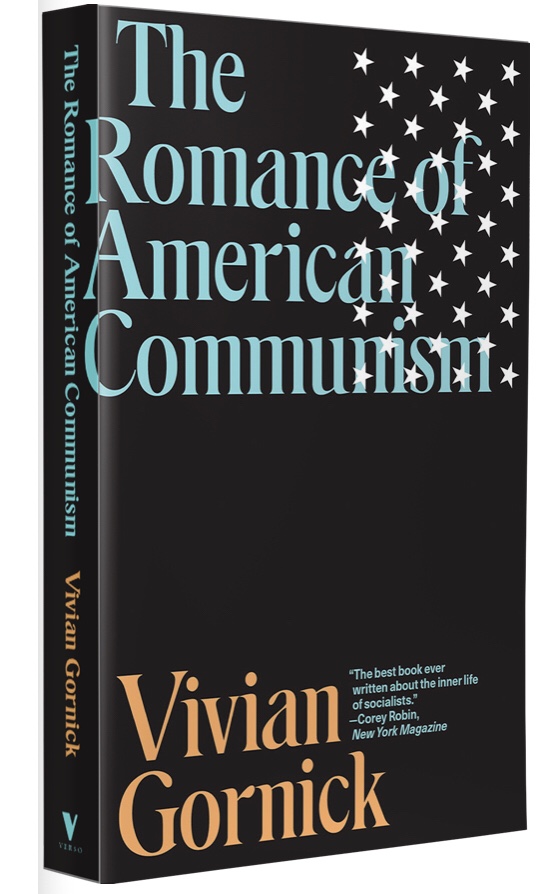
I find the question of why some people stayed and some people left fascinating. It is almost unanswerable. However, Vivian Gornick gets closer than most. The Romance of American Communism, republished by Verso in a beautiful edition in 2020 is by far the best book I have read on the subject and I’ve been pushing it onto people ever since I first encountered it. The book, which first appeared in 1977, is an oral history compiled from interviews with some of the American citizens who committed thenselves to the cause in the mid twentieth century. Gornick herself knew her subject well. She was bought up in a jewish working class family in New York. When she broke with the party she threw herself into second wave feminism. The gradual disillusionment she felt with that prompted her to think again about why people became communists. She embarked on a series of conversations with members and ex members and produced one of the first books in the post 1956 era not to regard communists as mindless, unthinking automatons.
Gornick herself is slightly mystified that the book has begun to attract a new audience. She’s been quick to criticise her style as too florid and her approach too judgmental. These are fair points to make however they do a disservice to a book that’s characterised by a marked sense of empathy towards its subjects . Though most of the people interviewed were drawn to communism due effects of the Great Depression and the threat of fascism in the 1930s the marks their experiences of being card carrying members left on them are myriad. Lives are enhanced, lives are ruined. There is nostalgia and there is regret.
A central question Gornick poses is why it ‘romance’ and not ‘tragedy’ that features in the title of the book. Each successive interviewee outlining the extent to which they fell head over heels with party life and felt driven by the Romantic ideals to change the world for the common good. However, when it comes to the reasons why they either stayed or left in the light of Khrushchev’s revelations about Stalin, they all struggle to find the words. There is no one simple answer.
Recently my family settled down to watch Kenneth Branagh’s much ridiculed but nonetheless sumptuously enjoyable remake of ‘Death on the Nile’. There is one brief moment where Branagh’s Poirot, his moustache filling up almost the entire screen, berates an outspoken and ludicrous communist heiress for her belief in ‘economic fairy tales’. It is a telling moment. The great rationalist detective pointing out hypocrisy but also choosing a side. That of the great wealth and power that has placed him there amongst these glamorous people, in these luxurious surroundings, precisely at that moment in order to satisfy his performative vanity. On the evidence it might be hard hard to argue with Poirot’s observation but, of course, capitalism is also an ‘economic fairytale’ and one that is better at hiding the misery and exploitation it creates. To bring us back to where we began – Naomi Klein’s The Shock Doctrine – the economic system we live in is appalling. Food banks exist in our wealthy country. They have become normalised. They are now asking for food that doesn’t need to be heated up as so many of their clients cannot afford their energy bills. Will this rising cost of living bring about a crisis in capitalism and usher in revolutionary change? Unlikely. However, like it or not, if we are ever to be free of it or, at least, remedy the inequality in our society, we will need people who display the same Romantic ideals as those portrayed in Gornick’s book. You can, of course interpret the world in different ways but at least these figures, admirable and flawed in turn, understood that the point was to change it.
Alan Stewart.
 Breaking the Fetters