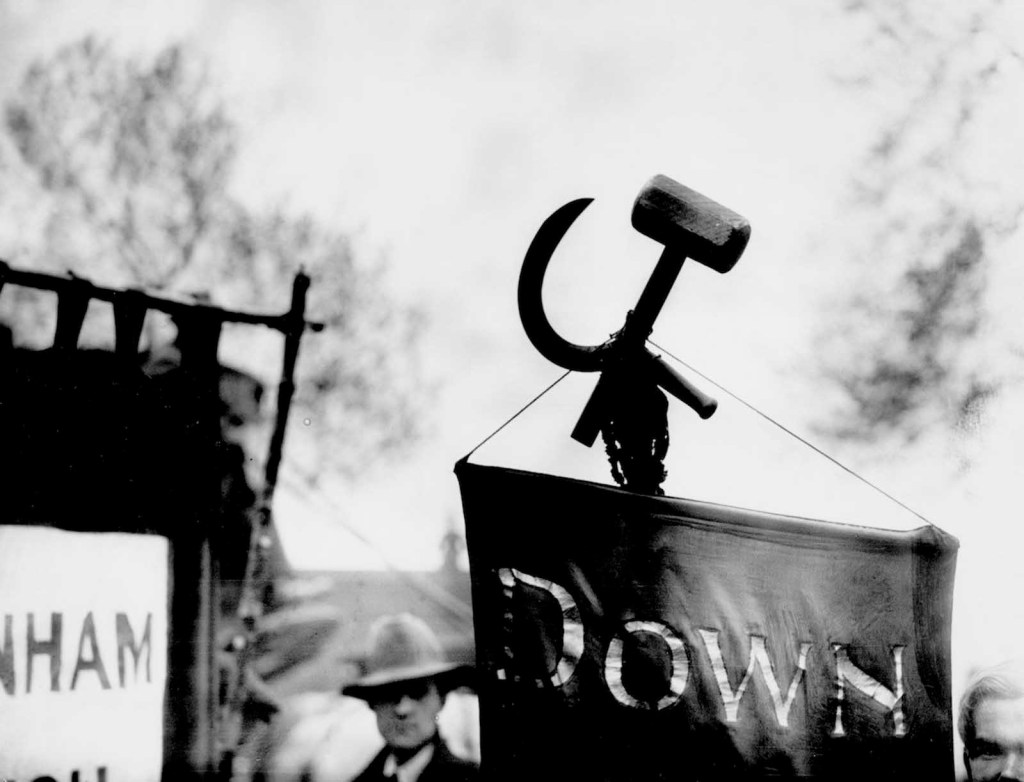
After the formation of the British Communist Party at the Leeds Conference, the main task was to build and strengthen the organisation. I was elected as the Scottish organiser, a very tough assignment.
The main political problem then was the beginning of mass unemployment, the fight for work, and the divisions which this creates in the working-class movement. During the war most big factories had established their “factory committees”. But now many of the factory committee members had become
unemployed, and factory committees had employed and unemployed workers working together. This, however, gradually ceased and there began the unemployed workers’ committees which led to the National Unemployed Workers’ Movement which was to play such an important role in the working-class struggles of the 1920s. This segregation of employed and unemployed workers was not then and never has been a good thing for workers in struggle. One section is always played off against the other by the boss and inevitably the boss wins.
Naturally our fellows, being the most militant, suffered most and were the first victims in the factories. Many joined the ranks of the unemployed, and while this meant they had time for political campaigning it cut them off from the much more decisive political work in the factory organisation.
In this setting we commenced to gather together the socialist fragments and build the Communist Party in Scotland. We inherited the British Socialist Party branches, the Communist Labor Party branches, and Socialist Prohibition Fellowship Party branches. All rather loose in organisation, and as I very soon found out, very inflated in assumed membership. The Communist Labour Party were supposed to bring over 4,000 members but I doubt if there was half that
number. The British Socialist Party claimed to bring over 10,000 members. If they did, there were thousands I never saw and I very much doubt if anyone else ever saw them. Propaganda was our strong point. We had many excellent speakers, and all dead sure of themselves. Tom Bell, for years the editor of The Communist; Willie Gallacher, for fifteen years M.P. for West Fife; Johnnie Campbell, who became editor of the Daily Worker, and Bill Joss, one of the ablest lecturers in the Scottish Labour College. These and many others made up a brilliant team of socialist agitators for the Scottish district of the new party.
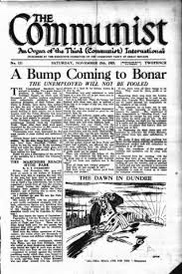

Then there was the selling of our paper, The Communist, an extremely important part of our political work. With self-sacrificing effort of fellows like big Pat Quinlan, Malcolm McFarlane and others the sales rose by thousands. Nothing was a handicap to them. They were out on sales late and early, in snow, sleet and rain, nothing deterred them. At this period I remember one strange incident that came up in the ordinary course of the work. In Glasgow there was a big Irish docker named Jimmy Fearns. He originally came from Newry in Northern Ireland, and I think he was one of the founders of the Irish Citizen Army. Jimmy was out of work and, like most people in his circumstances, living in one of the model lodging houses for which Glasgow was famous-or infamous, depending on which way you look at it. I never knew why the name “model” was given to these dens of human suffering, they were certainly revoltingly original, but never model. One morning Jimmy came to me and said:
“Bob, can’t we do something for the modelers?”
“Have they any grievances?” I asked.
“Sure they got nothing but grievances.”
So we had a meeting with a number of representatives from the models, mostly men living apart from their wives and families and trying to keep two homes going. We got their grievances, published a leaflet and distributed it around the lodging houses. Because of this agitation a number of these places became cleaner and started to provide more up-to-date cooking and washing facilities.
The story was not without sequel. We were amply repaid for our work. For us there was the guarantee that our meetings in Glasgow were conducted in a peaceful atmosphere. The modelers were very handy fellows when the occasion arose. They lived in a society in which “might was right” and if there was any attempt to break up our meetings they soon put an end to that nonsense, saying “they defended those who defended them.”
The Scottish organisation took shape on the basis of our propaganda meetings. We had branches in every big borough from Glasgow to Aberdeen and a lone scout or two in places like Inverness, Dumfries, Perterhead and Fraserburgh. We listed speakers for the meetings, checked that they were advertised- because in those days it was a hit or miss business, sometimes the speaker did not turn up, sometimes the meetings were not advertised and there was no audience. All arrangements had to be checked and re-checked.
This meant money, and sometimes the sums were large, at least large for us. Two members of the Scottish Executive who did a magnificent job on finance for the party were John Inches and George Whitehead. By their work the Scottish Party was entirely self supporting, and with good finances the
political and organisation work of the party received most attention. Thus early I already understood that freedom from financial worry is a boon to a Communist Party organiser.
The most distinguishing feature of the Scottish Party then was its solid industrial base. In fact, the party was so working-class that there was a real antipathy to what was termed “the intellectuals”. It was entirely wrong of course and was combated by the Party. At that time we had a number of students; one of them, Phil Canning, later to be elected as a Communist Councillor in Greenock for many years, became an outstanding representative of the working class. Our students became swallowed up in revolutionary thought and began to absent themselves from their university classes, thinking the revolution was round the corner. I had long conversations with them, and patiently explained that just as in the workshop a Communist had to be a capable worker and win the respect of his mates, so in the college and university the students must do the same. If a Communist could not pull his weight then his “preaching” will fall on deaf ears. A student with a degree was a much more valuable political worker than a student without a degree.
Our solid industrial base came largely from the members who had come to the party from the Clyde Workers’ Movements and the militant workers from the mines and the railways who also had an excellent record of militancy during the war. But they also brought a number of problems. Our relations with the Labour Party were not good. This was partly of our own making, in that many of the groups that had preceded the new Communist Party and helped to form it had a very abusive attitude towards the Labour Party. Many of these members were strong political individualists and spent the greater part of their political life calling the Labour Party names. Not that sometimes the abuse was not called for, but nevertheless it was not the right way to go about trying to cement relationships that certainly would have helped us to gain more working-class unity in action.
We also inherited a problem from the Socialist Labour Party, who had laid down that their members would not accept trade union office lest they be corrupted. We naturally had to fight against that principle; corruption in the trade unions was then and still is an occupational hazard for which membership of the Communist Party is a good antidote. This, however, was one of the reasons why many militant trade union leaders in Scotland did not immediately join our party.
Our principal problem in industry was to get a balanced understanding of the political work of the party, engaging in every struggle in the social field and blending this with our industrial work in the fight for wages and better working conditions. This conception was foreign to British politics and therefore the hardest nut to crack for our party. A break had been made during the war in the rent struggles on the Clydeside, which culminated in the pressure on the authorities being so great that a new Rent Act was passed in Parliament. The Clyde Workers’ Movement had played a decisive part in this fight, organising the workers in the factories and combining with the tenants’ organisations. In fact, it can truly be said it was this successful combination of social and industrial struggle that was the main reason for the success gained.
We also had to try and overcome strong syndicalist traditions which still endured in industry. In this there was good and bad. I well remember when the late Jack Tanner came to the party, at that time a strong syndicalist-in fact, he edited a paper called The Syndicalist from somewhere in Fetter Lane, London. But Handsome Jack, as he was called, developed ambitions to become a trade union leader and the Communist label did not make for an easy passage, so Jack
changed the label.

Another syndicalist, but one who was quickly shedding his syndicalist ideas and who came to the party, was Tom Mann. A great national and international figure and the first Labour candidate to contest Aberdeen; a fine trade unionist, a first-class politician, a great social mixer, known to everyone left, right and centre, respected by all and one of the best speakers the Communist Party ever had; Tom Mann was a great asset to the British trade union movement and an excellent representative of the Communist Party.
In these early days the party attracted all kinds of industrial do-gooders and the sieve of struggle sorted them out. In Scotland we got our quota, but the vast majority of our members were fine men and women, with the success of the working-class struggles and the achievement of socialism as their main aim. We had leading miners from every coalfeld, engineers like Willie Gallacher and Hugh Hinselwood, Tom Bell and Jim Gardner (later to be the general secretary of the Foundry Workers Union) from the foundry workers, from the railways Jimmy Davidson and Jimmy Figgins who many years later was general secretary of the N.U.R., and George Whitehead from the Clerks. They and many others were held in the very highest esteem in the unions and the factories, enhancing the prestige of our party.
At that time we had not reached the stage of factory organisation, but there is no doubt that the work of our industrial members at the formative stage of the party laid a firm base for party industrial work in Scotland which has endured, expanded and strengthened until the present time. One of the big disappointments when the party was formed in Scotland was that John McLean, one of the foremost members of the British Socialist Party, did not join the new
Communist Party.
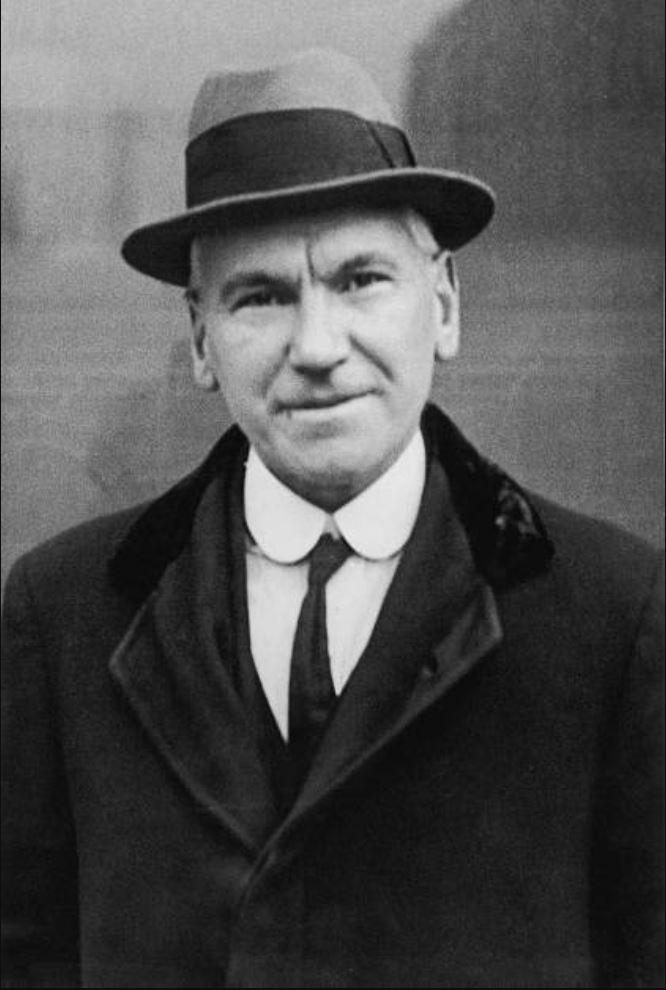
McLean was undoubtedly one of the greatest British socialists of all time. Lenin spoke of him as a fearless fighter against imperialist war. When the first All Russian Congress of Workers and Soldiers’ Councils met, John McLean and Karl Leibknecht were appointed honorary members of the presidium in recognition of the great international character of their socialist work. Later McLean was appointed as the first consul for Russian affairs in Great Britain. In this job he did a vast amount of work and many Russians then living in Britain thanked him for his assistance.
McLean’s main aim was to have Labour Colleges in every county and city in Scotland and he succeeded in doing so in all the main cities and in many of the counties. These colleges brought many thousands of Scottish workers closer to the understanding of socialist principles. As a school teacher and a mass working-class leader McLean naturally gravitated to this form of mass socialist education. I was an Executive member of the Scottish Labour College, worked with McLean, and came to appreciate his outstanding capabilities in this form of work.
I am many times asked, “Why did McLean not join the Communist Party?’ I have always found some difficulty in answering. John McLean was a Communist. His life and work was that of a dedicated Communist motivated by sincere socialist principles. He was a most energetic man and never at rest, a powerful debater and a skilful propagandist. He could hold a crowd for hours with his oratory. He was a comparatively easy man to work with, but more an individualist worker than a collective one. There can be no doubt that the long spells in His Majesty’s prisons totally undermined his health and that this had an effect on his thinking in his later years, when he became obsessed with the idea that he would be poisoned. He refused to eat in anyone’s house and on occasions refused food even from his wife. I noticed this particularly when he came down to assist me in the Caerphilly by-election in which I stood as the Communist candidate.
He told me he did not like a number of the leading members of the Communist Party, but I think he would not be alone in that, and we had a number of discussions on this question. Yet such things should not detract from the indispensable contribution John McLean made to the advancement of the British working class. He was truly a giant in the British labour
movement and an international socialist of whom the British people can be proud.
His early death in 1923 was a great blow to the Scottish working class.
 Breaking the Fetters