
During one of my periodic visits to Dundee in early 1923 I ran into a serious confrontation between the jute employers and the jute workers. To make things more serious this took place while nearly 25 per cent of the workers in the city were unemployed. A running battle was taking place over unemployment pay and parish council assistance to those who had exhausted their unemployment benefit.
In February 1923 there were 10,500 workers claiming benefit on the Dundee unemployment register. This was by no means the total unemployment figure; many women workers were not entitled to benefit when they were unemployed. Under the unemployment acts then in force, by April 4th 7,000 would be completely cut off from unemployment benefit and would then have to apply for parish relief. This bleak prospect was causing a serious crisis in every home in the city. The scales for weekly parish relief were 7s. 6d. for a husband, 7s. 6d. for a wife and 1s. for every child under fourteen years of age. This meant a family consisting of man, wife and four children under fourteen years of age (by no means an uncommon family then) had to live on 19s. a week.
Into this already seething cauldron of discontent another problem boiled up. In Cox’s jute mill, one of the largest in the city, employing thousands of workers, the management introduced new spinning frames and demanded a reduction of women spinners. Where formerly three worked, two now would be employed, thus saving the wage of every third spinner. No offer of extra payment to the spinners left was even contemplated. The impudence of such a demand was highlighted by the fact that only the week before, the Associated Companies of Jute Industries, whose chairman was Mr. J. Ernest Cox, had published their profits for the year showing a record £606,224 and declaring a dividend of 9 per cent, all of which Mr. Cox said was very satisfactory. No wonder Cox’s workers were hopping mad. The spinners refused to work the machines and held up the work for the rest of the mill, so the management then locked out all the workers. The mills in the Federation followed suit and in a few days 30,000 jute workers were on the streets swelling the number of unemployed to more than half the population of the city. The locked-out workers got no unemployment pay and were being denied relief from the parish council. There was no doubt in my mind that behind-the-scenes attempts were being made to smash the jute trade union and to try and bring the workers to heel.
The party had discussions with the workers involved and decided to approach the trades council. At first there was a joint effort to organise collections and pay out a few bob to the unemployed, but it soon became clear that this was not even scratching the surface of the problem. Arrangements were then made for a joint demonstration to demand that the parish council raise the relief rates and pay relief to all unemployed.
The demonstration was the largest, noisiest and possibly the most successful in Dundee’s history. The crowd assembled in the Albert Square. The newspapers at the time estimated that 50,000 filled the Square and the adjoining streets. The chairman, one of the locked-out workers, called on me to put the proposals on what should be done. I suggested that the demonstration should elect a delegation to go to the parish council, which was holding a meeting that evening, to table our demands. Secondly, that the crowd should form fours and march to the parish council offices at West Bell Street, making themselves and their demands heard on the way, and continue back to the Square where the delegation would return to give their report. A deputation of ten was selected including Billie Tom Stewart, Councillor John Ogilvie, the A.E. U. organiser Alf Maloney, myself and others. The ten heading the procession, we set off. When we reached West Bell Street there were hundreds of sweating policemen struggling with thousands of people, trying to keep them on the sidewalks so that the demonstration could pass on the road. All traffic was completely halted. In Dundee most of the jute employees were women and many of the husbands stayed at home to keep house and make the meals, so there was the contradictory spectacle of the majority of the marchers being women and those on the sidewalks men. The call went up from the women marchers: “Get the kettle-boilers in the march!” so there was a rush from the sidewalks into the road. The demonstration then became a seething mass of slow-moving humanity.
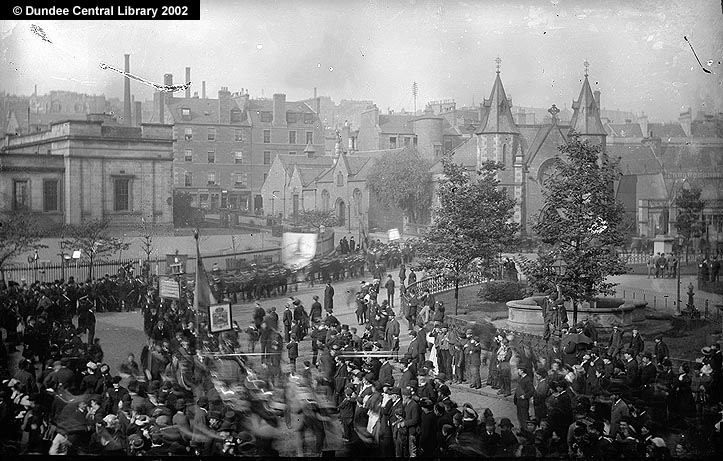
As the head of the march came to the parish council offices, the deputation dropped off and were admitted to the parish council meeting. At least we got there. A number of the parish councillors were unable to get in the front door and had to be hoisted in by the rear windows. The chairman, Davie Duncan, a pal of mine from the old Temperance movement days, opened the meeting, but no one heard a word he said; you could see his lips move but there was no sound. His voice was entirely drowned by the deafening noise from the thousands passing outside shouting slogans for unemployment benefit, increased relief rates, snatches of “The Red Flag”; the sound bounced off the walls of the building and filled every room. At last Bobby Allan, the clerk of the council, made signs that the delegation should be heard. Now Bobby Allan was a terror in Dundee. In the old days when the mothers wanted to frighten their children and get them to go to sleep they recited the old ditty:
“Hush ye, hush ye, dinna fret ye,
The Black Douglas’ll ne’er get ye.”
In many homes Bobby Allan had replaced the Black Douglas. He was a real swine who saw working-class people as beasts of burden and treated them as such.
Allan began by objecting to one of the delegation called McGuire and demanded that he be asked to leave. I promptly told him and the council that McGuire was an elected member of the delegation and if he left, all left. That finished that lot! So we had our say. I let Baillie Stewart and Councillor John Ogilvie, “Mr. Facing-both-ways” as we called him, have the first go. They started with tear-jerking humanitarianism, poor people without a crust of bread, children who were the future citizens starving, and so on. With the flint-hearted parish councillors that didn’t get us very far. When it came to my turn to speak, Davie Duncan said, “Please be brief, Bob.” “Why me?” I asked. I told them the workers were entitled to a good life and it was no fault of theirs that they were unemployed. I accused the jute bosses of locking out the workers and said they were deliberately trying to bust the trade union. “The workers won’t have it,” I said, “and what’s more if you don’t give them money to buy food and clothes, they will likely take them without asking your permission.” I cautioned them and said if there was any trouble then it was the fault of the parish council and not the starving workers.
Bobby Allan said there was the question of legality involved. Discussion would have to be held with government authorities on raising the scales of payment and certainly discussions with the unemployment exchange before any payments to the locked-out workers could be made. When Bobby cracked the whip the councillors usually obeyed, but on this occasion a few demurred. However, he had the majority with him. So we went back to the Albert Square to report. What a thunderous howl of rage greeted my simple announcement that the parish council were not prepared to move meantime! An unbiased outsider would have thought the day of revolution had arrived. From all sides came the demand to smash the council offices, to smash into the shops and take the goods “that belonged to the workers”. For a time it looked as if control of the meeting had been lost. The chairman then called on me to make any proposals of what could be done. I suggested that the demonstration refuse to accept the parish council decision as final, that the deputation should return to the council meeting, and that the demonstration form a procession again and march as before, only this time making their demands a bit louder. I knew that the “spies would be out” and that before we reached the council offices they would know what had transpired on the Square.
This time there was no one on the sidewalks; there was just a huge surging mass of humanity. On the way the window of G. L. Wilson the clothier went in, and this was followed by a few more, including the Buttercup Dairy, and a few goods were extracted; but the wonderful thing was that with the police impotent because of the vast surging mass, thousands of these people desperately in need of food and clothes remained disciplined and orderly.
When the deputation was received the second time I charged Bobby Allan with provoking the workers and creating a situation in which thousands of people could be seriously injured. I said if I went back and told these people nothing was to be done to relieve their distress, then it was the parish council who would be responsible for what would happen. Some of the councillors, no doubt already well briefed on what was happening, supported me, and Bobby Allan knew he would have to make concessions, so we started to talk. First it was conceded that the scales of payment should be raised, and then that the locked-out workers would be given relief while discussions proceeded with the unemployment exchange authorities. So it was back to the Square with a success report and victory for working-class solidarity and united action. This decision to a certain extent ended the starvation tactics of the jute employers and gave the workers confidence to fight on. Dundee people say Bobby Allan never forgot that evening and for years after he continued to extract revenge from the individual cases he dealt with in the parish council.
The case of the locked-out jute workers dragged on. The jute employers were hard men and did not give up easily. I am sure one of their aims was to smash the jute union, at least to cripple it. The case was discussed in parliament where Edmund Morel, M.P. for Dundee, demanded that something be done to end the lock-out. The Lord Provost tried to mediate but without success. Finally the Minister of Labour, Sir Montagu Barlow, intervened and set up a court of inquiry under the chairmanship of Sir David Shackleton. Naturally the report of the inquiry came down on the employers’ side but, if I remember correctly, it also said that increased rates should be given to the spinners, thus sweetening the blow. The lock-out lasted eight weeks, two months in which Dundee was a storm centre in every sense of the word. It was a remarkable coincidence, but true, that as the lock-out was ending the British Trades Union Congress was opening its first session in Dundee.
 Breaking the Fetters