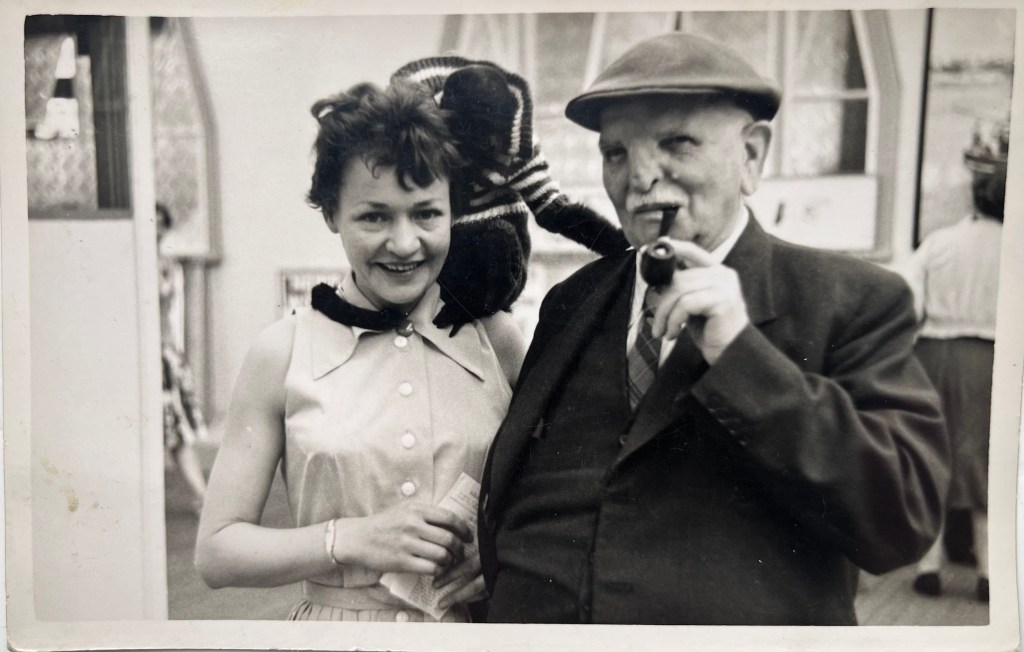
Happy birthday to Bob Stewart! I’ve spent the last month looking for a literary agent for the next stage in getting the biography published and it looks like I may have found one who’s keen to take the project on. More news when I get it it but I’m feeling very optimistic that the book will eventually see the light of day. I had wanted to celebrate great grandfather’s birthday by posting the photograph album from the 22nd Congress of the Communist Party of the Soviet Union which Bob attended in 1961 but due to the impossibility of my photographer friend and I being in the same place at the same time that’s not been possible. The images are so good I want them reproduced professionally rather than just rely on my phone. So, instead, I thought I’d post a few words on the Spycatcher affair which was when I first realised who exactly my ancestor was. They’re from an early draft of Everything You Get Must Be Fought For and unlikely to survive the next rewrite although I’d like to keep the portrait of my dad.
“As he approached late middle age, Sir Anthony Blunt, one of Britain’s leading art historians, Surveyor of the Queen’s Pictures and (retired) Soviet spy, must have been aware that time was running out. Always a skinny thing, he’d started to look positively gaunt – he wasn’t eating properly and he seemed distracted a great deal of the time. Colleagues at the Courtauld Institute of Art regarded him with affection but found him more self contained than usual. He had an enviably light teaching load, confining himself to the odd lecture and supervising a handful of students who shared his research interests but he still would have been aware of the rumours that circulated about him. It wasn’t until 1979 that he was identified in Parliament as a traitor by Margaret Thatcher but canteen whispers about his past abounded. That he may have been involved in espionage for the Russians seems to have been a popular topic of conversation within artistic coteries in the mid-1960s. Blunt’s biographer, Miranda Carter, attributed this to several possibilities. He’d been under suspicion since the defection of his Cambridge contemporaries Guy Burgess and Donald Maclean in 1951 and many of the Courtauld’s scholars were drawn from well connected families with links to the Establishment. Gossip about Blunt could have originated from there. Another source could have been his mention of Burgess in the preface to his book Artistic Theory in Italy: 1400-1600. Published in 1940, he’d written that his debts to Burgess “were too wide to be acknowledged adequately” and thanked his comrade for the “stimulus of constant discussion.” Between seminars and tutorials postgraduates discussed what this could all possibly mean. Contemporary news stories of the Cambridge spy network fanned the intrigue. Double agent Kim Philby had fled to the Soviet Union in January 1963 after being uncovered as the ‘Third Man.’ Later that same year, the exiled Burgess had succeeded in drinking himself to death in Moscow. The fear of discovery plagued Blunt and, once MI5 had received incontrovertible proof from the US that he was part of the spy ring that they’d been investigating for decades, they dispatched an agent, Arthur Martin, to elicit his confession.
The meeting took place on the 23rd April 1964. It had been a bright, cold day and the arrival of Martin that evening would have unsettled Blunt. He’d endured questions from different agents for years but now he was getting weary. As the Director of the Courtauld, Blunt ‘lived above the shop’ in a flat in the Institute’s Georgian townhouse in Portman Square. Martin had been authorized by the Attorney General to offer Blunt immunity from prosecution in return for a full debrief. The last thing that MI5 needed was yet another spy scandal hitting the newspapers making them look like a bunch of amateurs. Briefly mention other spy scandals? After introductions, Martin asked Blunt what he knew of someone called Michael Straight. The academic’s cheek twitched at the mention of a man he had recruited to spy for the NKVD decades before. While Blunt said nothing Martin explained that Straight had admitted everything to the Americans and that he was there to give Blunt the opportunity to tell the truth. Silence fell. A silence that Martin took as an admission of guilt. Blunt left the room to fix himself a stiff drink and returned to stare out of the window for a few minutes. Martin appealed to him once more to come clean. Blunt had finished wrestling with his conscience and, seeing no alternative, admitted that he had worked as a ‘talent spotter’ for the Soviets while at Cambridge in the 1930s and that during his time as an MI5 officer in the 1940s he had passed on thousands of secret documents to Russia.
If Blunt had imagined that a weight would be lifted from him after his confession the opposite seemed to be the case. He seemed to shrink and diminish even though the public remained unaware of his secret. He continued his duties at the Courtauld and maintained his position at Buckingham Palace looking after Her Majesty’s art collection; the authorities feared that if he were to retire prematurely the Kremlin might suspect something was untoward. He carried on forlornly and crept along the corridors eager to avoid any awkward encounters. In the months and years that followed he would meet with Martin and another MI5 agent, Peter Wright, to answer their questions in order that the Security Service might gain a better picture of the extent of Soviet penetration. These get togethers would often begin with Blunt downing a large gin and tonic for Dutch courage- the first of too many – as he had begun his descent into alcoholism. Sometimes he would be too far gone to be coherent. Nonetheless, it was Martin and Wright’s interrogation that revealed part of the spy network my great grandfather was involved in. In short, Bob’s connection with the Cambridge Five was that, in February 1940, Anatoly Gorsky, the rezident at the Soviet Embassy in London was recalled to Russia. In his absence, Bob took over the running of Philby, Burgess and Maclean until November of that year when Gorsky returned having miraculously survived another wave of Stalin’s purges.
In the mid-1980s, long after his retirement from MI5, Peter Wright wrote Spycatcher, an account of his efforts to root out communist agents from the upper echelons of British society For years, Wright had been regarded as a crank within the service due to his obsessions that had coarsened into conspiracy theories. Harold Wilson had been turned by the KGB, the Director General of MI5 was a Soviet mole, that sort of thing. His attempts to get Blunt to admit to things he had never done had risked derailing the investigation and some thought his theories had done “as much damage to the service as Blunt’s treachery.” On retirement he had been denied his full pension and the memoir was his spiteful revenge. The Thatcher government attempted to prevent its publication on the grounds of national security and the long drawn out media furore that followed is something I remember from my teenage years. Footage of Wright, a bitter looking old man in a floppy sunhat pacing in the Australian heat on television night after night while Tory MPs burbled on about the Official Secrets Act. My father followed the case closely. Lots of people did – it seemed to drag on forever. After being available worldwide for months, the book was finally cleared for sale in Britain in 1988. A proud, card carrying member of the local library, Dad would have brought it home soon after. Around this time licensing laws had been changed and pubs were allowed to open all day and he did most of his reading during the late afternoon quiet times. Maybe two ancient regulars puffing on their pipes in the corner with their halves of mild and dominoes and one young man feeding a looping, whirring fruit machine. Dad would be sat on a stool behind the bar oblivious to his customers and reading intently, his glasses pushed up on his forehead. Always a fag on the go, it would look as if he was aiming for the world record for holding a column of ash at a forty five degree angle. A mug of tea would slowly be developing a thick layer of wrinkly beige skin beside him as Mozart leaked out of a portable cassette player. Occasionally he’d wipe spilled ash off himself and the pages of his book. I can recollect this happening with Spycatcher and Dad showing me his grandfather’s name in the index. I was impressed. Wright described Bob as a “disciplined soldier” who had been “too long in the game to be broken.” He also outlined how Blunt had revealed to him the complex chain of couriers involved in espionage in the late 1930s and early 1940s. Kim Philby and Guy Burgess would send messages along to Litzi Friedman, Philby’s first wife, who would then get them to her friend Edith Tudor Hart who then delivered them to Bob who was the official liaison between the CPGB and the Soviet Embassy. Those secrets were then passed on to Moscow. Until Blunt’s confession MI5 had been completely unaware of this chain.”
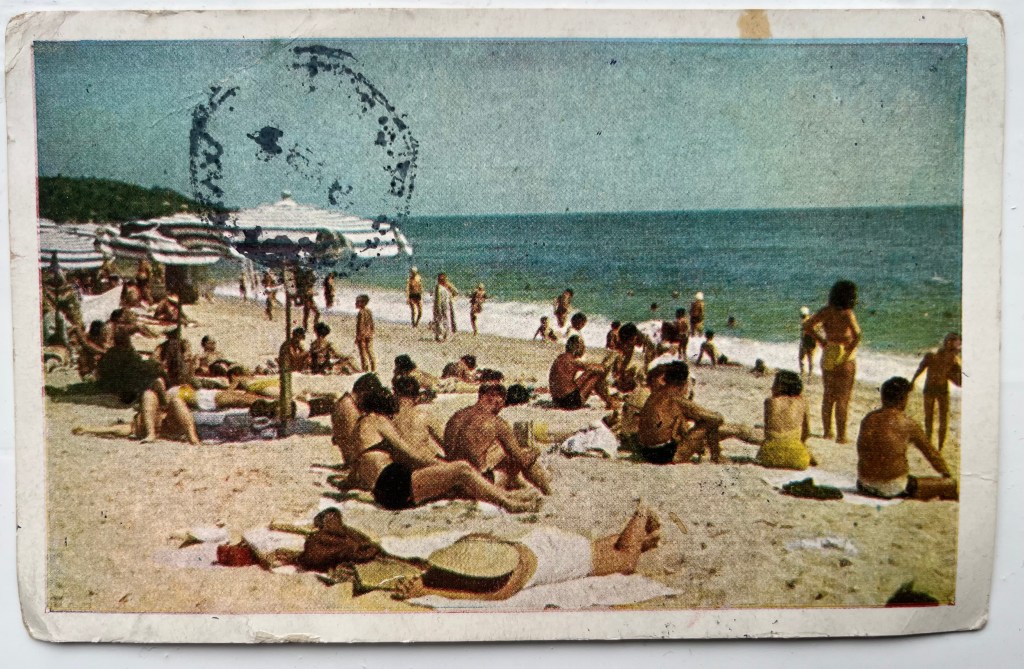
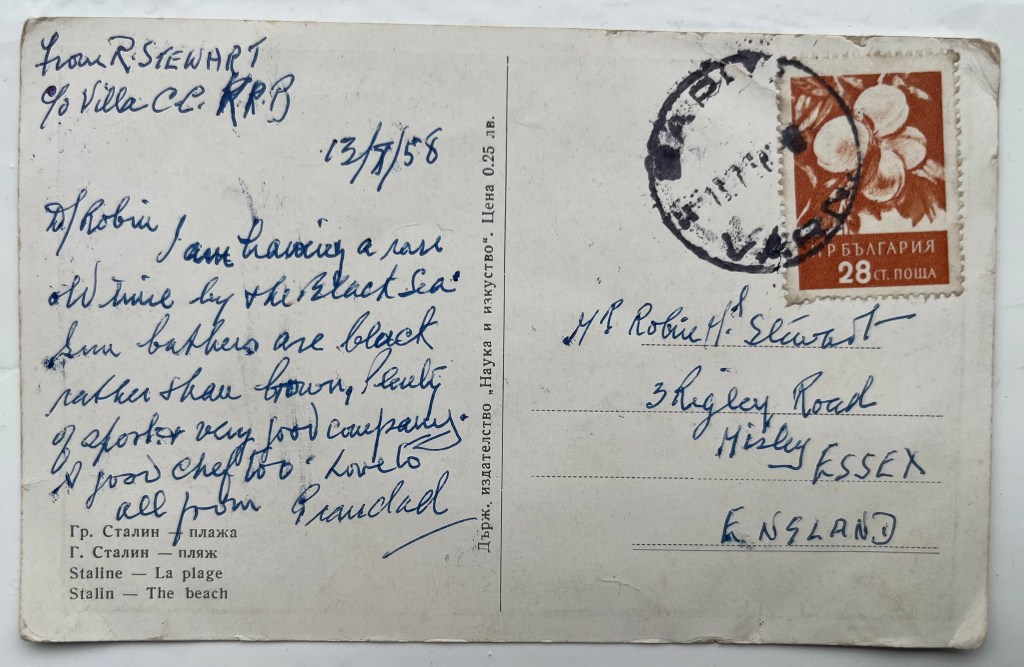
As a postscript here’s a postcard from Bob to my father. It was sent in 1958 while Bob was enjoying the sun on a beach on the Black Sea named after Stalin.
Alan Stewart.
 Breaking the Fetters