For Remembrance Sunday here’s something I wrote about Bob Stewart’s experiences as a conscientious objector during the First World War.
On the day war was declared, Bob was campaigning on behalf of the Prohibition and Reform Party a hundred miles up the coast in the fishing port of Peterhead. The last days of peace had been dreich. Endless rain lending a sullen mood to the maritime manoeuvres taking place a little way out of port. The clock ticking as the country waited for Britain’s ultimatum to Germany to expire. That morning the weather had improved enough to hold an outdoor meeting at which there was quite a crowd. He’d visited the town many times before and had always taken an interest in its affairs; some weeks previously he’d been presented with a pipe and a purse of sovereigns as a thank you for his part in organising a successful strike at the wood yard there. It had always been a good place to campaign.
The rally took place up on the links looking out onto the treacherous North Sea. Choppy, battleship grey whitecaps stretched out to the horizon. Also visible was the prison next to the Admiralty Yard. One of the toughest in the country, it housed long term convicts sentenced to breaking rocks in the granite quarry. These were used to construct the Harbour of Refuge breakwater to reduce the number of ships lost to storms. In Bob’s opinion anyone who couldn’t make a good socialist speech looking at that view didn’t know anything about socialism. Just as he was getting into his stride, the breeze carried a crescendo of tenor and contralto voices and the sound of euphoniums and trumpets began to drown him out. It was the Salvation Army band playing Lead Kindly Light as they accompanied the Naval Reserve to the station. This was how he learned of the outbreak of hostilities. The reservists were mainly trawlermen – the retainer both supplementing their income and acting as a “sweet little pill to recruiting.” He resumed his speech and tried in vain to tell them where exactly they were being led but the mood of those marching into town was buoyant and hymns gave way to songs of king and country. The meeting broke up and everyone followed them to the recruiting office where wives and mothers, who regarded the situation very differently, began to weep and howl. “Many affecting scenes were witnessed,” as the local paper put it.
That evening, there was another assembly, this time held at the fish market. Despite the rain it was full. These were uncertain times. Bob thought that wars were “always sprung on the people. They don’t know their enemies until they are told.” He was under no illusion who the real adversary was. During his speech he declared:
“[This] is a capitalist war. It is not worth sacrificing the bones of your domestic cat, or your pet canary, even less those of your husbands, brothers and sons.”
Conflict meant insecurity. Already the fishing trade in Peterhead was paralysed. The whole of the east coast was at a standstill. Fearing attacks on shipping, insurers had “intimated to trawler owners that vessels […..] must not leave port.” Any boats attempting to reach the fishing grounds would be uninsured and would sail entirely at their own risk. Five hundred fishermen in nearby Aberdeen had been laid off days before but worse was to come. On average, each trawler had nine crew members which meant that eventually four thousand sea going men would be thrown into idleness in the Granite City alone. This had ramifications for the rest of the industry. Thousands of men and women employed in gutting and packing would soon be out of work as would the hundreds of coopers who made the fish barrels. The daily losses would run in to thousands. Meanwhile, the first trawlers were being stripped of their fishing gear and were being made ready for mine sweeping duty.
Advertisements urging young men between the ages of 18 and 30 to heed their country’s call and “rally round the flag and enlist in the ranks of her army” were already appearing in the press the day after the declaration of war. The choice between no job or a soldier’s wage was no choice at all to many. Aside from the prospect of unemployment, Bob recognised that countless ordinary people joined up for the slaughter not due to nationalistic fervour but simply because a soldier’s wage together with the separation allowance for wives was better than a labourer’s earnings. At the beginning of the war a private at the front got 6s 8d a week. The separation allowance was 7s 7d with 1s 2d added per child. Although this benefit rose significantly – 12s 6d from March 1915- it does not say much for labourer’s wages.
Attitudes to the war divided the left and, as far as Bob was concerned, this was the first real test for socialist internationalism. A test he considered the Labour movement to have largely failed. His belief that a British worker had more in common with a German worker rather than a British capitalist was a minority view. As he put it, in no time at all, “the red flags turned to tartan.”
When Bob returned home he found his city gearing up for the battles ahead. An article in the Courier prosaically titled. ‘The Recruiting Sergeant is Busy’ gives some indication of what the first week was like. Lord Kitchener’s appeal for recruits was “stirring the hearts of young Dundee.” The thousands of millworkers and those in clerical professions proved “up to the hilt that the young fellows of the city [were] patriotic to the core.” They constituted a “fruitful source” to the Nethergate recruiting office which was now thronged by a persistent gathering of young and old outside. Periodically the door was unlocked and another batch of men passed through for processing. The flow of aspirants for the army was almost constant. This zeal carried on in the town’s social life. A programme of Strauss and Lizst at the King’s Theatre was preceded by “scenes of great enthusiasm” as the orchestra played Rule Brittania, The Marseillaise and God Save the King. The audience rose to the national anthem a second time when a company of soldiers marched into the auditorium greeted by cheers. Dundonians could also try and spot their loved ones on the big screen as the Scala Picture Theatre showed footage of the Tayside Naval Reserve and the Territorials carrying out their mobilisation orders before the main feature, Beneath the Czar. The movie topping the bill concerned a woman forced to enter the Russian Secret Service to save her father, an active Nihilist, from being put to death. If my great grandfather went to the pictures that week I do wonder what he made of that film.
The readership of The Courier was hungry for every scrap of detail about the war and the paper eagerly obliged. The coverage in one issue in the first week ranged from German submarines in the North Sea to a call for the women of Angus to knit two thousand pairs of socks for the forces while also taking in a French victory in the Alsatian town of Colmer and restrictions on aliens in the UK. A German spy was shot in Paris; there were skirmishes on the Russian frontier and English cricket was to continue. Articles about the phenomenal number of men joining up dominated. Some stories such as the West Fife licensees ordered to exercise more care in the supply of drink might have consoled Bob but not for long. Look closely and amid all the breathless excitement of world events and everyone pulling together for the good of the nation there’s hints of the crisis to come. The 26 year old infantryman fatally shot after coming off duty in Romford. A forgotten cartridge in the breech of his rifle had accidentally discharged. The British Red Cross appealing to the public for supplies. They needed mattresses and sheets, bandages and basins. The one naval and three military deserters committed to the respective authorities at Dundee Police Court. Presumably they were reluctant to find themselves confined to one of the beds the Red Cross had salvaged. Or they feared worse.
Looking back on 1914, Bob remarked, “ I don’t know of any honest working man who got anything out of the war.” He was also aware that, for some, it was very profitable. While the business sector “babbled about the war to end war” they were “in no hurry to end it.” He bemoaned the industrial truce that came into play with moderate trade union leaders resisting strikes and keeping their membership in check while the nation was in peril. What part of the country the ordinary people actually owned was a question he never heard answered. Dundee historian William Kenefick described the age as a time when, “citizens’ rights and civil liberties became secondary to those of the British state.” A condition that was “never fully removed.” The workers were handcuffed when the Munitions of War Act was passed in 1915 – eroding what little employment rights trade unions had fought for. It was an offence to leave your work without the consent of your employer or to refuse to take a new job whatever the rates of pay. With rent increases and a steep rise in the cost of living there was plenty for Bob to battle against.
As the war progressed, the supply of young factory and agricultural workers used as cannon fodder began to dry up. In March 1916 the Military Services Act came into effect and all single men aged 18 to 41 in Great Britain were to be called up to fight. Married men became eligible for conscription two months later and the age limit was extended to 51 in 1918. Widowers with children, clergymen and those in reserved occupations such as coal miners, train drivers and steel workers were exempt. Conscientious objectors had to appear before a tribunal to argue their case for refusing to enlist. These arguments did not get a sympathetic hearing.
The largest socialist organisation opposed to the war was the Independent Labour Party (ILP) and, in December 1914, they played a large part in establishing the No Conscription Fellowship (NCF). Formed in anticipation of the 1916 Act, the NCF would campaign against it and offer support and guidance to those refusing to join the armed forces. After a large ILP meeting in Dundee in November 1915 the city’s branch of the NCF was set up with the support of Bob’s party as well as that of his old rival Scrymgeour. In January the following year both organisations banded together with members of the Trades Council, the Labour Representation Committee, the ILP, the British Socialist Party and the Free Religious Movement to found the Dundee Joint Committee Against Conscription. Disparaged in the press as being “Pro-German” the group ensured that Dundee became one of the strongholds of the anti-war movement. They drew crowds of more than 1, 500 at their weekly Sunday meetings and Ramsay Macdonald, in an article in Forward in 1917, acknowledged that Dundee was “said to be ‘fair hotchin’ with conscientious objectors” as it fought for “liberty and Socialism.” By then the army had caught up with Bob. Pushing forty, he was conscripted in 1916. In July, he featured in a report on the COs appealing at the local tribunal. He appeared alongside several trade unionists and ILP officials, a couple of Socialist Sunday School teachers, another prohibitionist and an ex policeman turned left bookseller who declared he worked eighty four hours a week, “62 for wages and the remainder for downtrodden humanity.” Bob was described as:
“Ex-Town Councillor, Prohibitionist, Socialist and International Protagonist; a clever writer and convincing speaker; refuses non-combatant service on the grounds that it simply means holding the jackets for others to fight.”
He was an absolutist. Some of his fellow conscientious objectors managed to escape imprisonment after being offered alternative Home Office schemes which involved voluntary service for the war effort. This might include labouring on a farm or in a factory for a Work Of National Importance (WNI) initiative; or they might be drafted into the Non-Combatants Corps to fix infrastructure after battle or work as medics. But there was no way Bob would abandon his principles for an easier life. The war was wrong and he was not going to assist in its prosecution in any way. “Quakers, Christadelphians and priests in holy orders and their like” were, it was assumed, the only people who “could aspire to a conscientious objection to killing their fellow men.” He was not a member of any religious body. Even worse, he was a well-known socialist and anti-militarist. His appeal at tribunal was turned down as a matter of course and he was ordered to present himself for military service. He refused. Whatever hulking Victorian gaol was waiting to confine him, he was resolute.
Arrested and taken to the police court, he was charged with being AWOL. The Chief Constable. acting as prosecutor, asked for a pause of a week which allowed Bob more time to make preparations for the inevitable prison sentence. He spent this time assisting others with their cases and speaking at some anti-war meetings. This was “much to the annoyance of the local respectables, who if they couldn’t get me shot at least expected me to be put out of sight for a long time.” Also, Margaret would have to take over some of his work. He’d recently become the local organiser of the Scottish Horse and Motormen’s Union, applying for the job after the previous post holder had been called up. Margaret would have to carry on with this as well as bringing up the family. A legion of aunts would be on hand to help but it would be tough. Bill and Rab were thirteen and ten, old enough to understand what was going on. Annie or Nan as she was known was only three years old. Her earliest memories would be those of her father in jail and the general contempt in which the general public held people like him. Whether there was sympathy for the Stewarts among her neighbours I do not know but the common opinion that ‘conchies’ were cowards and traitors would have been part of the atmosphere in which she grew up. There was talk in the press of banning COs from positions such as teaching lest they contaminate the young and many, many similar stories. Annie would have to understand that her family stood for something and that the attacks these principles drew had to be stood up to.
Once Bob was back in court, a recruiting officer took to the witness stand to prove that on a given day Robert Stewart was ordered to appear and did not do so. The officer looked rather pleased with himself after giving his evidence, as did the magistrate. An example was about to be set. Not the example they expected though.
“…their expressions changed when I asked, “Under what regulations do you mark a man absent?” “Under the King’s Regulations,” was the reply. “Under which one?” I persisted. The beak looked blank. The assessor said, “Can you help us, Mr. Stewart?” a rather unusual form of address to a prisoner at the bar. So I helped them by quoting the […..] King’s Regulations, in which it was clearly stated that a man could not be posted absent until twenty-one days had expired from the date of his call-up.”
Unwilling to take the word of a prisoner as final, a messenger hurried to find a copy of the manual which bore out Bob’s contention. There was some frantic consultation before the magistrate announced, “I am afraid we can’t convict.” Bob walked free to the “great glee of a small crowd […..] and the extreme chagrin of the military escort.” Immaculate in his polished uniform, this officer brandished a pair of handcuffs. “Ay laddie […..] You’re too early,” was Bob’s greeting. Eventually, they got the paperwork right and he was court martialled for the first time. So began the seemingly endless spells at His Majesty’s Pleasure simply because, when asked why he wouldn’t fight, he answered, “It’s not my war.”
He was sentenced to one hundred and twelve days of hard labour in Wormwood Scrubs- almost five hundred miles away. He had no visitors and his mail was withheld from him, thus no contact with his wife and children or news from his friends during his incarceration. As he was handed over from the military to the civil authority in London Bob noted that, in actuality, it was “far less civil” than the army.
“The Scrubs was one of the largest and in consequence most regimental of what were known in official jargon as ‘His Majesty’s Prisons’, which of course he never used as a personal residence. I was turfed into a reception cell to await disposal. It was a dirty, begrimed hole, some thirteen feet long and six and a half broad, its dingy walls covered by names of former occupants and an occasional word of advice, like “Sleep on it, chum”, and some uncomplimentary remarks about officers and prison food.”
Late in the afternoon he was officially received. The voice of the head warder echoed around the reception room as he barked out every single one of Bob’s personal possessions while they were collected in and did the same for each article of kit that was handed out. They took down his height and weight and then he had to have a tepid bath in three inches of water. The suit of prison clothes he was given were, “not ready to wear but already well worn.” A medical followed. The prisoners were ordered to line up, face the wall, to stand apart and stop talking. Then, one at a time, they passed by the doctor as the guard yelled, “Shirt up and trousers down!” Bob found it strangely amusing that, “members of this humane profession should lend themselves to this farcical medical examination and humiliation of their fellows.”
After this, bibles and prayer books were doled out, the “compulsory library of each prisoner” and they were ordered to, “Get up them stairs!” He was housed on the third corridor of the D hall with the other conscientious objectors. In 1889, fifteen years after ‘the Scrubs’ had opened, the journalist FW Robinson had praised the “brightness and lightness” of the cells. Such an atmosphere was, “not frequently met with in a convict prison at all.” At that time it was considered a fine example of penal architecture. Bob’s appraisal of his new accommodation reflected the prison’s notorious reputation it had garnered in the three decades that had since passed.
“My new abode was the usual brick-walled domicile, thirteen feet by about seven feet. Its furnishing, a six feet by thirty-inch board bed. Top and bottom sheets of canvas, one or two blankets according to season, a bedcover, a small table under a pane of obscure glass through which a flicker of gaslight shone, sufficient to strain your eyes when reading. A small shelf for books, and a pint pot, a tin basin and a jug for water, a minute portion of soap, a very small weekly supply of toilet paper and a slop pot for natural necessities. A window in the outer wall with twenty-one very small panes of obscure glass. Woe betide any prisoner who was caught (as many were) trying to get a cock-eyed view of the outside world by standing on the stool provided to be sat on and not stood on. A copy of the prison regulations and diet sheet was hung on the wall.”
The warders he regarded curiously, contemptuous of their pretensions to be called officers. A “screw by any other name” was “still only a turnkey […..] under just as close a surveillance as the prisoners.” He observed that some were “sadistic and cruel [and] extra officious” with promotion being their main object rather than the care of their charges. Some could be “reasonably human” but all were “fearful of the economic consequences of losing their steady and comparatively lazy occupation which carries a pension with it.” As the following encounter demonstrates, prison magnified the intransigent aspect of Bob’s character.
“I soon ran into my first bit of trouble. […..] the screws regard themselves as officers and like to be called Sir. I have never said Sir to anyone in my life […..] One of them said to me, “Call me Sir.” “Why?” I asked. Well, there is no direct answer to that but it meant I did two weeks in very, very solitary confinement. After that I went to sewing mail bags for an hour or two a day.”
Besides the mail bags the hard labour he was engaged in was mostly joinery. A fortnight after his arrival he was marched before the inspector who demanded to know what his occupation in civil life was. He gave his profession as “Agitator.” Further questioning saw him passed to the carpenter’s shop to make furniture and fitments for the HM Office of Works. The prisoners laboured under the gaze of a pacing disciplinary officer whose snarling and growling annoyed even the artisan warder who was responsible for seeing that the men got the job done. All the tools had to be checked and locked up in a cupboard with drawings of each tool to show where it went “like a kindergarten” and pencils had to be sharpened by the guard who “painted one end and notched the other lest the lead be pinched for writing purposes.” Other than work the prisoners had exercise once a day – “the large contingent walked from nowhere to nowhere and back again. What a silly exhibition.”
The prison day seemed much longer than the normal twenty-four hours. Once his hundred and twelve days were done he was taken to the Governor and then to reception to be returned to Scotland for his next court martial. His army chaperon didn’t arrive and so he was shut up in his cell for one more night. “Overtime without pay” as he put it.
After refusing once more he was handed a sentence of one year, later commuted to sixth months. This time he did his stretch in Calton Gaol, Edinburgh. A remnant of this penitentiary is still visible today in the castellated form of Governor’s House looking down on the city from Calton Hill. Bob’s future comrade Willie Gallacher also endured a spell in there during the war for sedition. He described it as, “by far the worst prison in Scotland; cold, silent and repellent. Its discipline was extremely harsh, and the diet atrocious.” Bob viewed it as “grim and grey, old and forbidding” He found the initial reception “not quite so noisy as the Scrubs” as the warder fussed around listing the King’s property in Bob’s possession. To his relief, his family were allowed to visit. His reminiscences of the months spent there largely focus on the mischief he and other inmates got up to during Bible classes and Sunday services. Prisoners had to recite Bible passages and anyone who could perform Luke 15: 1-10 without error would receive their own copy of the good book when their term ended. On Bob’s second Sunday he gave full voice to the parables of the lost sheep and the prodigal son and won that prize on release. He also tried to diversify with a selection of Tennyson, Burns and Shelley. It got too much for the preacher who ruled that only extracts from scripture were allowed. Bob was then one of the older inmates who had to persuade some of the lads not to “utter some of the rather bawdy texts […..] which might offend the lass at the music box.”
One day a warder stopped by his cell and wondered aloud that such nice people as his wife and daughter could come to visit when he was an atheist. In the warder’s mind unbelievers were all “thieves, robbers, devils or whoremongers.” Bob asked him how many atheists were in the jail. The warder replied that Bob was in fact the only one. “Well, if all the others are Christians it doesn’t say very much for Christianity, does it?” replied Bob. The warder slunk off in confusion.
Perhaps the most significant event during his second term came in March 1917. He was trudging round the exercise yard when a fellow internee came up to him and whispered, “There’s been a revolution in Russia. They’ve set up Workers’ and Soldiers’ Councils!” Bob recognised that this was an epoch making event but was, at this stage, sceptical at its impact. Just before the warder put an end to their conversation Bob’s friend declared excitedly that there would be a revolution in Britain within six months. Bob’s verdict? “Hae ma doots.” Still, it sparked something in him. When his time at Calton came to an end the Chief Warder told him that he was going to get another chance to shoot the Hun. Bob replied, that if he ever got it into his head to go shooting he wouldn’t be looking for Germans. “And who will you be looking for?” was the next question. Bob looked him straight in the eye and said, “Warders.”
Found guilty of the charge ‘Refused to Parade’ in his third court martial and receiving two years hard labour in the process, Bob was interned at Edinburgh Castle for a short while. The sentence was later remitted to one year. His elderly mother was growing increasingly frail and found it hard to make the return journey to Edinburgh sixty miles away. She’d been a widow for several years, Bob’s father passing away in 1915, something he doesn’t touch upon in his book. Two of her sons, Jock and James were away fighting while Bob, her youngest was jailed. Naturally she wanted to see him as often as she could in the time she had left. There’s very little in Bob’s writing about her but he does mention that in the course of her visits she struck up a rapport with the prison Governor after he found out they both came from the same part of Scotland. After spending time with Bob she would be ushered into the Governor’s office to gossip about “lairds and tenants and the hamely fare o’ the countryside.” The issue of Bob’s godlessness came up once more. The Governor said to her, “What I canna understand, wumman, hoo wi’ a maither like you Robert’s an atheist.” She lamented that, “he was aye a great Bible student.”
Bob’s mother died at the age of seventy eight on the 10th September 1918. She passed away at home and a short notice in the Dundee People’s Journal announced these simple details along with her status as William’s widow and her maiden name, Georgina Ferrier Fraser. I cannot imagine what it was like to receive such news in prison, separated from loved ones. Worse was to come. Although he was held in a state prison, he was serving a military sentence. Regulations meant that he was refused permission to attend the funeral. With some understatement, he observed, “there was much local feeling about this.” Georgina had been “greatly respected by all her neighbours” and Bob had many friends on the outside. All were extremely angry at the situation and complaints were made to the Lord Provost of Dundee. He intervened and said he would vouch for Bob’s return. Wheels were grudgingly set in motion. Bob omitted any detailed description of how he felt about the whole experience but the contempt is still there. A “most inhuman warder” took him to Dundee but he was too late to see his mother buried. There was some consolation that he was at least allowed to meet his family. His two soldiering brothers had managed to get leave to join them. An all too brief hour or so with his wife and children and his siblings all united in grief. Impossible to find the words that needed to be said with the warder ever present and repeatedly checking his watch. His guard was impatient to get back to Edinburgh and so “dumped” him at Dundee Gaol. An awful end to an awful day. At least he was nearer home. After more deputations from colleagues and neighbours to the Lord Provost it was decided that he would do the rest of his time there.
At this late stage of the war, the jingoistic optimism exemplified by Jessie Pope, the favourite poet of The Daily Express, who urged the nation’s youth not to “lie low” but be “part of the fun” had given way to an acknowledgement of the realities of mechanised slaughter. In the newspaper carrying the details of Bob’s mother’s death, her name is among twenty six others who died either at home or in hospital of natural causes after living full lives. That list takes up about a third of a column. A further three and a half columns concern the Dundee war dead. Under the banner ‘For Their Country’ there’s a catalogue of the recently slain. Private Andrew McCabe aged 19 and the beloved son of Mrs McCabe, 40 Hunter Street- “died of wounds” on 25th August. Private Peter McIntyre, reported missing on October 4th 1917, now reported killed on that date – “Not dead to us who loved him dear.” Private Scott who died from gas poisoning on the 21st August – “We mourn for you dear son.” It goes on and on. Name after name in tiny print. Then there’s the ‘In Memoriam’ section marking the anniversaries of so many families’ bereavements. Private Donald Dewar of the Cameron Highlanders was killed in action on 14th September 1914 – “Not forgotten.” Did his family remember him this way every year? How long did they continued to do so?
The way the war was playing out was beginning to affect Bob’s jailers. Dundee was a much smaller prison and wasn’t fully occupied. This was a source of dismay to the warders. Bob recalls the glee at which they greeted new prisoners. Not because their hearts were softer or they were more devoted to their role than other officers but because, while they were avowedly patriotic, they were not overly keen on being called up to fight at the front while thousands of men were being killed each day in Europe. Bob even helped some of them complete their claim forms for exemption on compassionate and domestic grounds. It was an absurd position – “the warder who locked me up for resisting military service then asked my assistance to fill up his application form for exemption so that he could continue to lock me up!”
It was while he was captive in Dundee that Bob began to write the poems which he later gathered together in the pamphlet Prison Rhymes. Published in 1919 as a fundraiser for the Prohibition and Reform Party, Bob claimed it sold thousands and helped keep the organisation in funds. Copies are rare -there are a few in archives up and down the land but until recently the cheapest copy I’d come across was priced at £650. At the time of writing, Blackwell’s Rare Books advertise one at just under £5000. It comes an inscription to the Miners’ Leader, trade unionist and Labour politician Robert Smillie. Bob had served time in Worwood Scrubs with Smillie’s son Alex, a fellow conscientious objector. Collecting labour history is a habit I cannot afford but fortunately our family does have its own copy. It was acquired by my brother in the late 1980s around the time he had a wall length poster of Lenin in his bedroom and wore a Che Guevara t-shirt like an East Anglian Wolfie Smith. He rang up the Communist Party explaining the family connection and asked if they had a spare. The elderly lady on the other end of the line cooed about Bob being the one who shifted the Moscow gold around back in the day. A photocopy of the pamphlet landed on our doormat a few weeks later.
Bob was modest about his poetic achievements. “Prison”, he remarked “is not the best place to practice literary ambitions.” However his diffidence is more than made up in the preface to the work in which a Mr G Anderson of Coatbridge is effusive. The author of the verses is described in grandiloquent terms as formerly a “man of lucid and terse prose” whose forced confinement has made him turn to rhyme with “happy effect.” While the body is held captive by “stone walls and iron bars” the “spirit of the man never flinched” and the lines inspire a “veneration of love for humanity.”
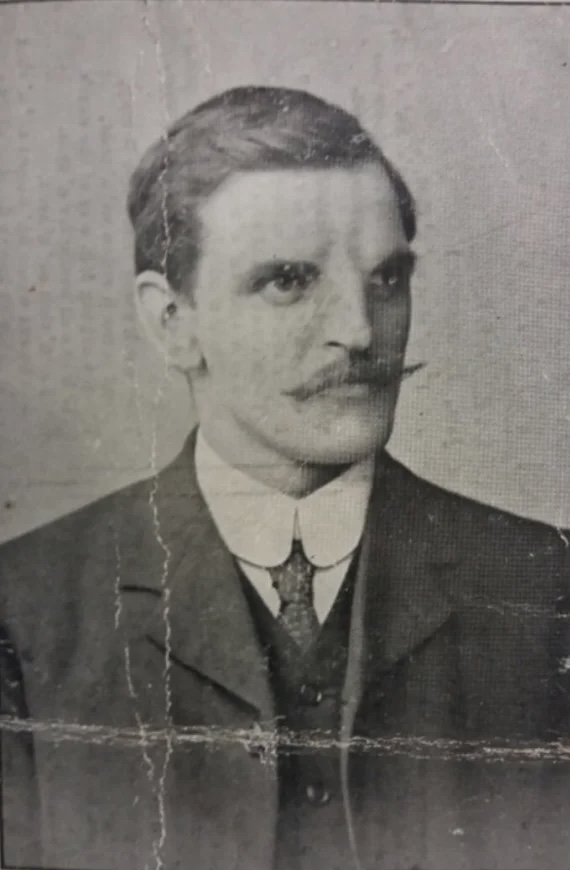
The poems are mostly written in Scots dialect and are largely concerned with protest, socialist agitation and reflections on the isolation of prison life. They are written to be sung to the tune of popular hymns and folk songs. Common harvests, scarlet banners and rallying comrades feature heavily. Robert Burns is an influence. One poem, ‘A Man’s a Man For A’ That’ takes the Scottish national poet’s celebration of egalitarianism and tailors it to the anti-war movement. This also featured on a postcard sold by the Prohibition and Reform Party featuring a portrait of the author on the other side. He looks very smart and serious with his moustache seemingly waxed at the tips in one concession to vanity. It’s the earliest photograph we have of him. The most affecting poems are those that deal with the sadness of separation. Little Nan is about Bob’s youngest child Annie. She would have been six at the time of publication and the poem reflects Bob’s sadness of being separated from her for most of the preceding three years.
“O bonnie lass o’ mine
Wih eyes that brightly shine,
With your winsome ways and tender loving smile
O how pleasant it would be
Could I come away with thee
And leave this dismal solitude awhile
O to listen to your voice
How ‘twould make my heart rejoice,
And to see the lovelight glancing in your eyes,
What recompense ‘twould be
For the days spent wearily
So far away from those I love and prize.”
While at Dundee he was court martialled for a fourth time but with little change in his situation. Prison life was dull. A pint of skillyfor breakfast; slopping out; work detail; exercise; an inedible dinner and as little association time as the authorities could manage before lock up. The only variation being chapel on Sunday or punishment in solitary. There was the occasional cause to fight for such as access to newspapers and books but then only the smallest subterfuge to be indulged in when passing round banned copies of Tribune and Socialist Monthly smuggled in by one or two sympathetic warders. As the months passed, it was “galling to be divorced from activity” and news from outside only added to “the impatience and yearning of release.”
Unlike the other prisons where Bob had viewed the religious mentors sympathetically or at least with an amused detachment there was one chaplain at Dundee named MacDonald who succeeded in antagonising him more than any other figure. Every Sunday in the pulpit he’d veer off the topic to “have a go at the Bolsheviks” The Russian Revolution had caught Bob’s imagination and the scraps of news he could gather were what inspired him while confined to a cell. It might seem unusual – a man imprisoned for refusing to fight and kill his fellow man clinging on to news of a violent revolution for hope but he knew his enemy. For Bob, being forced to listen to a man he held in contempt preach about how “Lenin ate children” and “Trotsky shot all the workers” was insufferable. He said nothing for a while as his friend, a fellow conchie called Dave Donaldson, was approaching his next court martial – to all intents and purposes a day out – and he didn’t want to get him into trouble. Still, during one sermon MacDonald moved on to how the Bolsheviks “must be crushed like rats” and Bob exploded.
“”You dirty miserable little coward,” I said, “standing up there in your coward’s castle maligning men who can’t speak back. Well, here’s one that speaks back, you dirty contemptible little rascal! They should put you in a prison cell not a prison pulpit.” During this outburst he sat down too surprised to say a word and he never rose again. It must be the shortest prison service on record.”
Amazingly there were few repercussions. No solitary. No withdrawal of privileges. Once the men were marched out of the chapel one of the warders suggested to Bob that he write to the Prison Commissioners to complain that the chaplain was using the pulpit for political purposes. Bob preferred to let the matter rest. He’d done what he’d wanted. The Head Warder told him that he’d have to apologise to the Rev. MacDonald. Bob expected this and was fully prepared to do so, even though he’d taken to referring to the clergyman as “The Weasel.” The minister never came. Too afraid. Here endeth the lesson.
Around this time Bob began to sense the war weariness “weighing heavily on everyone.” The “loss of millions of good lives” even affecting the top brass. The conflict was drawing to a close, victory was near but the atmosphere of the guard rooms where the conchies were shoved before facing military trial was subdued. Bob recalled one fellow silent and unable to answer the sergeant demanding, “How long have you been absent?” The man seemed to be wholly unaware of what was happening but just sat and stared despondently ahead. The sergeant took one look at his face and declared, “You’re no’ absent – you’re lost!” He wasn’t alone. Four long years and there were few families who hadn’t feared the knock at the door and the dreaded telegram. The sight of the wounded, the disfigured and the amputated was disturbingly common. Many wore their scars on the inside trying to suppress the trauma of what they’d experienced. All this damage wrought on people who mostly couldn’t even vote until the Representation of the People Act in 1918.
Bob was serving his fourth term when The Great War finally came to an end. The fighting carried right up until the last minute and then it simply finished. The combatants slowly limping home. A damaged generation. Once they’d returned, many hoped that things would be back to how they were before, or that things would be a little better. That world had gone. Who knew what kind of world would replace it? Bob, however, was still confined to gaol. Month after month passed and there was no word said about his release. Bob felt it as purgatory.
“One day I was communing with myself. “What am I doing in here? It was in April 1919. I was going with a bucket of water and a brush to clean some windows. “Ach,” I said, “I’m finished.’ So I went back to my cell and the warder hurried after me. “What’s up?” “I’m finished.” “What do you mean, you’re finished? “I’m through. I’m not going to do another damned thing. I’m not going to work, eat or drink in this prison.” Up came the Governor, but I held my ground. “I’m finished,” I said. “There’s neither sense nor reason for my being here. The war ended months ago and to keep me here is sheer malice. I am not going to continue.” That started the ball rolling and in a few days Dave Donaldson and I were out. They called a cab to take us home.”
As the pair stepped out of the cab it was Annie who first spied her father and went running to Margaret and told her that there were “two dirty looking soldiers coming into the house.” An impromptu party followed with neighbours and well wishers stopping by to celebrate the occasion. An honest man all his life, it might have occurred to Bob that he’d never see the inside of a jail again. There would be more prison sentences to come though and the decade that was about to begin would change his life forever.
Alan Stewart.
 Breaking the Fetters