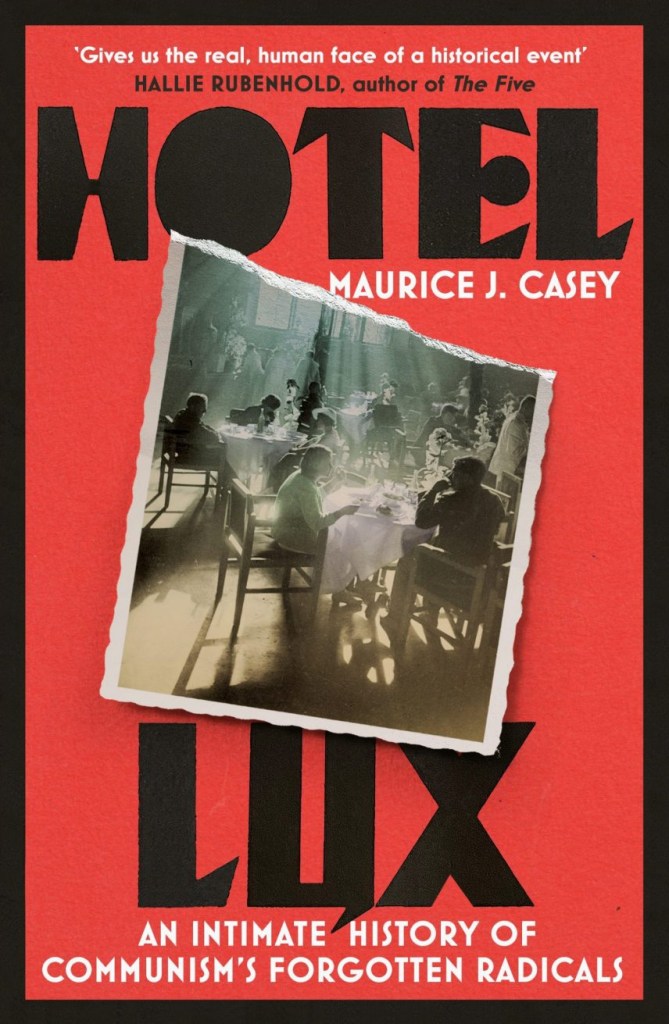
I can’t let the year end without posting something about my favourite book published this year – Maurice Casey’s ‘Hotel Lux’. I’ve no time to write a proper review so these hastily written words will have to do…
One of the least edifying aspects of being a socialist is the tendency of some comrades always having to prove to those present that they are the most left wing person in the room. Last week I achieved this enviable position with practically no effort on my part at all. And me being only slightly to the left of Ed Miliband. The occasion was the presentation of the Biographer’s Club Elizabeth Buccleuch Prize for best proposal for a first time biographer for which I was nominated for my Bob Stewart book. I didn’t win but it was fantastic to be in the running. The event was held at Albany, a large Georgian apartment block in the heart of London’s Piccadilly, the previous residents of which include Wordsworth, Byron and Gladstone.
It’s an exclusive address. Apartments or ‘sets’ rarely become available for sale and, when the occasion arises, you would need to have several million and be able to convince the residents’ association that you were just the right kind of person to have as a neighbour. Families tend to put their names down for a place a few generations before they secure one. As a child of the lower middle classes I was somewhat out of my depth in these surroundings. My hosts could not be faulted, however. My partner and I were made very welcome, wine flowed and I spent the evening chatting to other guests about our biographical obsessions.
The subject of my own work did occasion several wary enquiries as to whether I was a communist myself. It was if they were worried that I was about to requisition the property on behalf of the proletariat or collectivise their Hampshire estates. I reassured anyone who asked that there hadn’t been a Marxist-Leninist in the family since my grandfather died in 1978. Most of the guests were placated but one elderly gentleman in and immaculate Prince of Wales check jacket and a rather fetching bow tie muttered to me, “Communism is a virus!”
I bridled a little at first, taking it personally, a potential family insult, before we both steered the conversation away from the controversial. Encounters such as this do reflect one of the dilemmas of this project. Getting to know my ancestors has been a privilege, I find so much to admire and to celebrate. However, though their beliefs were shaken in 1956, they were staunch defenders of Stalin. This is a hard pill to swallow. I can understand, even when I don’t share it, this gentleman’s reaction. When I began my research this inheritance seemed far too huge for me to do it any justice. The best commentary I’ve read on it has been in ‘Hotel Lux.’
The book’s main focus is the relationship between three revolutionary women who came to Moscow and stayed at the Comintern’s preferred lodgings in the early twentieth century. It’s an immersive read full of fascinating detail. Woven through the narrative are the author’s reflections on being part of the radical left tradition and how one should deal with the ramifications of Stalinism. Early on in his research in Moscow, Casey is asked by a University professor, “So, are you for the Romanovs or the Bolsheviks?” The author fumbles his answer and wishes he could have given the more considered response he came up with after the event.
“The Soviet experiment inaugurated by the Bolsheviks was the culmination of many projects for revolutionary emancipation that arose in 19th century Europe. For better or worse, I consider all those emancipatory projects a part of my political ancestry. This is a messy inheritance, one that includes revolutionaries embracing one another in enthusiasm for a shared dream and former comrades sentencing one another to death in service to their cause. At the most basic level, the Romanovs did not want the world that I and others like myself desire. The Bolsheviks sought what I seek: equality. Therefore, when presented with this choice and within this context, I am for the Bolsheviks.“
This theme is developed during his research when he comes across that rare but not rare enough figure, a modern day admirer of Stalin.
“For two weeks, I made my way through the Comintern’s personnel files, folders where personal material relating to comrades and enemies of international communism was collated. I struck up an acquaintance with another English speaking researcher who regularly visited Moscow to work with Stalin-era materials. This researcher, I learned over coffee breaks, supported a resolutely hard-line form of communism. This gradually became clear over coffee- break discussions of our research topics. ‘Stalin was a man of great depth,’ he told me as I sat, disconcerted, before a disappointing cappuccino.
With one part of my mind thinking over the steel Memorial plaques I constantly saw on the walls of Moscow residential block, our conversation turned to 1937 and the Great Terror. For those who saw communism as a dead idea, it was not merely the Great Terror but one of the many inevitable red terrors. Violent oppression was, according to this theory, the unavoidable outgrowth of left wing ideas. They could not be fulfilled without it: radical levelling required violent purging. Such determinist readings, including those made by proponents of a teleological Marxism, always seemed unconvincing to me through their wilful blindness to the extraordinary range of possibilities that exist in the past. In our conversation, my coffee break companion appeared to share with the anti-communists a belief in the inevitability of terror. He differed only in his approach to its desirability. He upheld the orthodox communist line: yes, mistakes were made, but the terror was ultimately necessary to defend socialism: counter-revolution needed to be met with all-encompassing violence
This interpretation of the terror, one I’ve encountered occasionally in left wing circles seemed to render socialism a cruel idea. Yet I needed to confront how many of those I wrote about and researched people whose lives seemed to me so full of sympathetic moments accepted similarly cold logic. Before coming to Moscow I found it easier to see my people as those who courageously faced the firing squads without renouncing their ideals but now I could see more clearly that our political ancestry is never so neat. This was an admission that I tried to keep central in my mind once I returned to my work. I continued passing through fragments from a time when other paths seemed open, when dreams were not yet vanquished. I was learning to become more comfortable with murky moral complexity of revolutionary lives.“
Similar reflections are woven into the narrative as the book progresses and the protagonists and their families are affected in different ways by Stalinism. It’s an incredible piece of work and I’d encourage anyone to grab themselves a copy as soon as possible. If you’ve already read it buy it for friends and family for Christmas. It’s been invaluable to me as I contemplate the “murky moral complexity of revolutionary lives” of my own family.
Alan Stewart.


 Breaking the Fetters