During all the comings and goings, organising for the trade union and for the Templars, I was always drawn to political affairs. In a way this was natural, because Dundee was a politically radical city and had been so ever since the days of the Jacobins when Palmer, an associate of Thomas Muir, had been banished to the hulks in Botany Bay for his political activities. Dundee was also one of the main centres of Chartist agitation. In the 1880s and 1890s, Dundee was a real stronghold of radical liberalism and the local weekly newspaper, The People’s Journal, published strong radical views. I sold this newspaper on the streets and got fourpence a dozen; even when a boy I was doing a useful job in spreading the message.
In 1892, a political leftward move took place in Dundee when Jimmy McDonald, then secretary of the London Trades Council, stood as a Labour parliamentary candidate and polled 345 votes. In 1895 he again contested, this time as an Independent Labour Party candidate, and polled 1,313 votes. I did some campaigning for McDonald in this election and remember that the elder men thought this was an excellent vote because his candidature did not have the support of the Dundee Trades Council. A resolution which sought to support him in the Council had been defeated and an amendment to support the Liberal candidate had been carried by 19 votes to 16. It was shortly after this that I became a delegate to the Trades Council and very soon began to take part in the debates.
The Scottish Labour Party had been formed on July 23rd 1892. Many of the temperance men left the Liberal Party and joined the new party, taking their temperance views with them. But at this time I was still singularly obsessed with the struggle to stop the sale of strong drink and remained uncommitted to any political party. However, I read avidly-topical pamphlets, books theoretical and otherwise- I particularly remember several by Karl Kautsky. American temperance books and socialist pamphlets held a particular appeal, and I was always drawn to the Chartist books because they had a positive political programme.
Up to just after the turn of the century, therefore, my life consisted of finding a job, trying to keep it, trade union work, organising in the temperance movement, speaking and debating on radical platforms and reading and trying to assimilate the new revolutionary socialist ideas.
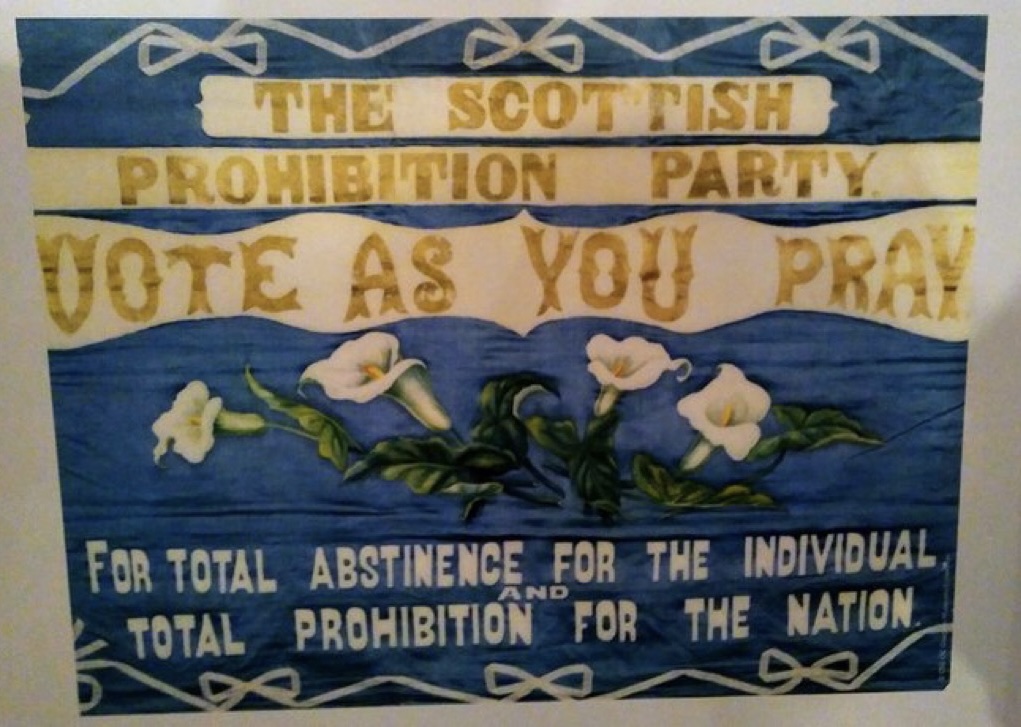
On my return from South Africa I was soon back again in the organising and political groove. I became full-time organiser for the Scottish Prohibition Party with a wage of 27s. a week; this was much less than I could have earned in the yards, but political idealism was taking a hold of me and political principle was more important than money. The Prohibition Party was committed to a reformist labour programme but was semi-religious. I travelled up and down Scotland in all the big cities and in many of the villages doing propaganda meetings. We had a small newspaper called The Prohibitionist, and I helped to edit this as well.
This was the period of great political struggle to break Liberal-Labour coalition politics and for independent working-class action. In the General Election of January 1906 fifty-one Labour candidates were returned as Members of Parliament, including some fine leaders for independent working-class action such as Keir Hardie. One month later, on February 15th at the Memorial Hall in Farringdon Street, London, the Labour Representation Committee transformed itself into the Labour Party and thus started the final break with Liberal-Labour unity and the birth of organised independent working-class political action. One of the first demands of the independent Labour M.Ps was the passing of the Trades Disputes Act, a very progressive piece of legislation that stood the test of time for over half a century.
In the 1906 Parliamentary General Election, Alex Wilkie, general secretary of the shipwrights’ union and one of the original Labor Representation Committee of 1900-6, stood on the Labour ticket in Dundee and won. He was, however, very much a Lib-Lab politician, and, while campaigning for him, I and a number of others tried to change his ideas. Dundee was then a double-barrelled constituency, that is, there were two votes for two parliamentary seats. Wilkie was returned to Parliament together with a Liberal named Robertson.
The year 1908 was one of heavy trade depression and high unemployment, but politically it was a vintage year for me. I stood for the Dundee Town Council and won. The full-time secretary of the Prohibition Party, Scrymgeour, was also on the Council so this made a mover and seconder for any motion we desired to put. We certainly enlivened the Council meetings. The first night I took my seat we were both suspended for being “‘offenders against decorum”. I had called another councillor a liar and the Lord Provost interrupted me to warn against the use of such language. The Provost was Jimmy Urquhart and I knew he had a university education, so I asked him to tell me how I could call a man a liar without actually saying so. “See me after the meeting,” he replied, “but don’t use that word here.”
There was a Baillie on the Council called Robertson who was, among other things, a director of the Dundee Football Club. Some material had disappeared from the Council Stores and found its way to the Dundee Football Club. I called Robertson a thief. This was a bit too much for a mere reprimand. I was taken to Court and fined £5 and £8 costs, but it put a stop to a number of things that were going on. A friend of mine, Adam Piggot, a butcher, paid the fine or I would have been “inside” again, because £13 was a small fortune to me in those days.
All this was good political campaigning, because it was all official Town Council business, and the local press gave it great publicity. Dundee in 1908 was in a desperate position. Unemployment was rampant, so bad that relief work had to be arranged. Soup kitchens were erected in the wards. Farmers from the surrounding area brought in vegetables free, and local butchers donated beef and bones. Door-to- door collections for money were organised and food was
distributed to the needy- over half of the town were needy. I did an immense amount of work on relief both for the Prohibition Party and as a councillor. One helper I remember, who worked like a Trojan, was a Roman Catholic priest called Turner. He was out day and night working; and never a needy case was turned away. He was a kindly, hard-working man, which was more than could be said for many of those who did nothing but were always on hand to give advice on how the relief should be distributed.
The employment position was so bad that I moved in the Council that we provide some work for the unemployed. I suggested that to provide work trees be planted in the Blackness Road to beautify the street. Many were against it because it was spending the town’s money needlessly. However, I won; the trees were planted and are still there today. Blackness Road, lined with trees, is one of the prettiest in the city.
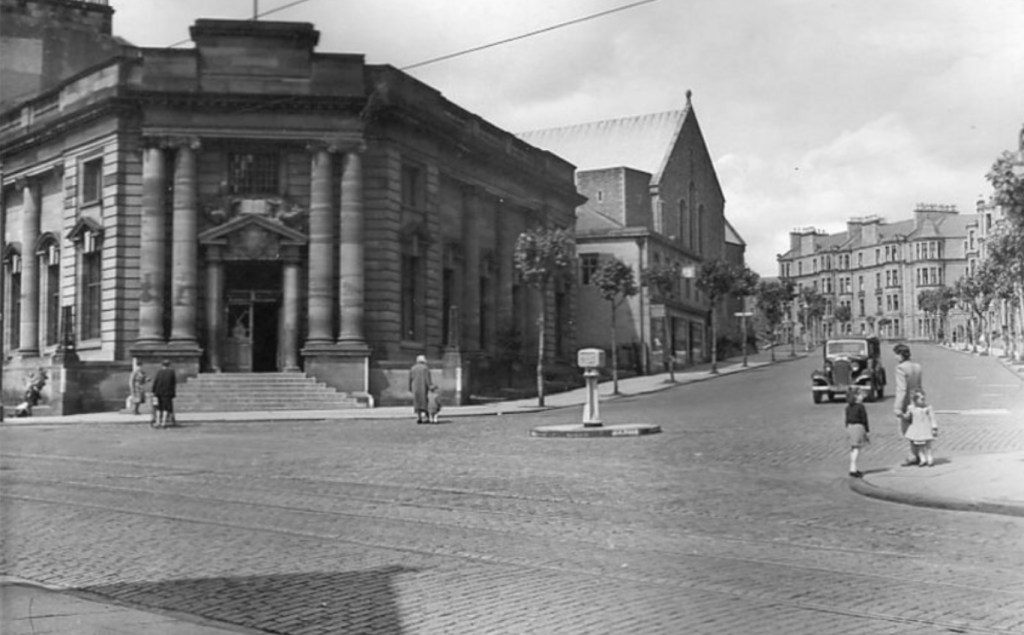
During the Council term I was elected as a representative to the Blind Institution Committee. Usually the meetings of the Committee lasted fifteen minutes. Minutes would be read and approved, a lot of nice things said and then everyone would go home. The Committee consisted of one or two mill owners, a few business men and representatives of the Town and Parish Councils. At my first meeting the minutes were read and approved and then I started to ask questions. There was consternation, but I knew many of the blind people living in their own homes were weaving baskets, making mattresses and the like, and were being very poorly paid. So I continued to press my questions and to get answers, which when followed up made it clear that the manager was making absurdly high profits out of the blind people’s work. On leaving the meeting, one of the mill masters, a great county cricketer, Sharp by name, said to me,
” Stewart I did not know anything like that was going on. I think it’s a scandal.” “So do I,” I replied, “but the living standard of the working class is a scandal.” He nodded his head and went away. No doubt next morning he would be demanding more effort from his jute workers to provide more profit for himself.
After a year in the Council I had to stand for re-election. A campaign was waged, in which the local press took a hand, to get Councillor Stewart, that spendthrift agitator, out of the Council. Naturally, with the expenses for relief work the rates had gone up -32d. in fact- -and I got the full blame for this. Of course I defended the relief work, but the forces against me were too strong, and I was defeated at the poll.
The year 1908 saw another famous election in Dundee. It was a Parliamentary by-election in which Winston Churchill stood as a Liberal candidate.
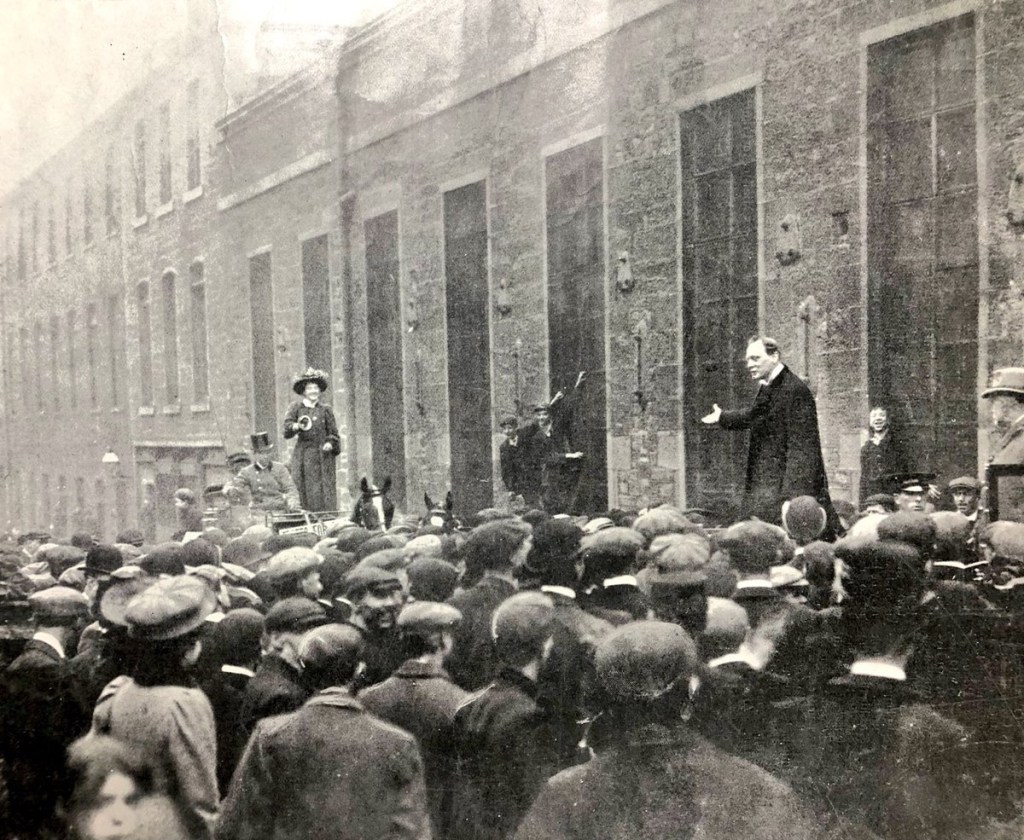
Churchill had started his parliamentary career as a Tory and won the seat at Oldham in October, 1900. In the fight for tariff reform at the beginning of the century he changed his coat and became a Liberal, contesting the North-West Manchester constituency. In the general election of 1906 he defeated Joynson Hicks in what was accepted as a safe Tory seat. In 1908 he succeeded Lloyd George as President of the Board of Trade and this necessitated a by-election. (This was the parliamentary procedure of the period: when an M.P. became a cabinet minister he had to face the electorate again.) On the 24th of April, 1908, in the by-election at North-West Manchester Jonson Hicks got his revenge and defeated Churchill, largely because of the intervention of Dan Irving, a Socialist candidate. The date is important because, while, Churchill was contesting this by-election, the Dundee Liberal Party were meeting to choose their candidate for the Dundee by-election. After a few stormy meetings the decision was postponed. There was a terrible row at the time, with the local press giving pages of publicity to the rumours that some Liberal leaders in Dundee were keeping the candidature warm for Churchill should he be defeated at Manchester. So it came about that Churchill, who was defeated as a sitting M.P. on April 24, packed his bags and was campaigning in Dundee three days later. On May 10, sixteen days after his defeat, the Dundee result was announced and Churchill was returned to Parliament and became President of the Board of Trade, but as M.P. for Dundee and not for Manchester. In this by-election I was election agent for Scrymgeour. The Prohibition Party had decided not to support the candidature of Stuart, the Labour candidate, but to put up our own candidate. It was a short but lively campaign. With four candidates in the field, the meetings were all packed out. I remember one meeting in the Drill Hall at which Churchill spoke. He shouted to the crowd: “Britain has great imperial strength. We have belted the world with free institutions.” He was speaking in Bell Street, next door to the Sheriff Court, across the road from the Salvation Home for fallen women; next door to that was the Parish Council Lunatic Department, nearby the Curr Night Refuge for homeless people to get a cup of tea and a bed, before they started their wanderings the next day. The gulf between Churchill’s oratory and the living reality was there in the street where the meeting was held. This was a good propaganda point I certainly did not miss.
During the counting of the votes I noticed Churchill standing alone in a corner twisting little rubber bands around his fingers, and as each one broke he threw it away. He was obviously in a very agitated condition.
I went over and started a conversation with him about stopping the sale of strong drink, asking what he would do in Parliament to bring this into law. It was obvious he was only interested in one thing-the result. In retrospect he was right; another defeat in Dundee after Manchester would have ruined his political career. “How do you think it’s going?” he asked me. “You’re in by a mile, worse luck,” I said. You didn’t have to look at the vote-counting very long to see that. However, our little discussion on prohibition had not gone entirely unnoticed. Later, the Provost, Jimmy Urquhart, came over to me and said: “I understand you’ve been trying to convert Winnie to prohibition. By Christ! Bob, you never give up!” He said it in a voice of admiration for my courage and with the certainty that I was on a forlorn quest. As later years proved, Churchill and the prohibition of strong drink were poles apart.
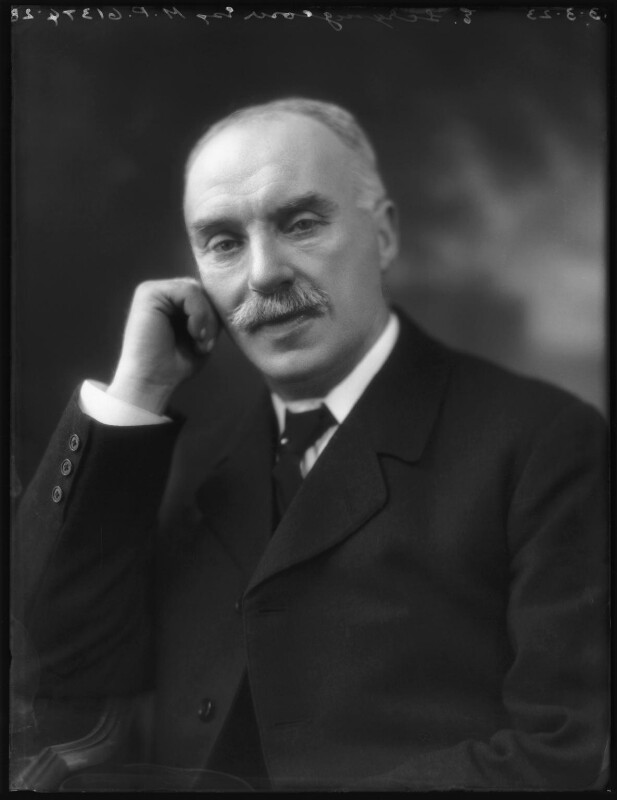
Scrymgeour and I had many differences in the election campaign. He dwelt too much on religion. He had a great advantage over all the other candidates because he had a mandate from God. His speech to the crowd after the announcement of the result was really heavenly: “I feel deeply grateful to the Almighty God that has enabled the Prohibition Party to put me forward as the first British Prohibition candidate and look forward to another day when success will attend our efforts.” That speech was the beginning of the break in the Prohibition Party.
Winston Churchill was Member of Parliament for Dundee until the general election of 1922, when Willie Gallacher stood for Dundee as a Communist candidate. But in 1908 he was the hero. When the result was declared that May night, the Dundee workers not only lifted Churchill shoulder high, they lifted his motor car with him inside it and carried him down Bell Street.
A year or so after the election the inevitable split came in the Prohibition Party. I could no longer stomach the religious prattlings of Scrymgeour and some of his adherents. A number of us broke away and formed the Prohibition and Reform Party. It was at this period that I wrote the pamphlets, En Route To The Sober Commonwealth and Socialism, which were laced with good socialist principles. Apart from the aim of achieving complete National Prohibition its aims were:
SOCIALISM
The abolition of private ownership of the land and the means of manufacture, production and exchange, and the substitution of public or social ownership without compensation.
COMPLETE DEMOCRATIC RULE
Abolition of the hereditary principle in government, adult suffrage, initiative and referendum, devolution on separate Parliaments of domestic legislation.
INTERNATIONALISM
Recognition of the common interests of mankind. The establishment of international arbitration courts for the settlement of all disputes between nations, leading up to world-wide government elected by the citizens of all nations.
 Breaking the Fetters