The Stewart Family pictured in the mid 1920s: -R: Bob, Rab, Annie (Nan), William and Margaret.
To the best of my knowledge the last person in my family to still be fully committed to a Marxist-Leninist revolution died in 1978. He was my grandfather William Stewart and he was lovely. However, even though those that remain have spent the intervening forty-four years failing to overthrow the capitalist system, communism has loomed ever present in the background in our lives for all sorts of reasons. It is a bittersweet inheritance. I suppose there is nothing surprising in its presence as, from the inception of the CPGB in 1920, communism essentially became the family business for the next fifty years. Practically everyone was involved.
At the end of 1955 – a few months before Khrushchev would acknowledge the crimes of Stalin for the first time in his ‘secret speech’ MI5 picked up some office gossip about the Stewart family through one of the bugs it had placed in the offices at the Communist Party’s HQ in King Street, Covent Garden. Reuben Falber, who, when Bob Stewart finally retired in 1957, would go on to be responsible for distributing funds from Moscow, was overheard talking to fellow party worker Betty Reid about a recent scandal involving Bob’s nephew Greg – a Cambridge student who had just been unforgivably rude to one of the comrades at Central Books. Here’s part of the transcript in the security files:
‘They’re a family that-well, they’re a law unto themselves because you’ve got a combination of the old fellow’s prestige and money. BETTY asked where the money came from. Regret FALBER’s reply was whispered and could not be followed.
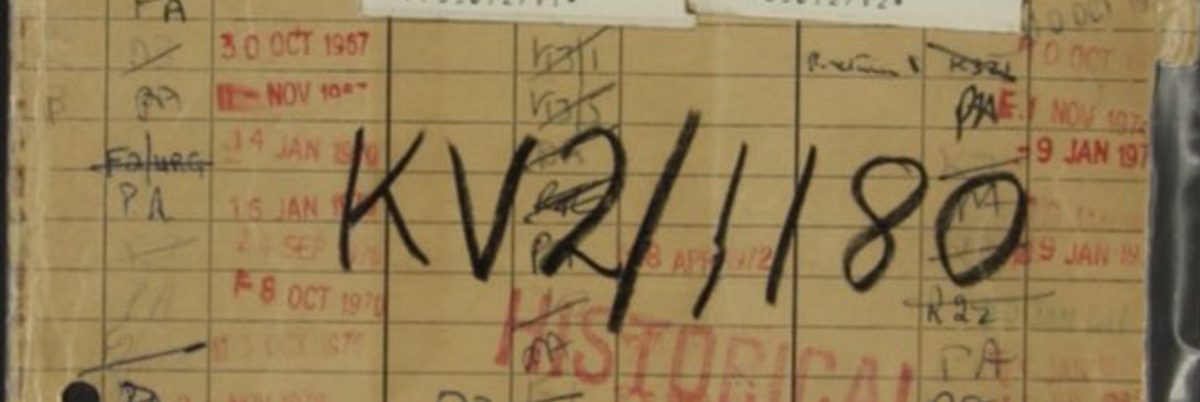
(From the MI5 Security File on Bob Stewart KV2/2790 – The National Archives)
The ‘old fellow’ is, of course, Bob Stewart and quite clearly the whole family had something of a reputation within communist circles. In fact, Betty Reid, in a conversation recorded about eight months later, was of the opinion that the Stewart children – William, Rab and Nan, had been “thoroughly spoiled all their lives.” This kind of attitude is elaborated further in an earlier document I came across in my grandfather’s security file on a recent visit to the National Archives. It’s dated 17th October 1932 and appears to be a memorandum from Special Branch to MI5 concerning the activities of Bob and his three children. I reproduce it here in full partly because I think it’s an interesting account of how the Stewarts and other similar families were viewed within the movement but mainly because I love the description of my grandfather.
The following information has been received.
WILLIAM STEWART, who used to drive the Soviet Ambassador’s car has given up driving altogether and is now employed in the Embassy as a ‘trusted’ man. He recently stated that he was engaged there on work of a secret nature, which included a little clerical labour.
His hours are from 5pm until 1am and his wife also has a job at the Embassy.
He is forbidden to undertake Communist Party of Great Britain work.
He now wears a small moustache, Charlie Chaplin style, which gives him an altered appearance, and carries an ash walking-stick. He often wears a light green shirt, brown jacket and shorts (at other times grey flannel trousers), light brown rabbit-skin hat, and brown shoes. He apes the appearance and mannerisms of a university student.
His father, ‘Bob’, is at present in Belfast where he is assisting the Irish Revolutionary Workers’ Party.
His brother, who lived with Ralph Edwin BOND, and was attached to St. Pancras Local Communist Party of Great Britain, has now secured a situation at Arcos Ltd. as also has his wife. Both have been transferred to Islington Local.
His sister, who was active in the Young Communist League of Great Britain, and who went to Russia on several occasions, has gone to live there permanently. She also was employed at Arcos and married a principal of that concern. As he has been recalled to Russia, she has accompanied him.
The state of affairs here outlined indicates how the movement is ‘exploited as a meal ticket’ (to use the phrase of certain disgusted genuine Communists) by certain fortunate families.
The CAMPBELL family is another case in point. The sum of over £20 weekly is received in John Ross Campbell’s home from Soviet sources.
The WATKINS’ are in the same position, whilst there is a host of others.
There is keen resentment in the ‘movement’ over this condition of things. It is freely expressed that no man and wife should be allowed to hold a situation while other ‘Comrades’ are unemployed. This objection has taken root and considerable trouble on the point seems likely to develop.
SUPERINTENDENT.
(From the MI5 Security File on William Stewart KV2/4494 – The National Archives)
William, the eldest son of Bob and Margaret Stewart, was born in 1903. He was our grandad. He died in 1978 when I was four and so I have few memories of him but those that I do are incredibly vivid. He was a warm, kind and gentle man. This impression has only been strengthened by the many letters and photographs he left behind. Every new detail I come across makes me wish I’d known him longer and I don’t know whether it’s his or Bob’s story I’d rather tell.
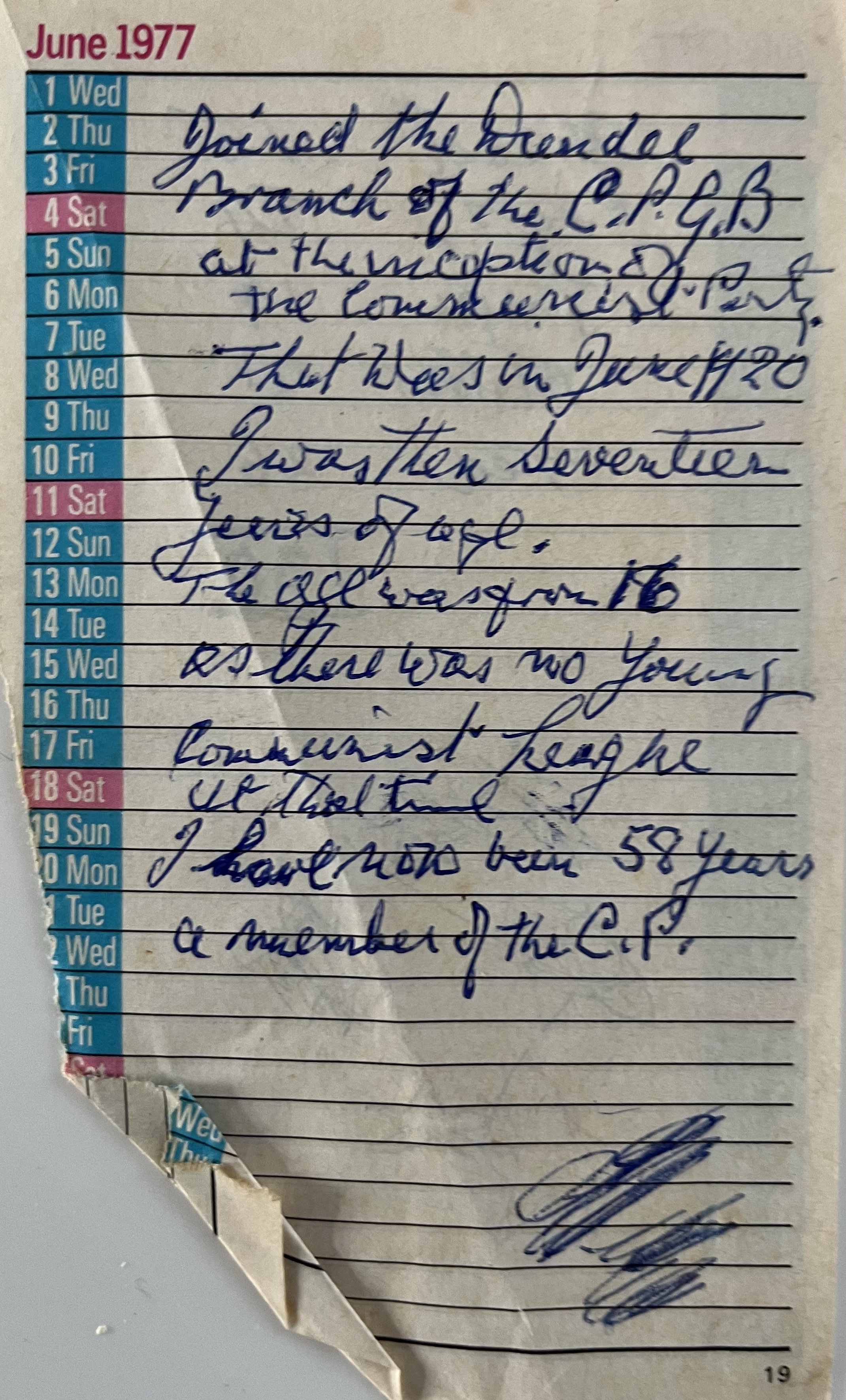
Like his father, he joined the Dundee Branch of the Communist Party of Great Britain on its inception in 1920. He was 17 and remained a card carrying member for the next 58 years until his death. It would have been his commitment to these ideals and presumably family connections that led to him working for ARCOS during the earliest years of the Soviet Union’s existence. Bill worked on merchant steamships sailing from British ports to Odessa and Leningrad progressing from cabin boy to chief steward on the way. ARCOS – the All Russian Co-Operative Society was the body responsible for facilitating Anglo- Soviet trade in the wake of Lenin’s New Economic Policy. MI5, quite understandably, regarded it as a front organisation for espionage and other subversive activities and it was raided and shut down in May 1927. Britain then broke off all diplomatic relations with the Soviet Union.
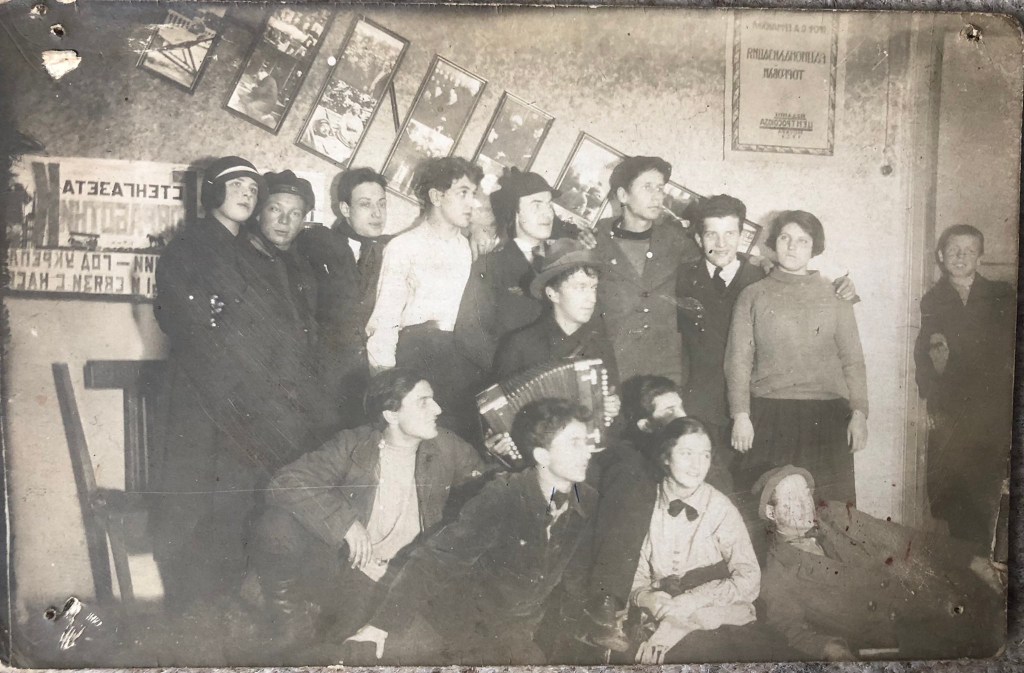
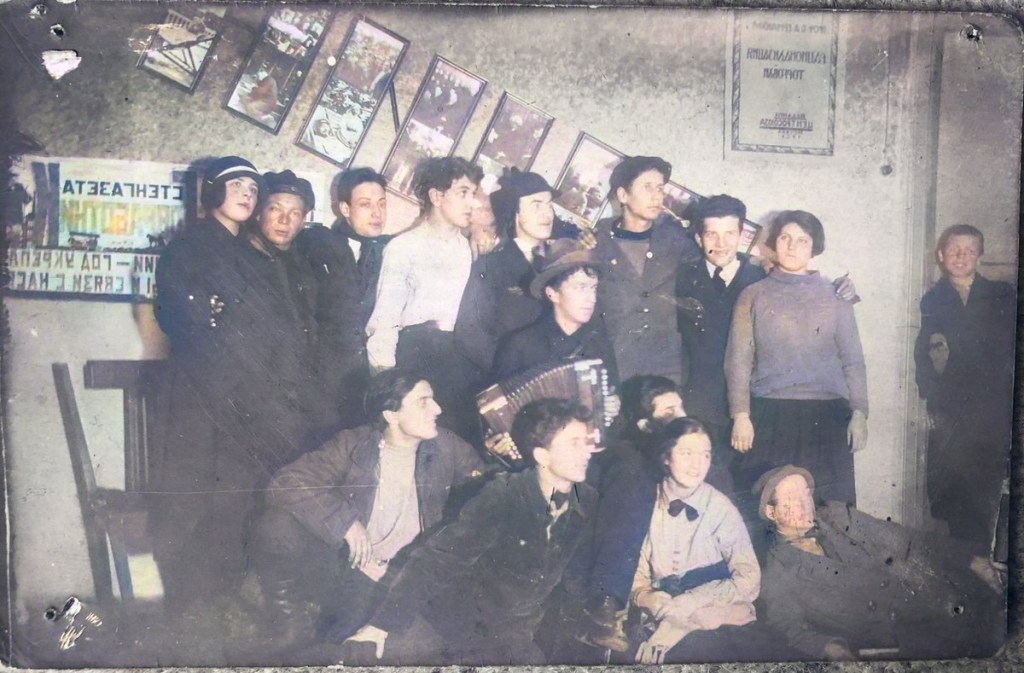
However, it is not the idea of espionage that interests me particularly. Still less the movement of textiles, timber and coal across the Baltic to the benefit of British commerce. It is this photograph that I found amongst hundreds of others in an old suitcase in my mother’s loft. A lively group of young people assembled in a shabby room adorned with agitprop posters and photos of Lenin. Their style of dress ranges from the bohemian to the Bolshevik. The majority of the group are looking towards their left- it appears that someone else is taking a group portrait while a second photographer caught this image from another angle. A couple of the figures stare out in other directions in slight confusion. Despite this there is a distinct sense of that much maligned word ‘comradeship’. One of the young men carries an accordion and I suspect that there has been quite a bit of drinking going on. A much younger boy looks on grinning in the doorway. I love this photograph.
Bill Stewart and the Russian Communists.
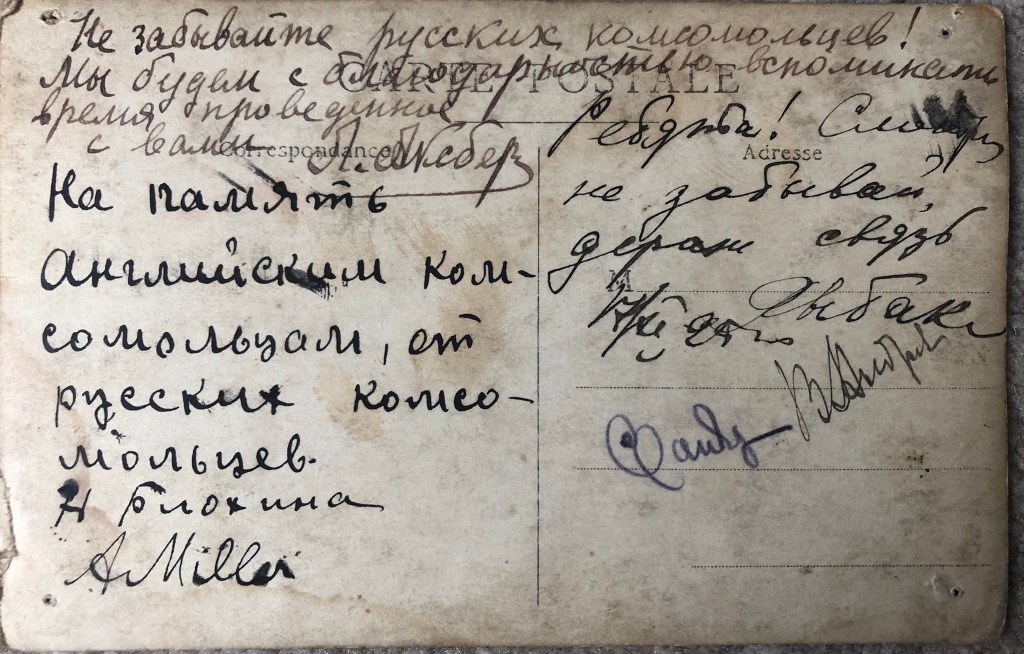
At the centre, in the back row is my grandfather. He’s the one wearing the budenovka- the distinctive early headgear usually worn by the troops of the Red Army in the 1920s. He looks like he’s having a good time. There is some writing on the back which explains that the picture features Russian and English communists with the affectionate declaration, “Don’t forget the Russian young communists! [Komsomoltsiev]” This is accompanied by signatures from several of those gathered there. It must have been a gift to Bill and it appears to have pinned up as a memento to serve as a reminder of his younger days.
“Don’t forget the Russian young communists! [Komsomoltsiev]” Thanks to Maurice Casey for the translation.
It’s hard enough to imagine your parents in their youth let alone your grandparents and my hearts bursts for grandad when I look at this image. It marks him out as someone who, in contrast to my own mundane life, had adventures. Striking out to places far away from home carried away in a moment in history. I’m quite jealous of him to be honest. How on earth did he end up there? When you think of the USSR youthful optimism and idealism is far from what first comes to mind but it’s certainly present in this image captured almost one hundred years ago. But, as with any photograph of the young when the subjects are long dead, there is melancholy too. Whatever happened to Bill’s companions, particularly the young Russians, in the years that followed? I fear for them.
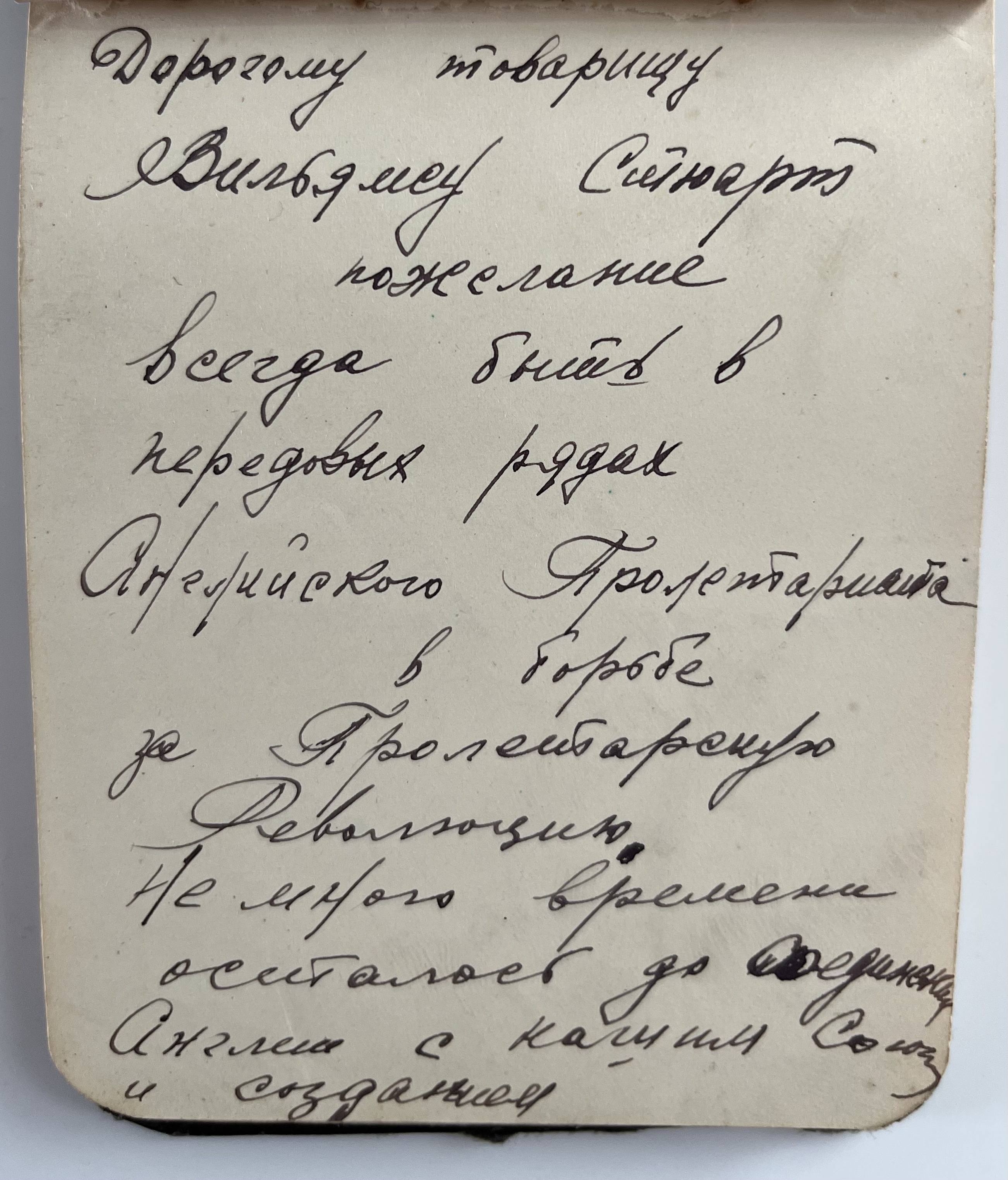
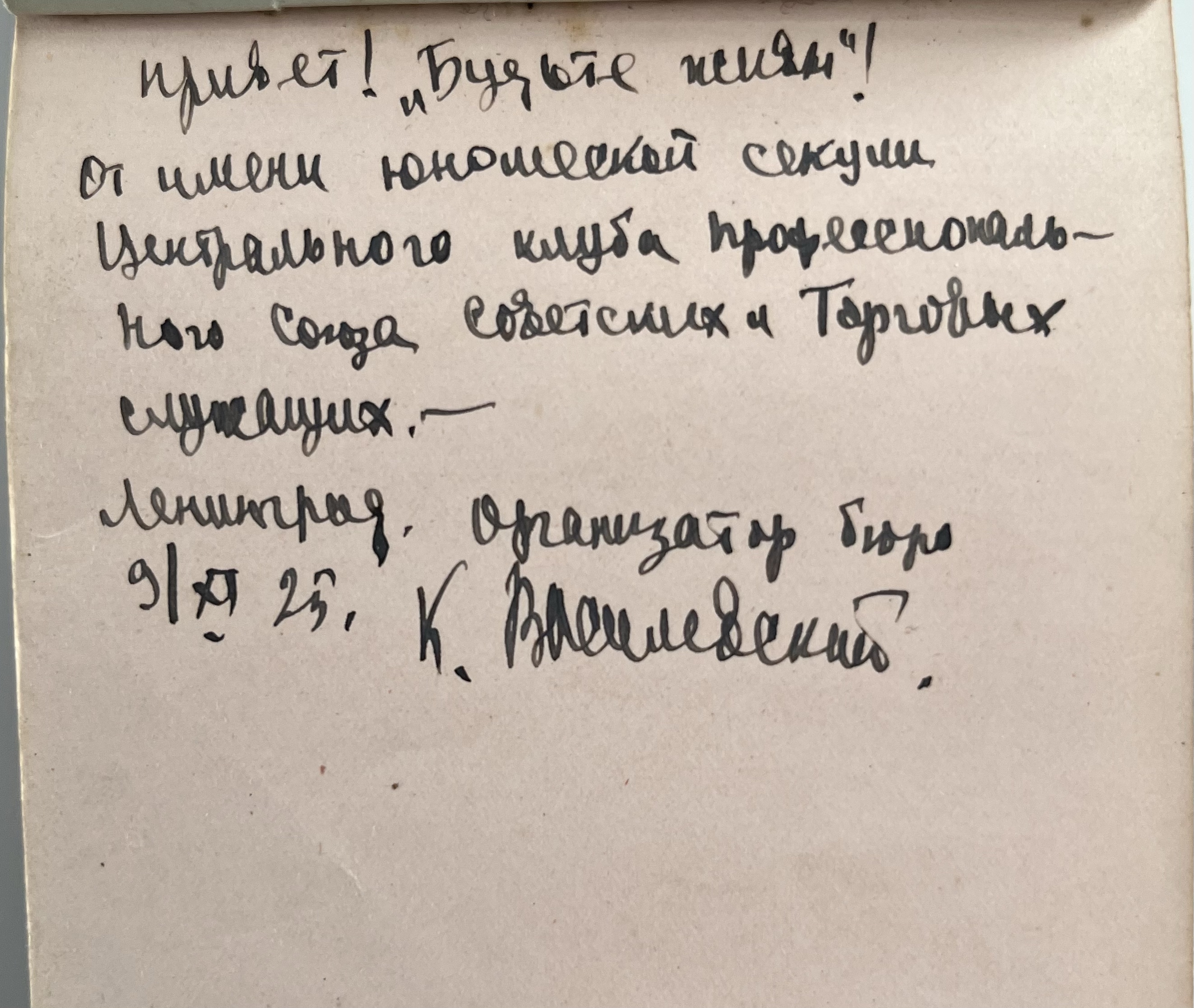
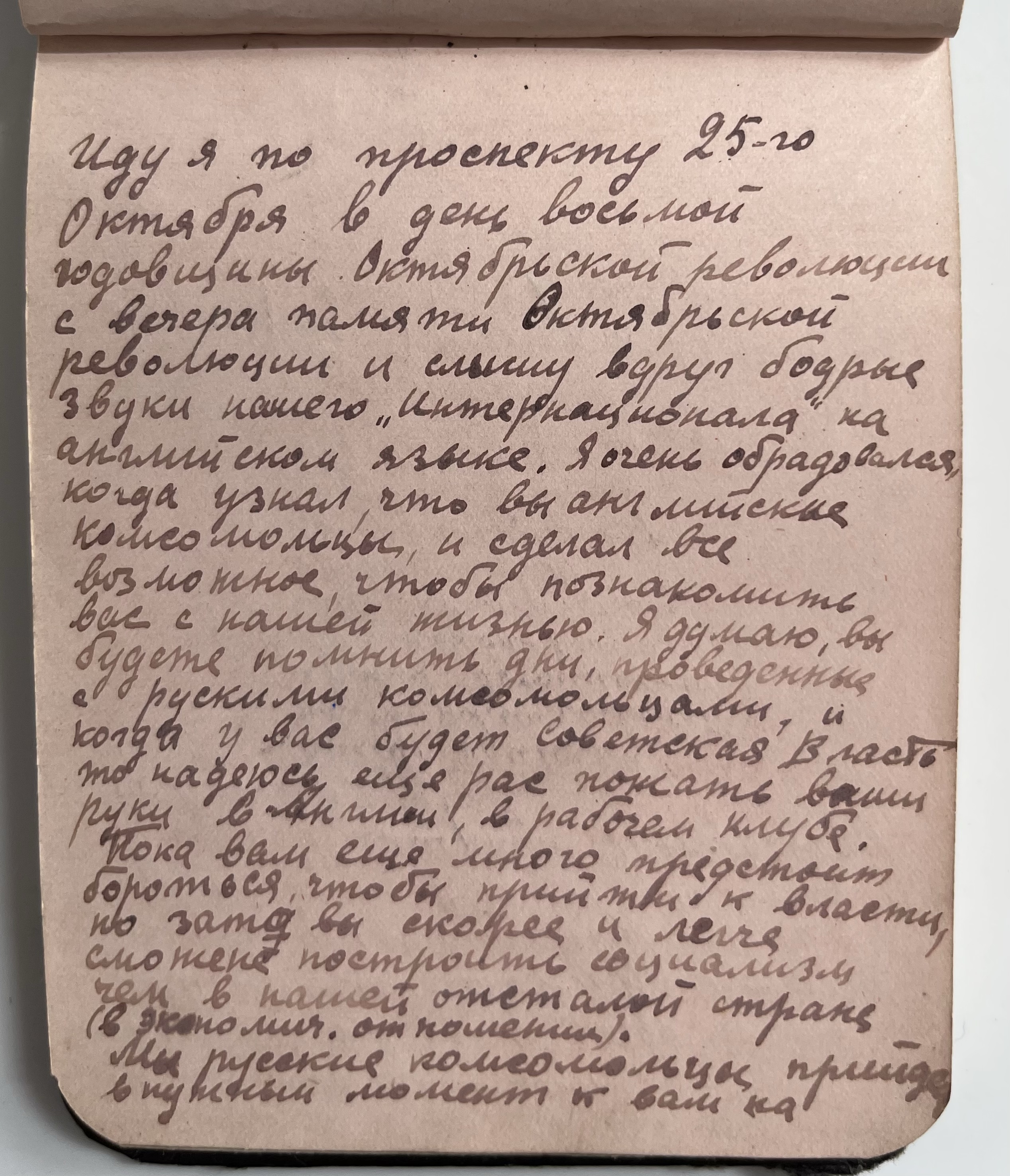
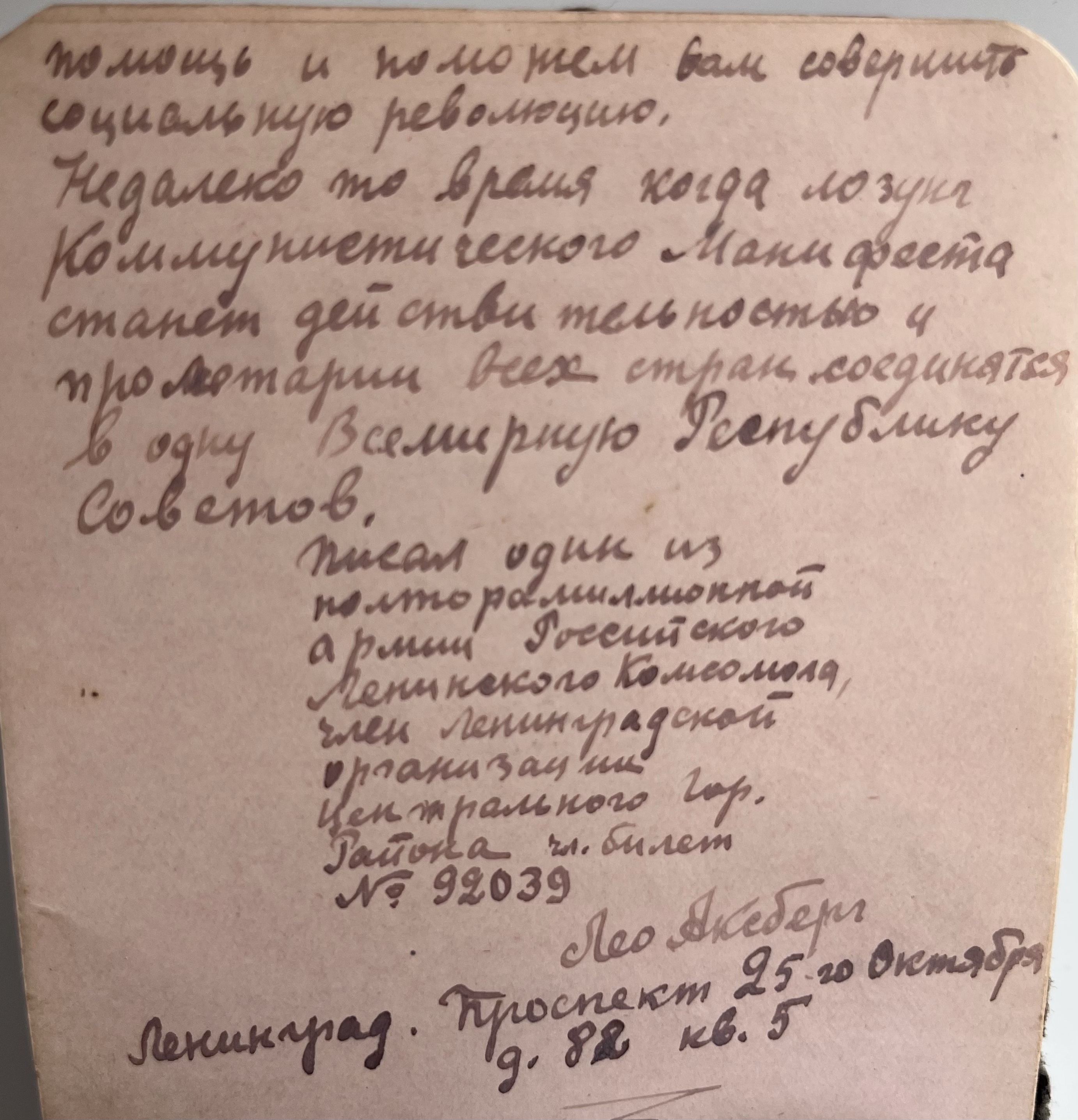
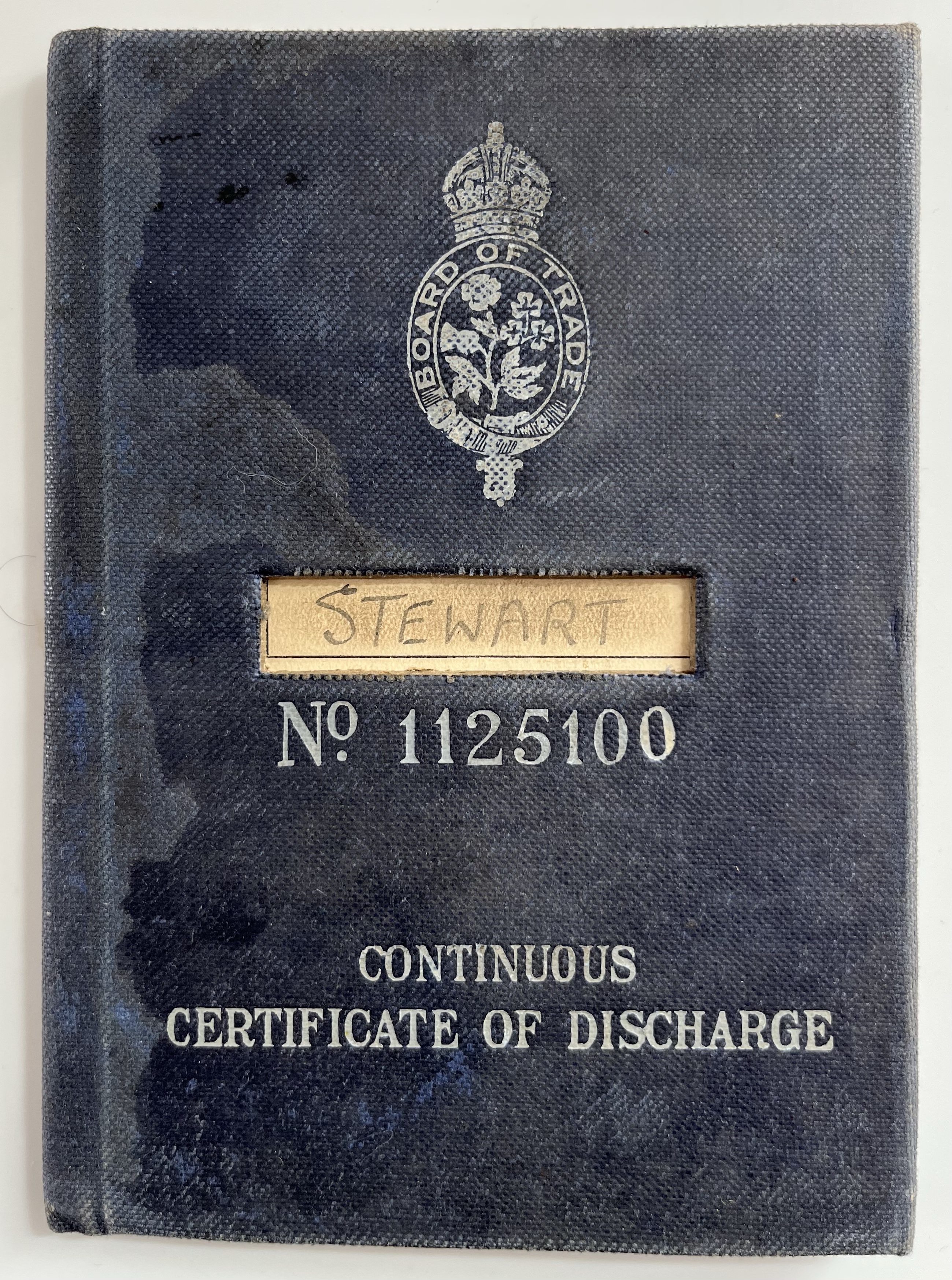
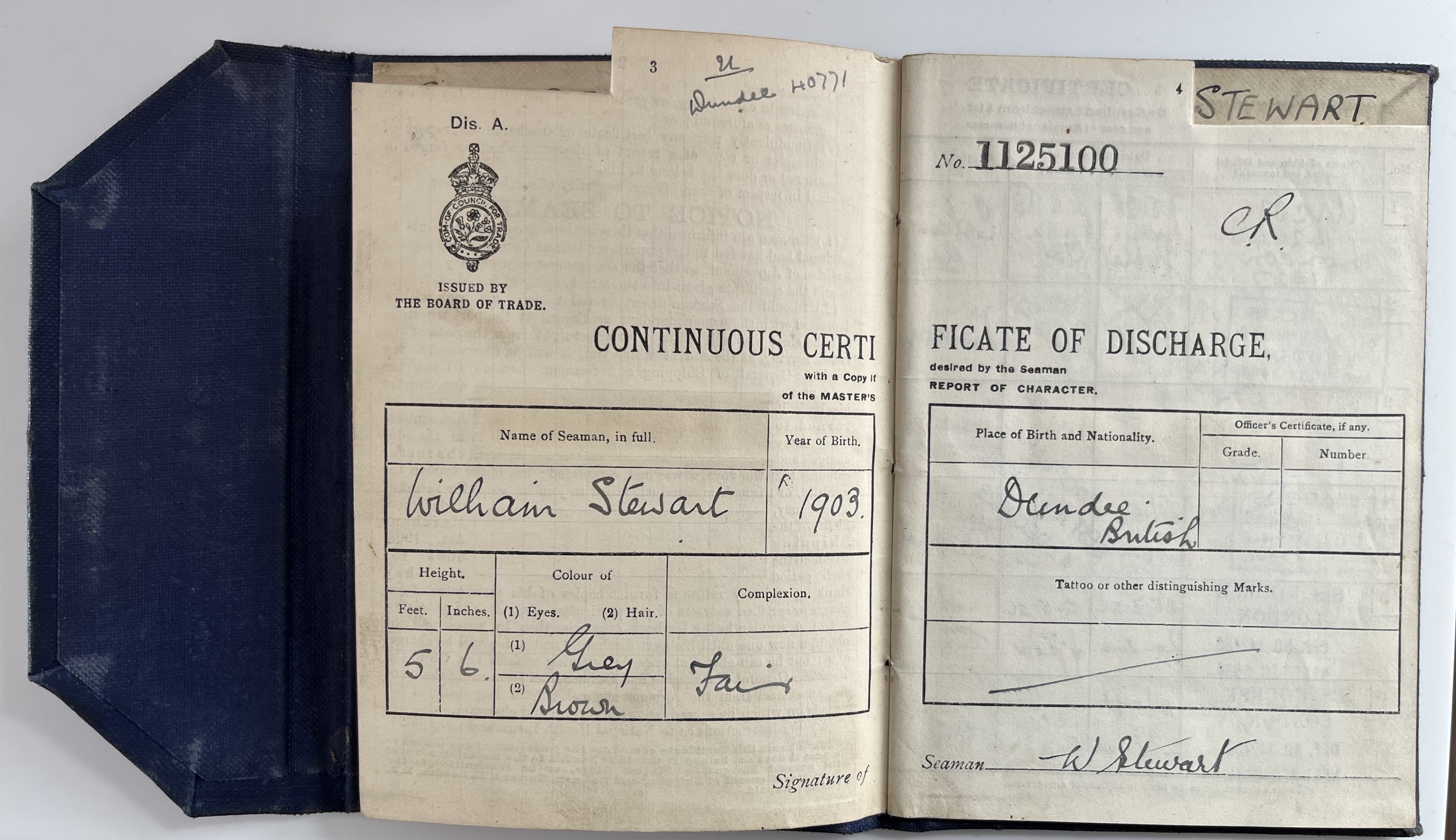
When I first came across the photograph I had the no idea of the circumstances surrounding it or when and where it was taken. The first clue was finding Bill’s ‘Continuous Cerificate of Discharge’- the log book that records the various voyages and their destinations. It would definitely have to have been taken between 1925 and 1927. However, it was finding a small battered autograph book that belonged to Bill that narrowed it down further. The pages are dotted with various signatures and messages in Cyrillic script from friends and comrades my grandfather met on his journeys. Yelena McCafferty of http://www.talkrussian.com provided the translations and the picture became clearer. The photograph was likely to have been taken around October or November 1925 while the SS Koursk, where Bill was working as an assistant steward, was docked at Leningrad. The messages reproduced below describe how Bill and his colleagues met a group of Russian members of the Kosomol during celebrations of the 8th anniversary of the October revolution and struck up a friendship. There is a sense of the Russians eager to know how the proletarian struggle is faring overseas and much talk of Britain working towards its own revolution which, of course, is inevitable and imminent. In the light of what happened in the years that followed I find it all incredibly moving.
Alan Stewart.
William Stewart’s autograph book.
Wishing dear comrade William Stewart to be always in the leading line of the English proletariat fighting for the proletarian revolution. It’s not long until England is united with our union and until the creation of one powerful Union of Soviet Socialist Republics.
[Signed]
Flat 6, 11 Voskresensky Pr., Leningrad
Dearest comrade,
It was so joyous for us, Komsomol members from Leningrad to see you, messengers of England’s youth, that England we so often see glimpses of in the news in our newspapers but which in essence we know so little about.
Somehow it was particularly joyous to see in you the signs of being relentless fighters, healthy in both spirit and body. You are not yet the powerful Lenin-like party, but you are a wonderful material, fire bricks which will be used to make it. When in the place of a group of young, stubborn Komsomol members, in the place of a small working league comes a broad, mass, proletarian Bolshevik party – then your cause will win. Until then we will bring this day closer together. We will be proud to see that you have found something to learn from our way of life and work. May your visit be an initial point in our closely-knit connection, friendship, correspondence. Please write to us about the way you live, work, what’s happening in Komsomol, about the progress of your work in the unions, work cells, printed press, among farming community. We will write to you everything you are interested in.
Hello! “Stay alive”!
On behalf of the youth section of the Central Club of the Professional Union of Soviet and Clerical Employees.
Leningrad. Bureau Organiser.
09.11.25 K. Vasilevsky
I am walking on Prospekt 25 Oktyabrya on the 8th anniversary of the October revolution, from the commemoration evening in honour of the October revolution and suddenly I hear energetic sounds of our Internationale in English. I was very happy to find out that you are English Komsomol members and did my best to show you our way of living. I think you will remember the days spent with Russian Komsomol members, and when you have Soviets in power I hope to shake handswith you once again in England in a workers’ club. So far you have a lot of fight on your hands to reach power, but you will be able to build socialism quicker and easier compared to our backward country (in the economic sense). We, Russian Komsomol members, will come to help you when needed and will help you to carry out a social revolution.
It’s not long until the slogan of the Communist manifesto becomes reality and the proletarians of all countries join in one World Republic of Soviets.
Written by one of the army of a million and a half Russian Lenin Komsomol members, a member of the Leningrad Organisation, Central City District, Membership card №92039.
Leo Aksberg
Flat 5, 82 Prospekt 25 Oktyabrya, Leningrad
‘Worker’s of the World Unite!’
Postscript
Here’s a few items I wanted to get into the main article but they wouldn’t quite fit:
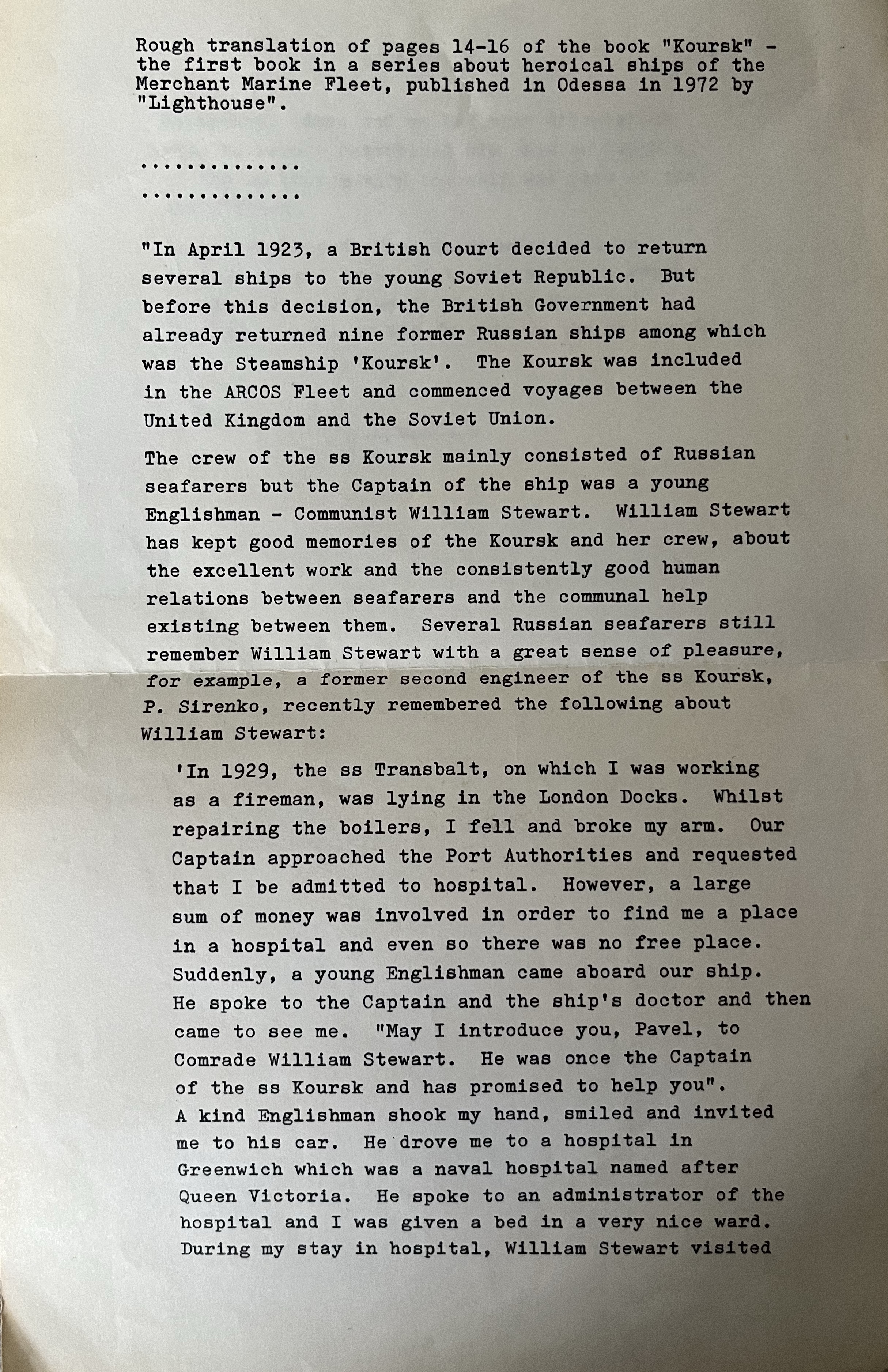
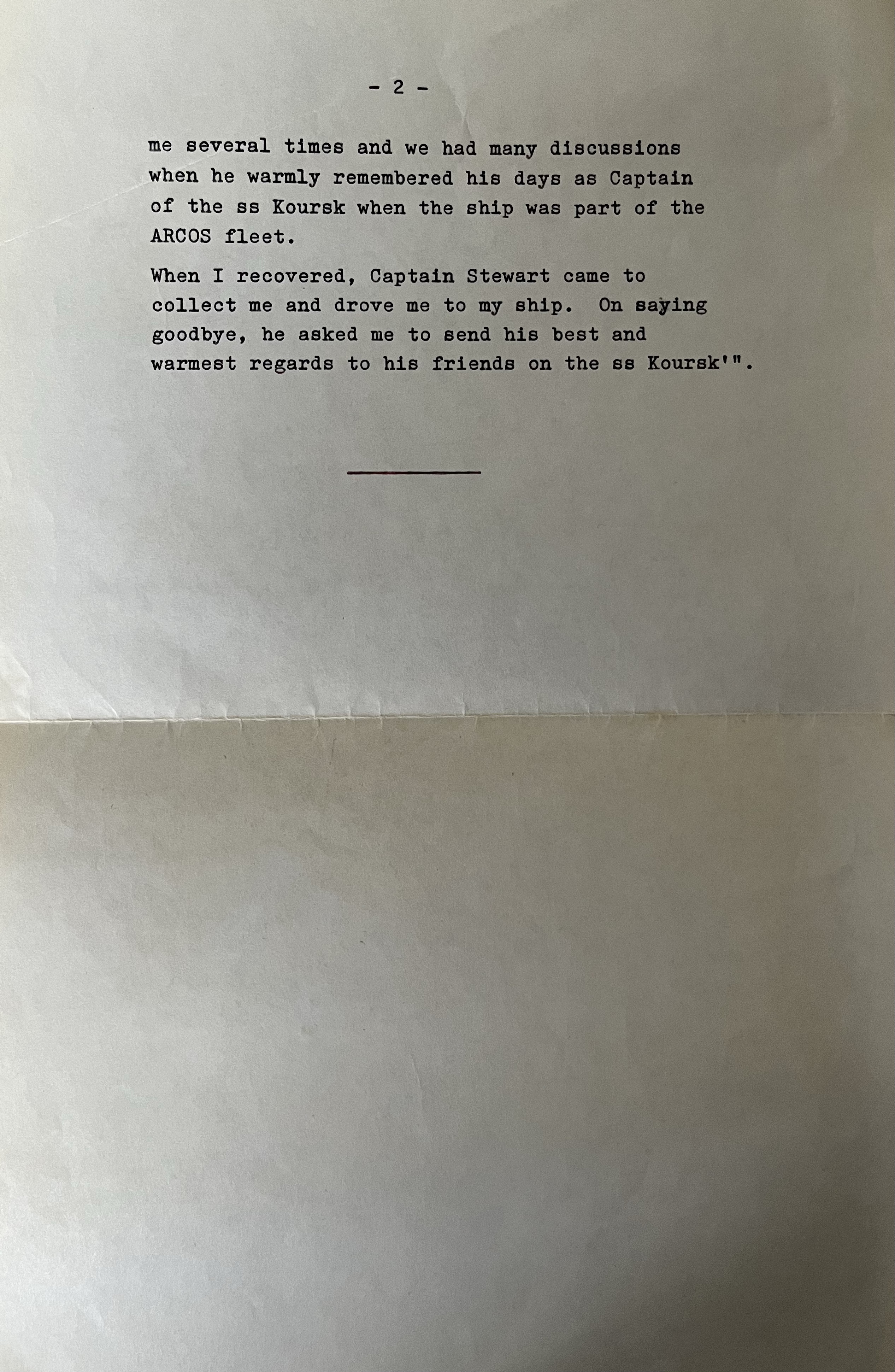
Bill obviously made firm friends on these trips. Here’s a translation from a book on the SS Koursk published in Odessa in 1972 in a series about ‘heroical ships of the Merchant Marine Fleet’. I found it amongst all the jumble of letters and documents I’ve been sifting through. I think the translation is, as the writer admits, only rough as I don’t think Comrade William Stewart ever reached the rank of captain.
“In April 1923, a British Court decided to return several ships to the young Soviet Republic. But before this decision, the British Government had already returned nine former Russian ships among which was the Steamship “Koursk’. The Koursk was included in the ARCOS Fleet and commenced voyages between the United Kingdom and the Soviet Union.
The crew of the SS Koursk mainly consisted of Russian seafarers but the Captain of the ship was a young Englishman – Communist William Stewart. William Stewart has kept good memories of the Koursk and her crew, about the excellent work and the consistently good human relations between seafarers and the communal help existing between them. Several Russian seafarers still remember William Stewart with a great sense of pleasure, for example, a former second engineer of the SS Koursk, P. Sirenko, recently remembered the following about William Stewart:
“In 1929, the SS Transbalt, on which I was working as a fireman, was lying in the London Docks. Whilst repairing the boilers, I fell and broke my arm. Our Captain approached the Port Authorities and requested that I be admitted to hospital. However, a large sum of money was involved in order to find me a place in a hospital and even so there was no free place. Suddenly, a young Englishman came aboard our ship. He spoke to the Captain and the ship’s doctor and then came to see me. “May I introduce you, Pavel, to Comrade William Stewart. He was once the Captain of the SS Koursk and has promised to help you”. A kind Englishman shook my hand, smiled and invited me to his car. He drove me to a hospital in Greenwich which was a naval hospital named after Queen Victoria. He spoke to an administrator of the hospital and I was given a bed in a very nice ward. During my stay in hospital, William Stewart visited me several times and we had many discussions when he warmly remembered his days as Captain of the SS Koursk when the ship was part of the ARCOS fleet.
When I recovered, Captain Stewart came to collect me and drove me to my ship. On saying goodbye, he asked me to send his best and warmest regards to his friends on the SS Koursk'”
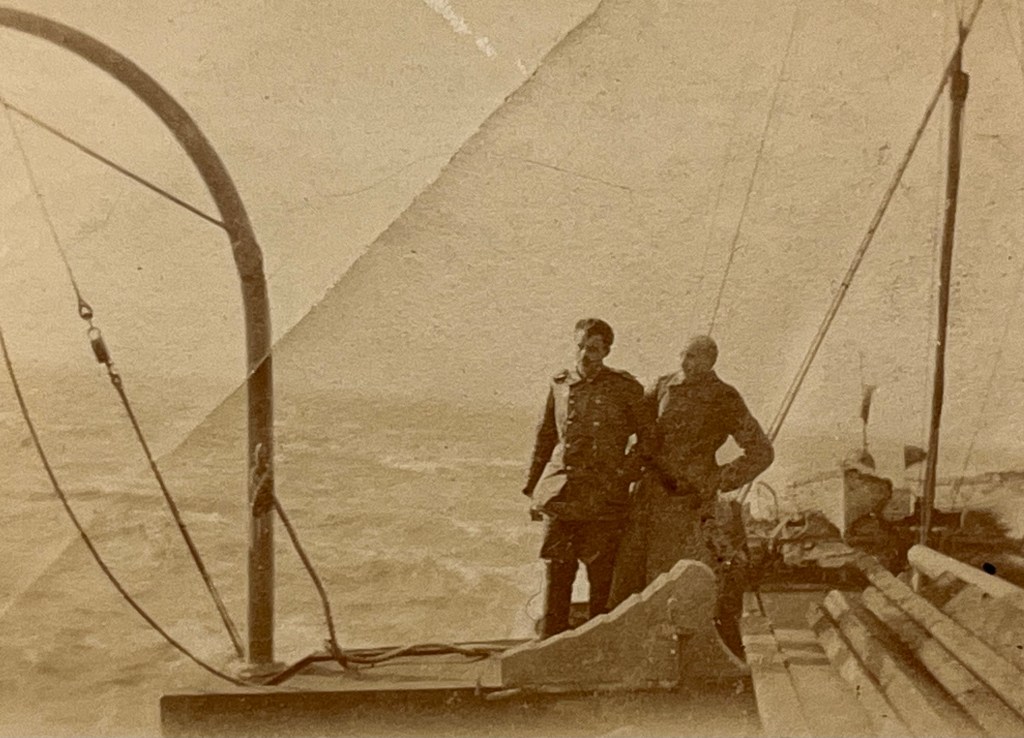
Photographs of the hospital anecdote above. It has just occurred to me that every single Russian he met seemed to be incapable of making the distinction between Scottish and English. He was a very patient man.Colourised version of the British and Russian young communists.Another entry in the autograph book- ‘To the Youth, the future- Sam Brasonovitch, Odessa.’ I love this.William Stewart’s record book detailing his many journeys to and from the Soviet Union aboard the SS ARCOS and then the SS Koursk.This is a tiny photograph that I’ve magnified here. I presume it was taken either on the SS Arcos or the SS Koursk. I had thought that the figure at the front was Bill Stewart but now I’m not so sure.“Comrade Stewart, from VLKSM (All-Union Leninist Young Communist League), 3rd Division of GPU (State Political Directorate). Medvedev” – Thanks again to Yelena McCafferty for the translation.










 Breaking the Fetters