I’m currently writing a chapter on Bob Stewart’s life during the decade after The Second World War. During that time the CPGB ran into financial difficulties and the security services were very interested in my great grandfather’s role in the secret funding of the party. He largely avoided banks and kept vast reserves of cash in various locations around the country. Welwyn Garden City and Bricket Wood were the places he visited most and MI5 were very interested in the contents of his briefcase when he left. There were as few written records as possible and he kept most of the transactions in his head. As he was in his mid seventies some in the party were very worried about what would happen to the money if he died suddenly.
At times circumstances forced him to travel further afield and one revenue stream that stood out while I was reading through Bob’s MI5 files was this one. Mainly because I have an enormous affection for Sheffield having spent my student days there but also because I love the idea of a wealthy communist baker. Fletcher’s Bakery was a Sheffield institution with a radical history still remembered affectionately today. The family sold the business in 1999 for £40 million.
This extract is short and a bit rough and ready but I hope some of it survives redrafting because there’s a couple of discoveries that made me laugh. I hope you enjoy it.
Occasionally, Bob would have to travel further afield. In September 1951, about a month before the general election that was Clement Attlee’s doomed attempt to increase his majority, Harry Pollitt and Bob were recorded discussing campaign expenses and the funding of The Daily Worker. Sums of £20, 000 and £17, 000 were mentioned. Pollitt was planning to stand ten candidates in a futile effort to restore the CPGB’s Parliamentary presence. Though the conversation was indistinct, Bob was understood to have said that he’d have to take a trip by car, keep “something” overnight and then take it down to Sam Cohen so as to have £10, 000 within easy reach. The following evening Bob was driven the hundred and seventy miles to Sheffield by party chauffer Sid Easton while MI5 informed the local police who managed to locate and tail them in the city. Bob and Sid drew up at the home of George Fletcher Jnr – heir to a city wide franchise of bakeries set up by his father- a direct contemporary of Bob’s who had been a member of the Party since the beginning. Bob left this address carrying a large suitcase and all three of them stopped off at two branches of Fletcher and Son Ltd. Shortly afterwards Bob and Sid headed back to London. The suitcase, which looked very heavy, remained in Bob’s house for the weekend. On the Monday, Bob took a smaller case into the offices of The Daily Worker and it was thought he delivered the remainder to the Cohen’s at Welwyn. If he had been carrying £10, 000 it would be equivalent to over £300, 000 today. As a result of this jaunt, MI5 applied for a Home Office Warrant in order to monitor the Fletcher family business more closely.
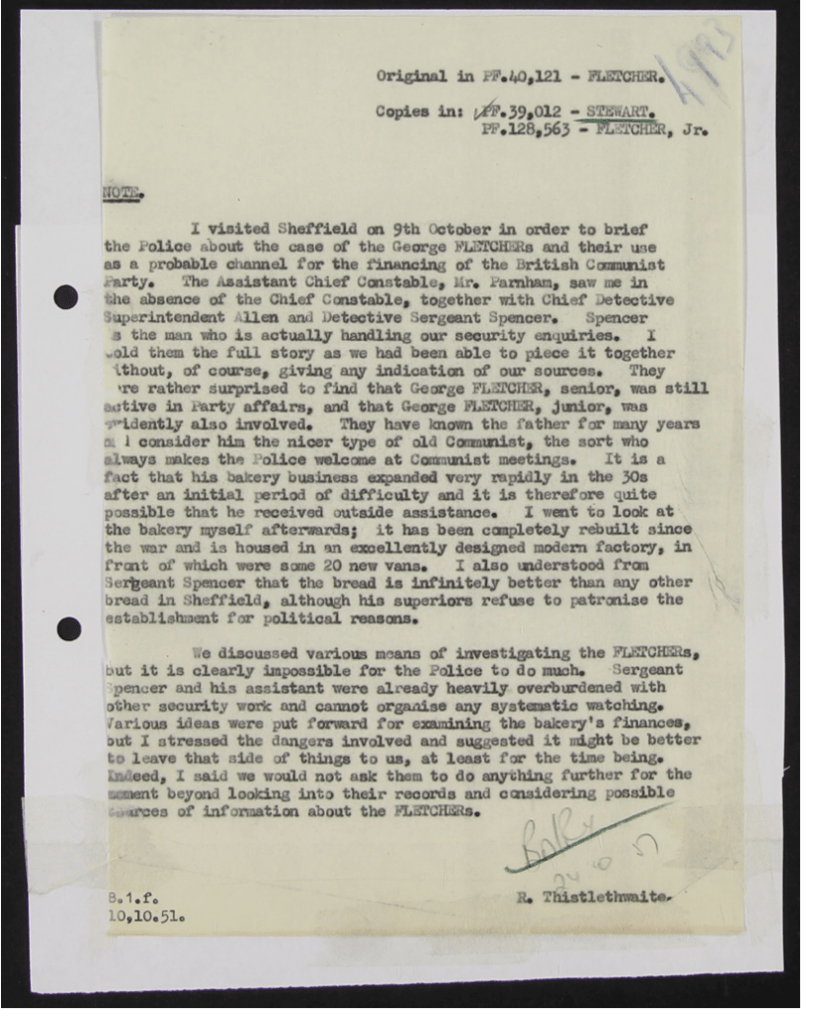
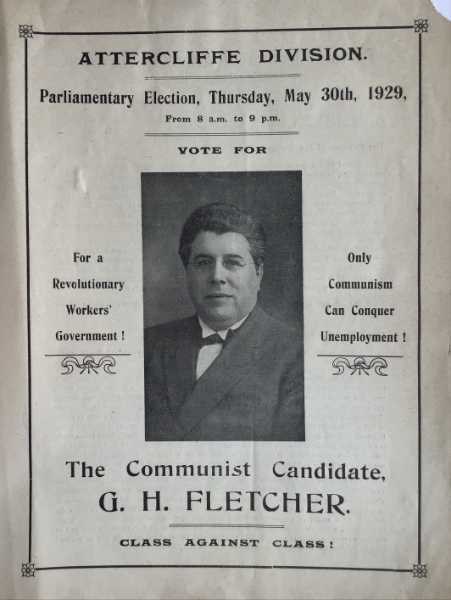
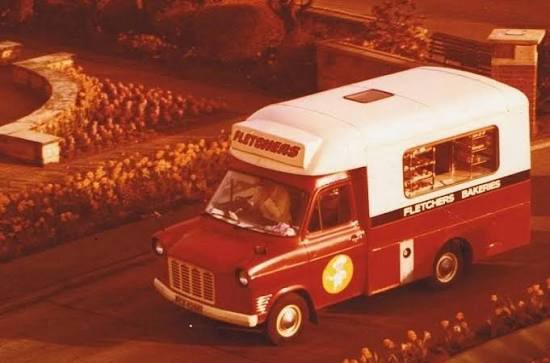
The journey up north to visit George Fletchers Senior and Junior became an annual event. The elder Fletcher was a prosperous man who, as well as the string of shops, owned a large factory and a fleet of vans delivering bread and cakes up and down the hills of Sheffield and its South Yorkshire environs. Queuing up at a burgundy liveried van to buy a sliced loaf and the firm’s speciality of an Elephant’s Foot – a chocolate slavered, cream filled, choux pastry, is still a fond memory for the baby boomer generation in the steel city. The deep red of the delivery vans was commonly thought to represent the baker’s communist beliefs. A staunch trade unionist, he’d also been an anti-war campaigner, endured a spell in prison for sedition after agitating for a miners’ strike and had stood as a candidate in several general elections. His son carried on the family tradition as a founder member of the Young Communist League. By the early 1950s, Fletcher Senior had retired a wealthy man and the authorities believed him to be a major financial supporter of the Party. In October 1951, the MI5 officer Richard Thistlethweight went up to Sheffield to brief the local constabulary on the security threat in their midst. They were already familiar with the Fletchers and regarded the father as, “the nicer type of old Communist, the sort who always make the Police welcome at […..] meetings.” One Detective Sergeant offered his opinion that, “the bread is infinitely better than any bread in Sheffield, although his superiors refuse to patronise the establishment for political reasons.” Bob’s dealings with the radical proletarian pâtissiers were to be closely monitored.
For his part, Bob looked forward to his get togethers with old man Fletcher and his wife. At least once a year he’d take the train up to Retford and stay at their charming home in the hamlet of South Leverton, their residence since handing over day-to-day oversight of the business to their son. Bob thought it had, “the most beautiful garden I’ve ever seen.” The family’s wealth was worn lightly. The bakery’s employees were treated well, they kept no servants and Fletcher was well regarded in the community, regularly helping out those in need. He was even friends with the local vicar. In Bob’s summation the family were “decent people.” But Bob was also overheard at King Street describing George Snr as a “useful man” who “does some things for us at times.”
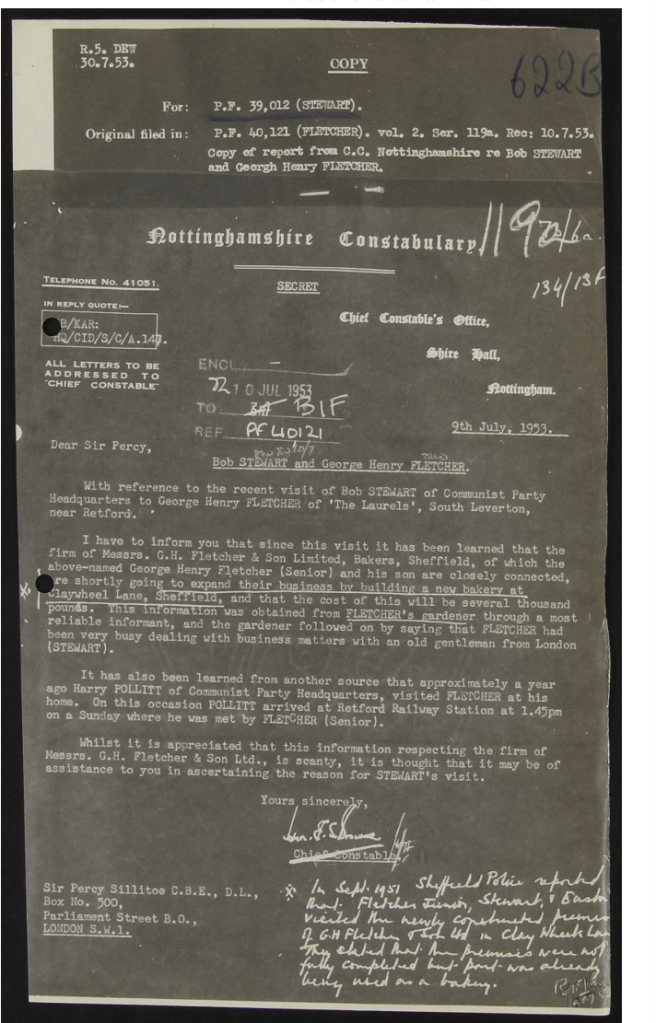
The authorities speculated that the firm had survived during the 1930s, when so many of its competitors had gone to the wall, due to the injection of Soviet cash and that it was still, to all intents and purposes, laundering Moscow gold. Consulting the Chief Constable of Nottinghamshire on proposed surveillance of Fletcher’s house in 1953, MI5 chief Sir Percy Sillitoe outlined how the business acted as “some kind of channel for secret Party funds.” When Bob had visited the Sheffield premises there was, “no doubt that the object was to fetch a large sum of cash to replenish the secret reserves of the Party.” Any appearance by Bob in the area was assumed to be for a similar purpose – either depositing large sums or withdrawing them. The Chief Constable wrote back to inform Sillitoe of the prospect of more underground financial dealings as the Fletchers were planning to “expand their business by building a new bakery at Claywheel Lane, Sheffield, and that the cost of this will be several thousand pounds.” This snippet of industrial intelligence was obtained through a “most reliable informant” who had quizzed the Fletcher’s gardener. The old boy had also volunteered that, “FLETCHER had been very busy dealing with business matters with an old gentleman from London (STEWART).” Any transactions were likely to be in large sums comprised of one pound notes. When Bob was seen taking a ride in the hilly outskirts of the city in George Fletcher Junior’s flashy but elegant two tone Ford Zephyr Zodiac the security services once again focussed all their guesswork on what his ever present battered briefcase contained.
Alan Stewart.
 Breaking the Fetters