Breaking the Fetters Chapter 22: The First Labour Government and the Zinoviev Letter.

The First Labour Government.

On my return from Ireland I found the country in a political ferment. A Labour government, with Liberal support, had been formed arising from the general election of November 1923. This government, headed by Ramsay McDonald as prime minister, had run into trouble and was in no way solving the deep economic crisis. The cost of living was high, wages were low and unemployment still at a very high level. Despite this the big political discussion was taking place on foreign policy. The de jure recognition of the Soviet Union had been effected in the early days of the Labour government, and demands were being made by Labour M.P.s for this to be followed up by normal trading and diplomatic relationships.

This demand soon ran into difficulties. The Tories were vehemently against. They demanded compensation for British property in the Soviet Union which had been nationalised by the Soviet government, and also trading rights for British firms on Soviet territory. The first was realisable, but naturally the Soviet government would not entertain the latter. In Parliament Lloyd George supported the Tories, so with a Tory-Liberal coalition the minority Labour government was in difficulty. Pressure by Labour M.P.s, however, forced the government to open discussions with the Soviet government on compensation for confiscated British property, trading relations and a British loan to the Soviet Union.

The Soviet delegation arrived in Britain in April 1924, and negotiations under Arthur Ponsonby from the Ministry of Foreign Affairs began immediately. By August all the problems had been settled except one: the compensation for British property. Then news came that negotiations had broken down. The Tories were jubilant, saying this showed that it was impossible to negotiate with these Bolsheviks. In this critical situation, when it was obvious that the future of the Labour government was in jeopardy, a number of Labour M.P.s went into action. One of them who played a leading part, and who later told the full story, was Edmund Morel, M.P. for Dundee, a man I knew well. Morel was secretary of the Union of Democratic Control, a champion of the colonial peoples and founder of the Congo Reform Association in 1904. Among his many books and pamphlets outstanding was Red Rubber, an exposure of the rubber slave trade in the Congo. Morel and the others had discussions with the Soviet delegation and then went to Ponsonby with a suggested formula. At first this was accepted, but later rejected by Ponsonby, and it was deadlock again. On the critical day when Parliament was to re-assemble and a parliamentary statement of the negotiations was to be made in the House of Commons, Labour M.P.s again saw the Soviet delegation and only four hours before the parliamentary statement was due agreement was reached by all parties in what were really last-minute negotiations. Edmund Morel later told the story of what the argument was about. The British government wanted the words “valid claims” inserted in the compensation agreement. The Soviet delegation suggested “valid and approved by both governments”. The Soviet government demanded they should have a say in what was “valid”. The eventual compromise which was finally accepted used the words “agreed claims”.

This draft treaty on trade was, however, never put into effect. It was clear that the Tories violently opposed any trade with the Soviet Union and, with the Liberals supporting them, the defeat of the Labour government was only a matter of time. The Communist Party estimated that the general election was at most only a few months away.

The party called for a closing of the working-class ranks and for an end to the divisions in the labour movement and a fight for the return of a majority Labour government based on the unity of the working class, with Communists being accepted with full rights in the Labour Party. We decided that no Communist candidates would run against Labour candidates when the election took place and instructed our branches to submit the names of Communists to the Labour selection conferences to go forward for selection with the Labour nominees. In some constituencies the nominations of Communists were ruled out by right-wing Labour, but in others Communists were nominated and eventually selected to stand as joint Communist-Labour candidates. In this way Saklatvala contested Battersea and won the seat. In all, seven Communists stood as Labour-Communist candidates and in Leeds Tom Mann lost a selection conference by two votes. Gallacher was only narrowly defeated in the Motherwell selection.

In Dundee, however, the position was different. It was a double-barrelled constituency, two seats for the city. There was only one Labour candidate, Edmund Morel. The other M.P. was Edwin Scrymgeour, the prohibitionist, who, while occasionally supporting Labour, was not officially connected with the Labour Party. We took a decision to contest Dundee and I was chosen as the candidate, thus becoming the only “clear” Communist candidate in the election. However, it was not the British-Soviet draft treaty that defeated the Labour government. The defeat came on a much smaller issue. Johnnie Campbell, who was then the editor of the Workers Weekly, the paper of the Communist Party, had written an article which the Crown held to be seditious. This contention was one which might have been difficult to sustain in Court and, on second thoughts, the Attorney General withdrew the charge. The Tories, hell bent for an election at any cost, raised an outraged cry. The Tory press claimed intimidation of the Labour government by the Communists and in parliament the Tories tabled a vote of censure on the government. This vote of censure was defeated, but a Liberal amendment to it seeking an “appointment or a select Committee to investigate ” the withdrawal of the charge against J. R. Campbell was carried against the government by 364 votes to 198. Next day, October 10, Ramsay McDonald announced the dissolution of Parliament.

Our party was first in the field in the Dundee hustings. I commenced my campaign with meetings on the 14th October. With me I had Harry Pollitt who, because he had been in Dundee with Gallacher in the previous elections, knew Dundee as well as his home town of Gorton. He was also a great favourite with the local shipyard workers, many of whom were to him “fellow boilermakers”. Also with me was Helen Crawfurd, a wonderful woman speaker invaluable in an election in a women’s town. And also Johnnie Campbell. Poor Johnnie, he always had to open his meetings with an apology: “I would much rather have discussed the election without dragging in personalities, but I will have to because if I don’t, you will.” After all, he was supposed to be the cause of the election, although he soon disposed of that in his speeches. Still, it was all grist to the mill and filled the meetings to capacity, with Johnnie always in top form.

The Dundee Tories and Liberals had made a pact for the election, running one candidate each, two votes -one Tory, one Liberal. The Liberal was Sir Andrew Duncan, a barrister from Kent, who boasted of Scots ancestry. This brought him his first mistake in the election. At his first meeting he was laying on the charm and said, “I come as a Scotsman among Scotsmen.” Then a voice from the audience put him right: “Hauf o’ wiz are Irish.” This was indeed true. At any Dundee meeting 50 per cent or more of the audience were Irish. Scrymgeour, who had lived all his life in Dundee, knew this and always deliberately campaigned for the Irish Catholic vote.

Early on in the campaign Harry Pollitt also gave Duncan a knock. Sir Andrew let it be known in the press that he wanted a debate with a trade unionist, preferably a shipyard worker, no doubt to show he knew the trade union position very well. The boilermakers got together and accepted the challenge and put forward as their speaker Harry Pollitt. The brave Sir Andrew then changed his pipe music. He would not debate with a Communist, he said, much to the glee of the local shipyard workers who put his gas at a peep for the rest of the campaign.

Sir Andrew Duncan’s running mate was a Tory called Frederick Wallace who had already contested Dundee in the 1923 General Election.

The Labour candidate was Edmund Morel, who as I have said had taken an important part in the British-Soviet negotiations on the trade treaty. When the Labour government was first formed he was tipped to be the first Foreign Minister, but he was much too left for Ramsay McDonald, who took the Foreign Ministry himself as well as being the Prime Minister. Morel was a strong candidate, a good speaker and always on the left, but he always hedged at being officially associated with the Communists. Privately he would say he hoped the Communists would win the second seat, but he would never say it publicly.

Edwin Scrymgeour was the sitting member and, while he stood as a prohibitionist, he campaigned for the second Labour vote. I said at the time he was the candidate from heaven who would steal a vote from all parties, Tory, Liberal, Labour and Communist, and then say he had a mandate for the abolition of the liquor trade. This in fact was a great joke at the time, because Dundee was one of the most “drunken” cities in Britain and many of those who voted for Scrymgeour could be seen every Saturday in life fou’ with the beer and whisky.

This election was one of the most rousing in Dundee’s long history of tousy election campaigns. From the day I opened my campaign on October 14th to my final meeting on the 28th I spoke to full houses only. On many occasions there were overflows. This went for every candidate. From the City Hall holding three thousand to the smaller halls holding a few hundreds, all were packed out. The main issues in the election, in fact almost the only two issues, were British-Soviet relations and employment with good wages. In Dundee these fused together because Dundee is a big textile town and before the war of 1914-18 a large flax manufacture was based on the export of flax from Russia. This had dried up and many flax workers were unemployed, so the question of British-Soviet trade was not an academic one in Dundee. It was on diplomatic relations between Britain and the Soviet Union that the big election fight took place.

I had just returned from my spell on the Communist International and my knowledge of the Soviet Union was standing me in good stead. I knew what I was talking about and could discuss developments in the Soviet Union at first hand. Morel, with his knowledge of British-Soviet trade discussions, was also campaigning well on this issue. This rattled Sir Andrew Duncan and his Tory running mate, and as they tried to answer the questions their meetings became rowdier and rowdier. They were under a constant barrage of interruptions, which was not unnatural because they began to insult people at the meetings. Many of the audience had been in dire straits and unemployed for months, and they retaliated by showing their disgust in good election fashion. The singing of “The Red Flag” at the end of the Tory and Liberal meetings became a commonplace event. The local newspapers, seeking to find a reason for this, accused the Communists of trying to break up the Tory-Liberal meetings. I was mad about this and wrote to the papers pointing out the Communists had a campaign in operation and this was stretching our resources to the limit and occupying 100 per cent of our time. We had no time to think about other candidates’ meetings.

So it was Morel and I for recognition and trade with the Soviet Union, Duncan and Wallace with their “down with the Bolsheviks and trust the boss” attitude, and in between came Scrymgeour talking of God and Heaven, the iniquity of the drink trade, appealing to the reason of the Labour voters, and in particular to the Irish Catholic voters. As the campaign went on he became more and more anti-Soviet, no doubt through pressure of the Catholics and in order to win Catholic support.

Of course the election hustings were full of good give and take questions and answers, with the Tory and Liberal mostly on the receiving end. The following question, noted by the press of the period and kept for posterity, is a good example. At Sir Andrew Duncan’s final rally, after he had concluded his final speech and was no doubt saying to himself, as all candidates do, “Well that’s finished,” the chairman asked for questions. Up jumped one bright fellow to ask: “As the only difference between Churchill and you is that Winnie sent us to war to slash the Germans whilst you stayed at home to slash wages, is there any reason why we should not give you the same dose as the Kiel Canal rat catcher?” Amid a storm of cheers Sir Andrew was heard to whimper, “I stand on my record.”

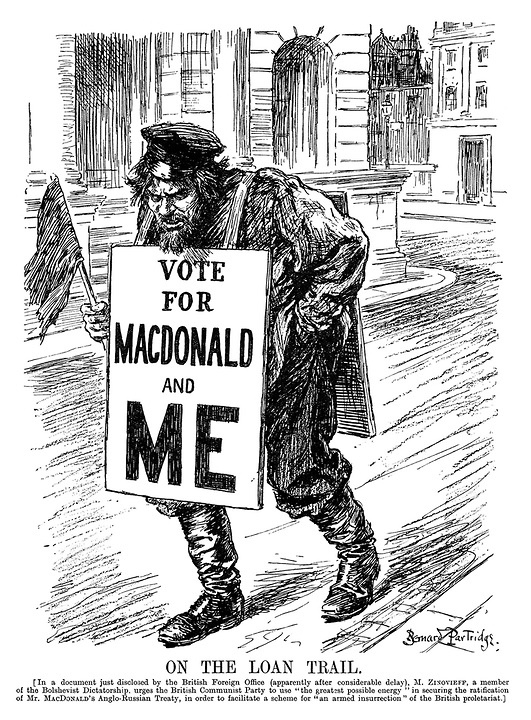
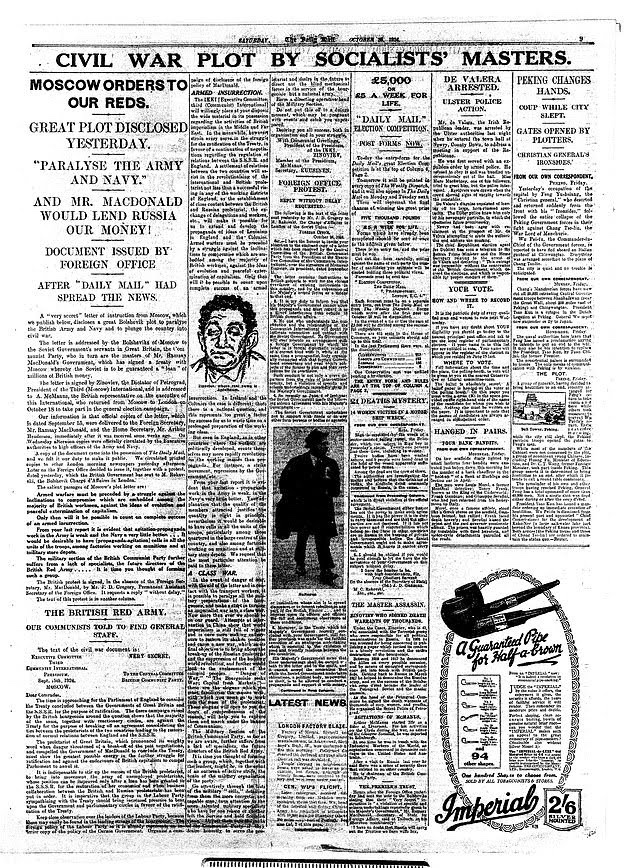
As the election campaign neared its end it became increasingly clear that Labour was gaining ground. It was at this point that the Zinoviev letter incident broke (1). This was one of the crudest political frauds ever inflicted on the British voter. It was a forged letter purporting to have been sent by the Communist International to the British Communist Party. On the Saturday before the election all the press in Britain had banner headlines: “Soviets Intervene in British Elections,” “Red Hands on Britain’s Throat”, and so on. Immediately Rakovsky, the Soviet Chargé d’Affaires in Britain, indignantly and emphatically denied the authenticity of the letter and categorically stated it a forgery. All Sunday the country waited for an explanation from Ramsay MacDonald, who was Foreign Minister, but nothing came. On Monday the local paper in Dundee, The Courier, carried a huge banner headline:

COMMUNIST PLOT-RAMSAY MACDONALD SILENT

While such a denial from the Soviet Ambassador was to be expected the fact remains that the socialist government, the foreign office, and Mr. McDonald personally were satisfied it was a genuine document and not a forgery.

Arthur McManus, who had taken my place on the Communist International and who was an alleged signatory to the letter from Zinoviev, was speaking at Manchester two days before the poll. In the audience were police and C.I.D. men. McManus denounced the document as a forgery and challenged the police to arrest him, but no one moved. The last thing the Foreign Office ever wanted was an investigation into the origins of the document.

On Tuesday, MacDonald made a statement casting doubt on the genuineness of the document, but the damage was done. The British electorate went to the polls without a clear statement from MacDonald, and the greatest hoax ever perpetrated in British political history had paid off. The result of the poll was a resounding Tory victory. On dissolution of Parliament the state of the parties was:

Tories 258

Labour 193

Liberal 158

After the election it was:

Tories 403

Labour 157

Liberal 38

The Liberals who had precipitated the election were smashed and never again returned as a main British parliamentary party. That was the outcome of their anti-Soviet policy and their demand for an investigation in the Johnnie Campbell case.

Edmund Morel held Dundee, with Scrymgeour second. The result was:

Morel (Lab.) 32, 864

Scrymgeour (Prob.) 29, 193

Wallace (Con.) 28, 118

Duncan (Lib.) 25, 566

Stewart (Comm.) 8, 340

After the count we mounted the platform to say our piece, but the Tory and the Liberal would not speak. They were sorely disappointed because they had really believed that the Zinoviev scare had won them the seats. Morel, knowing this, went for them, saying he would demand an immediate investigation from Parliament, which I think he did. Scrymgeour, safe in the second seat, found time to thank God for being good to him and thus saving the second seat from the Communist menace. He did not add but must have thought, “Yes, and with the aid of the Irish Catholic vote.”

With such a resounding victory at the polls the road was now open for a direct attack on the British working class. It certainly came.

Footnote (1): Some facts regarding the notorious letter came to light years after-wards. The letter was dated Moscow, September 15th 1924. It purported to be signed by three people: Zinoviev, President of the Presidium of the I.K.K.I., McManus, Member of the Presidium, Kuusinen, Secretary.

Zinoviev was not president of the presidium of the I.K.K.I. (Communist International) although he was president of the I.K.K.I. itself, and therefore would not sign himself as president of the presidium. Also, he always signed as G. Zinoviev. Secondly, McManus always signed as A. McManus. or Arthur McManus. Thirdly, Kuusinen was not the secretary of I.K.K.I The secretary was a man named Kolarov. To add to this mountain of obvious forgery the letter was headed from “the Third Communist International”. There was no Third Communist International. It was always referred to as “the Third International’ because it followed the First and Second Internationals, which were not Communist. These were such infantile mistakes that even a cursory examination would have shown the document to be a blatant forgery.

In later years it came to light that a Foreign Office official, Mr. J. D. Gregory, who was dismissed from the Foreign Office after an inquiry into some illegal currency deals, was stated to have been involved with some Russian emigrés in the forgery of the letter. This was never ultimately proved, but the whole story of the Zinoviev letter, dealt with in W. P. and Zelda K. Coates’ book A History of Anglo-Soviet Relations, is fascinating reading for all students of political history.

Breaking the Fetters Chapter 20: Moscow and the Comintern.

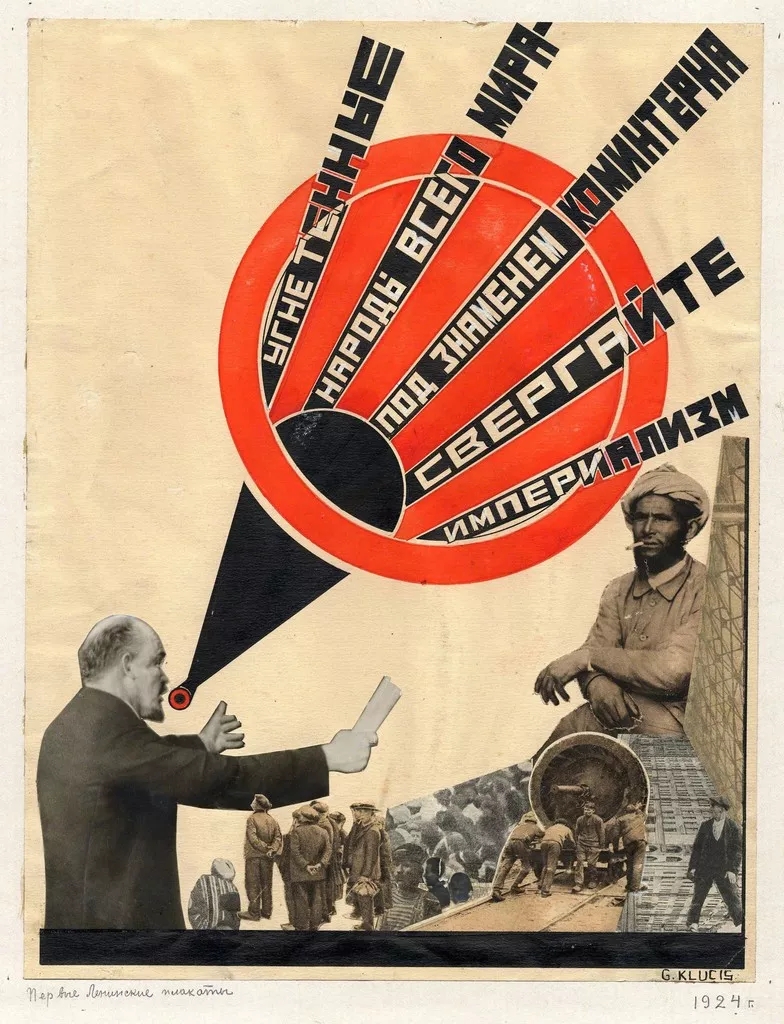
“The oppressed peoples of the whole world, under the banner of the Comintern, overthrow imperialism!” Soviet poster by Gustav Klutsis, 1924. Shamelessly nicked from @sovietvisuals.

I went to Moscow early in 1923 as British representative to the Communist International, or the Comintern as it was called more briefly. I was a bit diffident about accepting this job because I regarded myself as an apprentice in Communist Party work. My wife and daughter came with me and I left my two sons with my sister, so the arrangements were quite good. I liked the job very much. I was living in the heart of the revolutionary political world. I was meeting people who knew much better than I the main world political events and could interpret them much better. I was taking part in discussion with leading working-class politicians from all over the world, all with their special problems, and if at times I could not make a contribution at least I could listen and learn.

In the Comintern I did a fair amount of foreign work. Because I had a British passport, I was better able to cross frontiers and move about freely than many of the other foreign representatives. At this time, the Comintern was very much in its formative period and the communist parties of the various countries had serious conflicts of opinion on many political questions. There were many commissions in the work of the Comintern, trying to smooth the way and deal with the problems.

Troubles had grown in the Swedish Communist Party and the Comintern sent a delegation of which I was a member to help to sort things out. In Sweden I was known as Comrade XR (Executive Representative). Half the Swedish party were really right-wing social democrats, both in theory and action.

The party was led by Seth Hoglund, a social democrat who certainly put no R in revolution but had a very good anti war record. The party was split in two; the left-wing section was the more aggressive and was able to retain control of the party paper. Hoglund was a likeable chap, not in any way vicious but a true social democrat and for quiet, steady reform. The leadership afterwards passed to Samuelson and some others, but they too quarrelled and some left the party.

At this time Scandinavia was very important. Politically, despite some setbacks, the left forces were making good progress. There was also another practical reason. The Norwegian party had a good standing among the seamen, which enabled comrades to get across the seas illegally. Bill Gallacher, Sylvia Pankhurst and a number of others crossed the North Sea in this way. Irish sailors did the same before Eire became a state, ready to smuggle people across on the Irish boats. De Valera was got out of Lincoln Gaol and smuggled across in this way.

Many people with whom I worked and whom I met during my time at the Comintern are now dead. A few are still alive. Some made their political mark, some dropped out of political life in the development of the struggle, because being a Communist in politics is never easy, no matter in which country you are domiciled.

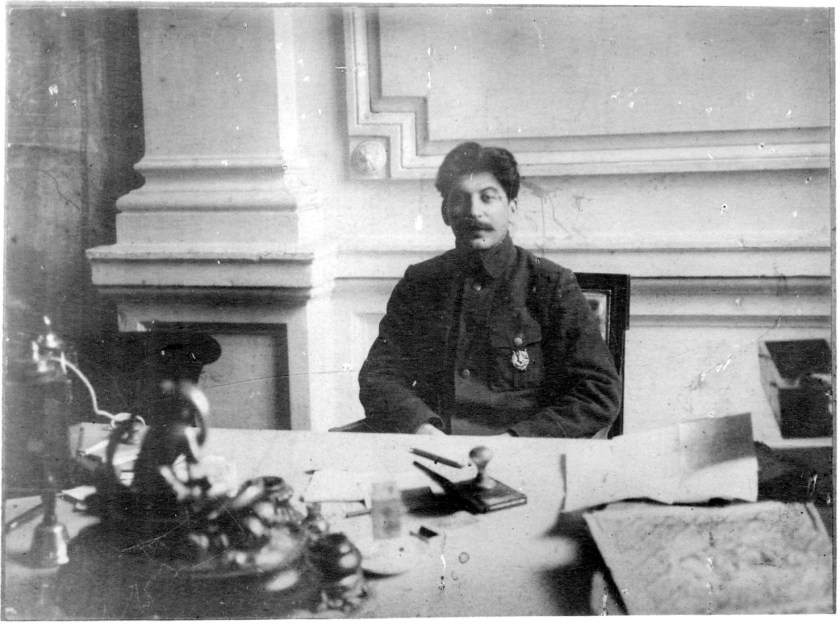
Stalin in the early 1920s- “quiet, painstaking and efficient.”

Naturally the reader will ask what I thought of Stalin. I always speak of people as I find them. I worked with Stalin on a commission on Germany after the defeat of the German party in 1923. I found him a quiet, painstaking and efficient chairman. He chaired the commission which was composed of members from all parties resident in Moscow and from the Russian party, which was represented by Kuibishev, who later became Minister for Planning in the Soviet Union. The discussion in the commission went on for weeks, and one interesting point was that after every session the delegates and their interpreters met singly with Stalin to make sure that if they had not spoken during the discussion, he would be aware of their views. In this way I had several talks with Stalin. I remember that one particular discussion he and I had dealt with the way in which the German party central committee worked. In my opinion there was too much bureaucracy and I said that certain changes in work should be considered. The Comintern could not enforce changes, since the national parties were independent; but the Comintern could, and did, make suggestions. At the end of our tête-a-tête Stalin made a number of pointed remarks and agreed with me on the need for change, but there was a great battle of personalities in the German party at that time. The need for unity was so important that one had to cut the suit according to the cloth and not seek changes that might possibly widen the division.

This commission usually started work about midnight. As a rule I was getting ready for bed when the telephone would ring, and then it was down to the Kremlin for an all-night sitting. They did not rush it, these people. Many of the Kremlin lads were long-distance men. I remember one night Terricini- the delegate from Italy I think his first name was Angelico, but he was certainly no angel -was delivering his point of view in French and doing it very well. He had been at it for over an hour and a half when Stalin intervened to say,

“Tovaritch Terricini, French is a beautiful language to listen to but it is now three o’clock in the morning.” Terricini nodded to show he had heard and then continued with his speech, as if no intervention had been made.

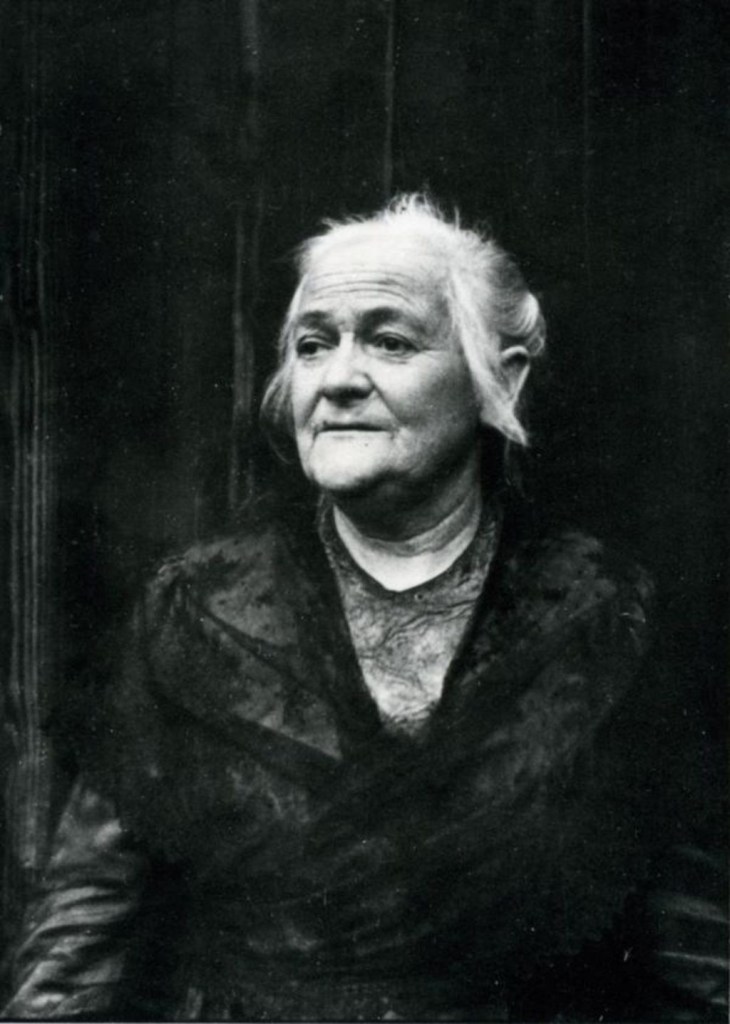
Clara Zetkin

During this German commission discussion, some leading members of the German party went after Clara Zetkin; they baited her unmercifully and this really sickened me. It was an exhibition of political cannibalism that should never be tolerated in working-class politics. Clara Zetkin may have had some weaknesses and faults we all have but she had many decades of selfless working-class struggle behind her and a great reputation both in the international communist movement and in Germany. I protested vigorously against the manner in which some of the German comrades were acting and, with several other delegates supporting me, Stalin said, “We hold a high opinion of Clara Zetkin, our Russian women have learned much from her work, and we will not permit this type of vilification.”

Radek was another member of the Comintern with whom I worked in close association When the first Labour Government was formed in January 1924, Radek, Theodore Roth-stein, Clara Zetkin, some others and myself, worked on a manifesto to be published in Britain in the name of the Communist International. Radek was the most remarkable reader I have ever come across. He had an insatiable appetite for newspapers and had a wide and fundamental knowledge of world politics. Lenin’s criticism of Radek was that he read too many bourgeois newspapers and I think he inferred that Radek was influenced by them. But Radek was most helpful to me. He was also a humorist with a ready answer to any question. He wore long side-whiskers, like the Ancient Mariner, but one day when I met him they were shaved off. “Oh, what’s happened to the growth?” I asked. “Got to go to Germany so I must have a disguise,” he replied. Another time when I was having a difference of opinion with Walton Newbold, who was once Communist M.P. for Motherwell, and was lamenting about it, he said, “Never mind Newbold, Bob, he not only sits on his arse, he sits on his brains as well.”

Kamenev, Zinoviev and other leaders of the Soviet party, Dimitrov from Bulgaria, Pieck from Germany and many others from other countries, I met both at work and socially, but as a rule the discussion was mainly political. I never found it easy or even practicable to discuss everyday “common-place” happenings through an interpreter. Language to me was always a great barrier and I am sure it is for everyone.

Radek was the one who spoke all languages. I heard him speak and communicate with ease with people of many nationalities. I never knew how many languages he spoke. He was a Pole by birth. He once said to me, “Bob, there are good Jews and bad Jews, and the worst of the bad Jews are Polish Jews and I am one of them.” I don’t think the part about Polish Jews is right, nor in my contact with Radek was it true of him. In Moscow, in all his work with me, he was a most able and helpful member of the Comintern.

Naturally, apart from the leading comrades I got to know in the course of my work, I also met the ordinary Russian people. A group of Russians I got to know fairly well consisted of teachers. This happened somewhat accidentally. One day my wife and I were having a walk in the suburbs, and as we passed a school the children were coming out. Some of the children, observing by our dress that we were foreigners, asked us questions. When they found out that we were British, a number of them had to try out their English on us. Because of this incident we became very well acquainted with the school and the teachers. I took any English delegations that came to Moscow to the school, and through this the pupils became the proud possessors of footballs, boots, sweaters and other sports equipment. I found the children most friendly and com-paniable, with no sullen shyness, and the teachers were born to their jobs aunties and uncles they were called. The school owned a huge boar, a real Goliath. One day I said to one of the children,

“Big boar.” “Da, bolshoi -bolshoi Curzon!”

(Lord Curzon was the most notorious anti-Russian British statesman of the period, the originator of the attempt to enforce the Curzon line).

Another school I used to visit was a school for musically gifted girls. The teacher was the first flautist of the Bolshoi Orchestra. The children gathered round in the most natural way and sang and played spontaneously, everything from folk drama to grand opera. Watching these girls, I began to realise the inborn musical understanding and appreciation of the Russian people, which has endured for centuries.

I remember the first time in my life I heard community singing. It was at the Agricultural Exhibition in Moscow in 1924 I was wandering around with Jim Larkin, the leader of the Irish Transport and General Workers’ Union, and we saw some people congregating near some seats. We strolled over to see what was happening. Out comes a fellow with a corduroy jacket and a pair of high boots curled up like a concertina. He stepped on to a small platform and started to sing, and away went the audience in wonderful community sing-ing. I couldn’t follow the words but there was no mistaking the real genuine feeling and natural musical ability of the crowd.

For the citizens of Moscow, however, it was not all singing and playing. Moscow was a political city, everyone talked politics. Even in the armed forces, the aim was to have politically understanding soldiers, sailors and airmen. Our party was a patron of some Russian regiments, and so got to know the officers and men. It was this political consciousness on the part of the Soviet soldiers, brought about by intense political discussions of day-to-day events, that created the understanding of the necessity to fight for the independence of the Soviet Union and the determination to crush the Nazi invaders in World War Two.

On the political side, I naturally attended conferences and meetings of the Russian Communist Party, and met with Russians from Stalin downwards. What struck me from the beginning was the business sense of the Russian political workers, very few of whom were business men. In these early days of Soviet rule, blacksmiths, mechanics, textile and other workers were pitchforked into top political jobs and had to adapt themselves to new work, sometimes dealing with old managements in production and, more important, themselves forming new managements in the big new factories. I remember Milnechesneski, who was an ordinary worker, telling me one day he was the biggest textile owner in the world -he had just been put in charge of the cotton textile industry.

In the countryside, many of the peasants were illiterate but, of course, while illiteracy is a great disadvantage, it does not mean lack of intelligence. The Russian peasant, who was intelligent enough to revolt against -and end serfdom, was also intelligent enough to combine with the Russian working class to end capitalism and also to end illiteracy among the peasant masses in the Soviet Union.

It was during my time in Moscow that a great tragedy befell the international working-class movement.

Lenin died in January 1924. I remember this well because I was then a member of the Executive Committee of the Comintern which was summoned immediately: firstly, to hear the announcement of Lenin’s death and also to make all the necessary arrangements for the funeral.

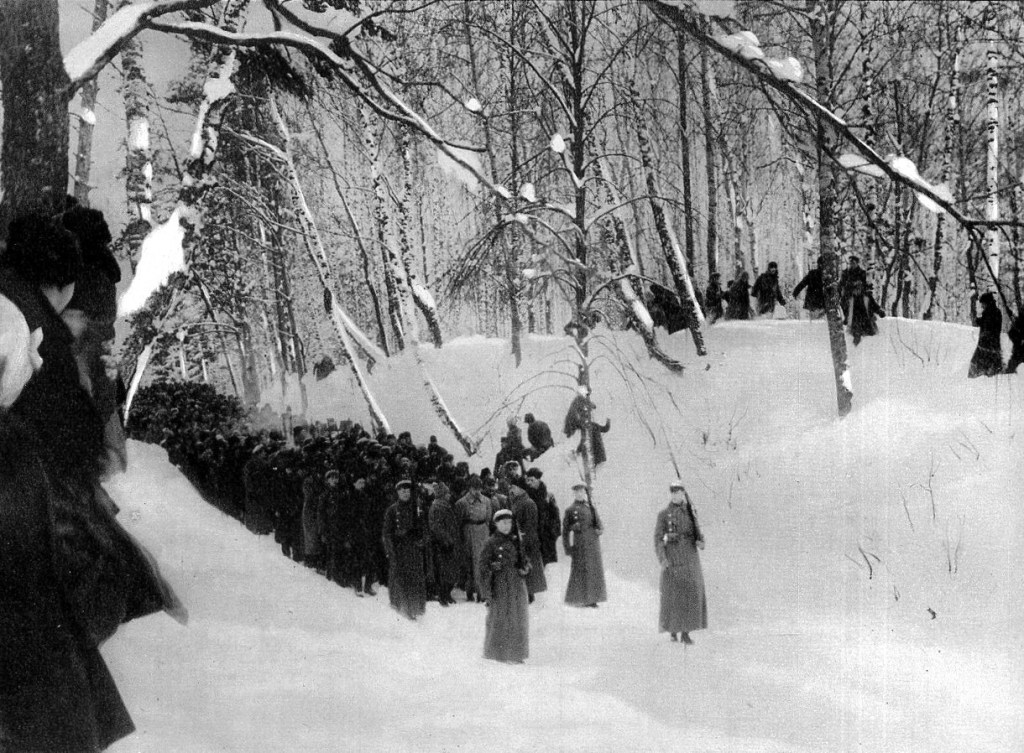
Harry Pollitt came over immediately from Britain to represent the British Communist Party at the funeral. It was desperately cold and both Harry and I felt it very much. It was forty degrees below zero. Fires were kindled in the streets and I remember seeing the militiamen’s horses going over and sticking their noses in the fire to melt the icicles. We were as cold as the horses but at least we could pull down our fur caps and peer out occasionally to see where we were going.

I was one of the delegation of the Comintern chosen to go to Gorky, where Lenin had died, to accompany his body back to Moscow. We left by train from Moscow at about 5am and then travelled by peasant sleigh from Gorky Station to Lenin’s house. From the station you could see the house down in the valley, but the road to it so twisted and turned that even by sleigh it took us a long time to reach it. At the house Lenin was laid on a bed wearing an ordinary Red Army man’s uniform with the Order of Lenin pinned to his breast. The house was full of people: leading members of the Russian Communist Party, of the Comintern, delegates from the factories and the professions, and amongst them all wandered a big black cat who had been a very great favourite with Lenin.

Lenin’s body being taken to Gorky station en route to Moscow.

The body was placed in the coffin and carried to the station en route for Moscow. Leading men from the party and the factories took turns to carry the coffin. On the journey, at every station, on the way, thousands of people waited to see the train pass. I do not think I ever saw so many tear-stained faces in my life. It was a very moving demonstration of the love the ordinary people for this great man.

When we got to Moscow I realised for the first time in my life what a mass demonstration really meant. Not a demonstration that was called, but one that came. Every conceivable foot of space was occupied. A great mass of people followed the coffin as it was borne from the station to the Dom Soyus (Hall of the Trade Unions), and from every side street and opening, mass upon mass of people converged with the main stream or waited their turn to do so. At the same time the digging was proceeding on the site of the mausoleum, so there was blasting and picking going on. All these streets were crowded with sad-eyed mourners. Every shop and hotel and all central places were ordered to keep open twenty-four hours a day so that people overcome by the cold could go in and thaw out.

Moscow has witnessed many varied scenes in her many centuries of troubled history; her ancient records must be filled with historic incidents, but never had such scenes been witnessed as during the days of Lenin’s lying in state and funeral. The Dom Soyus, a former palace of nobility, once the setting for the glitter and pomp of the aristocratic Tsarist circles, was the place where Lenin lay. Here his own people, the working masses of Russia, could pay their last tribute to the mighty leader of the Russian working class and the world proletariat. “Our Comrade Lenin” everyone said, as if he were a father or a brother.

For four days and nights, for mile after mile, people queued four abreast to pass the bier on which Lenin lay. Along with Harry Pollitt I took a turn on the guard of honour. I remember I was with Chicherin. The bier was surrounded by wreaths of flowers of every description, sent from all over Russia and indeed from all over the world. The magnificent hall with its white marble walls was a blaze of light, contrasting with the deep varied hues of the flowers, and on the balcony the band of the Red Guards played music befitting such a solemn occasion.

Delegations from all over Russia streamed into Moscow, joined the endless queues, and placed their wreaths as they passed the bier. But there were no kings or queens, no aristocrats and their ladies, no great admirals or field marshals with glittering medals. Only the endless stream of workers and peasants, soldiers and sailors with their wives and families. The queues never seemed to get less. Over a million had passed the bier and still the queues remained. It had been decided that on Saturday the doors must close at 12 noon. But on Saturday afternoon there were still hundreds of thousands of people waiting with banners and wreaths, still train after train arrived, pouring the delegations into Moscow from north, south, east and west. Every minute messages from all over the world came, telling the world-wide grief at the passing of this great working-class leader. Certainly, no king, no emperor, no bloody tsar has been honoured as Lenin, the leader of the world working class.

At 7am on Sunday came the final parting. Around the coffin stood the leaders of the Russian Communist Party and the Communist International, and with them, keeping her last vigil, was Krupskaya, Lenin’s wife and constant companion during thirty years of struggle. Lenin’s body was borne to the Red Square. As the coffin was raised the orchestra wailed the funeral march. After this a moment’s silence, then the International burst out, strongly and boldly sung. I thought then, this is the answer to the enemies of Leninism whose death was rekindling the hopes of new triumphs for imperialism. this is the answer of Lenin’s pupils, the Russian workers and peasants.

As the coffin was carried into the streets, crowds formed behind it. Leaders of the Party and trade unions took turns to shoulder the coffin along the Kremlin walls to the centre of the Red Square where the raised tribune was placed. The people filed past in millions until 4pm. Then silence just before the cannons crashed out the salute with a roar which could be heard in every corner of the world; factory sirens in every Russian city and village took up the salute; men, women and children stood still in silent homage. In every country throughout the world the workers paid their last respects to a great leader, who from small groups of Marxists had led the Russian workers forward to the formation of a mighty Communist Party and a mighty workers’ Republic and had laid the foundation by his leadership for a mighty Communist International.

The coffin was carried into the Mausoleum, Lenin’s final resting place. Queues formed again to pass the bier. It went on all night, all the next day and every day since. the years have passed and still the Russian workers and peasants and the visitors to Moscow from foreign lands pass the bier to pay homage to Lenin, the great working-class leader whose genius guided the people of downtrodden Russia and millions far beyond it, to break their chains and march to the not-so-distant communist society

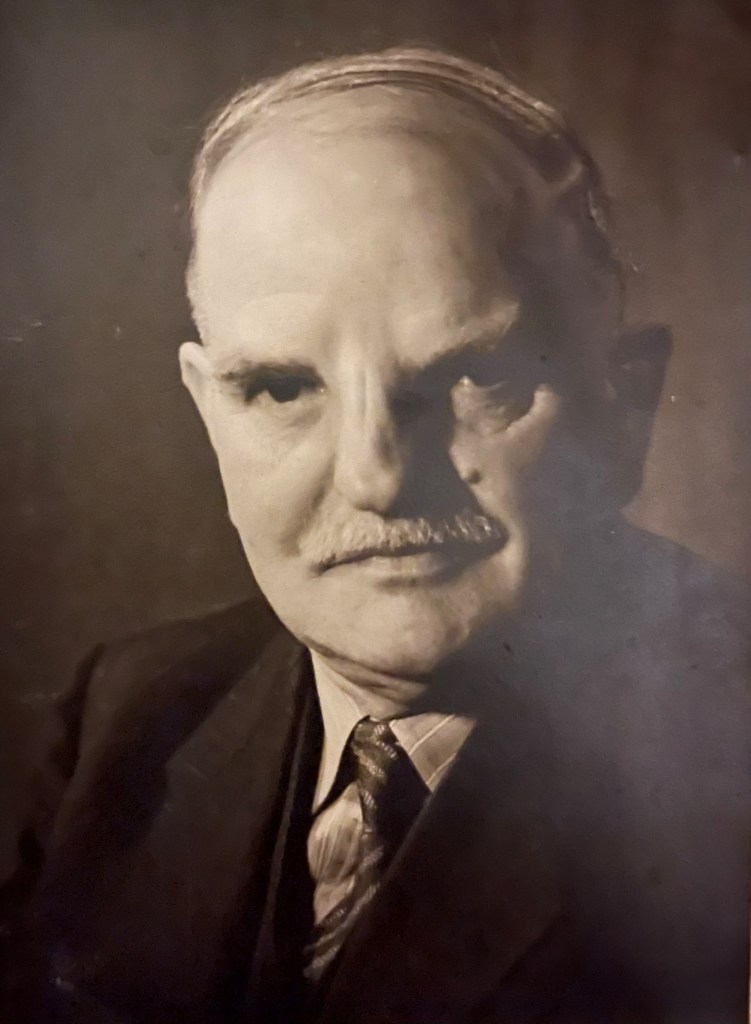
Happy 146th Birthday to Bob Stewart.

Our great grandfather Bob Stewart – founder member of the CPGB, Comintern agent and, in the words of Wikipedia, ‘spymaster’ was born on this day in 1877. To mark the occasion last year we posted photographs from an album celebrating his 70th birthday with portraits taken by Edith Tudor-Hart. We have similar albums from his 75th and 80th birthdays which we’d like to reproduce in the same way but I need to pull in some favours from my photographer mate first. In the meantime, here’s a few birthday related items from the archives.

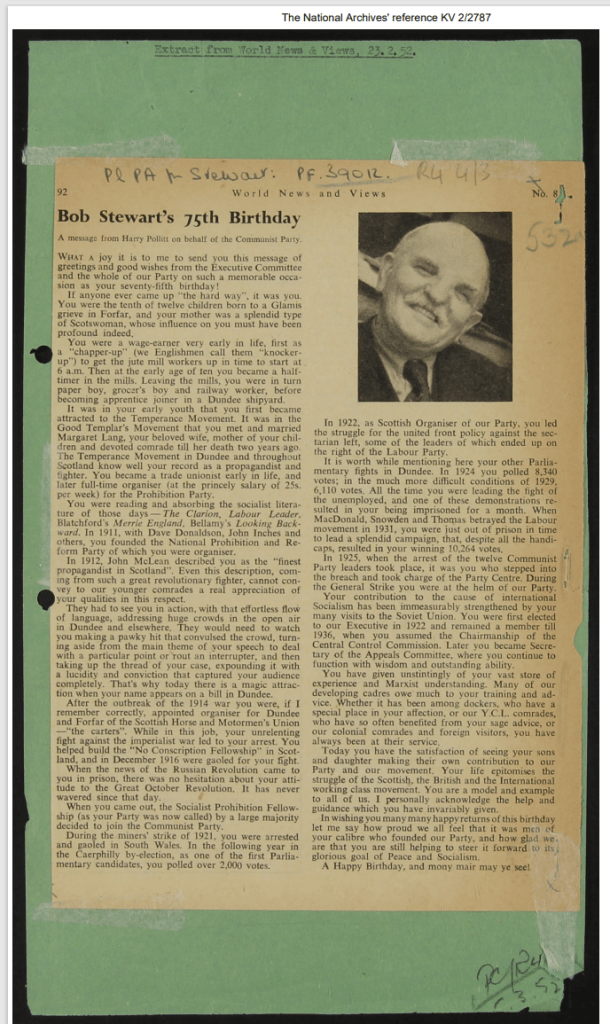
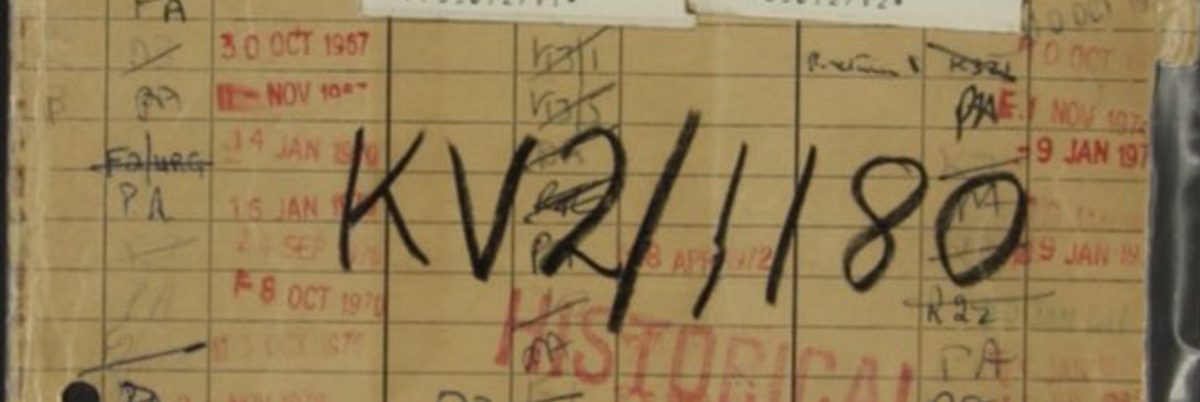
First of all, here’s a cutting from World News and Views from 1952. Harry Pollitt gives a brief overview of Bob’s life up to that point. This is taken from one of the many MI5 security files compiled on Bob now held at the National Archives.

Also from the National Archives is this brief note on Bob Stewart’s 80th birthday intercepted by MI5 in 1957.

Finally, here’s two accounts of Bob’s birthday celebrations. One from his 80th and one from his 90th in 1967. The latter was also the launch of his memoirs ‘Breaking the Fetters’.  They’re from the journals of Charles  Desmond Greaves, Marxist historian, revolutionary socialist and campaigner for Irish unity. Much, much more is available at www.desmondgreavesarchive.comhuge thanks to Pádraig Durnin for bringing them to our attention.

February 16 Saturday 1957: Bob Stewart’s 80th birthday party took place at King Street [CPGB headquarters] this evening. I met many people I had not seen for years – Robson, for example, and Aileen Palmer who was friendly with Jimmy Shields.  Idris Cox’s wife was there, whom I had not seen since just after I returned from Ireland to take over the Democrat, and found her son a job for the summer in Powell Duffryn. I cycled from Cardiff to London that day – it would be in 1951 I would say.  R. Palme Dutt was there but did not stay long.  He is a bad “mixer”. Wal Hannington [Unemployed Workers Movement leader in the 1930s] sang a song, and at a crucial point in the proceedings after Harry Pollitt had pronounced encomia, Bob was set beside the table to cut his cake.  He did it as the camera clicked. Then Harry insisted on his cutting it again, with Harry standing by his side.  But twice did he cut, and twice did the flash-bulb fail to light, so the attempt was abandoned!  I thought it served him right.  But it must be said it didn’t cast him down. He was in the best of spirits all night!

February 17 Friday 1967: I was in the office all day or most of it.  I signed the lease, then tried to phone Toni Curran for the purpose of securing her signature.   After a provoking series of wrong numbers I found her line was out of order, and had to wire.  Likewise Coutts was in Weybridge, so I could not inform the landlords.

At 7 pm. I went to Bob Stewart’s 90th birthday party in the Holborn Assembly rooms across the road in the Mews.  There was a large gathering, not exactly the same as those at R.Palme Dutt’s. The “oration” was delivered by JR Campbell who took occasion for a smack at Larkin which Pat Devine thought in poor taste.  “I wouldn’t have said that if I’d known you were here,” says Campbell to me afterwards.  But I have long accepted him as a “Rangers’ man” and see quite well that he will respect the Irish movement for its strength and nothing else.  His remark implied that whereas when he was in Dublin Bob Stewart “talked sense”, Larkin’s oratory was eloquent but nonsensical.  Of course Larkin did have his idiosyncrasies.  I remember Gallacher [ie. Willie Gallacher] writing to me once that he infuriated Connolly as he gave the right conclusions for all the wrong reasons.

Bob Stewart himself seemed to have aged since Dutt’s affair, but gave a lively speech.  His head is as clear as ever.  Idris Cox was there.  I think he has abandoned his old talk that Wales is “not a nation”, which was what he told Margot Parrish, who had not the stamina to keep going until reason asserted itself.  Some people age badly, others hardly at all.   Despite her illnesses Maggie Hunter looks as fresh as a daisy, and her husband into the bargain.  They were asking after Cathal.  Maurice Cornforth however seems partially lame and hobbled out like an old man. Jack Cohen is sprightly but grey.  James Klugman on the other hand looks much better.  He chased round the world looking for remedies for asthma, but was cured by his own hospital!  I was depressed to learn that Pat Devine’s recent illness was cancer of the lung.  He has now given up smoking.  But the pain is still there.  And he walks very very slowly indeed.  I had a drink with him and Gloria afterwards.  Palme Dutt was there but did not stay long, and of all people Aileen Palmer once again.  I thought she had retired from everything.  It brought back the memory of the days twenty years ago when Bob Stewart and Jimmy Shields shared an office and she used to be the technical worker for them.   Mrs Bowman was there too.  I had not met her since I used to stay in her house in Dundee, and Dave who still works for the NUR [National Union of Railwaymen]. He, by the way, told me that “Seven Seas” want to cooperate with the republication of Jackson’s book.  So I must get the time off.

One thing Pat Devine said was curious.  He had been somewhere in Eastern Europe and met Derek Peters of Belfast, a very “orange” socialist who after returning home from Manchester became interested in Gaelic and appeared when Sean Redmond spoke at Murlough [at the Roger Casement commemoration. Peters was the first secretary of the NICRA].  He said he had taken a marked dislike to him, and could not understand this son of a policeman who seemed to have visited every socialist country in the world and was so full of himself.  Why should I be interested?  Well, somebody suggested we ask him to be Democrat correspondent in Belfast.

Afterwards I read Bob Stewart’s book, of which Cornforth told me he had sold forty copies tonight, and I recognised the use he had made of material I provided for him twenty years ago!

Breaking the Fetters Chapter 19: A Storm – Workers in Action.

During one of my periodic visits to Dundee in early 1923 I ran into a serious confrontation between the jute employers and the jute workers. To make things more serious this took place while nearly 25 per cent of the workers in the city were unemployed. A running battle was taking place over unemployment pay and parish council assistance to those who had exhausted their unemployment benefit.

In February 1923 there were 10,500 workers claiming benefit on the Dundee unemployment register. This was by no means the total unemployment figure; many women workers were not entitled to benefit when they were unemployed. Under the unemployment acts then in force, by April 4th 7,000 would be completely cut off from unemployment benefit and would then have to apply for parish relief. This bleak prospect was causing a serious crisis in every home in the city. The scales for weekly parish relief were 7s. 6d. for a husband, 7s. 6d. for a wife and 1s. for every child under fourteen years of age. This meant a family consisting of man, wife and four children under fourteen years of age (by no means an uncommon family then) had to live on 19s. a week.

Into this already seething cauldron of discontent another problem boiled up. In Cox’s jute mill, one of the largest in the city, employing thousands of workers, the management introduced new spinning frames and demanded a reduction of women spinners. Where formerly three worked, two now would be employed, thus saving the wage of every third spinner. No offer of extra payment to the spinners left was even contemplated. The impudence of such a demand was highlighted by the fact that only the week before, the Associated Companies of Jute Industries, whose chairman was Mr. J. Ernest Cox, had published their profits for the year showing a record £606,224 and declaring a dividend of 9 per cent, all of which Mr. Cox said was very satisfactory. No wonder Cox’s workers were hopping mad. The spinners refused to work the machines and held up the work for the rest of the mill, so the management then locked out all the workers. The mills in the Federation followed suit and in a few days 30,000 jute workers were on the streets swelling the number of unemployed to more than half the population of the city. The locked-out workers got no unemployment pay and were being denied relief from the parish council. There was no doubt in my mind that behind-the-scenes attempts were being made to smash the jute trade union and to try and bring the workers to heel.

The party had discussions with the workers involved and decided to approach the trades council. At first there was a joint effort to organise collections and pay out a few bob to the unemployed, but it soon became clear that this was not even scratching the surface of the problem. Arrangements were then made for a joint demonstration to demand that the parish council raise the relief rates and pay relief to all unemployed.

The demonstration was the largest, noisiest and possibly the most successful in Dundee’s history. The crowd assembled in the Albert Square. The newspapers at the time estimated that 50,000 filled the Square and the adjoining streets. The chairman, one of the locked-out workers, called on me to put the proposals on what should be done. I suggested that the demonstration should elect a delegation to go to the parish council, which was holding a meeting that evening, to table our demands. Secondly, that the crowd should form fours and march to the parish council offices at West Bell Street, making themselves and their demands heard on the way, and continue back to the Square where the delegation would return to give their report. A deputation of ten was selected including Billie Tom Stewart, Councillor John Ogilvie, the A.E. U. organiser Alf Maloney, myself and others. The ten heading the procession, we set off. When we reached West Bell Street there were hundreds of sweating policemen struggling with thousands of people, trying to keep them on the sidewalks so that the demonstration could pass on the road. All traffic was completely halted. In Dundee most of the jute employees were women and many of the husbands stayed at home to keep house and make the meals, so there was the contradictory spectacle of the majority of the marchers being women and those on the sidewalks men. The call went up from the women marchers: “Get the kettle-boilers in the march!” so there was a rush from the sidewalks into the road. The demonstration then became a seething mass of slow-moving humanity.

As the head of the march came to the parish council offices, the deputation dropped off and were admitted to the parish council meeting. At least we got there. A number of the parish councillors were unable to get in the front door and had to be hoisted in by the rear windows. The chairman, Davie Duncan, a pal of mine from the old Temperance movement days, opened the meeting, but no one heard a word he said; you could see his lips move but there was no sound. His voice was entirely drowned by the deafening noise from the thousands passing outside shouting slogans for unemployment benefit, increased relief rates, snatches of “The Red Flag”; the sound bounced off the walls of the building and filled every room. At last Bobby Allan, the clerk of the council, made signs that the delegation should be heard. Now Bobby Allan was a terror in Dundee. In the old days when the mothers wanted to frighten their children and get them to go to sleep they recited the old ditty:

“Hush ye, hush ye, dinna fret ye,

The Black Douglas’ll ne’er get ye.”

In many homes Bobby Allan had replaced the Black Douglas. He was a real swine who saw working-class people as beasts of burden and treated them as such.

Allan began by objecting to one of the delegation called McGuire and demanded that he be asked to leave. I promptly told him and the council that McGuire was an elected member of the delegation and if he left, all left. That finished that lot! So we had our say. I let Baillie Stewart and Councillor John Ogilvie, “Mr. Facing-both-ways” as we called him, have the first go. They started with tear-jerking humanitarianism, poor people without a crust of bread, children who were the future citizens starving, and so on. With the flint-hearted parish councillors that didn’t get us very far. When it came to my turn to speak, Davie Duncan said, “Please be brief, Bob.” “Why me?” I asked. I told them the workers were entitled to a good life and it was no fault of theirs that they were unemployed. I accused the jute bosses of locking out the workers and said they were deliberately trying to bust the trade union. “The workers won’t have it,” I said, “and what’s more if you don’t give them money to buy food and clothes, they will likely take them without asking your permission.” I cautioned them and said if there was any trouble then it was the fault of the parish council and not the starving workers.

Bobby Allan said there was the question of legality involved. Discussion would have to be held with government authorities on raising the scales of payment and certainly discussions with the unemployment exchange before any payments to the locked-out workers could be made. When Bobby cracked the whip the councillors usually obeyed, but on this occasion a few demurred. However, he had the majority with him. So we went back to the Albert Square to report. What a thunderous howl of rage greeted my simple announcement that the parish council were not prepared to move meantime! An unbiased outsider would have thought the day of revolution had arrived. From all sides came the demand to smash the council offices, to smash into the shops and take the goods “that belonged to the workers”. For a time it looked as if control of the meeting had been lost. The chairman then called on me to make any proposals of what could be done. I suggested that the demonstration refuse to accept the parish council decision as final, that the deputation should return to the council meeting, and that the demonstration form a procession again and march as before, only this time making their demands a bit louder. I knew that the “spies would be out” and that before we reached the council offices they would know what had transpired on the Square.

This time there was no one on the sidewalks; there was just a huge surging mass of humanity. On the way the window of G. L. Wilson the clothier went in, and this was followed by a few more, including the Buttercup Dairy, and a few goods were extracted; but the wonderful thing was that with the police impotent because of the vast surging mass, thousands of these people desperately in need of food and clothes remained disciplined and orderly.

When the deputation was received the second time I charged Bobby Allan with provoking the workers and creating a situation in which thousands of people could be seriously injured. I said if I went back and told these people nothing was to be done to relieve their distress, then it was the parish council who would be responsible for what would happen. Some of the councillors, no doubt already well briefed on what was happening, supported me, and Bobby Allan knew he would have to make concessions, so we started to talk. First it was conceded that the scales of payment should be raised, and then that the locked-out workers would be given relief while discussions proceeded with the unemployment exchange authorities. So it was back to the Square with a success report and victory for working-class solidarity and united action. This decision to a certain extent ended the starvation tactics of the jute employers and gave the workers confidence to fight on. Dundee people say Bobby Allan never forgot that evening and for years after he continued to extract revenge from the individual cases he dealt with in the parish council.

The case of the locked-out jute workers dragged on. The jute employers were hard men and did not give up easily. I am sure one of their aims was to smash the jute union, at least to cripple it. The case was discussed in parliament where Edmund Morel, M.P. for Dundee, demanded that something be done to end the lock-out. The Lord Provost tried to mediate but without success. Finally the Minister of Labour, Sir Montagu Barlow, intervened and set up a court of inquiry under the chairmanship of Sir David Shackleton. Naturally the report of the inquiry came down on the employers’ side but, if I remember correctly, it also said that increased rates should be given to the spinners, thus sweetening the blow. The lock-out lasted eight weeks, two months in which Dundee was a storm centre in every sense of the word. It was a remarkable coincidence, but true, that as the lock-out was ending the British Trades Union Congress was opening its first session in Dundee.

Breaking the Fetters Chapter 18: Winston Churchill Takes a Beating.

A little over a year had passed since the Communist Party’s first parliamentary contest at Caerphilly when it had to face its first general election. Parliament was dissolved in October 1922 and the election was on. We were fighting for united political action with the Labour Party, and at the general election we came out strongly for electoral unity. In five constituencies our members contested with Labour support: Saklatvala for Battersea North, Geddes for Greenock, Windsor for Bethnal Green N.E., Vaughan for Bethnal Green S.W. and Walton Newbold at Motherwell. At Dundee Bill Gallacher contested because it was a two-seat constituency and there was only one Labour candidate.

Because of my knowledge of Dundee and its politics I was sent along with Harry Pollitt to assist Gallacher. In 1908 I had been election agent to Scrymgeour, when Churchill had been elected with great enthusiasm. Now I was back in 1922 to see him rejected with equal enthusiasm.

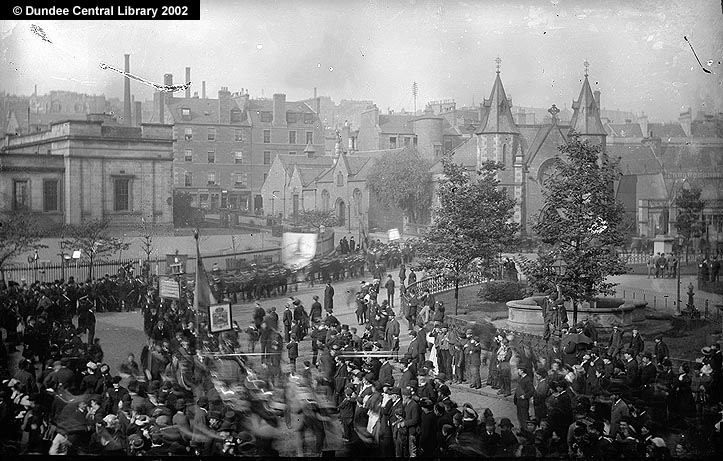
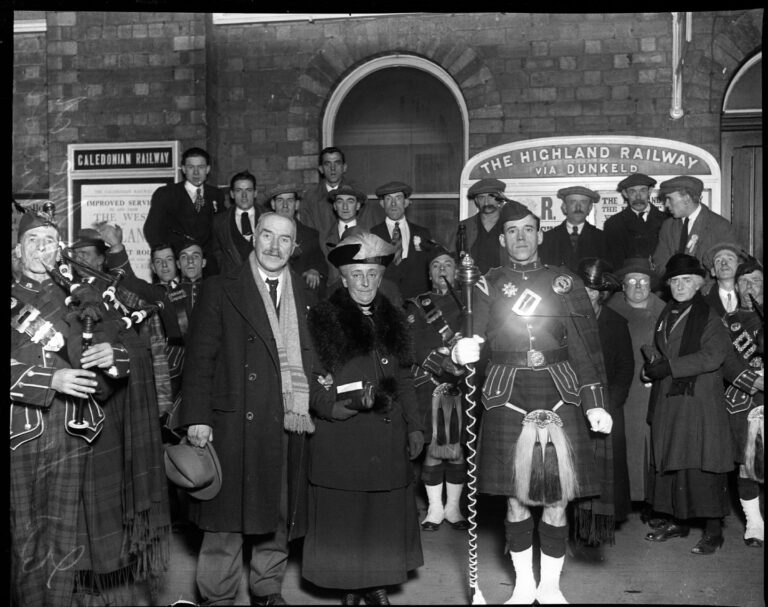
Gallacher arrived in Dundee on a Saturday evening. In fact he left an all-night sitting of the Party’s National Executive to travel from London on the day train. We had arranged a welcoming party for him which was more successful than we had ever hoped; at the Tay Bridge Station there were nearly 10,000 people gathered, along with the Engineers’ pipe band. At the station we formed a procession; the band, then Gallacher and the election agent, Jimmy Gardner (who later became general secretary of the Foundry Workers’ Union), then the thousands streaming behind. We marched through the town singing “Vote, Vote, Vote for Willie Gallacher!” and finished up in the Albert Square where we held the first meeting of the campaign.

That Dundee election campaign was a rowdy, tousy, all action affair. there were six candidates for two seats, but the main protagonists were Gallacher and Churchill. In every speech Willie went after Churchill and his government, and in his speeches Churchill slanged Russia, the Communists and Gallacher in particular. As the campaign progressed the Gallacher and Churchill meetings were packed to capacity with hundreds in overflows and Churchill invariably getting the bird.

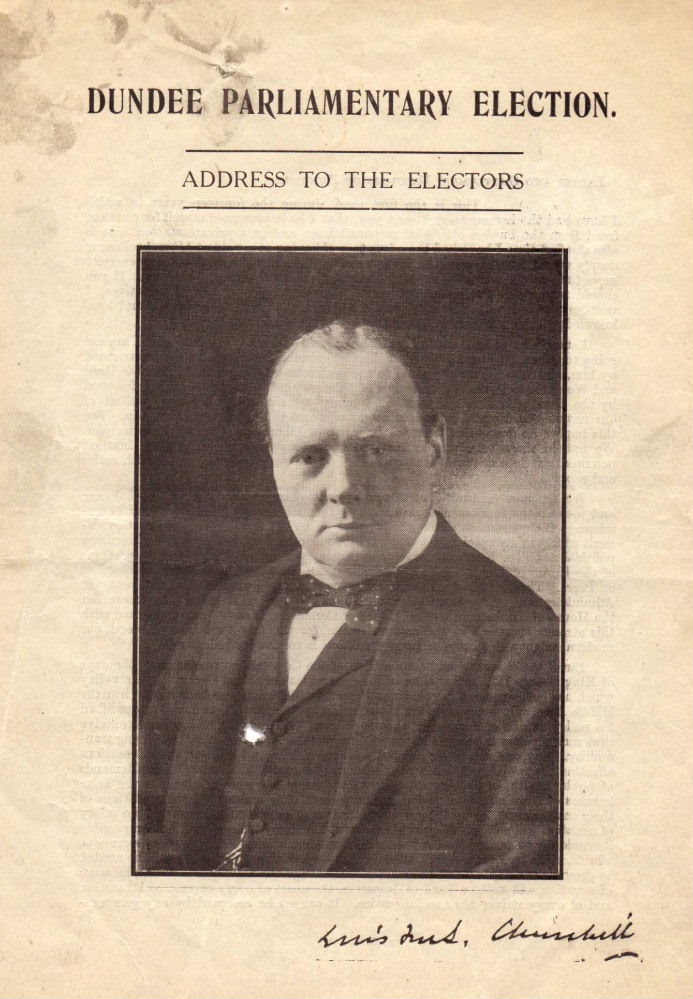
Winston Churchill’s campaign material for the 1922 election. In the words of The Ramones, “Glad to se ya go, go, go, go! Goodbye!”

Gallacher’s campaign was wonderfully organised and could serve as a lesson to many present day parliamentary candidates. It was in this election I first saw the effective use of the propaganda tactic of the short street meeeting. Jimmy Shand came up from Salford with his car – the same one we had at Caerphilly – to help Gallacher. Willie got a megaphone – no loudspeakers in those days- and, with Jimmy Shand driving, they toured the shopping centres and streets holding short quarter of an hour meetings and then moving on. In these days meetings were held at selected points at advertised times and Gallacher’s car and megaphone meetings were ‘with it’ political campaigning that none of the other candidates, not even Churchill, could match and were one of the reasons why Gallacher was the best known candidate.

Because of his powerful personality and forceful campaigning, Gallacher attracted many non-communists to support him. We had hundreds of very able people on election work, but our real campaigning punch was provided by our chalking team. They were experts and did a real artistic job. Right down the middle of all the Dundee tramlines, spaced every fifty yards, was a Gallacher slogan- not all political- such as , “Don’t be silly, vote for Willie” or “Willie for Dundee”. No one had to ask who Willie was. These slogans were brushed on with a solution of carbide and whitewash and withstood all weathers for many months.

Towards the end of the campaign Churchill suffered a second body blow. It was bad enough Willie kicking hell out of him in every speech, but his one-time pal, the Dundee press autocrat D. C. Thomson, also took a hand. Churchill had asked the Dundee Courier (D. C. Thomson’s morning news-paper) to publish an advertisement giving quotations from speeches from Austen Chamberlain and Bonar Law, of course supporting the Churchill point of view, but Thomson refused to accept the advertisement. No doubt Churchill’s ego was offended; anyway there followed a real slanging match between old David Thomson and Churchill in correspondence which lasted right up to polling day, when the whole correspondence was published verbatim in the D. C. Thomson press as the voters were going to the poll. On the day polling took place the Dundee Courier published a leading article which commenced as follows:

CHURCHILL WITH HIS CHOLER UP

The Tale of a Lost Temper

Whatever may be his chances at the poll today, there can be no doubt that Winston Churchill is in a vile temper. He has taken no pains to conceal the fact. For those within his reach he has buckets of calumny . . . Mr. Pilkington, Mr. Morel, Mr. Scrymgeour, and Mr. Gallacher. Now he has turned full blast on the Dundee newspapers. Whose turn it will be next God only knows.

And in the very same issue Thomson published a letter he had sent to Churchill which ended: “To be quite candid, if you wish to discuss anything with me on friendly terms, cut out this threat nonsense and let us discuss the matter man to man.” Churchill never replied to this letter.

If Churchill could read an election campaign, and I have no doubt he could, he must have known he was a “goner” long before the result was declared. The amazing scene at the declaration of the poll is vividly described in Gallacher’s Rolling of the Thunder and I will leave it there.

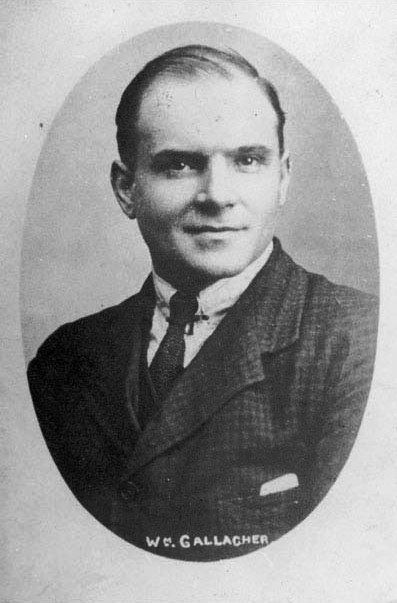
The Communist candidate for Dundee in the 1922 election – Willie Gallacher.

One more thing about this election I remember. The editor of our newspaper, the Communist, asked Gallacher to do a brief biography for publication. Remember this was Willie’s first parliamentary contest. How many of you municipal and parliamentary candidates have been in this same position? But the editor hadn’t bargained for what he received from Willie, which was as follows:

WILLIE GALLACHER

Dundee Communist Candidate- Story of My Life

I am born

I grow up – I go to school – I grow up more

I get a job carrying milk – I continue to grow

I leave school – I get a job with a grocer

I still grow

I get a job in an engineering shop – I began to grow in earnest

I become a knut: I join the IOGT – I’m a helluva fine fellow

Years pass – I join the Socialist movement

I lose my job

I stop growing – I go to sea – I get shipwrecked

I don’t get drowned – (What a pity)

I’m still a knut – I get married – Then get cracked

I start growing again – smaller

I go to America – become a “bum” – I return

The war starts

I grow again – crazy

I get involved in strikes – I go to gaol – I grow up again sad

I come out – The war goes on – So do I

The war ends – More strikes – More gaol

Come out again – I go to Russia – Great experience

Train on fire – Adrift in the Arctic Sea

Back again – Trouble again – Gaol again

Out again – Communist Party going strong

I become a “heid yin” – Communist Party not going strong any longer

I become a Parliamentary candidate

Great sensation – Overwhelming majority

Triumphant march to London – I enter Colney Hatch

Poor old Gallacher

Amen.

For the uninitiated, Colney Hatch is the site of a big mental hospital in north London. Willie had no romantic ideas about this election. His main aim was to expose Churchill and contribute to his final defeat. This he did handsomely as the final result showed:

Scrymgeour (Prob.) 32, 578

Morel (Lab.) 30, 292

MacDonald (N.L.) 22, 244

Churchill (N.L.) 20, 466

Pilkington (L.) 6, 681

Gallacher (Comm.) 5, 906

A year later in the 1923 General Election, Gallacher pushed his vote up to 10,380 in the same Dundee constituency, but by that time I was in the centre of world revolutionary politics- Moscow.

1922- the newly elected Prohibitionist MP for Dundee Edwyn Scrymgeour on his way to take his seat in Parliament.

Breaking the Fetters Chapter 17: Red Agent in Glasgow.

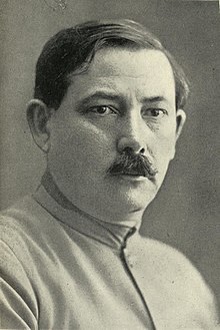
Mikhail Borodin

As the membership of the Communist Party grew and our organisation developed, better relations with the Labour Party were established in many districts. At the 1922 Labour Party Conference held in Edinburgh in June, the right wing on the National Executive Committee placed a change of rule on the agenda that would prevent such unity and indeed would go a long way towards isolating the Communists from the labour movement. The rule in question concerned the eligibility of delegates to local and national Labour Party conferences and the selection of candidates, and the changes read:

a) Every person nominated to serve as a delegate shall individually accept the constitution and principles of the Labour Party.

b) No person shall be eligible as a delegate who is a member of any organisation having for one of its objects the return to Parliament or any Local Governing Authority of a candidate or candidates other than such as have been endorsed by the Labour Party or have been approved as running in association with the Labour Party.

This change of rule, carried by a two-to-one majority at the conference, was directly aimed at the Communist Party and created a new position in the British labour movement. It was discussed by the Communist Party National Executive, who decided to recommend to their members that where it was necessary, such as in Trades and Labour Councils, Communists should accept the constitution of the Labour Party, and that where Communists were standing for parliamentary or local council elections they should be withdrawn unless there was agreement with the local Labour Party, thus fulfilling the conditions required by the change of rule.

To discuss the executive’s recommendations, I called a special extended meeting of the Scottish District Executive, but fate decreed that we were to have something more on our plate in this discussion. At this time Borodin, a member of the Communist International, was in Britain, and had previously visited a number of districts in England and Wales. He was a lawyer by profession, an erudite and well-informed man. He came to Britain to get an on-the-spot understanding and appreciation of British politics and the way in which the British Communist Party was working.

When I met him in Scotland he told me he wanted to meet people in the labour movement, to get to know them, their background and their attitude to politics. He said I was the only party organiser who had really been able to do this for him. I think that was flattery. He knew all the fine arts of winning people. I had a number of discussions with him and, while I was undoubtedly able to help him in assessing the Scottish political scene, he also greatly assisted me in reaching a deeper appreciation of the way a serious politician must work to win mass support. He patiently explained the value of international work, international trade union contact, international exchange of information in the cultural and educational fields, all of which was very new to me.

At the extended Scottish Executive meeting, Willie Gallacher spoke for the National Executive, emphasising the tactics of the right wing of the Labour Party to drive the Communist members out of the working-class movement, out of the Trades and Labour Councils and finally out of the trade unions. Naturally Mr. Brown, for that was the name Borodin used, asked to speak. He was quite critical of the way a number of Communist members were working. “When I saw the Communist delegates at the Labour Party Conference,” he said, “I thought- if this is how the party is handling the situation then it is manœuvring very poorly.” Borodin was a great story-teller, and went on to say: “It is easy not to get drunk when you pass every saloon bar, but to be good politicians our members must learn to enter these places and not get drunk. To be able to seek affiliation to the Labour Party, the greatest saloon bar I have ever seen, to drink in the bar without getting drunk, that is what is needed. No party can avoid these places.” He talked about the Glasgow Trades and Labour Council. “Here is a basic working-class organisation with 362 affiliations representing 126,116 members. We have fifteen Communists representing their organisations. What do they do? Are we to allow them to be thrown out or do they stay inside and conduct work for the unity of the working class and for working-class policy? Do we fight on ground favourable to the right wing Labour people or on ground favourable to the left wing? Revolutionary tactics demand they stay inside.”

Despite the support of Willie Gallacher, Johnnie Campbell and Mr. Brown for these proposals, there was much criticism in the ensuing discussion of the National Executive’s recommendations, particularly the one seeking to withdraw our candidates where we got no agreement with the Labour Parties. We had already selected candidates for the next general election. J. V. Leckie, Tommy Clark and Ned Douglas, all members of the Scottish Executive, and various other comrades, had a real go. Frankly I could see their point of view and said so in the discussion. At one o’clock in the morning it was voted that we adjourn the meeting on the understanding that we would re-assemble the following week and try and finalise the position.

But the next meeting did not last long. We had just started when the Glasgow Criminal Investigation Department intervened in force. There were dozens of policemen and plainclothes men-they must have been concealed on all the stairs round about. They burst into the meeting and commenced to take all our names and addresses until they came to Brown. “Who is he?” they asked me.”A Yugoslav journalist visiting Scotland, interested in the Scottish Labour Movement,” I answered truthfully. “He’s the man we want,” and they left, taking Borodin with them. This was not an entirely new experience for me, but I admit to being worried during the questioning because I was standing beside a little sideboard we had in the office, hoping they would just leave me there. Fortunately they did. In the sideboard lay Borodin’s briefcase and his private papers. He also left a beautiful big panama hat which would have been a major sensation in Sauchiehall Street any day. I can’t remember who fell heir to that. Once the police had left, we set to work. Goods, chattels and papers were taken away to safe custody.

We arranged for food to be taken to Duke Street Gaol where Borodin lay on remand awaiting trial. This the law allowed. We had a relay of comrades who carried out this duty very willingly and well. The privilege stopped and then he had to exist on the normal prison diet which, in those days, to Borodin, must have been really nauseous, a real punishment indeed only kail and porridge daily.

Our most important task was to find a lawyer to take charge of his defence. Our choice was an ex-bricklayer who had won his way into the legal profession; his name was Alex McGillivray. He worked night and day. In the course of the case Borodin and McGillivray developed a great admiration and a real affection for each other. I never heard a lawyer speak of a client with such profound comradely feeling. Even so, the defence was not a smooth run. Borodin was trained in American law and practice and Alex had great difficulty in persuading him that this would not take a trick in the much more subtle practices of the Scottish Court.

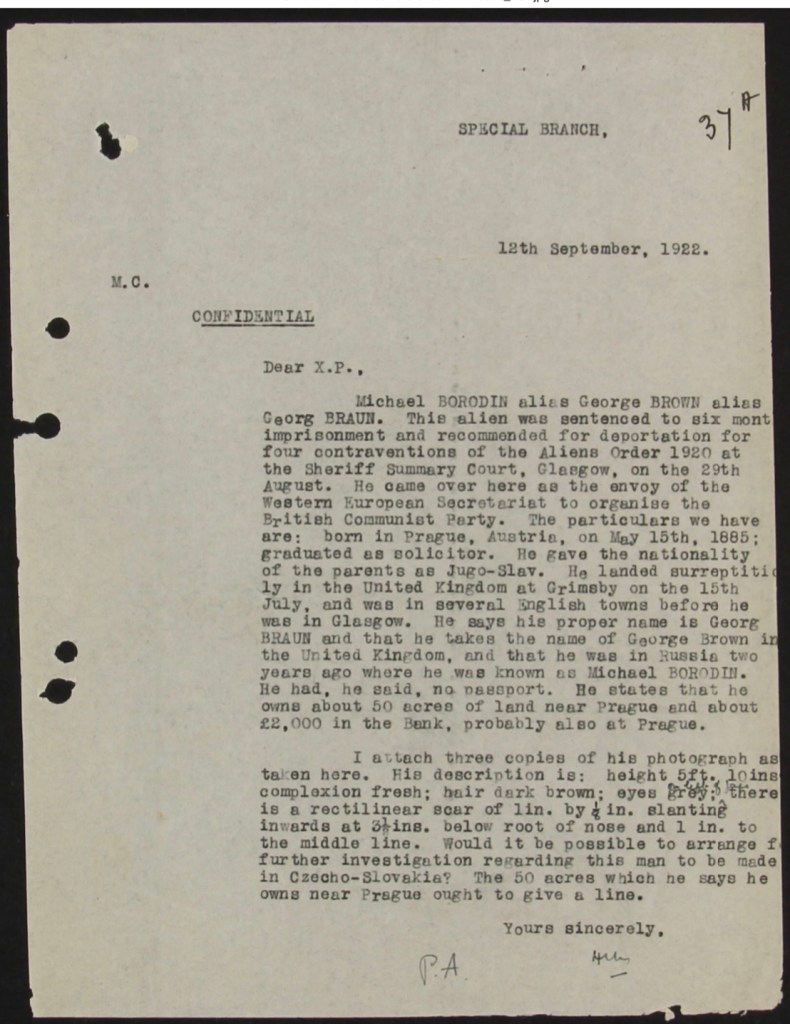
The newspapers made a meal of the incident. “Underground Agent of Communism Caught”; “Red Agent in Glasgow” were two of the headlines. On Wednesday, 3oth August 1922, Borodin appeared in the Glasgow Court. The Procurator Fiscal was J. D. Strathearn and Borodin was charged that, at 156 Vincent Street, Glasgow, he (a) failed to produce a passport to the Registration Officer; (b) failed to produce a registration certificate; (c) refused to answer questions.

The Procurator Fiscal said Mr. Brown, alias Borodin, was a Yugoslav journalist, in Britain without the knowledge or authority of his country. How he came to Britain was not known. The British Intelligence considered him a dangerous person because he was sent to this country to foster revolution and had been found in Glasgow about to deliver an address. The C.I.D. considered his arrest very important. He had previously been in Britain, but on this occasion had only been in Glasgow one day (a big build-up for the efficiency of the Glasgow C.I.D., but a lie). The Procurator Fiscal asked for a prison sentence and deportation. The sentence was six months’ imprisonment with deportation immediately on release.

Note from Special Branch about Borodin’s imprisonment.


Borodin served his time in Barlinnie Prison in Glasgow. He did not like jail, a sentiment I strongly shared with him. He said Barlinnie was colder than Siberia and having sampled both he would be a good judge of that. We did our best to cheer him up while he was on remand, taking in food and news of the outside world. I remember buying one of those iron plates that hold hot water and keep the food warm, to take into prison. Probably because of the coldness of the prison, he always asked for hot food.

Borodin was unfortunate in prison. He worked in the laundry and was badly scalded on the feet and legs with boiling water. Six months pass slowly in prison but fast enough outside. I got special visits to see him and much of our discussion dealt with his deportation. He was like a bird in a cage and his release and deportation must have been a welcome relief to him.

I had to consult with the Russian Trade Delegation about Borodin’s deportation. They were stubborn and, in my opinion, unreasonable people and I became a real angry man. However, I finally persuaded them I was right and on his release off Borodin sailed.

I met Borodin again on my first visit to Moscow when I went there to work on a British Commission. Borodin was very helpful to me during this long survey. After this I was asked to return to Moscow to work at the Comintern headquarters. I was very reluctant and doubtful about my competence to do this work but Borodin pleaded with me to accept. “Bob,” he said, “you come. I will give you all the help you need.” When I arrived in Moscow some time later, with my wife and daughter, as a delegate from the British Communist Party to the Comintern, Borodin had gone, I think to China. Anyway, he was not there to give the “every help” he had promised.

Naturally the Borodin arrest had a profound effect on the Scottish Party. There was an inquisition amongst ourselves as to how the leak had taken place. I began to treat the work with greater carefulness. Afterwards, when the full story was known, we discovered that the leakage did not come from Scotland but from further South.

Breaking the Fetters Chapter 16: The Caerphilly By-election.

Election Poster 1921.

This was the first parliamentary election ever to be contested by the British Communist Party. The decision to contest was taken by the Party Executive on July 16th 1921. The main reasons were, firstly, the severe attack on the party at the time sixty-eight leading Communists had been arrested and many of them, like myself, were doing hard labour. Secondly, the economic position was becoming desperate. In July, the unemployment figures, according to the Labour Gazette, were 2,178,000. Thirdly, it was a mining constituency and the betrayal of the miners by the right-wing Labour leaders had just taken place. Black Friday was only a few months before the by-election. During the miners’ struggle the party had supported them wholeheartedly throughout and in fact was the only political party to give full support, and we were therefore entitled to stand in a mining constituency. No doubt the reason that I was selected as the candidate was because I had been arrested for delivering speeches in favour of the miners’ wage demands and, when the election date was announced, was actually in jail only a few miles from the constituency. For these reasons the party decided that a contest was necessary and completely justified.

The selection of a Labour candidate created some trouble. A whole number of right-wing labourites, including Ramsay McDonald, were angling for what was considered a safe seat. However, the miners were so disgusted with the action of the right-wingers during the struggle of the Triple Alliance (miners, transport workers and railwaymen) and the final sell-out of Black Friday, that they had no hope of support from the miners’ lodges. The eventual choice of candidate for Labour was Morgan Jones. Like myself, he had been a conscientious objector during the war, but only on religious grounds. He was one of the big guns of the Independent Labour Party, a Baptist lay preacher and at the time of the election, Chairman of the Bible Classes in the valley and, as Tommy Jackson said, “this endeared him to the old women of both sexes”. He was a nice chap but not a virile working-class politician. The Coalition (Tory- Liberal) candidate was Ross Edmunds.

Morgan Jones had the full Labour election machine behind him- the Labour Party, the Miners Federation and the Daily Herald. Even the Free Church Council campaigned vigorously on his behalf. The Daily Herald laid it on thick. “A brilliant young man with a promising career before him–a man who was born among you a fine Baptist who can speak Welsh.”

The government candidate, Edmunds, had the traditional Tory and Liberal Party machines and all the capitalist newspapers on his side. To match this, we were a handful of rebels, maybe sixty in all mostly strangers to the district–with no election machinery, no tradition, no money, nothing to give except the “message” of working-class struggle to gain political power. Our main slogan during the election was ” All Power To The Workers”. Yet we conducted such a powerful political campaign that three days before the poll the Labour Party got the wind up, and in the Labour camp, with its big battalions, the word went out to smash the Communists. The Labour Party bullied, cajoled and wheedled and finished with an SOS- “Don’t split the vote and let the Coalition candidate in”, while the chapels worked overtime calling for the protection of Morgan Jones from the ungodly Reds.

We had a wonderful team of speakers- -Bill Gallacher, Helen Crawfurd and John McLean from Scotland, Walton Newbold, Arthur McManus, Bert Joy, Harry Webb, Joe Vaughan, who came within a hair’s breadth of winning Bethnal Green for the Communist Party in the 1924 parliamentary election, Tommy Jackson and myself. Open-air speaking was our strength. We opened our meetings in the Square in Caerphilly at ten o’clock in the morning and closed them at eleven o’clock at night. We swept the Coalition candidate supporters from the streets altogether, they retired from this arena defeated. Early on in the campaign, a Coalition speaker challenged Harry Webb during one of his speeches to a debate, and this was arranged to take place at Abertridwr. The hour arrived for the debate but not the Coalition speaker; he did not turn up. Bill Gallacher had a debate in public with a group headed by Captain Gee, VC. It was a political massacre of Coalition policies. One of my happiest recollections of the election was of a meeting when Edmunds asked me to state where I stood in relation to the industrial strife in British industry, and then I watched his face as I replied. His fixed conception of the inevitability of the master-worker permanent industrial relationship took a very hard knock.

I remember one night Gallacher and I were speaking at a place called Sengenet. The local synod had been having a meeting and when they finished a number of ministers came around the meeting to have some fun. “Ah! The Bolsheviks! Why don’t you read the Bible?” shouted one of them. Now that was a real question! Challenging Bill Gallacher and me to read the Bible! We gave them Bible lessons they had never dreamed of. Then, when they were quietened, and the audience were laughing their heads off, I told them quietly, “That’s what you get for putting people like Gallacher and me in gaol and making the Bible compulsory reading.”

Another time Tommy Jackson was holding forth to an audience in Caerphilly, when on looking up he noticed that the tower of the castle was leaning to one side. “There you are,” he said, “even the castle tower is leaning to the left.” It was just as well he was holding the meeting at that stance because if he had gone to the other side he would have seen it leaning to the right. Still, Tommy was always one to make the best of any situation.

Apart from our splendid team of propagandists we had dozens of hard workers on the knocker, selling our pamphlets, chalking, arguing in the streets and in the pubs. Everywhere there were people, our fellows were there. Many of them were unemployed and had come from all over Scotland, London, the Midlands and from every part of Wales- to help the party. To go into the committee rooms late in the evening and watch this bunch getting their shake-downs ready for the night was like walking into a picture from John Reed’s Ten Days That Shook The World. But they were a real bunch of first-class fighters. Dai Davies had charge of the Election Address and the job was done competently and on time.

In our campaign it was the transport that took the eye. One national newspaper talked of “Bolshevik emissaries rushing through the Caerphilly Division in expensive cars.” Actually, what happened was that Jimmy Shand came down with his big car from Liverpool and it did valuable service. It was certainly a big flash car; it seemed to hold dozens at a time and with great speed transported speakers and workers to the assigned places. Jimmy was possibly one of the best car drivers I ever knew, certainly one of the few I would sit back and trust on a pitch-black night, driving on a Welsh mountain-side.

The night before the poll I was talking to some journalists who were covering the election. They said, “Your speakers are first class, they have made a great impact. They have destroyed any chance the Coalition candidate had of pulling a patriotic vote-catching stunt, but in attacking and exposing the weakness of his policy you have created a real fear that a split vote will let the Coalition candidate in. You have frightened the Labour crowd and made them work as they have never done before. Your campaign has made the voters class-conscious enough to make them vote Labour but not enough to make them whole-hog Communists.” One should never under-estimate the wisdom of press reporters when speaking off the record and not for their papers, because the final result on polling day bore out their estimation:

Morgan Jones (Lab.) – 13, 699

Ross Edmunds (C. & L.)- 8, 957

Bob Stewart (Comm.) – 2, 592

We lost our deposit. We had spent all our money. In a constituency twenty miles broad, to cross which meant climbing three mountains real ones, not home-made mountains, as Ernie Brown called the slag heaps at the pits. We had given all the energy we had in a tremendously exhausting campaign. What did we get in return? In South Wales mining districts in 1921 there was mass unemployment, a psychology of gloom and despair. Labour was chanting “Leave it all to Parliament- direct action is dead”. We roused enthusiasm in many who had lost hope; we won an understanding that action by the rank and file was essential. We put light back in eyes grown leaden with despair, the spring back in the step of many a young miner, we painted a picture of a future of opportunity and prosperity.

For the first-ever Communist parliamentary election contest this was a real achievement. As the crowds waited for the result of the election, Gallacher, in his inimitable way, started a sing-song and soon everyone had joined in. When the result was announced, you would have thought by the shout that greeted the Communist vote that we had won the seat. We did not win the seat but we won many other things including, most of all, the appreciation that the British Communist Party had a right to take its place in parliamentary elections, against the alleged statesmen whose policies spelt ruin to Britain.

Comrades: Anatole Naumovich Kaminsky (Part One).

Anatomy Naumovich Kaminsky (1907-1941)

Where to begin? It’s a troubling, ultimately tragic part of the story and some of it is truly inexplicable. Perhaps the best way to deal with it is to set out the information as simply as I can.

What we knew was this. At some point in the early 1930s Bob Stewart’s daughter, Annie (my dad’s Aunt Nan) married a ‘Russian’ and they went to live in Moscow. We didn’t know his name nor had we ever seen a photograph of him. At some point Nan gave birth to a baby boy – my dad’s cousin Greg. Soon after this Nan’s husband was killed in Stalin’s purges. Nan fled with their infant child back to London. Information about her husband was almost impossible to come by. I have no idea how they managed to escape. In the years that followed, Nan remarried, had two more children and remained a member of the Communist Party until 1956.

For me, all of this was rather abstract. Dad had a lot of family somewhere out there but was rarely in contact with them. Until recently, apart from visits to my grandfather when I was a toddler, the only other person I’d ever met from my father’s side was Greg. That was at my brother’s wedding just over a decade ago. I only spoke to him briefly as I was on best man duties. All I can really remember is how strange it was to be speaking to somebody who bore such a strong resemblance to my dad and yet was someone who was to all intents and purposes a complete stranger. I never made the effort to remain in touch. I wish I had.

After my father died, I started reading through the security files on Bob Stewart that the National Archives had digitised and put online. Trying to find glimpses of who he was before he was our dad. To begin with, I knew very little about the Communist Party or our family. I tended to focus on the later files as during that period MI5 weren’t simply intercepting Bob’s post and tailing his movements but bugging his offices and tapping his phone. Rather than squinting at spidery 1920s handwriting and trying to work out what it all meant I could easily read the transcripts of conversations and, through their voices, almost begin to get to know these people who were long gone.

I started looking at the files collected during 1956. The year that Nikita Khrushchev gave a speech condemning the crimes of Stalin and the first official recognition about what had gone on in the decades before. At this time Nan was living in a large house in North London with her family and also her father who was nearing eighty but still involved in the secret side of the Communist Party of Great Britain. Most of the documents in that file focus on the general disquiet about the revelation in ‘secret speech’ felt by those at the CPGB’s HQ at Covent Garden. However, a more personal impact is outlined in the transcript of a phone call Nan made to her sister in law Margaret on 10th August 1956.

O/G call from NAN CAPLAN to MARGARET STEWART, BOB’S daughter in law. HARRY is back, and DRONA, (the father of NAN’s son GREGORY CAPLAN) was definitely shot in 1941. They are both shattered by it. HARRY came to see BOB and NAN insisted on seeing him. She says there is not one of the five brothers in KRONA’s (sic) family left. She threatened that if HARRY does not give her justice she’ll follow him to every meeting at which he speaks. BOB’s threatening to leave (The house? The party?) She would like her brother RAB STEWART to come and see her. BOB is going away next week so they will arrange it.
(KV2/2790 – Security File on Robert Stewart held at the National Archives.)

‘HARRY’ was Harry Pollitt, the leader of the CPGB, who had gone to Russia in part to find out what had happened to the family members of several of his own colleagues and friends. Of course, this transcript raises so many questions. How had they lived with this trauma for so long? How had they maintained their commitment to the CPGB in all that time in the face of it? What had they already known?

At this stage I still did not know the identity of Nan’s husband. From the battered suitcase that had been up in the loft, every old photograph or letter in Russian that I sifted through proved a dead end. So too did the references to KRONA or DRONA in the transcript- a nickname that didn’t seem to crop up elsewhere. However, later on in the files I did find a reference that linked Greg’s father to Grigory Kaminsky and this was the first real breakthrough in my search.

Grigory Kaminsky

Grigory Kaminsky was the People’s Commissar for Health of the Soviet Union between 1934 and 1937. He set up the Soviet health system, improved the production of medicine and medical training and battled malaria in the USSR. Evidently, he was also Nan’s brother-in-law. However, in 1937 he made speech in which he condemned the wrongful arrests of people and accused Lavrentiy Beria, the head of the NKVD, of counter revolutionary activities. As a result, he was arrested and then executed by firing squad in February 1938. Then, it seems, the NKVD went for the rest of his family.

Now I had a surname I went back to the earlier files from the 1920s and 1930s and managed to find documents that linked Anatole Naumovich Kaminsky and Annie Stewart together which speculated about whether they were married. So, now I knew who he was but still no idea of what he looked like or any real details of what had happened to him. My first port of call would have been to search for him through the Memorial website. Memorial is the Russian human rights organisation set up to investigate the crimes of the Stalin era and beyond. They’d amassed records of all known victims in a ceaseless effort to record every human rights violation. However, last year it was closed down after years of intimidation by the Putin regime. During one court hearing the state prosecutor announced that Memorial was “creating a false image of the Soviet Union as a terrorist state.”

Screenshot of the information I found on Anatole Kaminsky. Apparently the information is from a database of “Victims of political terror in the USSR”; Moscow, execution lists -Kommunarka.

Despite Memorial being closed down I think I’ve still managed to find a record of what exactly had happened to Anatole. It appears that there are several websites that have ‘backed up’ the information held by Memorial and similar agencies and these have not all been shut down yet. Not being a Russian speaker, I can’t fully judge the reliabilty of the website I found but, as key parts of the information held on Anatole Kaminsky match what’s held in the MI5 files, I am reasonably sure that this is what happened.

On June 20th 1938 NKVD officers arrived at Anatole Kaminsky’s Moscow flat on the St. Malaya Dmitrovka. They arrested him on charges of espionage and participation in counter revolutionary organisations. He remained in custody for the next three years and was eventually convicted on 8th July 1941 shortly after the Nazis invaded the USSR. His sentence was noted down as ‘VMN’. This stood for ‘Vysshaya Mera Nakazaniya’ which translates as ‘the supreme measure of punishment’. In other words, the death penalty. On July 28th the sentence was carried out. They took him to the Kommunarka shooting ground on the outskirsts of Moscow where his body lies alongside thousands of other victims to this day. He was 34 years old.

Anatole was rehabilitated by the Khrushchev regime in 1956. Rehabilitation would have had to have been requested and I assume it was Harry Pollitt who put that in motion or it might have been Bob on his visit to Moscow in August that year. That’s as far as justice stretched.

In November this year I finally saw some photographs of Anatole, one of which is reproduced at the top of this article. They were attached to his MI5 security file held at the National Archives. I spent the morning reading all about the six years he spent in Britain before he returned to the Soviet Union and the dreadful fate that awaited him. That afternoon I met, for the very first time, another of my dad’s cousins. It was Rab and Margaret’s daughter Linda. It had been Margaret who Nan had rang up after discovering what had happened to her husband in that summer in 1956. It was an emotional meeting and we covered a lot of ground in the few hours we were together. She could not believe I had found photographs of ‘Natte’ as he’d been known. He’d died long before she was born and she’d never seen a picture of him either. Of course she was familiar the story and knew that her aunt and cousin had got away by “the skin of their teeth.” When I showed her the photographs on my phone she was instantly struck by the resemblance to Greg who she’d known well and who died in 2019. I was glad I was able to show her these images. I wish that I could have shown them to my father. Above all, I wish I could have shown them to Greg.

Alan Stewart.

Thanks to Linda Stewart, Ian Stewart, Ruth Holliday and Maurice Casey for all their help.

Breaking the Fetters Chapter 15: In Gaol Again.

HMP Cardiff.

In 1921 I was attending the Party’s National Executive in London. It was close to May Day and McManus, who was booked to speak at a May Day meeting in South Wales, said he could not go and asked me if I would like to take his place. “Sure,” I said, “I have never been to South Wales and it will be a new experience.” As it turned out it was.

I went down by train to Aberdare but before reaching there the train stopped at a small station and along the platform came a group of fellows shouting, “Bob Stewart, Bob Stewart!” I stuck my head out of the window and said, “That’s me.” “Can you do a meeting for the Party in Mountain Ash tomorrow night?” they asked. “Yes, I’ll be there.” So, after the meeting in Aberdare I travelled to Mountain Ash. The meeting was in a cinema and was crowded out. As usual at the time, the “splits” were in the boxes taking notes of my speech, but this happened at all meetings so I ignored them. The meeting finished and the local fellows said they were very pleased with the attendance and the effect. The repercussions were then still unknown.

I returned to London, and on the following Saturday, 7th May 1921, came the police raid on the party offices at King Street, Covent Garden, when Inkpin the general secretary was arrested. The raid was made without a warrant, under the Emergency Regulations Act. It was carried out by Detective-Inspector Parker, acting under the instructions, so he said, of the Director for Public Prosecutions.

During the raid all personnel in the office were rounded up from their individual rooms and brought to the general office on the ground floor of the building. The rooms were ransacked and, while this was going on, the homes of the office workers, even those of the girl clerks, were being searched. The police authorities certainly put on all the trimmings to build the raid up into a first-class political scare.

When Inkpin came into the general office and he exploded at Parker for the unwarranted intrusion into private property. “I demand to see your warrant to search these premises,” he said. “I don’t need a warrant,” replied Parker. “I am acting under the Emergency Regulations.” Parker then started to question Inkpin about the publication and sale of the Communist Party pamphlet called The Statutes of the Communist International. “Who wrote the book?” asked Parker. “What do you mean who wrote it?” said Inkpin. “These are the Statutes adopted by the 2nd Congress of the Communist International.” “Where did the books come from?” persisted Parker. “They came from Moscow, from the Communist International,” replied Inkpin. During the interrogation Inkpin again protested to Parker about the manner in which the police were acting, forcing their way into all the rooms in the building, sorting out files of correspondence obviously with the intention of taking them away. But Parker brushed this aside and kept on asking questions about the pamphlet The Statutes of the Communist International. Inkpin continued to answer truthfully this was a record of the decisions of the Communist International which was sent by the International not only to Britain but to most countries throughout the world.

Now Detective Inspector Parker might have been a good man at detecting crime, but he did not seem to have the elementary knowledge required to comprehend the simple working of an international body. Maybe, of course, he had had his instructions not to try to understand. Anyway, after fifteen minutes of this sham he stopped asking questions and started giving instructions. To Inkpin he said, “I am going to arrest you under the Emergency Regulations Act No. 19. I am further going to search the premises and take possession of anything I think fit under an order signed by the Chief of Police.” He then turned to another detective and said, “Mr Hole, here is the order,” and to “Inkpin, “Come with me.” “What, without a warrant?” said Inkpin. “None necessary,” was the reply and he turned to leave. It was then he spotted me standing in a corner trying to look as inconspicuous as possible, but obviously not succeeding. “Who is that man?” he barked. “That’s Mr Stewart,” said Inkpin. “Get his name and address, and the name and addresses of all the others.” And with that little lesson of how democracy works in this land of the free he turned, taking Inkpin with him, and disappeared out of the door.

The place was alive with police and plain-clothes men. I ran from room to room trying to salvage what I could, but the police ransacked the place, almost everything went, even to the paper and the stencils. There were a number of spare files of our paper Communist and I knew that McManus had some papers ‘filed’ away for safety. I said to the policemen who were carting all the material away for examination., “Here, take these away; they are only in the damned way here. You’ll be doing something useful then.” “We don’t need these,” was the reply, “we have files of them ourselves.” So that saved something. After the raid, in the evening, I went out to try and contact some of the Executive members.  I went to the Corner House in the Strand and luckily, I bumped into a few of them and learned that there was to be a meeting at Bill Mellor’s house later to discuss what we could do under the circumstances. After the discussion, I had an argument with McManus because I said I thought that Mellor was deciding to leave us-to get out. McManus said I was a fool, but I was eventually proved right; William Mellor, despite all his thunder and aggressive revolutionary phrases, was afraid of being on the wrong side of the police authorities, and a short time after left the party.

After the meeting, I was sent to get a lawyer for Inkpin, to Torrington square, to see WH Thompson, a lawyer who was on the left. I found him in a strange way. I was ascending the stairs to his place when a young fellow came running past me. Suddenly, he stopped and said, “Jesus Christ! Bob Stewart!” “The latter’s right,” I replied. “What brings you here?” This fellow had been a conscientious objector in Wormwood Scrubs when I was there, so we wore the same old school tie. I explained the position. He worked for WH Thompson. He said, “He’s not here but I’ll tell you where to find him.  He has gone to see his girl friend,” and he gave me the address. I found WH, explained the position, where Inkpin was- Snowhill Prison- and he assured me that I could leave everything to him. I returned to my hotel in Villiers Street, near the Strand, a good evening’s work done. As I entered two big fellows ‘took’ me, one on each side. “Your name Stewart, Robert Stewart?” one of them said. “Yes, a good Scottish name.” “Well, we want you, we have a warrant out for your arrest.” Naturally, I thought it was in connection with the raid on the party office, but as soon as I got to Cannon Row Police Station I discovered I was booked at the request of the Welsh police for speeches made in Aberdare and Mountain Ash. So, I was stuck in a cell, arrested for sedition. I was interrogated by an inspector, a very clever fellow, to his own way of thinking. “Ah! I know you,” he said. “I have heard you speaking in Dumbarton.” “Up on the rock?” I asked. “Sure, there was always a big crowd there.” There was never a meeting on Dumbarton Rock in all history, so I continued to kid him but he twigged it and finally closed up.

Next day I was taken to Wales, to the Abercynon Gaol where I rested the night, and the day after I went before the magistrate. He was an old fellow, sitting at his desk. “Your name Robert Stewart?” he asked. “Yes, but what’s going on?” I replied. “You’re in Court.” “What Court? Only you, me and a policeman?” “Yes, and you are remanded to the Assizes.” And that was the strangest court I was ever in, but then the Welsh do many things in strange ways. Back I went to the cell and the policeman said, “I want to take your fingerprints.” “Not mine, I am no criminal, I draw the line at that.” “We’ll see about that,” he said and went off but he did not return for the fingerprints.

In due course I was taken to the Assizes at Pontypridd. A bunch of snuffy magistrates, local publicans and others of that ilk. The prosecutor was a little fellow called Lloyd. The charges were seditious speeches. Little Lloyd had a real go. He built up a terrible case against me, and said I should be ashamed to call myself a British subject, I was an agitator coming into the district in troublesome times stirring up strife and hatred, saying the miners were being treated worse than German prisoners and that Jimmy Thomas was a traitor to the working class- which appeared to be sedition, I don’t know why. In passing I may add that the selfsame Mr Lloyd was some time later pinched for embezzlement , but I suppose that that would not trouble his loyalty to Britain. The witnesses said their piece. The local secretary, who was a canny lad named Foot, was very good. But the other party witness, Billy Picton, undid the good work. Billy was one of the aggressive type; good in an industrial struggle, but not much use in a court of law. Asked about my reference to miners being treated worse than German prisoners, he replied, “Well, it’s bloody true, isn’t it?” – not very helpful in a court in which the scales have already been loaded against you. In the long run the trial came to an end. The magistrate said a lot of wise words, then asked if there was anything known about a past record. Innocent like, of course. Then out came the dossier. Tried, court-martialled; tried, court-martialled, on and on. When he finished reading out the record, I looked at him and said quietly, “A good record.” The magistrate said that this sort of thing must not be allowed to continue, it would not continue, and so on. The sentence would have to be appropriate to the offence. I would be made an example. The sentence was three months’ hard labour. Three months’ hard. You can do that, as the old lags say, on the door knob.

Well, there I was inside again. In Cardiff Gaol. Interesting, because Cardiff being a big seaport the gaol is very cosmopolitan- men from all nationalities are inside and going around the ring at exercise you saw all colours and all kinds of men. For the first three days I sat sewing a pillow case. That was my hard labour, putting in stitches and pulling them out again. Of course, reading the Bible in between. This was the compulsory reading, but a very valuable book for left wing propagandists. One day the artisan warder came to see me. “What the hell are you sewing pillowcases for?” he demanded. “You’re a carpenter, aren’t you?” I told him what I thought about his pillowcases, his prison and his magistrates, but he only laughed. He turned out to be a good sort. He didn’t like clergymen and that was an instant bond between us. The prison chaplain at Cardiff and I could not get on. Charlie Chaplin we called him. This was because of the way he walked, not because of his humour. One day in my cell he said to me, “Mr Stewart, in cases of your kind, it is the wives and children I am sorry for.” I said, “Don’t you try telling my wife you are sorry for her, because if you do you will end up being sorry for yourself.”

The artisan warder stopped the pillowcases lark and took me down to the workshop. There was method in this because part of the prison was being demolished and an old oak floor was being scrapped. “Can you do anything with this, Jock?” he asked me, showing me a bit of the wood. It was a good bit of oak. “You could make some nice things with that,” I said. And I did- bookcases, hallstands, cupboards, small stools and many other pieces of oak furniture found their way into the warder’s home from the floor of the Old Cardiff Gaol. I am quite sure the government got none of it.

One day the warder gave me a shout when I was working. “Come here, Jock, I have a job for you.” So, I picked up my tools. “No, no,” he said, “all you need is an oil can. We’re going round to the execution chamber to oil the joints of the hanging apparatus.” Two men, sentenced to death for murder, were to be hanged the next day. “I’ll not oil your bloody hanging apparatus.” “What! You not in favour of hanging?” “Oh yes I would hand prison warders at a bob a time,” I said; “the trouble is they usually hang the wrong people.” “Well come and see how it works,” he said. So off we went to the execution chamber. He oiled the necessary places then gave me a demonstration of the proper way to operate it by pulling the lever and pointing to the drop. He seemed to take delight in it.

One day towards the end of my term, in came Jock Wilson, the Welsh Party Organiser, to see me; well, really to tell me something- that I had become a parliamentary candidate because Alfred Irons, the MP, had died. A by-election was pending at Caerphilly and the party had decided to contest their first ever parliamentary election as a party and I had been chosen as the candidate. Well, anyway, being in gaol, I couldn’t speak back. There had been quite a barney with the prison authorities. A report in The Communist appeared as follows:

We had expected difficulties to be put in the way of Robert Stewart’s Candidature in the Caerphilly mining constituency. They have already begun, and the Prison Governor has taken a hand. We wished to know when Stewart would be released for the purpose of the election campaign.

The party had sent a letter to the Governor of Cardiff Gaol in the following terms:

Dear Sir,

I should be very much obliged if you would kindly let me know on what date Robert Stewart, the National Organiser of the Communist Party, whom we understand to be present in Cardiff Gaol, will be released.

Yours faithfully

(signed) Fred H. Peat, acting secretary

Back came the reply:

HM Prison,

Cardiff

23rd July, 1921

In reply to your letter of inquiry it is regretted that the information asked for cannot be given.

I am your obedient servant

(signed) HJ Perwin

One night before the end of my time I was pleasantly surprised when the head warder came and asked if I would like to be released a day early. “Fine,” I said. But really the authorities were afraid of a demonstration, because when I had been taken from Pontypridd to Cardiff Gaol to start my sentence there was a bus load of policemen in the front and a bus load of policemen behind all the way. Certainly a good few tons of policemen to hold mine nine stones of communism. No doubt they were also taking no chances when I was leaving.

Out of the gaol, I went to Alf Cook’s house to discuss the political situation, and I had just arrived when a telegram was delivered from Moscow informing us of the death of Bill Hewlett in a monorail accident in Russia. It had been a bad accident and Jim Stewart of Lochgelly was also injured. So, I had the sad task of making arrangements for someone to break the news to Mrs Hewlett.

Breaking the Fetters Chapter 14: Scottish Party Organiser.

After the formation of the British Communist Party at the Leeds Conference, the main task was to build and strengthen the organisation. I was elected as the Scottish organiser, a very tough assignment.

The main political problem then was the beginning of mass unemployment, the fight for work, and the divisions which this creates in the working-class movement. During the war most big factories had established their “factory committees”. But now many of the factory committee members had become
unemployed, and factory committees had employed and unemployed workers working together. This, however, gradually ceased and there began the unemployed workers’ committees which led to the National Unemployed Workers’ Movement which was to play such an important role in the working-class struggles of the 1920s. This segregation of employed and unemployed workers was not then and never has been a good thing for workers in struggle. One section is always played off against the other by the boss and inevitably the boss wins.

Naturally our fellows, being the most militant, suffered most and were the first victims in the factories. Many joined the ranks of the unemployed, and while this meant they had time for political campaigning it cut them off from the much more decisive political work in the factory organisation.

In this setting we commenced to gather together the socialist fragments and build the Communist Party in Scotland. We inherited the British Socialist Party branches, the Communist Labor Party branches, and Socialist Prohibition Fellowship Party branches. All rather loose in organisation, and as I very soon found out, very inflated in assumed membership. The Communist Labour Party were supposed to bring over 4,000 members but I doubt if there was half that
number. The British Socialist Party claimed to bring over 10,000 members. If they did, there were thousands I never saw and I very much doubt if anyone else ever saw them. Propaganda was our strong point. We had many excellent speakers, and all dead sure of themselves. Tom Bell, for years the editor of The Communist; Willie Gallacher, for fifteen years M.P. for West Fife; Johnnie Campbell, who became editor of the Daily Worker, and Bill Joss, one of the ablest lecturers in the Scottish Labour College. These and many others made up a brilliant team of socialist agitators for the Scottish district of the new party.

Then there was the selling of our paper, The Communist, an extremely important part of our political work. With self-sacrificing effort of fellows like big Pat Quinlan, Malcolm McFarlane and others the sales rose by thousands. Nothing was a handicap to them. They were out on sales late and early, in snow, sleet and rain, nothing deterred them. At this period I remember one strange incident that came up in the ordinary course of the work. In Glasgow there was a big Irish docker named Jimmy Fearns. He originally came from Newry in Northern Ireland, and I think he was one of the founders of the Irish Citizen Army. Jimmy was out of work and, like most people in his circumstances, living in one of the model lodging houses for which Glasgow was famous-or infamous, depending on which way you look at it. I never knew why the name “model” was given to these dens of human suffering, they were certainly revoltingly original, but never model. One morning Jimmy came to me and said:

“Bob, can’t we do something for the modelers?”

“Have they any grievances?” I asked.

“Sure they got nothing but grievances.”

So we had a meeting with a number of representatives from the models, mostly men living apart from their wives and families and trying to keep two homes going. We got their grievances, published a leaflet and distributed it around the lodging houses. Because of this agitation a number of these places became cleaner and started to provide more up-to-date cooking and washing facilities.

The story was not without sequel. We were amply repaid for our work. For us there was the guarantee that our meetings in Glasgow were conducted in a peaceful atmosphere. The modelers were very handy fellows when the occasion arose. They lived in a society in which “might was right” and if there was any attempt to break up our meetings they soon put an end to that nonsense, saying “they defended those who defended them.”

The Scottish organisation took shape on the basis of our propaganda meetings. We had branches in every big borough from Glasgow to Aberdeen and a lone scout or two in places like Inverness, Dumfries, Perterhead and Fraserburgh. We listed speakers for the meetings, checked that they were advertised- because in those days it was a hit or miss business, sometimes the speaker did not turn up, sometimes the meetings were not advertised and there was no audience. All arrangements had to be checked and re-checked.

This meant money, and sometimes the sums were large, at least large for us. Two members of the Scottish Executive who did a magnificent job on finance for the party were John Inches and George Whitehead. By their work the Scottish Party was entirely self supporting, and with good finances the
political and organisation work of the party received most attention. Thus early I already understood that freedom from financial worry is a boon to a Communist Party organiser.

The most distinguishing feature of the Scottish Party then was its solid industrial base. In fact, the party was so working-class that there was a real antipathy to what was termed “the intellectuals”. It was entirely wrong of course and was combated by the Party. At that time we had a number of students; one of them, Phil Canning, later to be elected as a Communist Councillor in Greenock for many years, became an outstanding representative of the working class. Our students became swallowed up in revolutionary thought and began to absent themselves from their university classes, thinking the revolution was round the corner. I had long conversations with them, and patiently explained that just as in the workshop a Communist had to be a capable worker and win the respect of his mates, so in the college and university the students must do the same. If a Communist could not pull his weight then his “preaching” will fall on deaf ears. A student with a degree was a much more valuable political worker than a student without a degree.

Our solid industrial base came largely from the members who had come to the party from the Clyde Workers’ Movements and the militant workers from the mines and the railways who also had an excellent record of militancy during the war. But they also brought a number of problems. Our relations with the Labour Party were not good. This was partly of our own making, in that many of the groups that had preceded the new Communist Party and helped to form it had a very abusive attitude towards the Labour Party. Many of these members were strong political individualists and spent the greater part of their political life calling the Labour Party names. Not that sometimes the abuse was not called for, but nevertheless it was not the right way to go about trying to cement relationships that certainly would have helped us to gain more working-class unity in action.

We also inherited a problem from the Socialist Labour Party, who had laid down that their members would not accept trade union office lest they be corrupted. We naturally had to fight against that principle; corruption in the trade unions was then and still is an occupational hazard for which membership of the Communist Party is a good antidote. This, however, was one of the reasons why many militant trade union leaders in Scotland did not immediately join our party.

Our principal problem in industry was to get a balanced understanding of the political work of the party, engaging in every struggle in the social field and blending this with our industrial work in the fight for wages and better working conditions. This conception was foreign to British politics and therefore the hardest nut to crack for our party. A break had been made during the war in the rent struggles on the Clydeside, which culminated in the pressure on the authorities being so great that a new Rent Act was passed in Parliament. The Clyde Workers’ Movement had played a decisive part in this fight, organising the workers in the factories and combining with the tenants’ organisations. In fact, it can truly be said it was this successful combination of social and industrial struggle that was the main reason for the success gained.

We also had to try and overcome strong syndicalist traditions which still endured in industry. In this there was good and bad. I well remember when the late Jack Tanner came to the party, at that time a strong syndicalist-in fact, he edited a paper called The Syndicalist from somewhere in Fetter Lane, London. But Handsome Jack, as he was called, developed ambitions to become a trade union leader and the Communist label did not make for an easy passage, so Jack
changed the label.

Tom Mann in 1920.

Another syndicalist, but one who was quickly shedding his syndicalist ideas and who came to the party, was Tom Mann. A great national and international figure and the first Labour candidate to contest Aberdeen; a fine trade unionist, a first-class politician, a great social mixer, known to everyone left, right and centre, respected by all and one of the best speakers the Communist Party ever had; Tom Mann was a great asset to the British trade union movement and an excellent representative of the Communist Party.

In these early days the party attracted all kinds of industrial do-gooders and the sieve of struggle sorted them out. In Scotland we got our quota, but the vast majority of our members were fine men and women, with the success of the working-class struggles and the achievement of socialism as their main aim. We had leading miners from every coalfeld, engineers like Willie Gallacher and Hugh Hinselwood, Tom Bell and Jim Gardner (later to be the general secretary of the Foundry Workers Union) from the foundry workers, from the railways Jimmy Davidson and Jimmy Figgins who many years later was general secretary of the N.U.R., and George Whitehead from the Clerks. They and many others were held in the very highest esteem in the unions and the factories, enhancing the prestige of our party.

At that time we had not reached the stage of factory organisation, but there is no doubt that the work of our industrial members at the formative stage of the party laid a firm base for party industrial work in Scotland which has endured, expanded and strengthened until the present time. One of the big disappointments when the party was formed in Scotland was that John McLean, one of the foremost members of the British Socialist Party, did not join the new
Communist Party.

John McLean.

McLean was undoubtedly one of the greatest British socialists of all time. Lenin spoke of him as a fearless fighter against imperialist war. When the first All Russian Congress of Workers and Soldiers’ Councils met, John McLean and Karl Leibknecht were appointed honorary members of the presidium in recognition of the great international character of their socialist work. Later McLean was appointed as the first consul for Russian affairs in Great Britain. In this job he did a vast amount of work and many Russians then living in Britain thanked him for his assistance.

McLean’s main aim was to have Labour Colleges in every county and city in Scotland and he succeeded in doing so in all the main cities and in many of the counties. These colleges brought many thousands of Scottish workers closer to the understanding of socialist principles. As a school teacher and a mass working-class leader McLean naturally gravitated to this form of mass socialist education. I was an Executive member of the Scottish Labour College, worked with McLean, and came to appreciate his outstanding capabilities in this form of work.

I am many times asked, “Why did McLean not join the Communist Party?’ I have always found some difficulty in answering. John McLean was a Communist. His life and work was that of a dedicated Communist motivated by sincere socialist principles. He was a most energetic man and never at rest, a powerful debater and a skilful propagandist. He could hold a crowd for hours with his oratory. He was a comparatively easy man to work with, but more an individualist worker than a collective one. There can be no doubt that the long spells in His Majesty’s prisons totally undermined his health and that this had an effect on his thinking in his later years, when he became obsessed with the idea that he would be poisoned. He refused to eat in anyone’s house and on occasions refused food even from his wife. I noticed this particularly when he came down to assist me in the Caerphilly by-election in which I stood as the Communist candidate.

He told me he did not like a number of the leading members of the Communist Party, but I think he would not be alone in that, and we had a number of discussions on this question. Yet such things should not detract from the indispensable contribution John McLean made to the advancement of the British working class. He was truly a giant in the British labour
movement and an international socialist of whom the British people can be proud.

His early death in 1923 was a great blow to the Scottish working class.