This Land Is Your Land. (Night Off).

Gillian Welch, David Rawlings and Breakfast With Friedrich Engels.

David Rawlings and Gillian Welch at Manchester 02 Apollo. Picture shamelessly nicked from The Guardian.

I hadn’t realised quite how worried I was about the possibility of Reform winning the Caerphilly by-election. Their polling and subsequent media coverage made it seem inevitable that the hard right populists would topple Labour’s century held dominance in the area and return a Member of the Senedd. The Labour Party were trailing a pitiful third place and ran a dismal campaign, plaintively lying to the electorate that they were the only ones who could stop Farage’s candidate. My brother pointed out that they could get fewer votes in the area than our great grandfather did. In the Caerphilly by-election of 1921 Bob Stewart, fresh out of prison, stood as the first ever CPGB Parliamentary candidate and came last in a three horse race against Labour and the Liberals. He received 2, 592 votes – 10.3% of the total. The CPGB were never an electoral powerhouse. Thankfully, in 2025, the Reform victory was not to be. I think a lot of people were spooked by the polling and voted for Plaid Cymru who romped home by a comfortable margin proving swivel eyed racism is not the only game in town. Though over a century later, Labour’s share of the vote was only marginally higher than Bob’s achievement- they scraped 3, 713 – 11.02% of the total. A humiliating indictment of the party which was, until comparatively recently, my natural home.

Despite Reform’s defeat in Wales I don’t think the danger is over. The swing towards them was worryingly impressive. So, a pause in their ascendancy; not a total wipe out. That the Conservatives lost their deposit is cold comfort.

The prospect of Reform winning power terrifies me. I’m a child of the post war consensus. Just as Margaret Thatcher was dismantling it I was lucky enough to catch the tail end of its benefits and it formed my political worldview. All I want is a compassionate welfare state working as an effective safety net against poverty, an NHS which remains free at the point of use, the opportunity to pursue education for its own sake without the fear of impoverishing yourself and decent housing for all. In this day and age that’s tantamount to living in cloud cuckoo land. I’ve probably got another eight general elections left to vote in before my death and the realisation that I’ll never see the building a New Jerusalem is dispiriting to say the least. The possibility of it ever existing retreats as another round of endless migrant bashing takes hold.

America, with its mad king and ICE paramilitaries disappearing people on its streets gives an indication of the direction of travel should Farage wind up in Number 10. But, after you’ve stopped the boats; after you’ve deported your friends and your neighbours; after you’ve waged war on woke, shrunk the state even further and redesigned the economy in the mould of Javier Milei what happens when people realise their lives are still shit? Rising inequality and poverty will not simply disappear. I’d like to think we could avoid reaching this point but I’m not optimistic. As a country we seem set on becoming smaller and meaner. Trapped in a doom spiral of spite.

Hope and defiance are in short supply and you have to cling on to them when they come your way. Being on the left, I’m used to being on the losing side and I need my consolations. The Gillian Welch and David Rawlings concert in Manchester on Saturday night might just keep me going for a little longer.

I was first introduced to the Nashville pair’s music through the soundtrack to the Coen brothers’ O Brother Where Art Thou? – a dustbowl retelling of The Odyssey. But it wasn’t until I met my partner, who was a huge fan, that I really began to take notice. Almost twenty years ago she gave me Welch’s third album Time (The Revelator) as a present and its earthly melancholy has kept me spellbound ever since.

I’ll remember one moment from Saturday night forever. Still amazed that two people on a bare stage, discreetly lit can weave magic solely from their pure voices and dizzying guitar picking. At one point they played I Hear Them All – a Rawling’s number. A quiet, plaintive song offering compassion to America’s downtrodden it takes on a special resonance while Donald Trump sits in The White House.

So, while you sit and whistle Dixie with your money and your power

I can hear the flowers a-growing in the rubble of the towers

I hear leaders quit their lying, I hear babies quit their crying

I hear soldiers quit their dying, one and all

I hear them all

I hear them all

I hear them all

Midway through the song the playing got more forceful and the pair segued into a spirited rendition of Woody Guthrie’s This Land Is Your Land. This folk standard has long been sanitised by over familiarity, the song often serving as a complacent call for American unity and a more palatable liberal reading of manifest destiny. Jennifer Lopez performed it at Biden’s inauguration. However, Rawlings opted for the rarely sung verses from Guthrie’s original manuscript. Verses which pinpoint the problems he saw in the United States in the 1930s and 40s in the manner of William Blake’s London.

In the shadow of the steeple I saw my people, 
By the relief office I seen my people; 
As they stood there hungry, I stood there asking 
Is this land made for you and me?

As I went walking I saw a sign there,
And on the sign it said “No Trespassing.” 
But on the other side it didn’t say nothing.
That side was made for you and me.

I don’t know where the tears came from but it was at this point that I practically dissolved. Luckily, my partner is used to this. I don’t imagine for a moment that Gillian Welch and David Rawlings are radical leftists but by Christ it’s a comfort to know there’s people out there who view the world with empathy and who know exactly who the real enemy is. I don’t know how we’ll escape from these bleak times but that performance offered a little bit of light. You can hear this version of the song on Another Day, Another Time, the live album celebrating the music of another Coen brothers film Inside Llewellyn Davies. It had a profound effect on me.

The next morning before heading back to Yorkshire we stopped to visit the statue of Friedrich Engels that stands outside the Home arts centre.
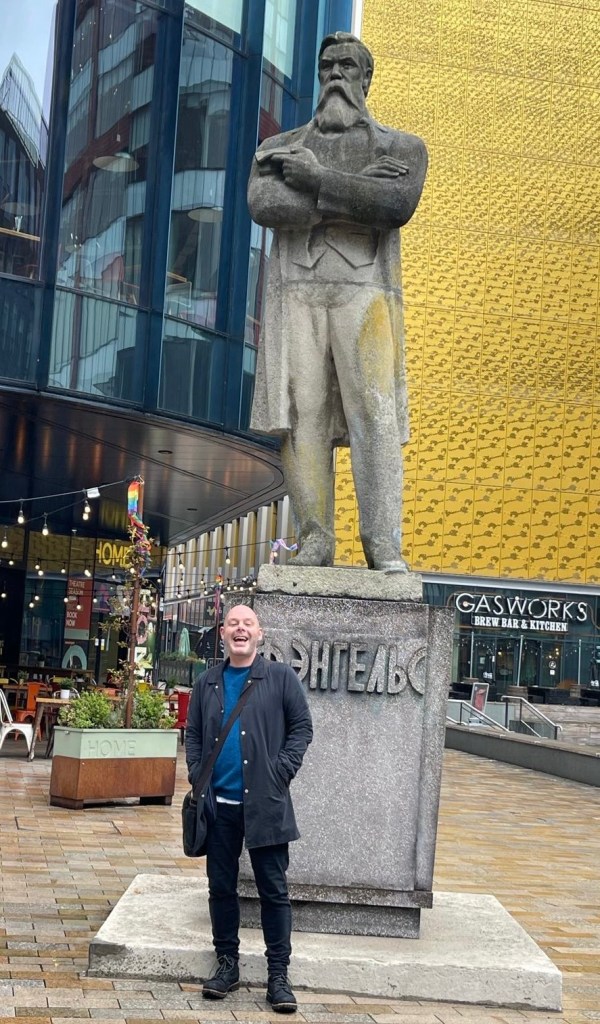
Smile and say ‘The emancipation of the working classes can only be achieved by the working classes themselves.’

I am a sucker for a Soviet relic but it’s weird that it’s a hop skip and a jump from the Engels Apartment- a £2.5 million luxury penthouse named after the author of The Condition of the Working Class in England. I’m sure this says something about Manchester’s radical tradition but it echoes Engels’ assertion that the city is where, “The social war, the war of all against all is […..] openly declared.”

Alan Stewart.

Breaking the Fetters Chapter 16: The Caerphilly By-election.

Election Poster 1921.

This was the first parliamentary election ever to be contested by the British Communist Party. The decision to contest was taken by the Party Executive on July 16th 1921. The main reasons were, firstly, the severe attack on the party at the time sixty-eight leading Communists had been arrested and many of them, like myself, were doing hard labour. Secondly, the economic position was becoming desperate. In July, the unemployment figures, according to the Labour Gazette, were 2,178,000. Thirdly, it was a mining constituency and the betrayal of the miners by the right-wing Labour leaders had just taken place. Black Friday was only a few months before the by-election. During the miners’ struggle the party had supported them wholeheartedly throughout and in fact was the only political party to give full support, and we were therefore entitled to stand in a mining constituency. No doubt the reason that I was selected as the candidate was because I had been arrested for delivering speeches in favour of the miners’ wage demands and, when the election date was announced, was actually in jail only a few miles from the constituency. For these reasons the party decided that a contest was necessary and completely justified.

The selection of a Labour candidate created some trouble. A whole number of right-wing labourites, including Ramsay McDonald, were angling for what was considered a safe seat. However, the miners were so disgusted with the action of the right-wingers during the struggle of the Triple Alliance (miners, transport workers and railwaymen) and the final sell-out of Black Friday, that they had no hope of support from the miners’ lodges. The eventual choice of candidate for Labour was Morgan Jones. Like myself, he had been a conscientious objector during the war, but only on religious grounds. He was one of the big guns of the Independent Labour Party, a Baptist lay preacher and at the time of the election, Chairman of the Bible Classes in the valley and, as Tommy Jackson said, “this endeared him to the old women of both sexes”. He was a nice chap but not a virile working-class politician. The Coalition (Tory- Liberal) candidate was Ross Edmunds.

Morgan Jones had the full Labour election machine behind him- the Labour Party, the Miners Federation and the Daily Herald. Even the Free Church Council campaigned vigorously on his behalf. The Daily Herald laid it on thick. “A brilliant young man with a promising career before him–a man who was born among you a fine Baptist who can speak Welsh.”

The government candidate, Edmunds, had the traditional Tory and Liberal Party machines and all the capitalist newspapers on his side. To match this, we were a handful of rebels, maybe sixty in all mostly strangers to the district–with no election machinery, no tradition, no money, nothing to give except the “message” of working-class struggle to gain political power. Our main slogan during the election was ” All Power To The Workers”. Yet we conducted such a powerful political campaign that three days before the poll the Labour Party got the wind up, and in the Labour camp, with its big battalions, the word went out to smash the Communists. The Labour Party bullied, cajoled and wheedled and finished with an SOS- “Don’t split the vote and let the Coalition candidate in”, while the chapels worked overtime calling for the protection of Morgan Jones from the ungodly Reds.

We had a wonderful team of speakers- -Bill Gallacher, Helen Crawfurd and John McLean from Scotland, Walton Newbold, Arthur McManus, Bert Joy, Harry Webb, Joe Vaughan, who came within a hair’s breadth of winning Bethnal Green for the Communist Party in the 1924 parliamentary election, Tommy Jackson and myself. Open-air speaking was our strength. We opened our meetings in the Square in Caerphilly at ten o’clock in the morning and closed them at eleven o’clock at night. We swept the Coalition candidate supporters from the streets altogether, they retired from this arena defeated. Early on in the campaign, a Coalition speaker challenged Harry Webb during one of his speeches to a debate, and this was arranged to take place at Abertridwr. The hour arrived for the debate but not the Coalition speaker; he did not turn up. Bill Gallacher had a debate in public with a group headed by Captain Gee, VC. It was a political massacre of Coalition policies. One of my happiest recollections of the election was of a meeting when Edmunds asked me to state where I stood in relation to the industrial strife in British industry, and then I watched his face as I replied. His fixed conception of the inevitability of the master-worker permanent industrial relationship took a very hard knock.

I remember one night Gallacher and I were speaking at a place called Sengenet. The local synod had been having a meeting and when they finished a number of ministers came around the meeting to have some fun. “Ah! The Bolsheviks! Why don’t you read the Bible?” shouted one of them. Now that was a real question! Challenging Bill Gallacher and me to read the Bible! We gave them Bible lessons they had never dreamed of. Then, when they were quietened, and the audience were laughing their heads off, I told them quietly, “That’s what you get for putting people like Gallacher and me in gaol and making the Bible compulsory reading.”

Another time Tommy Jackson was holding forth to an audience in Caerphilly, when on looking up he noticed that the tower of the castle was leaning to one side. “There you are,” he said, “even the castle tower is leaning to the left.” It was just as well he was holding the meeting at that stance because if he had gone to the other side he would have seen it leaning to the right. Still, Tommy was always one to make the best of any situation.

Apart from our splendid team of propagandists we had dozens of hard workers on the knocker, selling our pamphlets, chalking, arguing in the streets and in the pubs. Everywhere there were people, our fellows were there. Many of them were unemployed and had come from all over Scotland, London, the Midlands and from every part of Wales- to help the party. To go into the committee rooms late in the evening and watch this bunch getting their shake-downs ready for the night was like walking into a picture from John Reed’s Ten Days That Shook The World. But they were a real bunch of first-class fighters. Dai Davies had charge of the Election Address and the job was done competently and on time.

In our campaign it was the transport that took the eye. One national newspaper talked of “Bolshevik emissaries rushing through the Caerphilly Division in expensive cars.” Actually, what happened was that Jimmy Shand came down with his big car from Liverpool and it did valuable service. It was certainly a big flash car; it seemed to hold dozens at a time and with great speed transported speakers and workers to the assigned places. Jimmy was possibly one of the best car drivers I ever knew, certainly one of the few I would sit back and trust on a pitch-black night, driving on a Welsh mountain-side.

The night before the poll I was talking to some journalists who were covering the election. They said, “Your speakers are first class, they have made a great impact. They have destroyed any chance the Coalition candidate had of pulling a patriotic vote-catching stunt, but in attacking and exposing the weakness of his policy you have created a real fear that a split vote will let the Coalition candidate in. You have frightened the Labour crowd and made them work as they have never done before. Your campaign has made the voters class-conscious enough to make them vote Labour but not enough to make them whole-hog Communists.” One should never under-estimate the wisdom of press reporters when speaking off the record and not for their papers, because the final result on polling day bore out their estimation:

Morgan Jones (Lab.) – 13, 699

Ross Edmunds (C. & L.)- 8, 957

Bob Stewart (Comm.) – 2, 592

We lost our deposit. We had spent all our money. In a constituency twenty miles broad, to cross which meant climbing three mountains real ones, not home-made mountains, as Ernie Brown called the slag heaps at the pits. We had given all the energy we had in a tremendously exhausting campaign. What did we get in return? In South Wales mining districts in 1921 there was mass unemployment, a psychology of gloom and despair. Labour was chanting “Leave it all to Parliament- direct action is dead”. We roused enthusiasm in many who had lost hope; we won an understanding that action by the rank and file was essential. We put light back in eyes grown leaden with despair, the spring back in the step of many a young miner, we painted a picture of a future of opportunity and prosperity.

For the first-ever Communist parliamentary election contest this was a real achievement. As the crowds waited for the result of the election, Gallacher, in his inimitable way, started a sing-song and soon everyone had joined in. When the result was announced, you would have thought by the shout that greeted the Communist vote that we had won the seat. We did not win the seat but we won many other things including, most of all, the appreciation that the British Communist Party had a right to take its place in parliamentary elections, against the alleged statesmen whose policies spelt ruin to Britain.