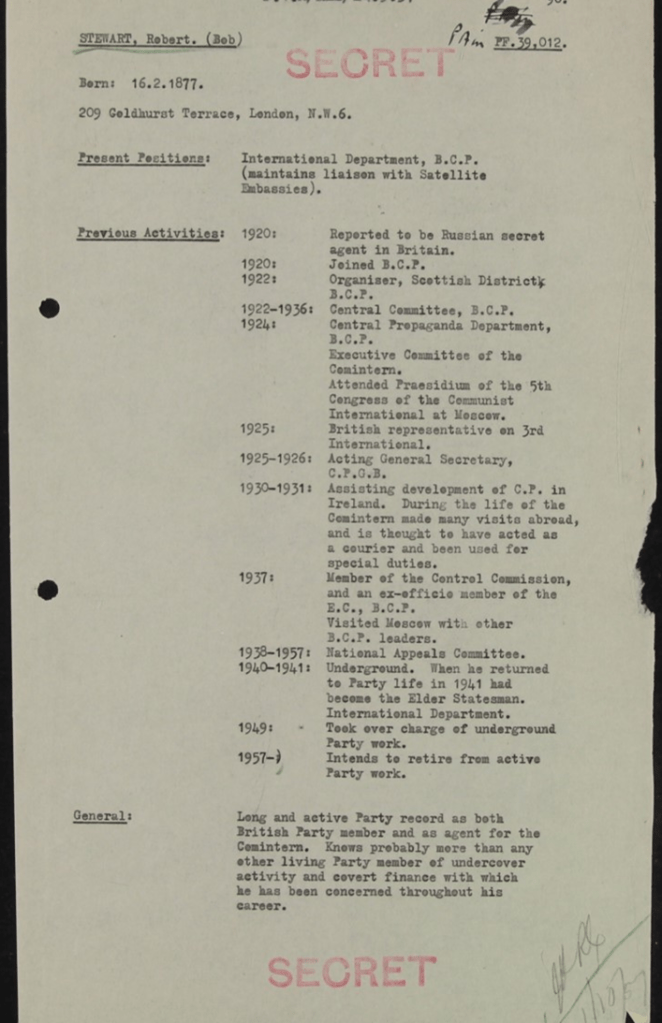
Despite Bob Stewart – the communist spy being a background presence throughout my life I never once took my copy of his autobiography ‘Breaking the Fetters’ off the shelf and read it until my mid forties during the first COVID-19 lockdown. To be honest I’d been reluctant to tackle it for a long time fearing an unreadable droning of a stern and unrepentant Marxist-Leninist full of words and phrases that I still don’t fully understand like ‘surplus value’ and ‘commodity fetishism’. I’d imagined the kind of person who, just at the point when everyone wants to leave a three hour meeting, starts bringing up endless points of order while everyone else coughs and sighs while dying inside. It was a surprise and a relief to find that spending a few hours with him, through the years, through his printed words was, by and large, a joy. I found someone with a deep sense of justice, of compassion and who possessed a sense of humour as dry as the bar at the temperance movement’s Victory Lodge.
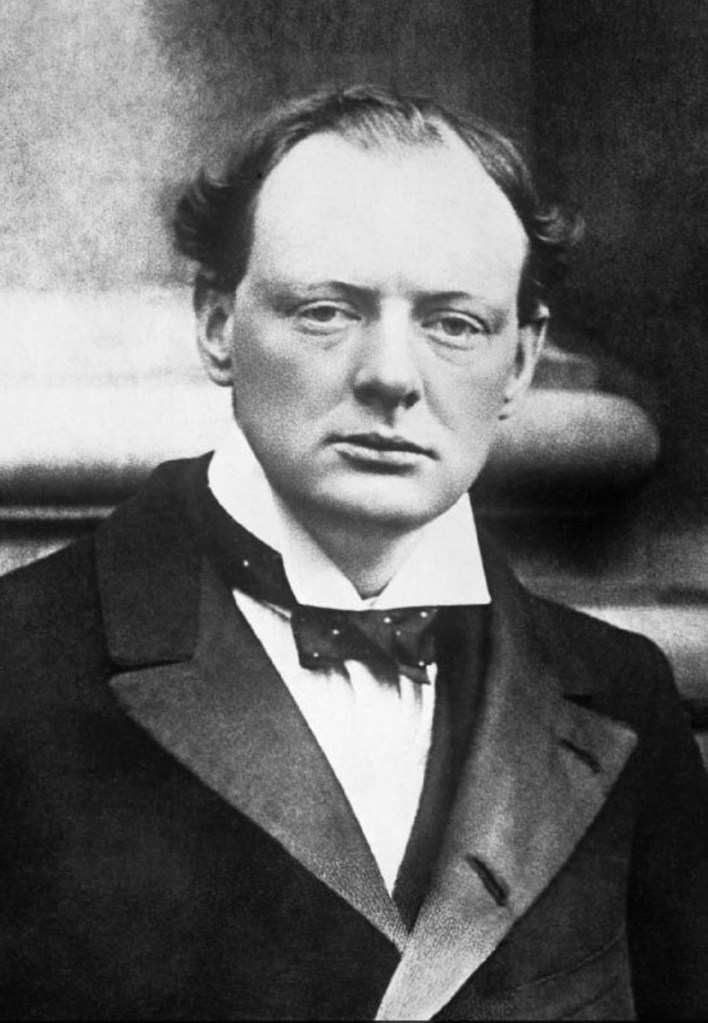
A highlight was Bob’s encounter with Winston Churchill early on in the future Prime Minister’s career. Surreally, so many years after his death, Churchill looms larger in our national consciousness now than at any other point in my lifetime. Towering historical figure he may be but he’s now revered in a way he simply wasn’t in his own time. The heavy jowelled, bulldog appearance synonymous with British grit and determination in the face of the enemy to those convinced they fought them on the beaches even though they were born in 1963 and the closest they’ve got to combat was watching ‘The Dambusters’ endlessly just because you can’t say the dog’s name these days. Voice any slight criticism of the Harrow and Sandhurst alumni and his conduct regarding Gallipoli, or striking miners in Tonypandy or famine in Bengal is tantamount to treason. There’s a whole generation of people out there who believe that the scene in ‘Darkest Hour’ where Gary Oldman in bald cap and fat suit is riding on the London Underground and a representative cross section of the population travelling with him offer him their unanimous wholehearted emotional support is literally true. But it wasn’t like that. It never is. Whole nations rarely take serving politicians to their hearts- they cause too much damage on the way. Watch the footage of crowds at Walthamstow Stadium booing the great man while canvassing for votes in the general election that followed our victory in the Second World War. Look at how decisively the electorate booted him out that year. Churchill on the 5th of July 1945 represented a return to the old way of life and he was comprehensively rejected.
Whatever your views on him however, there is one pillar of Winston’s appeal that is ingrained into the British psyche– his herculean capacity and tolerance for the grape and the grain. He was, by all accounts, a sot. One of the greatest drinkers of the twentieth century. If you locked Oliver Reed, Peter O’Toole, Richards Burton and Harris and, oh, let’s say Dylan ‘Drink Canada Dry’ Thomas together with the nation’s favourite Prime Minister in the Coach and Horses overnight I know which one would I would bet on being the last one standing when the owner came to open up in the morning. It wouldn’t be the actors and it wouldn’t be the poet. Churchill would still be there pouring himself a whiskey mouthwash and ignoring the smoking ban. So, when my great grandfather met Churchill for the first time in 1908 they were not only political opposites– the one being an advocate for the cause of the working class, the other a patrician born into the highest levels of the aristocracy- they were divided on what Bob considered the most moral question of the time – the production and sale of alcoholic beverages. The temperance movement had got Bob early and it was the damage that drink caused in working class communities that most concerned him.
Bob had recently returned from South Africa and his miserable experiences in Pretoria and Cape Town cemented his wish to fight the exploitation of ordinary working people and so he decided to go into politics full time. Up to this point he writes that his life had, “consisted of finding a job, trying to keep it, trade union work, organising in the temperance movement, speaking and debating on radical platforms and reading and trying to assimilate the new revolutionary socialist ideas.” The polar opposite of the life of an aristocratic, high Tory grandee such as Churchill. Bob became a full-time organiser for the Scottish Prohibition Party and in 1908 he was elected to Dundee Town Council where he worked to alleviate the effects of endemic unemployment and hunger through organising soup kitchens, food donations and tree planting schemes to provide much needed work. Around this time Winston Churchill, eight years into his Parliamentary career and enjoying an opportunistic dalliance with Asquith’s Liberal Party found himself having to contest a by-election in Dundee. This was occasioned by him having been promoted to the cabinet by being appointed President of the Board of Trade and this required him, due to the regulations of the period, to face the electorate again in his constituency of North West Manchester. Embarrassingly, he lost to the Tory candidate. At this point, he was parachuted in to contest a seat in Dundee. For Churchill the stakes were high – if he didn’t win then his future in politics was in doubt. Young Winston threw himself into his campaigning with his customary energy but Bob, working as election agent for the Prohibition Party candidate couldn’t help but notice “the gulf between Churchill’s oratory and the living reality” on the streets where meetings were held. While in a packed Drill Hall Churchill declared, “Britain has great imperial strength. We have belted the world with free institutions!” my great grandfather pointed to the Sherriff Court next door, the salvation Army Home for fallen women across the street, the Parish Council Lunatic Department next to that and the nearby Curr Night Refuge for homeless people. Tick off any of Beveridge’s five great evils – want, disease, ignorance, squalor and idleness – it was as unlikely then as now that any tory in a liberal disguise would throw a life belt or offer so much as a sticking plaster to those in suffering. Let alone the institutions of empire. That said, and true to the eternal frustration of the left whereby the proletariat inevitably vote against their own bloody interests, Churchill romped home with a comfortable majority. “How do you think it’s going?” he asked Bob at the count. “You’re in by a mile, worse luck,” was my ancestor’s reply.
Nevertheless, earlier on that evening – with his future in the balance – Churchill was agitated. Bob noticed him alone twisting little rubber bands around his fingers until they snapped and pacing the floor. Seizing the opportunity of the seasoned temperance campaigner he struck up a conversation with him while the Liberal votes started to pile up and the aristocrat’s cabinet position was increasingly secured. What concerned Bob most would be what his opponent would do in Parliament to bring the banning of the sale of strong drink into law. Eventually the Lord Provost sidled up to the veteran temperance campaigner and remarked, “I understand you’ve been trying to convert Winnie to prohibition. By Christ! Bob, you never give up!” In his memoir Bob, laconically observes:
“He said it in a voice of admiration for my courage and with the certainty that I was on a forlorn quest. As later years proved, Churchill and the prohibition of strong drink were poles apart.”
The understatement in that last sentence serves as an elegant example of his humour. Bob looked on as the electorate hoisted Churchill onto their shoulders at the moment of victory and then deposited him in is automobile outside and then proceeded to carry him- in his car – down the street. No doubt much strong drink was taken that night. However, this anecdote also highlights one of the problems of those in the temperance movement. That of separateness, of being apart. Your concern for the less fortunate making you holier than thou. Bob found it hard to understand the pleasures drink can bring – the release, the freedom, the escape. At one level it shows an inability to understand the people you’re supposed to be representing – clearly the path the Communist Party of Great Britain was on when Bob was writing his memoirs in the mid-sixties. However, by the time Bob was heading into his forties he wasn’t yet a communist, nor did the organization that he would dedicate the rest of his life to exist. It would take the First World War to bring that about.
Alan Stewart.

 Breaking the Fetters