This Land Is Your Land. (Night Off).

Gillian Welch, David Rawlings and Breakfast With Friedrich Engels.

David Rawlings and Gillian Welch at Manchester 02 Apollo. Picture shamelessly nicked from The Guardian.

I hadn’t realised quite how worried I was about the possibility of Reform winning the Caerphilly by-election. Their polling and subsequent media coverage made it seem inevitable that the hard right populists would topple Labour’s century held dominance in the area and return a Member of the Senedd. The Labour Party were trailing a pitiful third place and ran a dismal campaign, plaintively lying to the electorate that they were the only ones who could stop Farage’s candidate. My brother pointed out that they could get fewer votes in the area than our great grandfather did. In the Caerphilly by-election of 1921 Bob Stewart, fresh out of prison, stood as the first ever CPGB Parliamentary candidate and came last in a three horse race against Labour and the Liberals. He received 2, 592 votes – 10.3% of the total. The CPGB were never an electoral powerhouse. Thankfully, in 2025, the Reform victory was not to be. I think a lot of people were spooked by the polling and voted for Plaid Cymru who romped home by a comfortable margin proving swivel eyed racism is not the only game in town. Though over a century later, Labour’s share of the vote was only marginally higher than Bob’s achievement- they scraped 3, 713 – 11.02% of the total. A humiliating indictment of the party which was, until comparatively recently, my natural home.

Despite Reform’s defeat in Wales I don’t think the danger is over. The swing towards them was worryingly impressive. So, a pause in their ascendancy; not a total wipe out. That the Conservatives lost their deposit is cold comfort.

The prospect of Reform winning power terrifies me. I’m a child of the post war consensus. Just as Margaret Thatcher was dismantling it I was lucky enough to catch the tail end of its benefits and it formed my political worldview. All I want is a compassionate welfare state working as an effective safety net against poverty, an NHS which remains free at the point of use, the opportunity to pursue education for its own sake without the fear of impoverishing yourself and decent housing for all. In this day and age that’s tantamount to living in cloud cuckoo land. I’ve probably got another eight general elections left to vote in before my death and the realisation that I’ll never see the building a New Jerusalem is dispiriting to say the least. The possibility of it ever existing retreats as another round of endless migrant bashing takes hold.

America, with its mad king and ICE paramilitaries disappearing people on its streets gives an indication of the direction of travel should Farage wind up in Number 10. But, after you’ve stopped the boats; after you’ve deported your friends and your neighbours; after you’ve waged war on woke, shrunk the state even further and redesigned the economy in the mould of Javier Milei what happens when people realise their lives are still shit? Rising inequality and poverty will not simply disappear. I’d like to think we could avoid reaching this point but I’m not optimistic. As a country we seem set on becoming smaller and meaner. Trapped in a doom spiral of spite.

Hope and defiance are in short supply and you have to cling on to them when they come your way. Being on the left, I’m used to being on the losing side and I need my consolations. The Gillian Welch and David Rawlings concert in Manchester on Saturday night might just keep me going for a little longer.

I was first introduced to the Nashville pair’s music through the soundtrack to the Coen brothers’ O Brother Where Art Thou? – a dustbowl retelling of The Odyssey. But it wasn’t until I met my partner, who was a huge fan, that I really began to take notice. Almost twenty years ago she gave me Welch’s third album Time (The Revelator) as a present and its earthly melancholy has kept me spellbound ever since.

I’ll remember one moment from Saturday night forever. Still amazed that two people on a bare stage, discreetly lit can weave magic solely from their pure voices and dizzying guitar picking. At one point they played I Hear Them All – a Rawling’s number. A quiet, plaintive song offering compassion to America’s downtrodden it takes on a special resonance while Donald Trump sits in The White House.

So, while you sit and whistle Dixie with your money and your power

I can hear the flowers a-growing in the rubble of the towers

I hear leaders quit their lying, I hear babies quit their crying

I hear soldiers quit their dying, one and all

I hear them all

I hear them all

I hear them all

Midway through the song the playing got more forceful and the pair segued into a spirited rendition of Woody Guthrie’s This Land Is Your Land. This folk standard has long been sanitised by over familiarity, the song often serving as a complacent call for American unity and a more palatable liberal reading of manifest destiny. Jennifer Lopez performed it at Biden’s inauguration. However, Rawlings opted for the rarely sung verses from Guthrie’s original manuscript. Verses which pinpoint the problems he saw in the United States in the 1930s and 40s in the manner of William Blake’s London.

In the shadow of the steeple I saw my people, 
By the relief office I seen my people; 
As they stood there hungry, I stood there asking 
Is this land made for you and me?

As I went walking I saw a sign there,
And on the sign it said “No Trespassing.” 
But on the other side it didn’t say nothing.
That side was made for you and me.

I don’t know where the tears came from but it was at this point that I practically dissolved. Luckily, my partner is used to this. I don’t imagine for a moment that Gillian Welch and David Rawlings are radical leftists but by Christ it’s a comfort to know there’s people out there who view the world with empathy and who know exactly who the real enemy is. I don’t know how we’ll escape from these bleak times but that performance offered a little bit of light. You can hear this version of the song on Another Day, Another Time, the live album celebrating the music of another Coen brothers film Inside Llewellyn Davies. It had a profound effect on me.

The next morning before heading back to Yorkshire we stopped to visit the statue of Friedrich Engels that stands outside the Home arts centre.
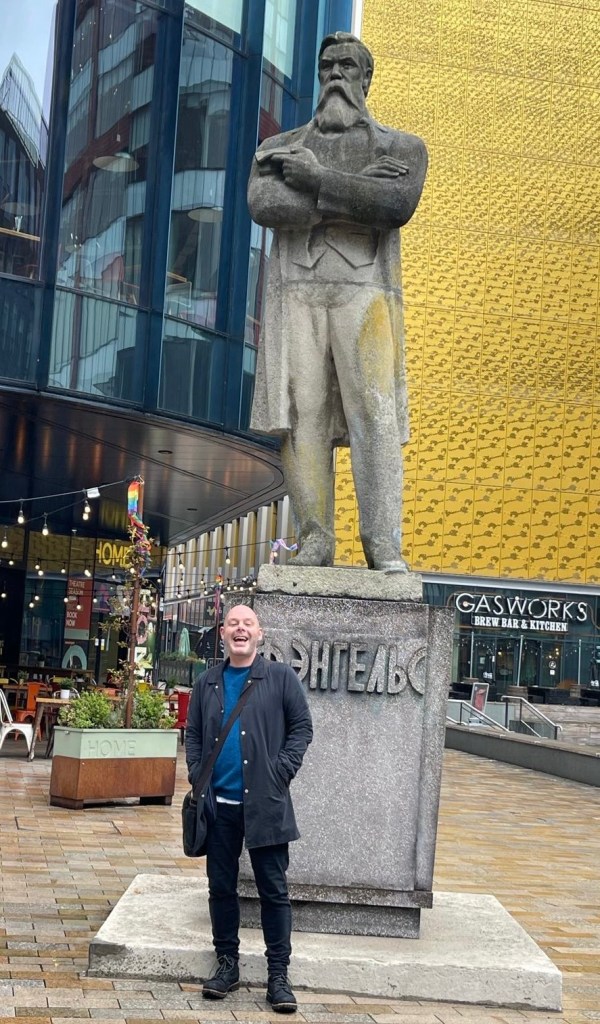
Smile and say ‘The emancipation of the working classes can only be achieved by the working classes themselves.’

I am a sucker for a Soviet relic but it’s weird that it’s a hop skip and a jump from the Engels Apartment- a £2.5 million luxury penthouse named after the author of The Condition of the Working Class in England. I’m sure this says something about Manchester’s radical tradition but it echoes Engels’ assertion that the city is where, “The social war, the war of all against all is […..] openly declared.”

Alan Stewart.
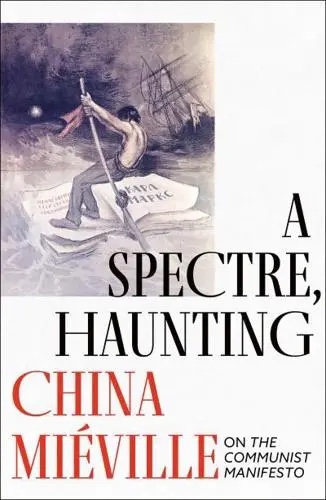
Books: ‘A Spectre, Haunting’ by China Mieville.

I have conflicting attitudes towards communists and communism. On the one hand, the sight of a YCL sticker in the gents of a Leeds bar last year prompted a warm glow of affection. It wasn’t something I’d ever expected to see in this day and age. It seemed so out of time. On the other hand actually seeing the YCL at a teachers’ strike demo a few months ago with their hammer and sickle flags brought out the feelings of contempt I usually reserve for the SWP and the right wing of the Labour Party. Clearly I prefer my communists in the past rather than the present.

I think it’s reasonable to be sceptical that the change we need can be brought about by anything declaring itself communist. The taint is there to stay. However, I can totally understand why people became communists in the 1920s and 1930s in the light of escalating poverty and mainstream politicians’ indifference to do anything about it. A century later and we’re in much the same position. With that in mind I recently listened to the audiobook of China Mieville’s A Spectre, Haunting. It’s a commentary on Marx & Engels’ The Communist Manifesto. Fiercely argued and compassionate it’s a powerful defence of the text and a good antidote to cynicism.

The last section is a reworking of Engels’ The Principles of Communism and I’m going to quote it at length here because I found it profoundly moving and it made me cry on the walk to work.

Early on Mieville asserts what it means to be on the left in this day and age. “It is to say that we deserve better, and that betterness is not impossible.” He then outlines a symptom of modern capitalism – the ruling of the US Supreme Court that “Nestlé has no responsibility, no guilt, for the use of child slavery in its supply chain.” This is not because the company were unaware of these circumstances but that they’re not responsible because it’s beyond the jurisdiction of the court. Nestlé has, “authority from the highest court in the most powerful state in human history to outsource slavery.” Mieville goes on:

“Welcome to capitalism. No, before you say that thats a terrible anomaly, or a questionable ruling, or a regrettable side effect of a flawed but otherwise decent system, or anything, ask yourself, how many such does it take before you can diagnose a fundamental dynamic? A way of things? Welcome to capitalism, where in the heart of ‘civilisation’ outsourced child slavery is acceptable. To be a communist is to say not just that this is a world of systematic barbarism and cruelty, not just that this is what it is to always prioritise profits over people, but that the system that does this is strong, and adaptable, and seeps into every area of our political and economic and cultural and psychic lives, and so whatever bulwarks and defences and counter-attacks we make against it, as we have done and will again, they will always be embattled, strained, constrained, rowed back, pushing against the fundamental tide of a society in which the vast majority of people are expendable for the profits controlled and sought by a very few. To be on the right is, at base, to say at very minimum that nothing can change, nothing can be done, systematically, to alter that system – if not that such a system is desirable, and that it’s more important that some have the power to control the world, even if that means others in vast numbers suffering and being without power. To be on the Right is even, increasingly, to say that that suffering is a good in itself And for all that there are those who’ve made their peace with power or enjoyed the cruelty of the moment, this isnt, moralistically, to separate people into Good and Bad. Capitalism implicates us all. We can’t live outside of it we can’t think outside of it. No wonder the circuses that increasingly take the place of bread appeal, even against our own better angels. But the system isn’t seamless, and we can all change our minds, and the world. None of us is born a communist, any more than we’re born capitalists, or sadists. And is it any wonder that for whatever knowable and unknowable reasons individual minds change, they change en masse when history changes? How many times has the utter impossibility of change been proved, only for change to rock the world and throw up everything we thought we knew? Open up a glimmer to a life worth living, is it not possible, likely, that millions of people who now see no prospect of any fight ever making this a habitable world, who’ve been encouraged by our rulers to believe absolutely that the sum total of their input in the grand decisions of history is at best ten to fifteen crosses on a ballot paper for parties they don’t control and which betray them at every turn, might suddenly decide that in fact the fight is worth it, not only in principle, but because it might, just possibly, win? And those who don’t? Who, in the face of a prospective crack in history, push back and fight for this regime? They won’t be the enemies of the communists, then, they’ll be the enemies of humanity, a humanity changing and liberating itself, and that’s no licence for cruelty or spite, but it’s legitimate to struggle as hard as you must against the enemies of a better world. Yes, we know that even many who love us are bewildered by our ‘unrealism’, our la-la land dreamwork, our utopian foolishness, in striving for wha we strive for: but can you understand how unrealistic their beliefs are to us? Their wager that this system, this carnival of predatory rapacity, will ever be fit to live in? Their sad certainty that we can do no better?”

The final part of this section asks how people could achieve a better world. It around this point I started to well up.

“By the elimination of private property and its replacement by community of property. By rupture. Yes, we will change the existing state of things. Not ‘we’ communists: ‘we’ all of us who come to believe through the slow accretion of tiny victories and of defeats, too, by experiencing the solidarity of others directed at us and ours at them; we who change our minds when the blared lie that ‘Nothing can ever be different is heard for the lie it is, whether or not difference follows; we who reach the tipping point where this unliveable disempowering tawdry ugly violent murderous world can no longer be lived; we who don’t believe the barked insistence that the best targets for the exhausted rage that follows are black people or brown people or Jews or Muslims or queers or trans people or migrants or children in cages; we who for whatever reasons don’t succumb to or who recover from the sadism that is inculcated and encouraged by this same system that endlessly hoses down true sentiment with caustic sentimentality; we who come to believe not only that we deserve better, but that there is a chance, a chance that we can build that betterness. Yes. Yes we will change the existing state of things. Not we will in the sense of it is inevitable but in the sense of it is not impossible, in the sense that it is necessary, that it is utterly worth the wager and the fight. In the sense that living with that Yes smouldering at the core of you, next to, as, ultimately stronger than the also smouldering No of necessary hate, is the only way to come close to existing, to living as a human, in so foul and monstrous and in- and anti-human a system. Yes. Yes we will change the existing state of things.”

Apologies to those YCL members at the demo. I have huge issues with the (several) iterations of the British Communist Party but if you see yourself in Mieville’s words here then we’re not so far apart.