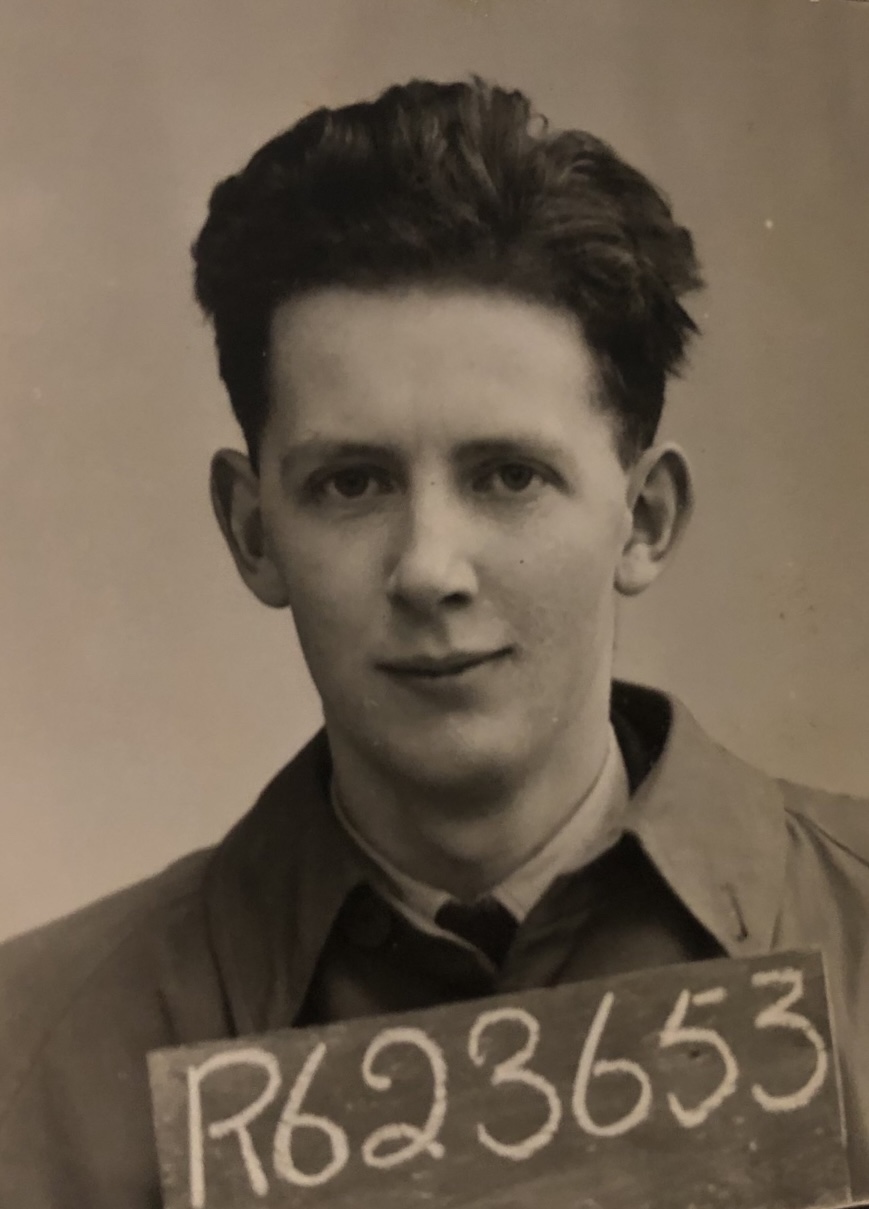
Comrades: Michael Robin Stewart.

Michael Robin Stewart (1933-2018).

Before it got dropped from the GCSE English Literature syllabus, I used love teaching ‘Before You Were Mine’ by Carol Ann Duffy. In the poem, Duffy describes a photograph of her mother as a teenager, laughing with two friends on a Glasgow street corner in the 1950s. The wind blows her polka dot dress around Marilyn Monroe style. Duffy was recently bereaved when she wrote it and the snapshot presents an altogether different person from the parent she knew. The image prompts her to imagine the intense years of teenage life and early adulthood of her mother a decade before she was born. Growing up, Duffy caught glimpses of the person her mother used to be but, of course, they had become someone else entirely.

The poem offered me a lot of scope in the classroom to do what I do best: show off a lot. Nicking my partner’s high heels so I could act out the infant Duffy walking around in her mother’s shoes and bringing in a stray disco ball we had in the living room and suspending it in front of the Smartboard projector to mimic a dancehall from the mid twentieth century. All of this, I imagined, would highlight to the class the distance between who their parents were now and who they used to be. I’m not sure how much my students learned but I had fun. It’s strikes me now that that a tendency to put on a performance at the drop of a hat and a love of poetry are two of the main things I’ve inherited from my dad. My most perfect memories of him are when he was entertaining crowds of drinkers during Christmas and New Year in the pub he ran and, at other times, being the only person I knew who would sit quietly reading poetry behind the bar on a slow afternoon shift while the cigarette between his fingers became three quarters ash before collapsing all down his front. My parents had children quite late on in life for their generation and perhaps it’s because my father and Duffy’s mother would have been roughly contemporaries that this particular poem resonates with me. When he died I came to realise there was so much about him I didn’t really know.

To my brother and I he was ‘Dad’, to practically everyone else he was ‘Mike’ but to his side of the family, who we rarely met, he was ‘Robin’. I have a mountain of photographs of him in his youth and, if I weren’t a terrible poet, I might attempt something along the lines of ‘Before You Were Mine’. However, by way of consolation, I have much more than old photographs. Thanks to the security services interest in his grandfather Bob, and to a lesser extent his own father Bill, both founder members of the Communist Party of Great Britain, my father occasionally turns up in the intercepted letters, transcripts of bugged conversations and observation logs of MI5, all of which are available at the National Archives. I can’t put into words what it meant to find him there. You’d expect there to be an element of Cold War spy movie glamour in all this but the reality is much more mundane. He was an odd figure to turn up in the files – categorically the least likely threat to the nation’s security who ever lived. That didn’t stop the state secretly documenting his existence by default. What follows are the moments where I’ve found him in the once top secret documents. Of course it doesn’t describe the person I knew – it’s an imperfect and haphazard depiction reliant on stray comments from many different people made years apart. The reader is unlikely to get an idea of of who my dad was from all this and whether it is of interest to anyone else I can’t tell but it matters little. I write all this down purely for my brother Ian, myself and our mother. We loved him and we miss him. It is the fifth anniversary of his death and we wish he was still here.

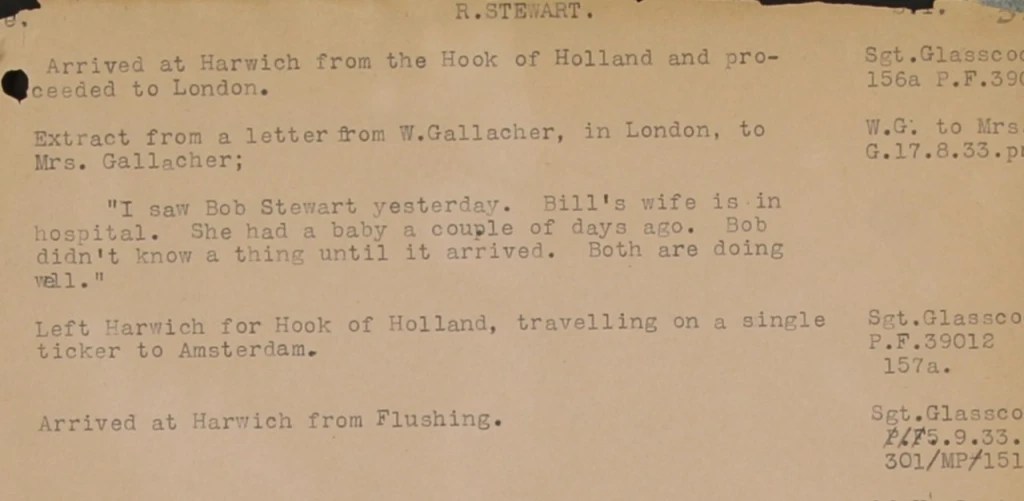
The first appearance is an extract from a letter written in 1933 by Red Clydeside hero and future Communist MP Willie Gallacher to his wife. He mentions Bob Stewart’s return from one of his many trips abroad and his surprise on his return to find out he had become a grandfather. The baby was our dad who was born a few weeks before.

…I saw Bob Stewart yesterday. Bill’s wife is in hospital. She had a baby a couple of days ago. Bob didn’t know a thing until it arrived. Both are doing well

Just over two years later dad appears in a letter from Bob Stewart to his daughter Nan and her husband Anatole Kaminsky. The couple had recently moved to Moscow and are eager for news about the family. Even as a toddler dad seems to be demonstrating one of his key characteristics- a love of the limelight and thriving in front of an audience.

…We have not seen Bill and family for a fortnight but they are all well and Robin has had more photographs taken. Everyone likes to take his picture and he quite likes it. We have now got a big one of him and all the lady visitors are taking him for a walk -he is so lovely to look at they say…. (8/10/35)

The next encounters are via the reports of MI5 agents as they follow my grandfather, eager to find out what exactly his job at the Soviet Embassy entails. It’s all very John Le Carre. Is it weird to know that spies were watching your dad play in the park when he was three years old? Yes.

17th August 1936.

re/ William STEWART, Soho Street, W

For thirteen days, between 30th July and 15th inst. observation was kept on this man but nothing of importance was seen except on 10th inst. when he and GLADING met for half an hour, between 1 and 2 p.m. at a public house in Queens Road, W.

STEWART attends the Soviet Embassy daily from 8 a.m. to 5 p.m. and appears to be employed there the whole of that time apart from his hour for lunch which he takes generally alone at a cafe or public house at Notting Hill Gate.

On leaving work he goes direct home and usually remains there although on one or two occasions he has taken his young child to play in Hyde Park…

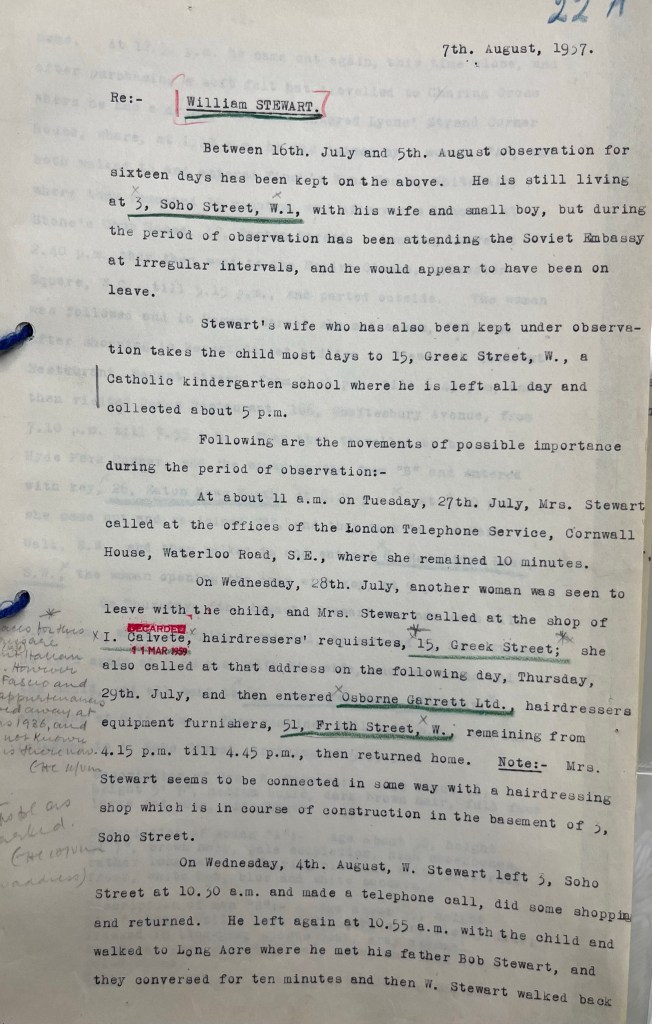
Surveillance was maintained on William Stewart throughout his employment at the Russian embassy to the extent that the security services are also following our grandmother on the school run at a discreet distance.

7th August 1937.

Re: William STEWART

Between 16th July and 5th August observation for sixteen days has been kept on the above. He is still living at 3, Soho Street, W.1, with his wife and small boy, but during the period of observation has been attending the Soviet Embassy at irregular intervals, and he would appear to have been on leave.

Stewart’s wife who has also been kept under observation takes the child most days to 15, Greek Street, W., a Catholic kindergarten school where he is left all day and collected about 5 pm…
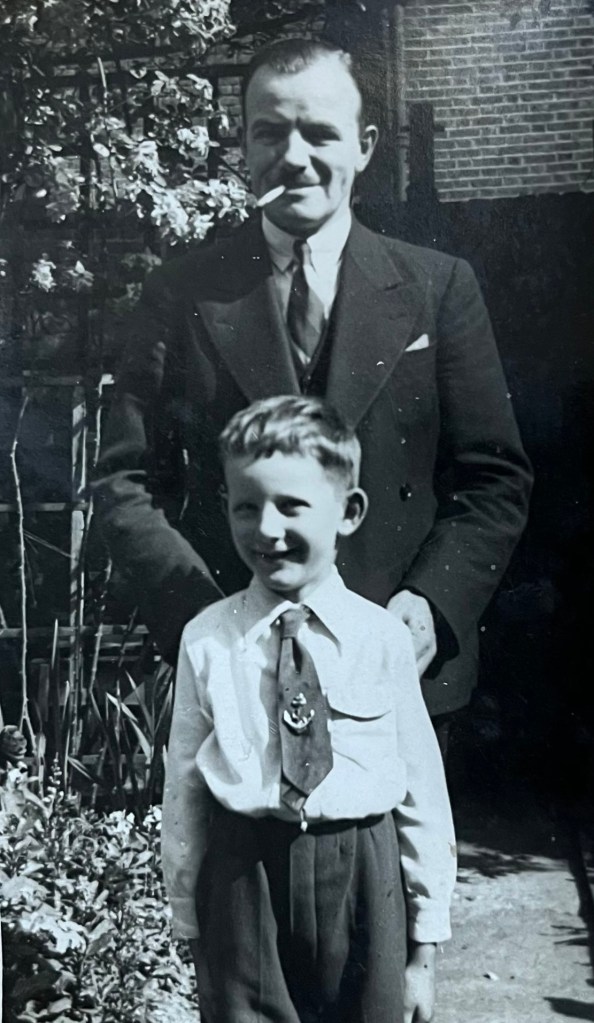
Our grandfather William with our dad sometime around the late 1930s or early 1940s.

There are a few other mentions of Dad around this time- always referred to as ‘the child’. Mainly mundane visits to shops or relatives. However, the surveillance comes to an end as by 1938 our grandad was no longer working at the Soviet Embassy. Moscow had decided their diplomatic service should not employ anyone who wasn’t a Soviet citizen and so his position no longer existed. For a while he was working away as the catering manager at Laycock Engineering Company in Sheffield. It’s looks like this was a position he took on for money rather than anything to do with espionage. However, MI5 weren’t taking any chances and began to intercept his letters home.

My own Darling,

I have just got in from a rather heavy day, Furnell and Bolton another chief (I’m wondering how many chiefs I have on this firm) have been this evening and are coming again tomorrow. Talk about slave driving it isn’t in it. They expect me to do a whole lot more yet and I gave them quite quietly a piece of my mind. Furnell says I am a good chap but I must get still higher percentage and I don’t see how it is humanly possible. If it wasn’t for the fact that jobs are so damn hard to get I would walk out on it. I don’t mind work and I have worked harder than anyone in Laycocks that’s Walker’s own statement. Now I feel that I am being played with and being used in some gigantic swindle. Anyway did “Our lad” get his “chewing gum” and you your “Woodbines”?

Bless you both I wish I had you here to talk to now don’t worry my pet I won’t do anything drastic but it is hellish when you work like a slave and to be told your giving satisfaction one minute and then something else the next. I feel so tired now so I will off to the post and then turn in.

Bless you both and keep you.

Yours ever,

William – your own Bill.

By the time The Second World War began, Bill had taken up the position of catering manager at Tottenham Lido and, apart from ensuring that he wasn’t called up due to his ‘past record’, MI5’s interest in him seems to have waned. Consequently, it’s not until 28th September 1951 that we catch sight of dad again. He would have been eighteen years old and, perhaps for the first and last time, a potential person of interest for the security services. A report from Essex County Constabulary outlines some concerns about William Stewart, licensee of The White Hart Hotel in Manningtree and his son after they had been instructed to make “discreet enquiries”. After noting grandad’s interest in politics, his meeting with far left associates and that he took The Daily Worker attention turns towards dad.

The son Michael has been attending a technical school in London to be trained as a chef and in hotel management.

He only comes home at week-ends, but not every week-end. His London address has not been obtained to date.

It is said that he has appeared on the stage in a Noel Coward production in London, and knows many actors.

He is shortly to be called for National Service (Believed October, 1951).

It is not known whether he attends political meetings. No political meetings are known to be held in this District.

It is known that this person holds Communist views. One customer pointed this out to the licensee who made no comment

Michael usually assists his father in the public house when he comes home.

Further discreet enquiries will be made as the opportunity presents.

The Noel Coward play was actually ‘The Dancing Years’ by Ivor Novello at the Casino which has since reverted back to it’s original name, the Prince Edward’s Theatre. It was his sole engagement, at the age of fourteen, as a professional actor. I remember the delight he took in telling us about the different characters that inhabited the Soho world that he encountered and how much he enjoyed the role of ‘Otto- the bastard son’. The idea of dad holding communist views is also interesting. Certainly not something he clung on too. In a way, it wouldn’t be surprising due to the milieu of his upbringing but as far as I know he was never a member of the CPGB. His parents were unusual in communist circles in that William had ‘married out’ – his mother Jess wasn’t a party member either. And she wielded a very strong influence over him. Growing up, it was Boy’s Brigade for dad rather than the Young Communist League. In later life his politics were broadly left wing but not particularly partisan. I remember him sitting on a beer keg the day after the 1987 Conservative victory smoking and looking folorn. “We’ll get through it somehow,” he said to me. In fact, the last video clip of him I have is from 2017. you can hear me off camera asking him how he was going to vote in the general election. Due to to vascular dementia it’s unlikely he could remember the name of the Labour Party let alone any of its major figures at the time. He looks straight at the camera and says, after some thought, “Socialist.”

As the police noted, Dad was shortly to be called up for National Service which is the subject of his next appearance in the files. There’s a letter from Bill to his father dated 27th November 1952.

…Robin was in slight trouble last week! he was put on charge for being unshaved, up before the Captain under escort hat & belt off – was admonished, the RQSM put a good word in…

While in the army Dad did make it to the rank of Sergeant a fact which will forever astound me because, if there is one single that could define him, it was his lifelong inability to distinguish between his left and his right. How he managed on the parade ground I do not know.
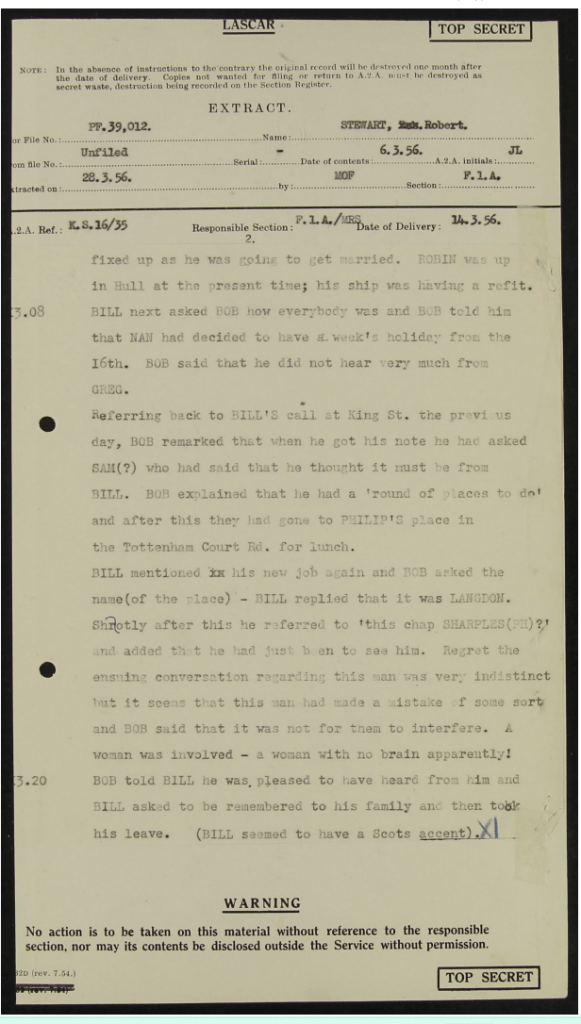
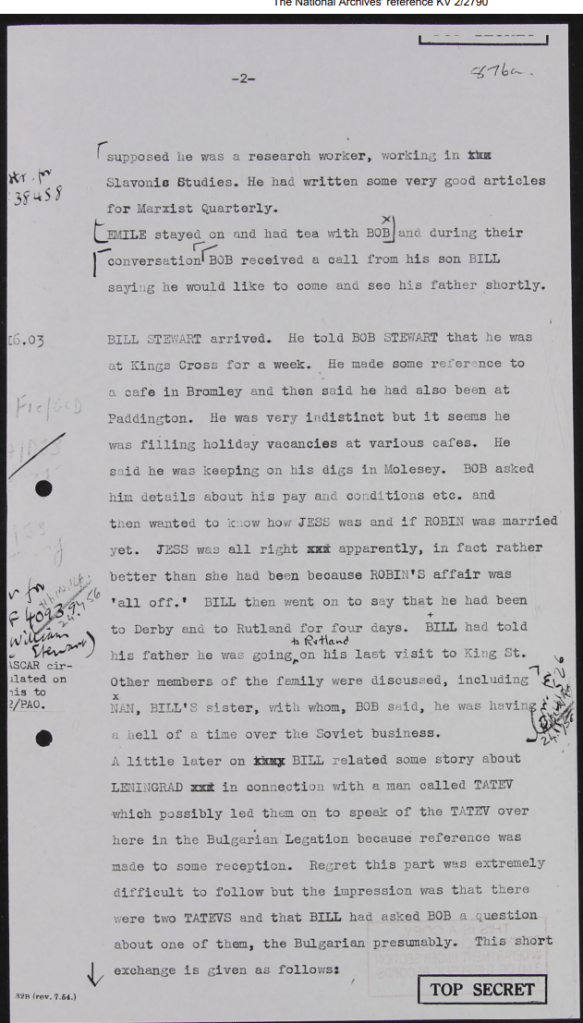
By 1956 Dad was in his early twenties and he drifts in and out of the files as Bob Stewart struggles with the twin shocks of Khruschev’s revelations about Stalin and the Soviets actions in Hungary. In March there’s a surprise as it appears he was about to be married. This was four years before he met our mother- my brother and I might never have been born. I imagine the photographs on mum’s mantlepiece fading ‘Back to the Future’ style.

BOB STEWART welcomed another comrade whom he later addressed as BILL. BOB asked BILL if he had come in the previous day. BILL replied that he had and had left a message because he had so much running about to do. BILL said that he had been after a job in Whitechapel in a coffee snack bar and he was to start on Tuesday. BOB wanted to know how this would affect ROBIN. BILL replied that ROBIN was getting his own little place fixed up as he was going to get married. ROBIN was up in Hull at the present time; his ship was having a refit. BILL next asked BOB how everybody was and BOB told him that NAN had decided to have a week’s holiday from the 16th. BOB said he did not hear very much from GREG…

In June, however, it’s all over much to the relief of Grandma Jess. No one’s good enough for her son.

BILL STEWART arrived. He told BOB STEWART that he was at Kings Cross for a week. He made some reference to a cafe in Bromley and then said he had also been at Paddington. He was very indistinct but it seems he was filling holiday vacancies at various cafes. He said he was keeping on his digs in Molesey. BOB asked him details about his pay and conditions etc. and then wanted to know how JESS was and if ROBIN was married yet. JESS was all right apparently, in fact rather better than she had been because ROBIN’S affair was ‘all off’. BILL then went on to say that he had been to Derby and to Rutland for four days. BILL had told his father he was going on his last visit to King St. Other members of the family were discussed, including NAN, BILL’S sister, with whom, BOB said, he was having a hell of a time over the Soviet business.

‘The Soviet business’ refers not just to the public reaction to Khruschev’s speech but the devastating news of what had happened to Nan’s husband, Anatole Kaminsky. He’d been arrested by the NKVD in Moscow in the late 1930s. Nan had escaped with baby Greg, my dad’s cousin, but they’d had no news for years. The new openness of 1956 brought with it the news that Greg’s father had been shot in 1941. Relationships within the family were strained and I have a feeling they remained that way from then on. Understandably Nan and Greg went on to reject communism entirely. Maybe the ramifications of this are why we never really knew Dad’s side of the family. Until relatively recently I was unaware of these events and I’m sad that I’ll never know the truth of it now because Dad’s not around to ask.

In addition to this, the Soviet invasion of Hungary ensured my Dad and Greg’s generation viewed the USSR with much more scepticism than their parents and grandparents. There’s a transcript of a tapped telephone call fom grandad to Bob which mentions Dad’s concern over the events in Budapest. Bob and grandad however are rather more defiant.

I/C call to BOB from BILL STEWART (BOB’s son). BILL, asks when BOB got back as he didn’t know he was back. BILL says something about telling MOIRA five weeks ago. He says the last he heard BOB was in the Sanatorium. He says GEOFF and ROBIN (Michael Robin STEWART – BOB’s grandson – son of Bill STEWART have been up in London, and he is now in a job at Liverpool Street where he starts early in the morning. BILL says he is in digs at Ampney Court but is going to try to get digs more centrally placed. BILL says ROBIN and JESS are fine. But ROBIN is worrying about the situation. BOB says there are only two sides in this business “our side, and the other side. Whether it’s mistakes or accidents or anything else of that kind, It’s got nothing to do with it. It’s a show down now, and we’ve either got to fight it through or not?” BILL replies “Yes that’s the line”. BOB says, “We can’t stand on the side lines”. BILL agrees saying “No, no, there’s no flagwaving in this business you either fight or you don’t.” BOB says “Very serious business, there’s no saying where it will end”. BOB says “The honeymoon’s over anyway, and the rest is just to be”. BILL asks about BOB’s trip to Russia etc. BOB says he travelled a lot and will tell BILL about it when he sees him. They will fix up something on the telephone arranging for BILL to come out one evening after his work to see them. BILL sends his love to everyone.
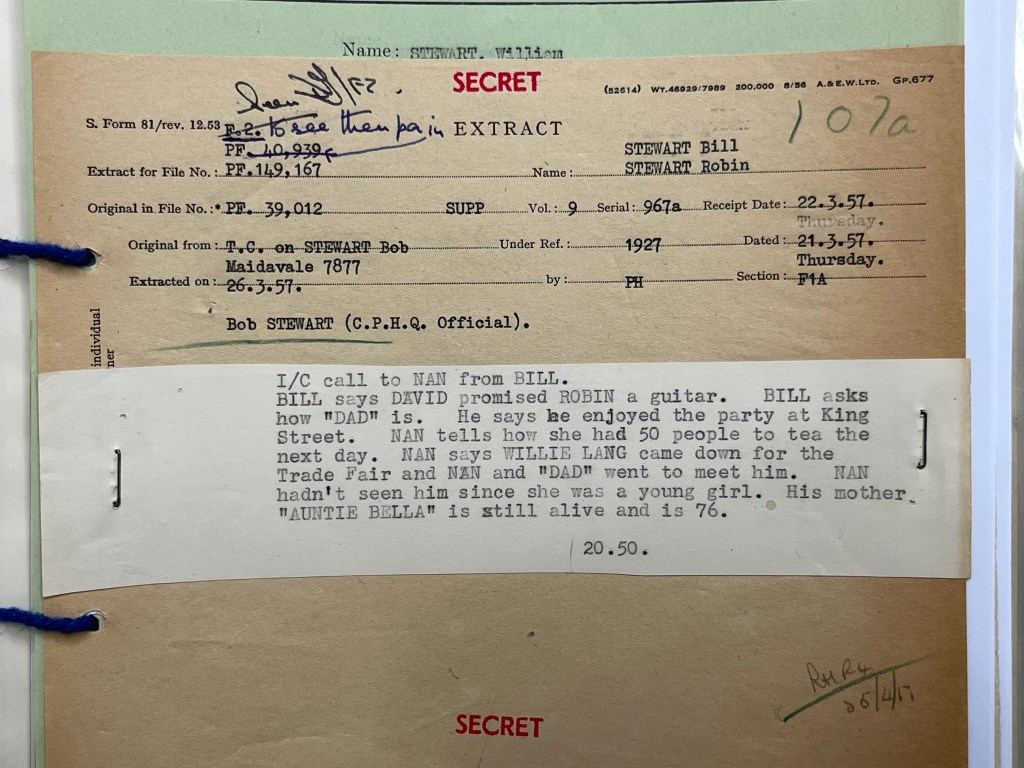
From 1957, other than a comment from grandad about his brother in law having ‘promised ROBIN a guitar’ dad starts to fade from view in the security files. There appears to be nothing for a decade. After all, grandad’s involvement in the covert world of Communist agitation seems to have dwindled and Bob is blind and bedbound. The last reference is a letter from grandad to John Gollan, the General Secretary of the CPGB dating from 1967.

Dear Comrade Gollan,

On behalf of my wife and I and of my son and his wife I wish to thank the Executive for this invitation to Dad’s birthday celebrations.

I do hope sufficient publicity will give rise to fast sales of the book to the benefit of the Party.

Congratulations to you for your ‘Socialism in the Sixties’.

This would have been Bob Stewart’s 90th birthday at the CPGB HQ at King Street, Covent Garden and the launch of his autobiography ‘Breaking the Fetters’. It’s also, I think, the only time my mother makes an appearance in the security files.

I had my dad for 45 years. He was wonderful and I treasure his memory. I do not know why I have to write all this down – I only know that it helps. Rereading Alison Light’s magisterial book on family history and why we need to know who came before us and what we owe them I came across these words from Joseph Brodsky, “What’s the point of forgetting if it ends in dying?” That might be part of it but, more importantly, and more simply, I wish I could speak to Dad now and learn more about who he was all those years ago before he was mine. But I can’t. So, this will have to do.

Alan Stewart.
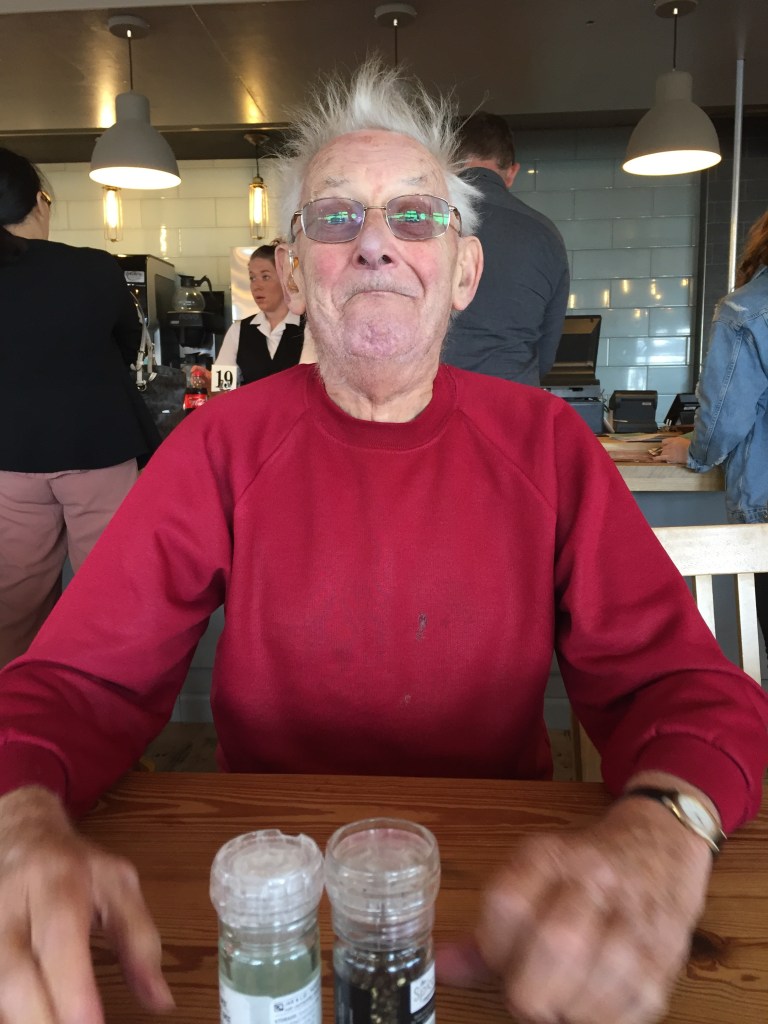
Michael Robin Stewart on his 84th birthday about five months before he died. I think this picture gives an indication who he really was. A gloriously silly man. I love you Dad x

Breaking the Fetters Chapter 11: Third Court Martial.

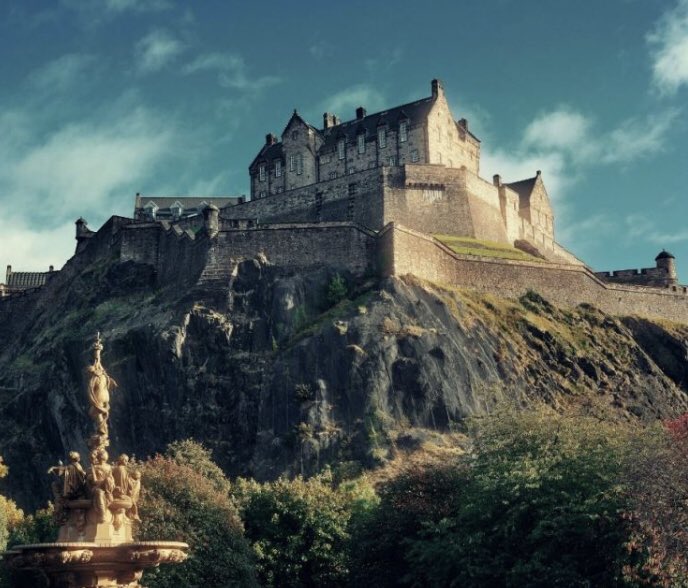
Edinburgh Castle.
Duffy, he got huffy,
And says he to little John,
“You've got no business talkin'
When you're out at exercise,
I've tould you that, I'm sure, until I'm sick."
“Ach, Duffy dear, recall the days,When you were human too,
Before you took a screw’s job in the nick.”
"There's got to be no more of it
Or else I'll lock you up;
Will yez promise that ye won't talk any more?"
“Ach bless yer heart, I couldn't promise,such a stupid thing,
I'd be speakin' to mesilf behind the door."

Bob Stewart’s Prison Rhymes

I was taken from Calton Gaol to East Linton to await my third court martial. The officer in charge there was a Broughty Ferry man (Broughty Ferry is a suburb of my home town, Dundee) and he asked me, “Is it true, Stewart, that while you were in Calton you got home at weekends?”‘ “If it is,” I answered, “I never noticed it.” “Well, that’s what they said in the Ferry.” “It isn’t the only lie they told about me in the Ferry.” As the Ferry was, and still is, the stronghold of Toryism since it became the home and playground of jute millionaires, I was certain I was right, but if anyone believed that conscientious objectors got weekends out from Calton Gaol they would believe anything.

Keeping me company in the line of court martials was a very fine man called Alex McCrae. A little chap who had been in Smyrna when the war broke out. When he came home to Britain he had declared his conscientious objection. His wife, a very pretty lass who was active in the No-conscription Fellowship, came to East Linton the day I arrived, to see her husband. Knowing this, McCrae asked the Broughty Officer in Charge if he could have a night out with his wife, which was granted. So when I arrived at East Linton I got a seat at a table set for four, McCrae, two of God’s own, Christadelphians I think, and myself. Knowing McCrae would be absent, these two others shared the third meal between them and never said “Would you like an extra bite?” I was so enraged that I rounded on them. “I don’t know which Bible class you were brought up in but there’s not a prostitute in the whole of Glasgow as mean as you two.’

Then off I went to Leith Street School for the court martial. The two men in charge were rankers, had risen from the ranks to this exalted position, and didn’t they let everyone know it. My wife arrived and they refused to let her see me. I got to know and demanded to see the orderly sergeant. “This is a
bloody lousy trick,” I said, “keeping my wife and kid from seeing me.” “I know,” he replied, “but it’s that fellow Cross (the ranker), he refused permission. But hang around and I think it will be all right when he goes.” And it was.

But at the court martial I got my own back good and proper. It was a real field day. Edinburgh Castle was the headquarters of Scottish Command and most defaulters passed that way. So there we were, a huge crowd in Leith Street, sergeants, corporals, privates, all in the queue; and there in the court- the Colonel and his henchmen.

Command: “Prisoners and escorts in!” So in we march, and are ranged in front of the Court. The Chairman said, “I am Colonel so-and-so, this is Captain —-and this is Lieutenant —-. By regulation I have to ask you, each one separately, if you are satisfied with the composition of the Court.” He didn’t say what would happen if anyone objected. Then he went on. “Sergeant —-, are you satisfied?” “Yes, sor.” Then it came to Private Stewart. No answer. A repeat, a bit louder, and still no answer. So he passes on until the queue is finished then bawls out, “All except Stewart.” At least there is no “Private” this time. He
then turned direct to me and shouted, “Are you satisfied?” “Before we come to that I would like to ask you a question,” I said. “What is it?” “How much notice should an accused get before he is court martialled?” “Well, that depends on the conditions.” “In the present conditions?” I asked. “Twenty-four or forty eight hours.” “What happens if you don’t get any notice?” I asked. Suddenly he whipped round on them lieutenant. “Did this man get notice? “Didn’t think it was necessary,” replied the lieutenant. “Case adjourned–prisoner and escort out!” shouted the colonel. “Wait here, Lieutenant.” My escort was standing, his eyes like glass, and the order had to be repeated. When we reached the corridor he was besieged by his mates. “What happened? What did he get?” “Made a bloody mess o’ them, case adjourned.” “Holy jees!” So the story buzzed around the escorts and accused, and all seemed highly pleased. Then the door opened and out came the lieutenant in a furious rage. “Take him back to barracks,” he shouted; then howled, “And see he gets no privileges.”

So we reach the street and then I find the escort is blazing mad. He had schemed that he could leave me after sentence and visit his wife who lived in Leith, only a mile away. “Well,” I said, “that’s tough on you, you haven’t done anything wrong. Why should you be deprived of a night with the wife? Why not buzz off and I will meet you in the morning?” “Can I trust you?” “Sure, I’ll be at the station in the morning.” So off he went to see his wife and I to see an old pal, Jimmie Leven, who lived out in Gorgie. There I had a great welcome, a bath and a good feed. In the evening Jim and I went to a Peace Committee meeting and I made such an impassioned speech that the secretary thought the war had come to his meeting.

I was soon back again and this time no mistake. All regulations duly observed – ‘Refused to Parade’ was the charge. So I was sentenced to two years’ imprisonment with hard labour (later remitted to one year). I was sent to the state prison in Edinburgh Castle. But I was not long there. My mother was much too old to make the journey to Edinburgh but naturally she wanted to see her youngest son as many times as she could. So she came a few times, and in the process discovered that the Governor came from the same part of the country as she did. When she had said good-bye to me, the Governor invited her into his office to chat–as we Scots say, “Hame crack ower farms and farmers, cattle and crops, lairds and tenants and the hamely fare o’ the countryside.” I remember my mother telling me about him saying to her, “What I canna understand, wumman, hoo wi’ a maither like you Robert’s an atheist.” “Aye;” she replied, “he was aye a great Bible student.”

My mother died while I was in the state prison, but military regulations would not allow me permission to attend the funeral. There was much local feeling about this because my mother was greatly respected by all her neighbours, and protests were made to the Lord Provost of Dundee. He did intervene and said he would vouch for my return. I was then transferred to civil imprisonment again in Calton Gaol for a few hours, and taken under a most inhuman warder to Dundee, where I arrived too late to see my mother buried; but I met the family, among them my two soldiering brothers who had managed to get leave. The warder was in a hurry to get back to Edinburgh and so he dumped me in Dundee Gaol. More deputations to the Lord Provost and the upshot was that it was decided I would do the rest of my time in Dundee. Dundee was a smaller prison than Calton, and at that time, much to the chagrin of the warders, not fully occupied. How well I remember their glee at reception of new prisoners. Not that they were more devoted to duty or softer-hearted than the turnkeys at Calton, but the massacres in Europe were eating up hosts of men, and patriotic as the warders naturally were, they were not at all anxious to be called up to the front for service.

As a matter of record, I helped some of them make out their claims for exemption on compassionate, domestic or other grounds. So the warder who locked me up for resisting military service then asked my assistance to fill up his application form for exemption so that he could continue to lock me up!

Jute being the staple industry of Dundee, the situation in its prison was more or less the same. Teasing jute ropes, making and sewing sacks for coal, copper, meat-packing, etc. The working day was ten hours, sixty sacks, sides and bottoms, being the daily norm: a smaller number of coal sacks, which were heavy and hard to bore with the needle. Of course, all material was hand sewn, there were no machines, and the work was primitive and not very economic. At times my work was in association with a fellow called Tammy Sword, a local worthy doing his fifty-second sentence for being drunk and disorderly. When he got really drunk he boasted that it took half a dozen policemen to carry him to gaol, where he was more at home than in his own home.

The warders appreciated Tammy’s capacity as a sewer. He set a hard pace for his fellow prisoners, but he had a soft spot for me. “Dinna sew any, Bob,” he would say,”tak’ some o’ mine to mak’ up your lot.” Dave Donaldson and I were
couriers in a romance with his sweetheart, who was doing time in the female part of the gaol. Dave was working with the artisan warder who did the maintenance work, and so was able to move around. In this way amorous notes were exchanged between Tammy and his lass with great regularity. Dave Donaldson was a beam and scale maker, and was handy at pipe fitting and whatever small smithy work had to be done. When necessary I was his labourer. We changed over when there was a carpenter’s job to be done, I then becoming
the skilled man. We painted and whitewashed too, and were getting quite proud of our skill until Willie Findlay, another “conchie” and a painter by trade, came to do his hard labour. Then we sadly gave in and admitted that painting was a trade.

The Death of V.I. Lenin.

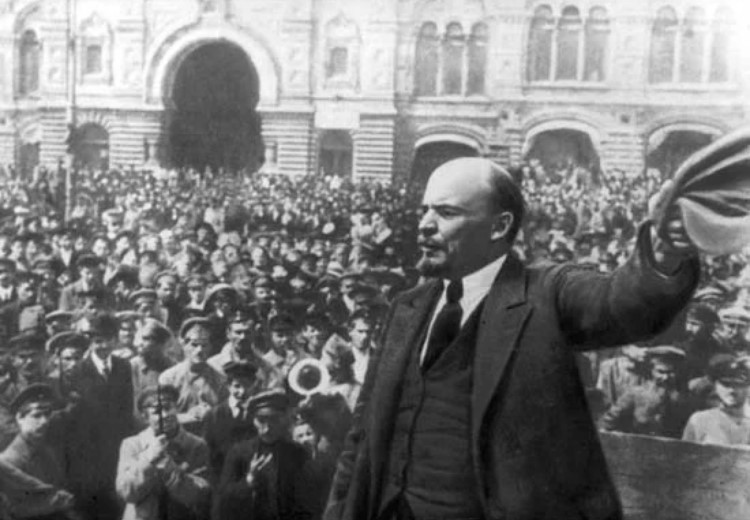
Lenin speaking in Petrograd 1917

Today is the 98th anniversary of Lenin’s death. At that time, Bob Stewart was in the Soviet Union working as a member of the Executive Committee of the Comintern. In this role he accompanied Lenin’s body on its journey from Gorky to Moscow and also stood, alongside Georgy Chicherin the People’s Commissar for Foreign Affairs, as a guard of honour during the lying in state. Today’s post presents two pieces by Bob about Lenin’s passing and his funeral. The first article, ‘In Memory of Lenin’ appeared in Pravda shortly after the Bolshevik leader died and the second, ‘From Ch20: Moscow and the Comintern’ is an extract from Stewart’s memoirs ‘Breaking the Fetters’ published in 1967.

Alan Stewart.

In Memory of Lenin.

Front page of Pravda announcing Lenin’s death. 22nd January 1924.

On the eve of the anniversary of the Petrograd massacre of 1905, the proletariat of the world has suffered a cruel blow; the death of our dear Comrade Lenin has removed the greatest figure in revolutionary history since Marx left the field of struggle. It is hard to reconcile oneself to the idea that the voice of Comrade Lenin will no longer sound in our revolutionary councils. Lenin has become for us the absolute ‘symbol’ of communism and the proletarian revolution. No one was more hated by the enemies of the working class than our beloved leader, and no other leader and teacher of the working class ever commanded such power and influence throughout the world. Since 1917 his name has been, as we say in England, a household word. His revolutionary writings and theoretical works have changed the character of socialist organisations in Great Britain and led them out of chaos onto revolutionary lines.

In this hour of great grief our profoundest sympathy goes out to our Russian comrades and to all the peoples of the Union of Soviet Republics. Now that our great leader, Comrade Lenin, can lead us no longer, his works and teaching, his revolutionary vigour and unshakeable realism must guide and inspire us in the revolutionary tasks which confront the proletariat of the world.

May the memory of Comrade Lenin live forever!

Long live the Union of Soviet Republics!

Long live the international proletariat!

Long live the Communist International!

Robert Stewart

Member of the Executive Committee of the Comintern and the Central Committee of the Communist Party of Great Britain.

Pravda, January 24, 1924.

From Chapter 20 of Breaking the Fetters: Moscow and The Comintern.

Transport of Lenin’s body to the Gorky railway station. Bob Stewart will be somewhere in amongst the crowd as a member of the Executive Committee of the Comintern.

“…It was during my time in Moscow that a great tragedy befell the international working-class movement.

Lenin died in January 1924. I remember this well because I was then a member of the Executive Committee of the Comintern which was summoned immediately: firstly, to hear the announcement of Lenin’s death and also to make all the necessary arrangements for the funeral.

Harry Pollitt came over immediately from Britain to represent the British Communist Party at the funeral. It was desperately cold and both Harry and I felt it very much. It was forty degrees below zero. Fires were kindled in the streets and I remember seeing the militiamen’s horses going over and sticking their noses in the fire to melt the icicles. We were as cold as the horses but at least we could pull down our fur caps and peer out occasionally to see where we were going.

I was one of the delegation of the Comintern chosen to go to Gorky, where Lenin had died, to accompany his body back to Moscow. We left by train from Moscow at about 5am and then travelled by peasant sleigh from Gorky Station to Lenin’s house. From the station you could see the house down in the valley, but the road to it so twisted and turned that even by sleigh it took us a long time to reach it. At the house Lenin was laid on a bed wearing an ordinary Red Army man’s uniform with the Order of Lenin pinned to his breast. The house was full of people: leading members of the Russian Communist Party, of the Comintern, delegates from the factories and the professions, and amongst them all wandered a big black cat who had been a very great favourite with Lenin.

The body was placed in the coffin and carried to the station en route for Moscow. Leading men from the party and the factories took turns to carry the coffin. On the journey, at every station, on the way, thousands of people waited to see the train pass. I do not think I ever saw so many tear-stained faces in my life. It was a very moving demonstration of the love the ordinary people for this great man.

When we got to Moscow I realised for the first time in my life what a mass demonstration really meant. Not a demonstration that was called, but one that came. Every conceivable foot of space was occupied. A great mass of people followed the coffin as it was borne from the station to the Dom Soyus (Hall of the Trade Unions), and from every side street and opening, mass upon mass of people converged with the main stream or waited their turn to do so. At the same time the digging was proceeding on the site of the mausoleum, so there was blasting and picking going on. All these streets were crowded with sad-eyed mourners. Every shop and hotel and all central places were ordered to keep open twenty-four hours a day so that people overcome by the cold could go in and thaw out.

Moscow has witnessed many varied scenes in her many centuries of troubled history; her ancient records must be filled with historic incidents, but never had such scenes been witnessed as during the days of Lenin’s lying in state and funeral. The Dom Soyus, a former palace of nobility, once the setting for the glitter and pomp of the aristocratic Tsarist circles, was the place where Lenin lay. Here his own people, the working masses of Russia, could pay their last tribute to the mighty leader of the Russian working class and the world proletariat. “Our Comrade Lenin” everyone said, as if he were a father or a brother.

For four days and nights, for mile after mile, people queued four abreast to pass the bier on which Lenin lay. Along with Harry Pollitt I took a turn on the guard of honour. I remember I was with Chicherin. The bier was surrounded by wreaths of flowers of every description, sent from all over Russia and indeed from all over the world. The magnificent hall with its white marble walls was a blaze of light, contrasting with the deep varied hues of the flowers, and on the balcony the band of the Red Guards played music befitting such a solemn occasion.

Delegations from all over Russia streamed into Moscow, joined the endless queues, and placed their wreaths as they passed the bier. But there were no kings or queens, no aristocrats and their ladies, no great admirals or field marshals with glittering medals. Only the endless stream of workers and peasants, soldiers and sailors with their wives and families. The queues never seemed to get less. Over a million had passed the bier and still the queues remained. It had been decided that on Saturday the doors must close at 12 noon. But on Saturday afternoon there were still hundreds of thousands of people waiting with banners and wreaths, still train after train arrived, pouring the delegations into Moscow from north, south, east and west. Every minute messages from all over the world came, telling the world-wide grief at the passing of this great working-class leader. Certainly, no king, no emperor, no bloody tsar has been honoured as Lenin, the leader of the world working class.

At 7am on Sunday came the final parting. Around the coffin stood the leaders of the Russian Communist Party and the Communist International, and with them, keeping her last vigil, was Krupskaya, Lenin’s wife and constant companion during thirty years of struggle. Lenin’s body was borne to the Red Square. As the coffin was raised the orchestra wailed the funeral march. After this a moment’s silence, then the International burst out, strongly and boldly sung. I thought then, this is the answer to the enemies of Leninism whose death was rekindling the hopes of new triumphs for imperialism. this is the answer of Lenin’s pupils, the Russian workers and peasants.

As the coffin was carried into the streets, crowds formed behind it. Leaders of the Party and trade unions took turns to shoulder the coffin along the Kremlin walls to the centre of the Red Square where the raised tribune was placed. The people filed past in millions until 4pm. Then silence just before the cannons crashed out the salute with a roar which could be heard in every corner of the world; factory sirens in every Russian city and village took up the salute; men, women and children stood still in silent homage. In every country throughout the world the workers paid their last respects to a great leader, who from small groups of Marxists had led the Russian workers forward to the formation of a mighty Communist Party and a mighty workers’ Republic and had laid the foundation by his leadership for a mighty Communist International.

The coffin was carried into the Mausoleum, Lenin’s final resting place. Queues formed again to pass the bier. It went on all night, all the next day and every day since. the years have passed and still the Russian workers and peasants and the visitors to Moscow from foreign lands pass the bier to pay homage to Lenin, the great working-class leader whose genius guided the people of downtrodden Russia and millions far beyond it, to break their chains and march to the not-so-distant communist society.”