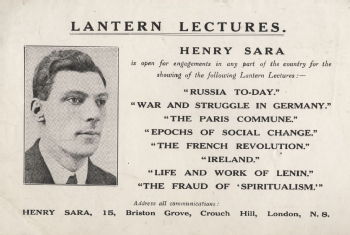
Late last year I was contacted on Twitter by someone who runs the Warwick Modern Records Centre account who told me they thought they had some lantern slides of Bob Stewart in Russia in 1924 – the time he was on the Executive Committee of the Comintern. They were part of the Henry Sara collection – someone I had never heard of before. A brief biography apppears on their website:
“Henry Sara (1886-1953) was attracted early in his life to social ideals, and during his twenties became active within the small British anarcho-syndicalist movement. With the advent of the First World War in 1914 Sara aligned himself with the anti-war movement and, after a campaign of public meetings, was arrested and imprisoned in April 1916 for his refusal to serve in the army. He remained in prison until February 1919, when he was finally released after going on hunger strike.
Henry Sara joined the Communist Party of Great Britain (CPGB) in the early 1920s, shortly after its formation, and became a popular speaker within the Party, travelling widely as a representative of the CPGB and associated organisations. His international trips included a lecture tour of the USA on behalf of the Friends of Soviet Russia in 1922; and visits to Germany and France in 1924, Russia / the Soviet Union in 1921, 1925 and 1927 (in 1921, by his own account, he “smuggl[ed] away on a ship from Hull, because he wanted to see for himself”), and China in 1927, where he attended the 5th Congress of the Communist Party of China in Hankow and witnessed the beginnings of the Chinese civil war. Sara’s willingness to criticise Party leaders and association with other Trotskyist “dissidents” resulted in his expulsion from the CPGB in 1932, and he went on to become a leading figure in the British Trotskyist movement of the 1930s.”
Sara used to give lectures and talks about socialist politics and illustrate them with magic lantern slides taken, in the main, from his own travels. The slides, reproduced by the WMRC on their website are exhaustive and fascinating and I’d encourage anyone interesting in Soviet history or the broader sweep of left wing politics in the early twentieth century to view them. An absolutely exhaustive and stunning resource. You can view them here: https://warwick.ac.uk/services/library/mrc/archives_online/digital/sara/
The photos the WMRC sent me on Twitter are reproduced below. The first is a group portrait taken in Faustovo. Henry Sara is the tall, dark haired young man standing on the left while that’s unmistakeably Bob Stewart standing on the right hand side of the picture. He’s roughly my age there (47) but looks odd due to an industrial accident and too many policemen stamping on his face. His wife Margaret in the glasses is sitting on the left and the little girl by his knee I’m pretty sure is their daughter, my dad’s Aunt Nan. Years later in the late 1930s/early 40s she would have to flee Russia with her baby son after her husband was arrested as a Trotskyist. He was shot in 1941 and the full details only came out in 1956. Standing at the back is British Trade Union legend Tom Mann who I’ll be writing about later. Also in this photograph is Rose Cohen – she’s sitting next to Margaret. She was a suffragette and like my great grandad a founder member of the British Communist Party. Standing behind her is probably her soon to be husband David Petrovsky. In 1938 he was arrested and executed and later on Rose was also arrested. There was nothing anyone could do as she had given up her British citizenship. Her trial lasted twenty minutes and then she was taken out and shot. Their child was sent to an orphanage. All of this is described in Francis Beckett’s superb book ‘Stalin’s British Victims’ and in Maurice Casey’s article, ‘The Suffragettes Who became Communists’ which you can read here: https://www.historytoday.com/miscellanies/suffragettes-who-became-communists

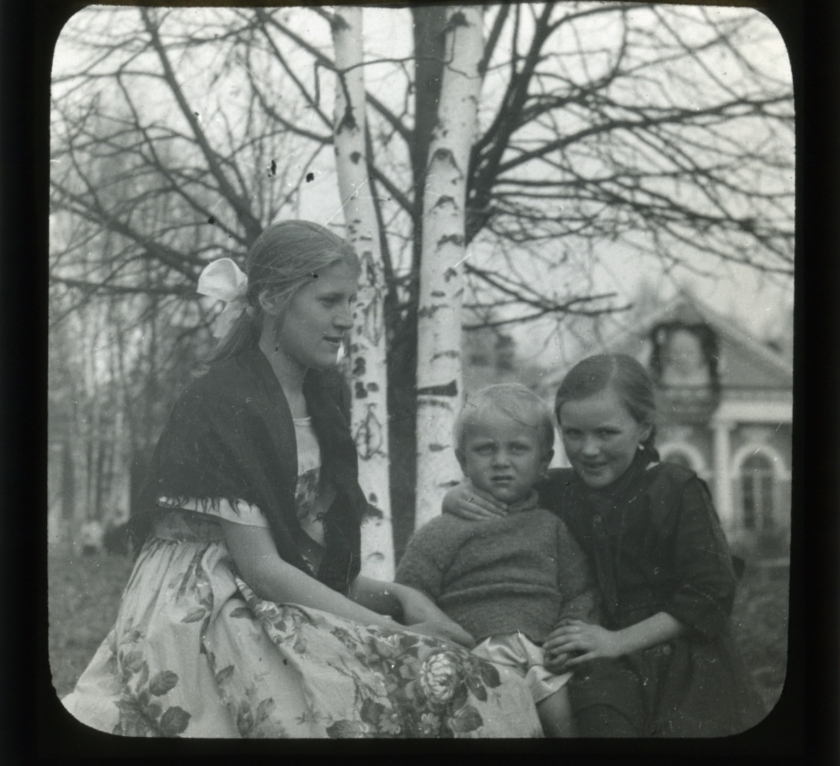
This next photograph was simply labelled ‘Nan’ and though I don’t know who the older girl and the small boy are that’s definitely Bob and Margaret’s daughter Annie ‘Nan’ Stewart aged about 11 on the right. The picture appears to have been taken in the grounds of the Pushkin School.
Annie Stewart can also be seen in the class photo from the Pushkin School – she’s the little girl standing in the dark dress fifth from the right. Bob and Margaret Stewart can just about be spotted at the back on the left hand side.

The last slide features Bob and Margaret Stewart in Red Square visiting the grave of John Reed- the American journalist who wrote the eyewitness account of the Russian Revolution ‘Ten Days That Shook the World’.

If anyone has any more information regarding these images please do get in touch. I’d love to know more. Many thanks to the kind but anonymous person who brought them to my attention. Learning all about Henry Sara was fascinating. Thanks also to Maurice Casey who has always been so helpful.
Alan Stewart.
 Breaking the Fetters