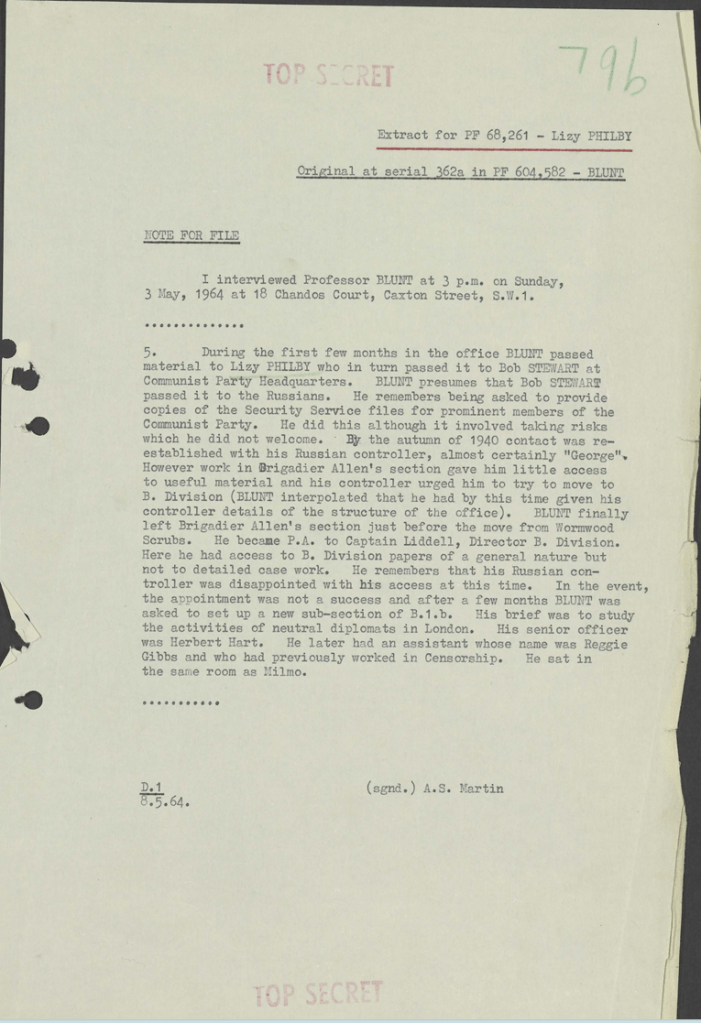
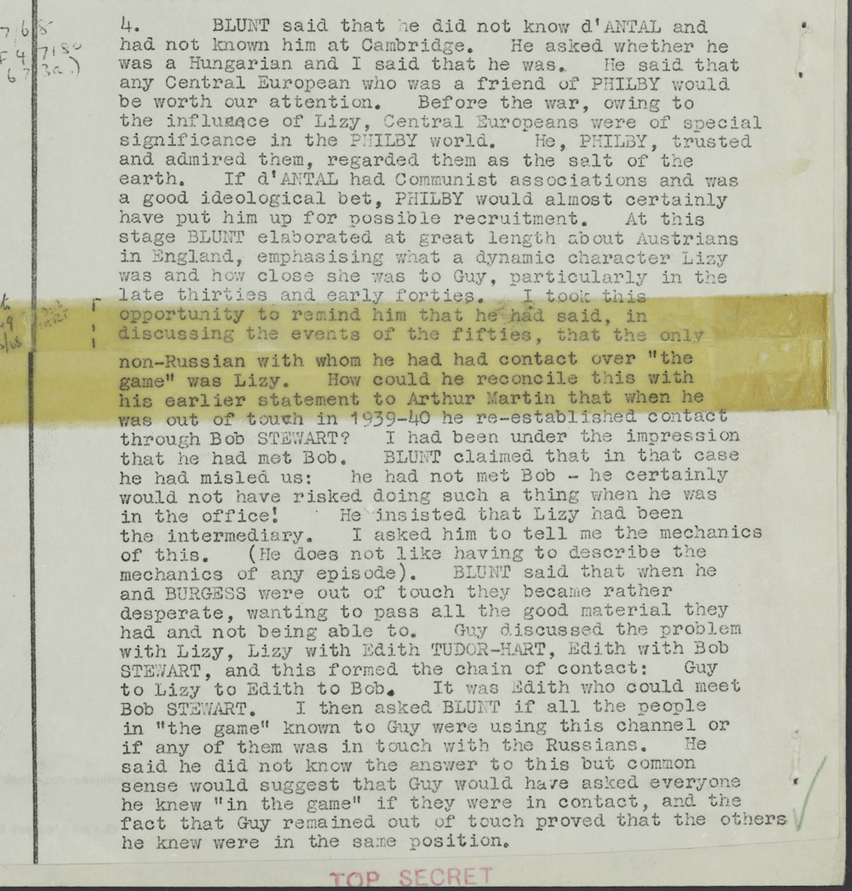
Notes from Anthony Blunt’s confession in 1964 where he mentions Bob Stewart’s role in the network.
On Tuesday I received a late Christmas present courtesy of The National Archives – a selection of previously secret MI5 files were made available to the public for the first time. This latest release of material is largely concerned with the Cambridge Five. There’s acres of material on Kim Philby, Anthony Blunt and John Cairncross as well as Philby’s first wife Litzi Friedmann. It couldn’t more opportune time as I’m currently attempting to write the first draft of the 1940s chapter in my biography of Bob Stewart.
I’ve known about Bob’s involvement with the Cambridge Five since I was a teenager in the 1980s; it was mentioned in Peter Wright’s Spycatcher. It’s been further outlined by security expert Nigel West who states in The Historical Dictionary of British Intelligence that, “in the absence of [their Soviet contact] Anatoli Gorsky in 1940, Stewart had run Blunt, Kim Philby, and Guy Burgess.”
Although it’s a minor part of the book I’m writing, I recognise that people are still fascinated by the Cambridge spies. I’m fascinated too. Recently, I loved the TV adaptation of Ben MacIntyre’s A Spy Amongst Friends which sent me rushing to the book; I recently finished the excellent Guy Burgess biography Stalin’s Englishman by Andrew Lownie (Burgess has always been my favourite since Alan Bates in An Englishman Abroad) and I’m currently rereading Enemies Within by Richard Davenport-Hines which argues that the whole affair shaped modern Britain. It’s always blown my mind that my great grandfather was involved. I’ve been trying to write about it for a while now but, as so much of the detail is, well, secret, I’ve found it very hard going. I am so relieved all this material is now easy to access. I had a quick scan through some files the other night and here’s a few things that I found.
Bob’s involvement was first revealed when Anthony Blunt confessed in 1964. After this MI5 renewed their interest in Litzi Friedmann and, in one of the documents in her file, you get a fuller exploration of her and Bob’s roles,
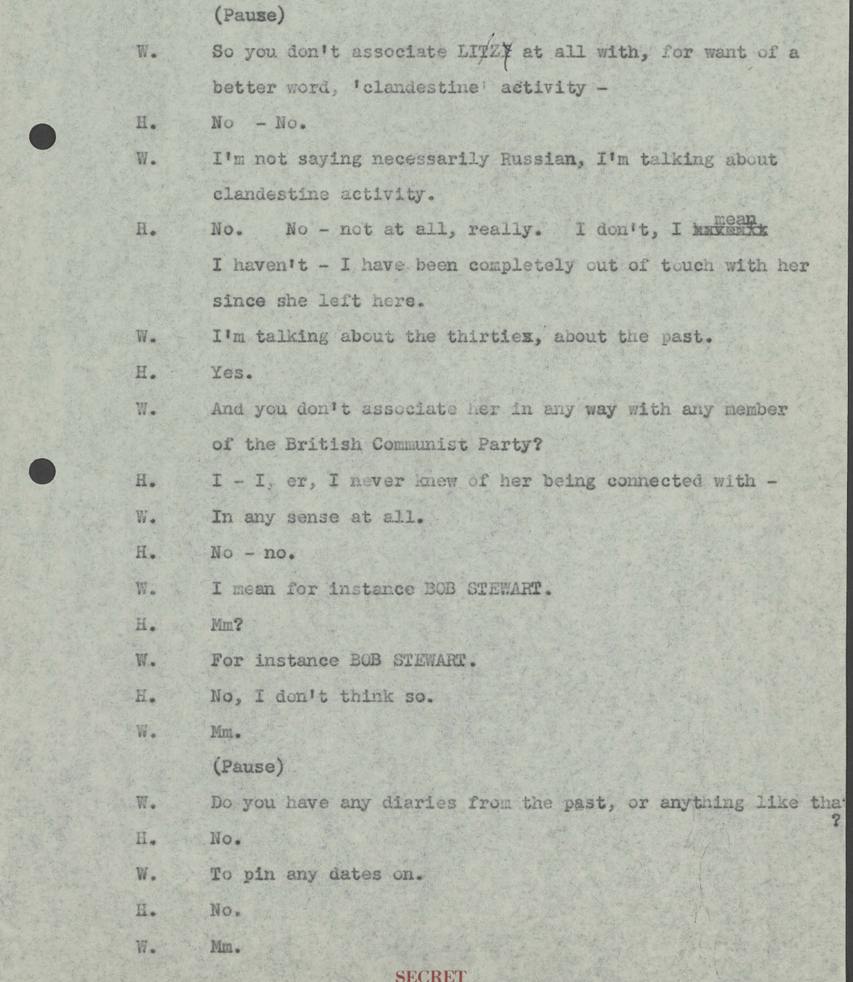
Also in Litzi’s file is the transcript of a lengthy interview in 1968 with Edith Tudor-Hart her friend and the woman who helped recruit Kim Philby as a penetration agent for the Soviets. I love her evasiveness in this passage.
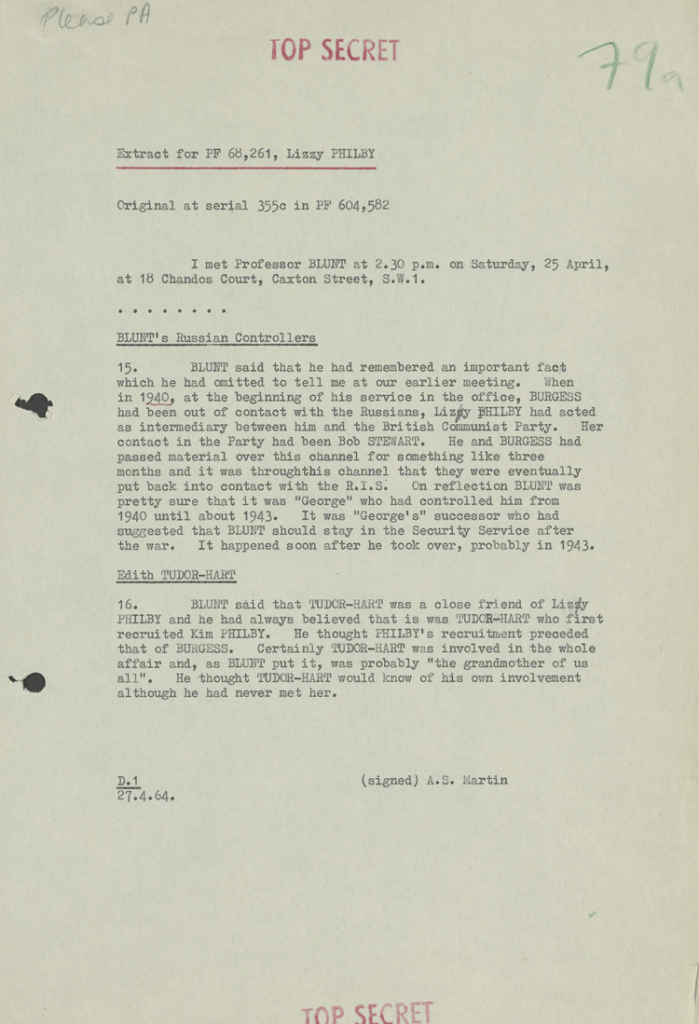
Tudor-Hart’s interview was in 1968 as Blunt spent the years following his confession in endless debriefs with MI5. Here’s more information from one of those sessions.
So far all of this simply adds a bit more detail to what we already know. If I’m lucky there’ll be a bit more buried somewhere in this latest release although it might take a while to uncover it in the thousands of documents. In particular I’m hoping to uncover Peter Wright’s interview with Bob that he alludes to in Spycatcher. I’ll never uncover the whole story though. I’d need to visit Russia and gain access to the archives there. Given the world situation and the state of my finances there’s two hopes of that. Appropriately enough, one of those hopes is called ‘Bob.’
Alan Stewart.
The latest release of MI5 files by The National Archives is available here:
Before it got dropped from the GCSE English Literature syllabus, I used love teaching ‘Before You Were Mine’ by Carol Ann Duffy. In the poem, Duffy describes a photograph of her mother as a teenager, laughing with two friends on a Glasgow street corner in the 1950s. The wind blows her polka dot dress around Marilyn Monroe style. Duffy was recently bereaved when she wrote it and the snapshot presents an altogether different person from the parent she knew. The image prompts her to imagine the intense years of teenage life and early adulthood of her mother a decade before she was born. Growing up, Duffy caught glimpses of the person her mother used to be but, of course, they had become someone else entirely.
The poem offered me a lot of scope in the classroom to do what I do best: show off a lot. Nicking my partner’s high heels so I could act out the infant Duffy walking around in her mother’s shoes and bringing in a stray disco ball we had in the living room and suspending it in front of the Smartboard projector to mimic a dancehall from the mid twentieth century. All of this, I imagined, would highlight to the class the distance between who their parents were now and who they used to be. I’m not sure how much my students learned but I had fun. It’s strikes me now that that a tendency to put on a performance at the drop of a hat and a love of poetry are two of the main things I’ve inherited from my dad. My most perfect memories of him are when he was entertaining crowds of drinkers during Christmas and New Year in the pub he ran and, at other times, being the only person I knew who would sit quietly reading poetry behind the bar on a slow afternoon shift while the cigarette between his fingers became three quarters ash before collapsing all down his front. My parents had children quite late on in life for their generation and perhaps it’s because my father and Duffy’s mother would have been roughly contemporaries that this particular poem resonates with me. When he died I came to realise there was so much about him I didn’t really know.
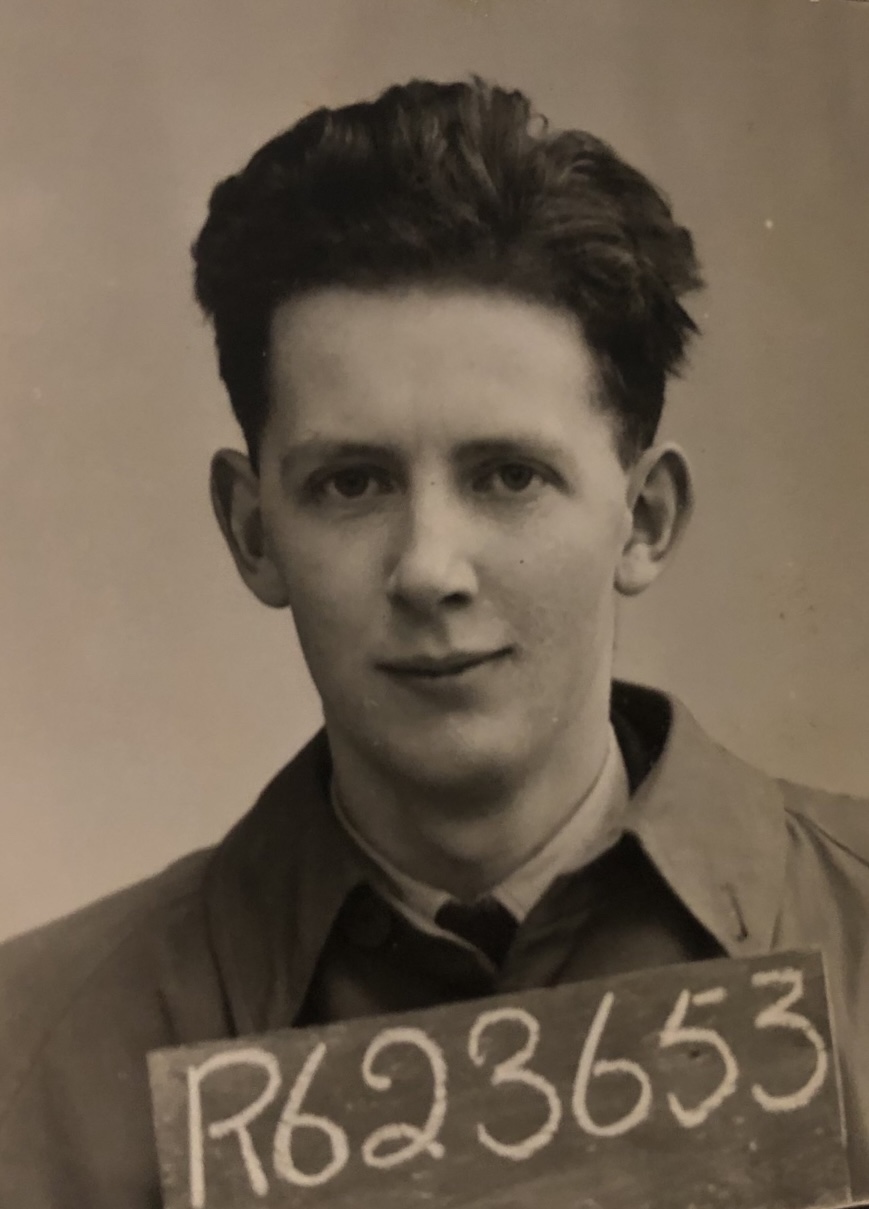
To my brother and I he was ‘Dad’, to practically everyone else he was ‘Mike’ but to his side of the family, who we rarely met, he was ‘Robin’. I have a mountain of photographs of him in his youth and, if I weren’t a terrible poet, I might attempt something along the lines of ‘Before You Were Mine’. However, by way of consolation, I have much more than old photographs. Thanks to the security services interest in his grandfather Bob, and to a lesser extent his own father Bill, both founder members of the Communist Party of Great Britain, my father occasionally turns up in the intercepted letters, transcripts of bugged conversations and observation logs of MI5, all of which are available at the National Archives. I can’t put into words what it meant to find him there. You’d expect there to be an element of Cold War spy movie glamour in all this but the reality is much more mundane. He was an odd figure to turn up in the files – categorically the least likely threat to the nation’s security who ever lived. That didn’t stop the state secretly documenting his existence by default. What follows are the moments where I’ve found him in the once top secret documents. Of course it doesn’t describe the person I knew – it’s an imperfect and haphazard depiction reliant on stray comments from many different people made years apart. The reader is unlikely to get an idea of of who my dad was from all this and whether it is of interest to anyone else I can’t tell but it matters little. I write all this down purely for my brother Ian, myself and our mother. We loved him and we miss him. It is the fifth anniversary of his death and we wish he was still here.
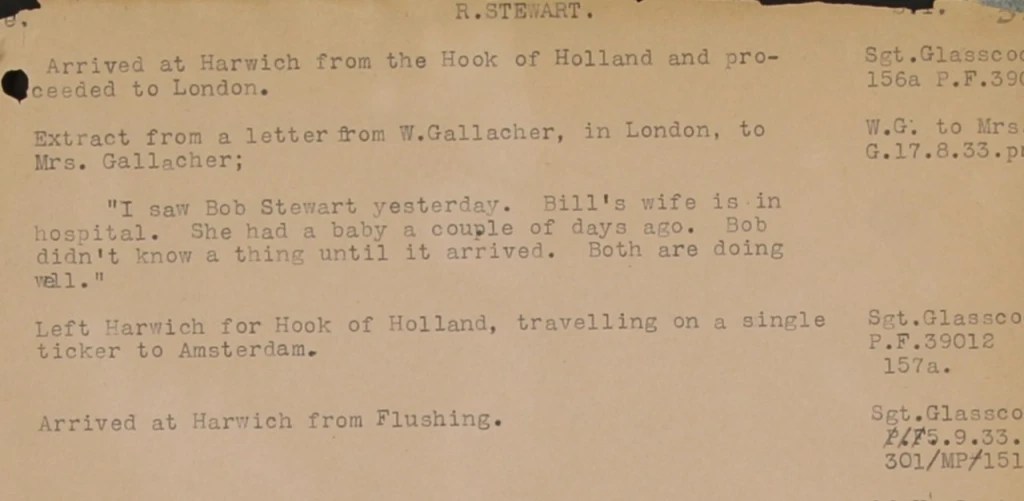
The first appearance is an extract from a letter written in 1933 by Red Clydeside hero and future Communist MP Willie Gallacher to his wife. He mentions Bob Stewart’s return from one of his many trips abroad and his surprise on his return to find out he had become a grandfather. The baby was our dad who was born a few weeks before.
…I saw Bob Stewart yesterday. Bill’s wife is in hospital. She had a baby a couple of days ago. Bob didn’t know a thing until it arrived. Both are doing well…
Just over two years later dad appears in a letter from Bob Stewart to his daughter Nan and her husband Anatole Kaminsky. The couple had recently moved to Moscow and are eager for news about the family. Even as a toddler dad seems to be demonstrating one of his key characteristics- a love of the limelight and thriving in front of an audience.
…We have not seen Bill and family for a fortnight but they are all well and Robin has had more photographs taken. Everyone likes to take his picture and he quite likes it. We have now got a big one of him and all the lady visitors are taking him for a walk -he is so lovely to look at they say…. (8/10/35)
“…Everyone like to take his picture and he quite likes it…”
The next encounters are via the reports of MI5 agents as they follow my grandfather, eager to find out what exactly his job at the Soviet Embassy entails. It’s all very John Le Carre. Is it weird to know that spies were watching your dad play in the park when he was three years old? Yes.
17th August 1936.
re/ William STEWART, Soho Street, W
For thirteen days, between 30th July and 15th inst. observation was kept on this man but nothing of importance was seen except on 10th inst. when he and GLADING met for half an hour, between 1 and 2 p.m. at a public house in Queens Road, W.
STEWART attends the Soviet Embassy daily from 8 a.m. to 5 p.m. and appears to be employed there the whole of that time apart from his hour for lunch which he takes generally alone at a cafe or public house at Notting Hill Gate.
On leaving work he goes direct home and usually remains there although on one or two occasions he has taken his young child to play in Hyde Park…
Reports on Bill Stewart- 1930s.
Surveillance was maintained on William Stewart throughout his employment at the Russian embassy to the extent that the security services are also following our grandmother on the school run at a discreet distance.
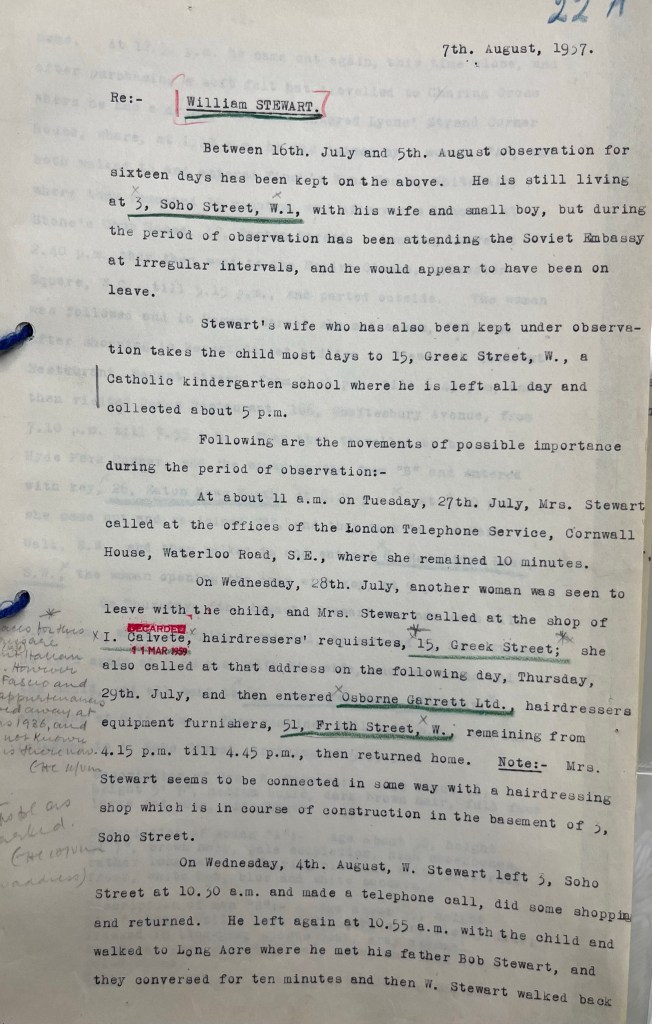
7th August 1937.
Re: William STEWART
Between 16th July and 5th August observation for sixteen days has been kept on the above. He is still living at 3, Soho Street, W.1, with his wife and small boy, but during the period of observation has been attending the Soviet Embassy at irregular intervals, and he would appear to have been on leave.
Stewart’s wife who has also been kept under observation takes the child most days to 15, Greek Street, W., a Catholic kindergarten school where he is left all day and collected about 5 pm…
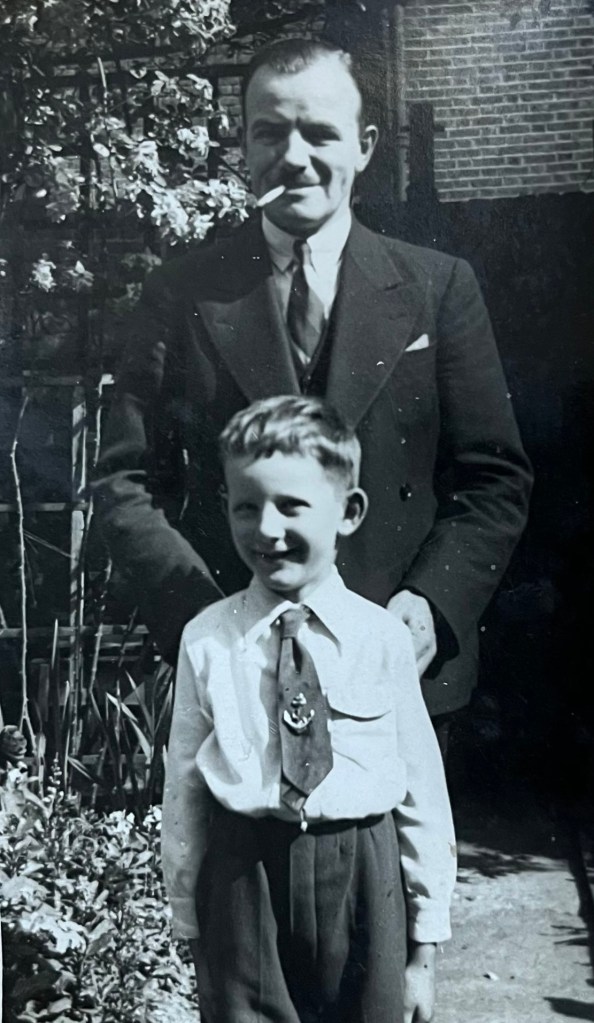
Our grandfather William with our dad sometime around the late 1930s or early 1940s.
There are a few other mentions of Dad around this time- always referred to as ‘the child’. Mainly mundane visits to shops or relatives. However, the surveillance comes to an end as by 1938 our grandad was no longer working at the Soviet Embassy. Moscow had decided their diplomatic service should not employ anyone who wasn’t a Soviet citizen and so his position no longer existed. For a while he was working away as the catering manager at Laycock Engineering Company in Sheffield. It’s looks like this was a position he took on for money rather than anything to do with espionage. However, MI5 weren’t taking any chances and began to intercept his letters home.
My own Darling,
I have just got in from a rather heavy day, Furnell and Bolton another chief (I’m wondering how many chiefs I have on this firm) have been this evening and are coming again tomorrow. Talk about slave driving it isn’t in it. They expect me to do a whole lot more yet and I gave them quite quietly a piece of my mind. Furnell says I am a good chap but I must get still higher percentage and I don’t see how it is humanly possible. If it wasn’t for the fact that jobs are so damn hard to get I would walk out on it. I don’t mind work and I have worked harder than anyone in Laycocks that’s Walker’s own statement. Now I feel that I am being played with and being used in some gigantic swindle. Anyway did “Our lad” get his “chewing gum” and you your “Woodbines”?
Bless you both I wish I had you here to talk to now don’t worry my pet I won’t do anything drastic but it is hellish when you work like a slave and to be told your giving satisfaction one minute and then something else the next. I feel so tired now so I will off to the post and then turn in.
Bless you both and keep you.
Yours ever,
William – your own Bill.
Dad at Tottenham Lido early 1940s. Grandad second from left also at the Lido guarding the home front.
By the time The Second World War began, Bill had taken up the position of catering manager at Tottenham Lido and, apart from ensuring that he wasn’t called up due to his ‘past record’, MI5’s interest in him seems to have waned. Consequently, it’s not until 28th September 1951 that we catch sight of dad again. He would have been eighteen years old and, perhaps for the first and last time, a potential person of interest for the security services. A report from Essex County Constabulary outlines some concerns about William Stewart, licensee of The White Hart Hotel in Manningtree and his son after they had been instructed to make “discreet enquiries”. After noting grandad’s interest in politics, his meeting with far left associates and that he took The Daily Worker attention turns towards dad.
The son Michael has been attending a technical school in London to be trained as a chef and in hotel management.
He only comes home at week-ends, but not every week-end. His London address has not been obtained to date.
It is said that he has appeared on the stage in a Noel Coward production in London, and knows many actors.
He is shortly to be called for National Service (Believed October, 1951).
It is not known whether he attends political meetings. No political meetings are known to be held in this District.
It is known that this person holds Communist views. One customer pointed this out to the licensee who made no comment
Michael usually assists his father in the public house when he comes home.
Further discreet enquiries will be made as the opportunity presents.
The Noel Coward play was actually ‘The Dancing Years’ by Ivor Novello at the Casino which has since reverted back to it’s original name, the Prince Edward’s Theatre. It was his sole engagement, at the age of fourteen, as a professional actor. I remember the delight he took in telling us about the different characters that inhabited the Soho world that he encountered and how much he enjoyed the role of ‘Otto- the bastard son’. The idea of dad holding communist views is also interesting. Certainly not something he clung on too. In a way, it wouldn’t be surprising due to the milieu of his upbringing but as far as I know he was never a member of the CPGB. His parents were unusual in communist circles in that William had ‘married out’ – his mother Jess wasn’t a party member either. And she wielded a very strong influence over him. Growing up, it was Boy’s Brigade for dad rather than the Young Communist League. In later life his politics were broadly left wing but not particularly partisan. I remember him sitting on a beer keg the day after the 1987 Conservative victory smoking and looking folorn. “We’ll get through it somehow,” he said to me. In fact, the last video clip of him I have is from 2017. you can hear me off camera asking him how he was going to vote in the general election. Due to to vascular dementia it’s unlikely he could remember the name of the Labour Party let alone any of its major figures at the time. He looks straight at the camera and says, after some thought, “Socialist.”
As the police noted, Dad was shortly to be called up for National Service which is the subject of his next appearance in the files. There’s a letter from Bill to his father dated 27th November 1952.
…Robin was in slight trouble last week! he was put on charge for being unshaved, up before the Captain under escort hat & belt off – was admonished, the RQSM put a good word in…
While in the army Dad did make it to the rank of Sergeant a fact which will forever astound me because, if there is one single that could define him, it was his lifelong inability to distinguish between his left and his right. How he managed on the parade ground I do not know.
Transcripts of conversations from 1956 picked up by the listening device hidden in Bob Stewart’s office at CPGB HQ .
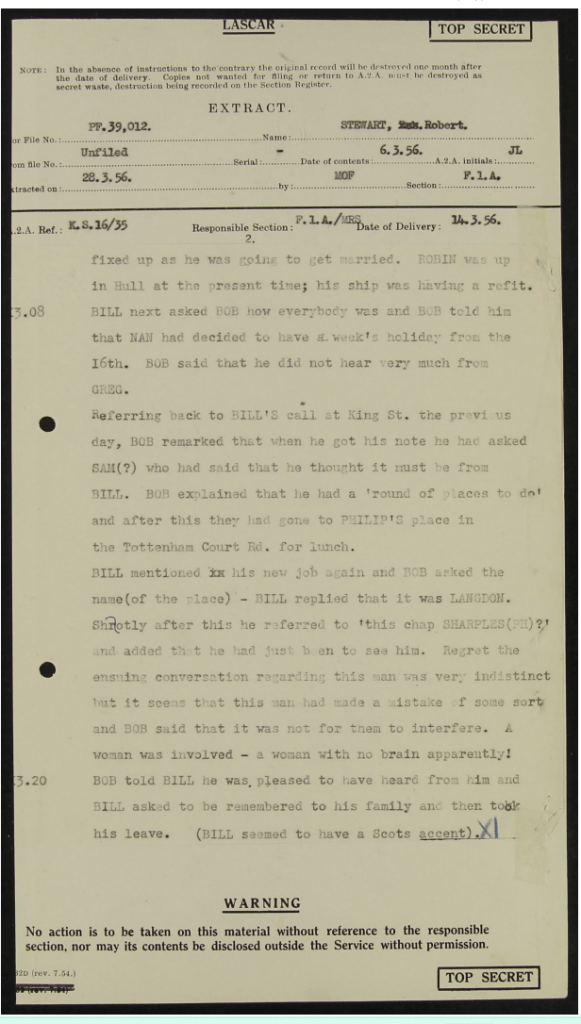
By 1956 Dad was in his early twenties and he drifts in and out of the files as Bob Stewart struggles with the twin shocks of Khruschev’s revelations about Stalin and the Soviets actions in Hungary. In March there’s a surprise as it appears he was about to be married. This was four years before he met our mother- my brother and I might never have been born. I imagine the photographs on mum’s mantlepiece fading ‘Back to the Future’ style.
BOB STEWART welcomed another comrade whom he later addressed as BILL. BOB asked BILL if he had come in the previous day. BILL replied that he had and had left a message because he had so much running about to do. BILL said that he had been after a job in Whitechapel in a coffee snack bar and he was to start on Tuesday. BOB wanted to know how this would affect ROBIN. BILL replied that ROBIN was getting his own little place fixed up as he was going to get married. ROBIN was up in Hull at the present time; his ship was having a refit. BILL next asked BOB how everybody was and BOB told him that NAN had decided to have a week’s holiday from the 16th. BOB said he did not hear very much from GREG…
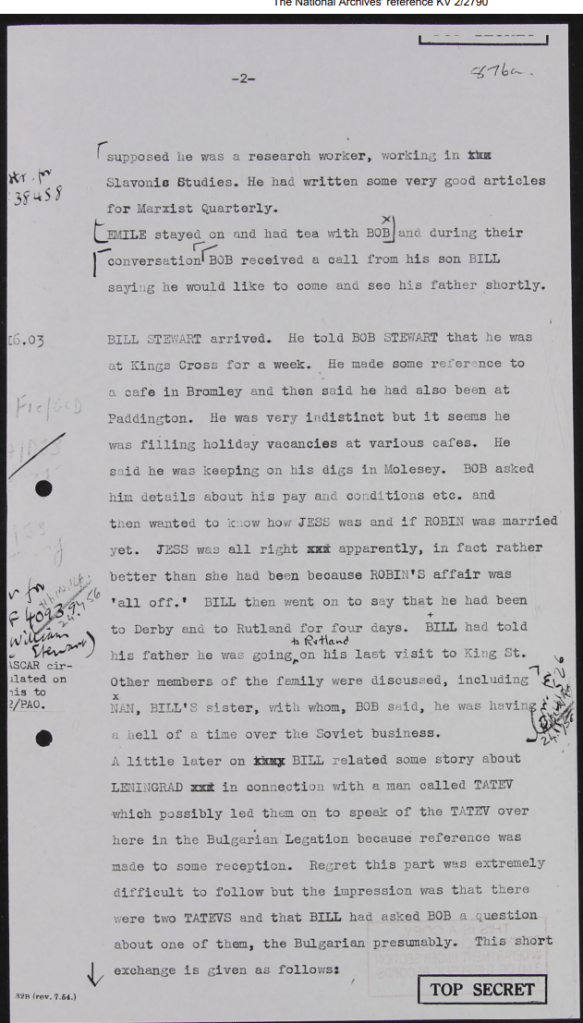
In June, however, it’s all over much to the relief of Grandma Jess. No one’s good enough for her son.
BILL STEWART arrived. He told BOB STEWART that he was at Kings Cross for a week.He made some reference to a cafe in Bromley and then said he had also been at Paddington. He was very indistinct but it seems he was filling holiday vacancies at various cafes. He said he was keeping on his digs in Molesey. BOB asked him details about his pay and conditions etc. and then wanted to know how JESS was and if ROBIN was married yet. JESS was all right apparently, in fact rather better than she had been because ROBIN’S affair was ‘all off’. BILL then went on to say that he had been to Derby and to Rutland for four days. BILL had told his father he was going on his last visit to King St. Other members of the family were discussed, including NAN, BILL’S sister, with whom, BOB said, he was having a hell of a time over the Soviet business.
‘The Soviet business’ refers not just to the public reaction to Khruschev’s speech but the devastating news of what had happened to Nan’s husband, Anatole Kaminsky. He’d been arrested by the NKVD in Moscow in the late 1930s. Nan had escaped with baby Greg, my dad’s cousin, but they’d had no news for years. The new openness of 1956 brought with it the news that Greg’s father had been shot in 1941. Relationships within the family were strained and I have a feeling they remained that way from then on. Understandably Nan and Greg went on to reject communism entirely. Maybe the ramifications of this are why we never really knew Dad’s side of the family. Until relatively recently I was unaware of these events and I’m sad that I’ll never know the truth of it now because Dad’s not around to ask.
In addition to this, the Soviet invasion of Hungary ensured my Dad and Greg’s generation viewed the USSR with much more scepticism than their parents and grandparents. There’s a transcript of a tapped telephone call fom grandad to Bob which mentions Dad’s concern over the events in Budapest. Bob and grandad however are rather more defiant.
I/C call to BOB from BILL STEWART (BOB’s son). BILL, asks when BOB got back as he didn’t know he was back. BILL says something about telling MOIRA five weeks ago. He says the last he heard BOB was in the Sanatorium. He says GEOFF and ROBIN (Michael Robin STEWART – BOB’s grandson – son of Bill STEWART have been up in London, and he is now in a job at Liverpool Street where he starts early in the morning. BILL says he is in digs at Ampney Court but is going to try to get digs more centrally placed. BILL says ROBIN and JESS are fine. But ROBIN is worrying about the situation. BOB says there are only two sides in this business “our side, and the other side. Whether it’s mistakes or accidents or anything else of that kind, It’s got nothing to do with it. It’s a show down now, and we’ve either got to fight it through or not?” BILL replies “Yes that’s the line”. BOB says, “We can’t stand on theside lines”. BILL agrees saying “No, no, there’s no flagwaving in this business you either fight or you don’t.” BOB says “Very serious business, there’s no saying where it will end”. BOB says “The honeymoon’s over anyway, and the rest is just to be”. BILL asks about BOB’s trip to Russia etc. BOB says he travelled a lot and will tell BILL about it when he sees him. They will fix up something on the telephone arranging for BILL to come out one evening after his work to see them. BILL sends his love to everyone.
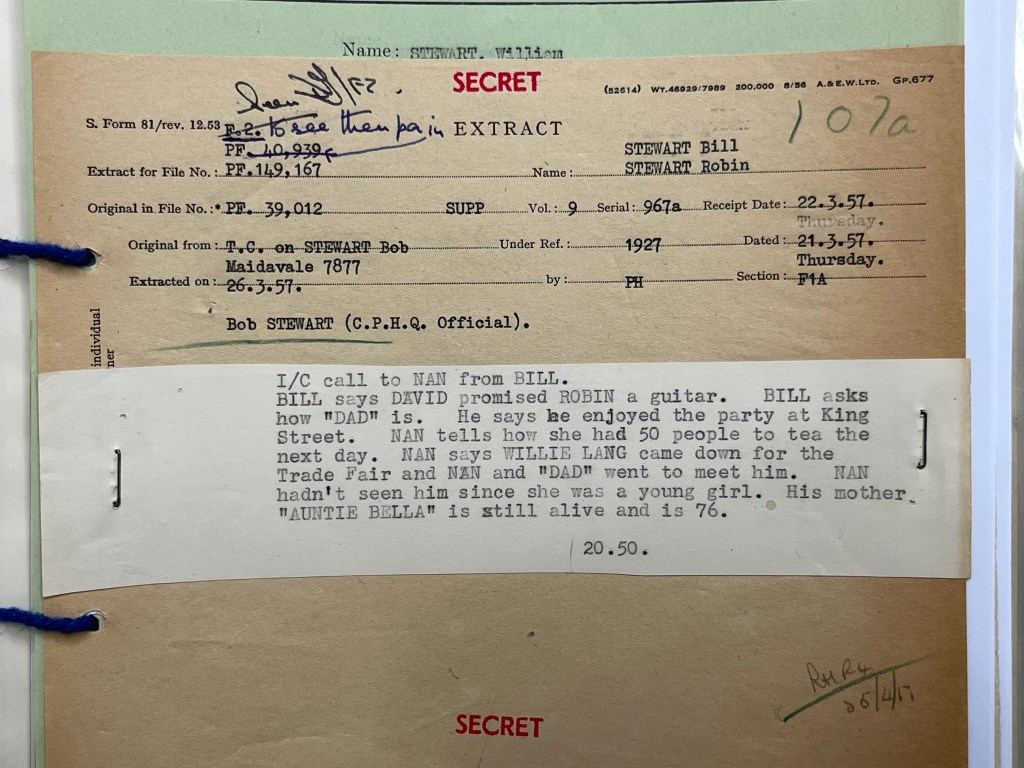
Tapped telephone call 1957. Letter from Grandad to John Gollan 1967.
From 1957, other than a comment from grandad about his brother in law having ‘promised ROBIN a guitar’ dad starts to fade from view in the security files. There appears to be nothing for a decade. After all, grandad’s involvement in the covert world of Communist agitation seems to have dwindled and Bob is blind and bedbound. The last reference is a letter from grandad to John Gollan, the General Secretary of the CPGB dating from 1967.
Dear Comrade Gollan,
On behalf of my wife and I and of my son and his wife I wish to thank the Executive for this invitation to Dad’s birthday celebrations.
I do hope sufficient publicity will give rise to fast sales of the book to the benefit of the Party.
Congratulations to you for your ‘Socialism in the Sixties’.
This would have been Bob Stewart’s 90th birthday at the CPGB HQ at King Street, Covent Garden and the launch of his autobiography ‘Breaking the Fetters’. It’s also, I think, the only time my mother makes an appearance in the security files.
I had my dad for 45 years. He was wonderful and I treasure his memory. I do not know why I have to write all this down – I only know that it helps. Rereading Alison Light’s magisterial book on family history and why we need to know who came before us and what we owe them I came across these words from Joseph Brodsky, “What’s the point of forgetting if it ends in dying?” That might be part of it but, more importantly, and more simply, I wish I could speak to Dad now and learn more about who he was all those years ago before he was mine. But I can’t. So, this will have to do.
Alan Stewart.
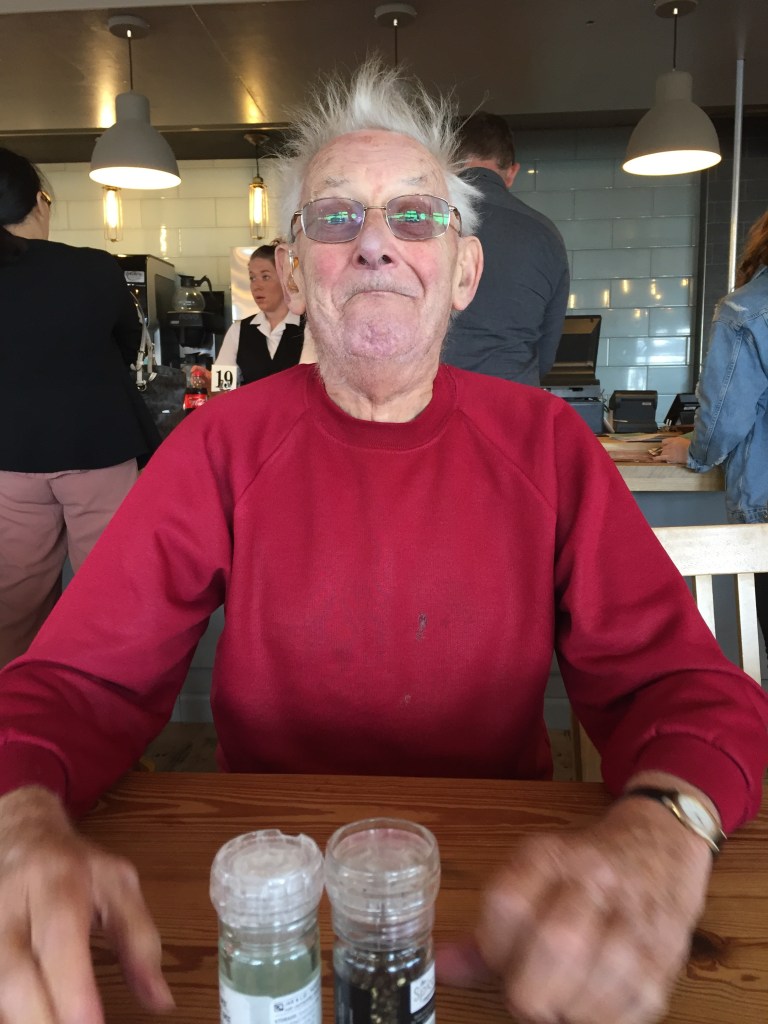
Michael Robin Stewart on his 84th birthday about five months before he died. I think this picture gives an indication who he really was. A gloriously silly man. I love you Dad x
Where to begin? It’s a troubling, ultimately tragic part of the story and some of it is truly inexplicable. Perhaps the best way to deal with it is to set out the information as simply as I can.
What we knew was this. At some point in the early 1930s Bob Stewart’s daughter, Annie (my dad’s Aunt Nan) married a ‘Russian’ and they went to live in Moscow. We didn’t know his name nor had we ever seen a photograph of him. At some point Nan gave birth to a baby boy – my dad’s cousin Greg. Soon after this Nan’s husband was killed in Stalin’s purges. Nan fled with their infant child back to London. Information about her husband was almost impossible to come by. I have no idea how they managed to escape. In the years that followed, Nan remarried, had two more children and remained a member of the Communist Party until 1956.
For me, all of this was rather abstract. Dad had a lot of family somewhere out there but was rarely in contact with them. Until recently, apart from visits to my grandfather when I was a toddler, the only other person I’d ever met from my father’s side was Greg. That was at my brother’s wedding just over a decade ago. I only spoke to him briefly as I was on best man duties. All I can really remember is how strange it was to be speaking to somebody who bore such a strong resemblance to my dad and yet was someone who was to all intents and purposes a complete stranger. I never made the effort to remain in touch. I wish I had.
After my father died, I started reading through the security files on Bob Stewart that the National Archives had digitised and put online. Trying to find glimpses of who he was before he was our dad. To begin with, I knew very little about the Communist Party or our family. I tended to focus on the later files as during that period MI5 weren’t simply intercepting Bob’s post and tailing his movements but bugging his offices and tapping his phone. Rather than squinting at spidery 1920s handwriting and trying to work out what it all meant I could easily read the transcripts of conversations and, through their voices, almost begin to get to know these people who were long gone.
I started looking at the files collected during 1956. The year that Nikita Khrushchev gave a speech condemning the crimes of Stalin and the first official recognition about what had gone on in the decades before. At this time Nan was living in a large house in North London with her family and also her father who was nearing eighty but still involved in the secret side of the Communist Party of Great Britain. Most of the documents in that file focus on the general disquiet about the revelation in ‘secret speech’ felt by those at the CPGB’s HQ at Covent Garden. However, a more personal impact is outlined in the transcript of a phone call Nan made to her sister in law Margaret on 10th August 1956.
O/G call from NAN CAPLAN to MARGARET STEWART, BOB’S daughter in law. HARRY is back, and DRONA, (the father of NAN’s son GREGORY CAPLAN) was definitely shot in 1941. They are both shattered by it. HARRY came to see BOB and NAN insisted on seeing him. She says there is not one of the five brothers in KRONA’s (sic) family left. She threatened that if HARRY does not give her justice she’ll follow him to every meeting at which he speaks. BOB’s threatening to leave (The house? The party?) She would like her brother RAB STEWART to come and see her. BOB is going away next week so they will arrange it. (KV2/2790 – Security File on Robert Stewart held at the National Archives.)
‘HARRY’ was Harry Pollitt, the leader of the CPGB, who had gone to Russia in part to find out what had happened to the family members of several of his own colleagues and friends. Of course, this transcript raises so many questions. How had they lived with this trauma for so long? How had they maintained their commitment to the CPGB in all that time in the face of it? What had they already known?
At this stage I still did not know the identity of Nan’s husband. From the battered suitcase that had been up in the loft, every old photograph or letter in Russian that I sifted through proved a dead end. So too did the references to KRONA or DRONA in the transcript- a nickname that didn’t seem to crop up elsewhere. However, later on in the files I did find a reference that linked Greg’s father to Grigory Kaminsky and this was the first real breakthrough in my search.
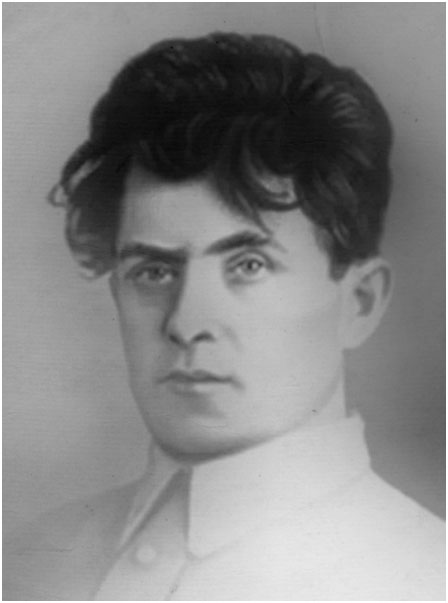
Grigory Kaminsky
Grigory Kaminsky was the People’s Commissar for Health of the Soviet Union between 1934 and 1937. He set up the Soviet health system, improved the production of medicine and medical training and battled malaria in the USSR. Evidently, he was also Nan’s brother-in-law. However, in 1937 he made speech in which he condemned the wrongful arrests of people and accused Lavrentiy Beria, the head of the NKVD, of counter revolutionary activities. As a result, he was arrested and then executed by firing squad in February 1938. Then, it seems, the NKVD went for the rest of his family.
Now I had a surname I went back to the earlier files from the 1920s and 1930s and managed to find documents that linked Anatole Naumovich Kaminsky and Annie Stewart together which speculated about whether they were married. So, now I knew who he was but still no idea of what he looked like or any real details of what had happened to him. My first port of call would have been to search for him through the Memorial website. Memorial is the Russian human rights organisation set up to investigate the crimes of the Stalin era and beyond. They’d amassed records of all known victims in a ceaseless effort to record every human rights violation. However, last year it was closed down after years of intimidation by the Putin regime. During one court hearing the state prosecutor announced that Memorial was “creating a false image of the Soviet Union as a terrorist state.”
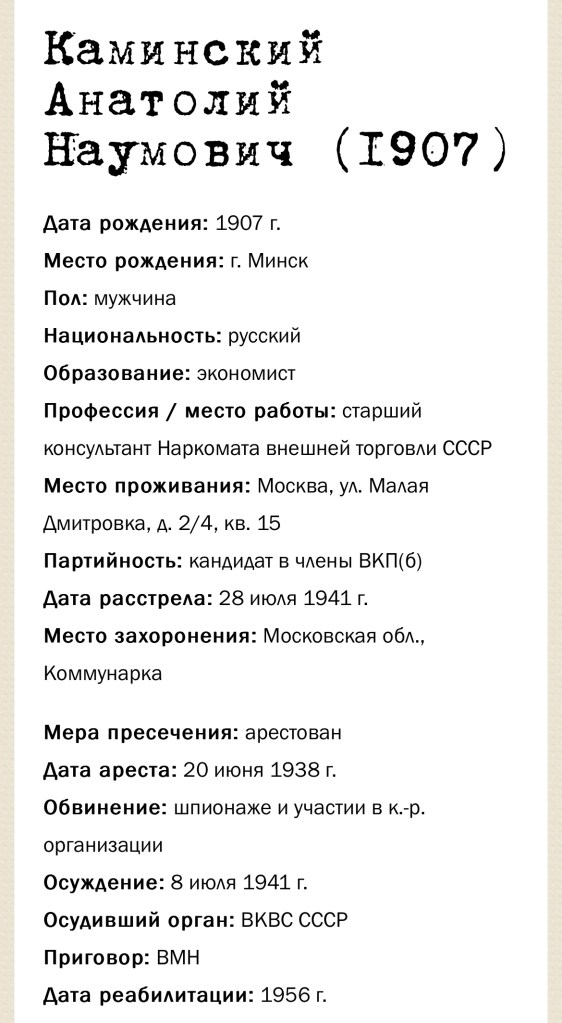
Screenshot of the information I found on Anatole Kaminsky. Apparently the information is from a database of “Victims of political terror in the USSR”; Moscow, execution lists -Kommunarka.
Despite Memorial being closed down I think I’ve still managed to find a record of what exactly had happened to Anatole. It appears that there are several websites that have ‘backed up’ the information held by Memorial and similar agencies and these have not all been shut down yet. Not being a Russian speaker, I can’t fully judge the reliabilty of the website I found but, as key parts of the information held on Anatole Kaminsky match what’s held in the MI5 files, I am reasonably sure that this is what happened.
On June 20th 1938 NKVD officers arrived at Anatole Kaminsky’s Moscow flat on the St. Malaya Dmitrovka. They arrested him on charges of espionage and participation in counter revolutionary organisations. He remained in custody for the next three years and was eventually convicted on 8th July 1941 shortly after the Nazis invaded the USSR. His sentence was noted down as ‘VMN’. This stood for ‘Vysshaya Mera Nakazaniya’ which translates as ‘the supreme measure of punishment’. In other words, the death penalty. On July 28th the sentence was carried out. They took him to the Kommunarka shooting ground on the outskirsts of Moscow where his body lies alongside thousands of other victims to this day. He was 34 years old.
Anatole was rehabilitated by the Khrushchev regime in 1956. Rehabilitation would have had to have been requested and I assume it was Harry Pollitt who put that in motion or it might have been Bob on his visit to Moscow in August that year. That’s as far as justice stretched.
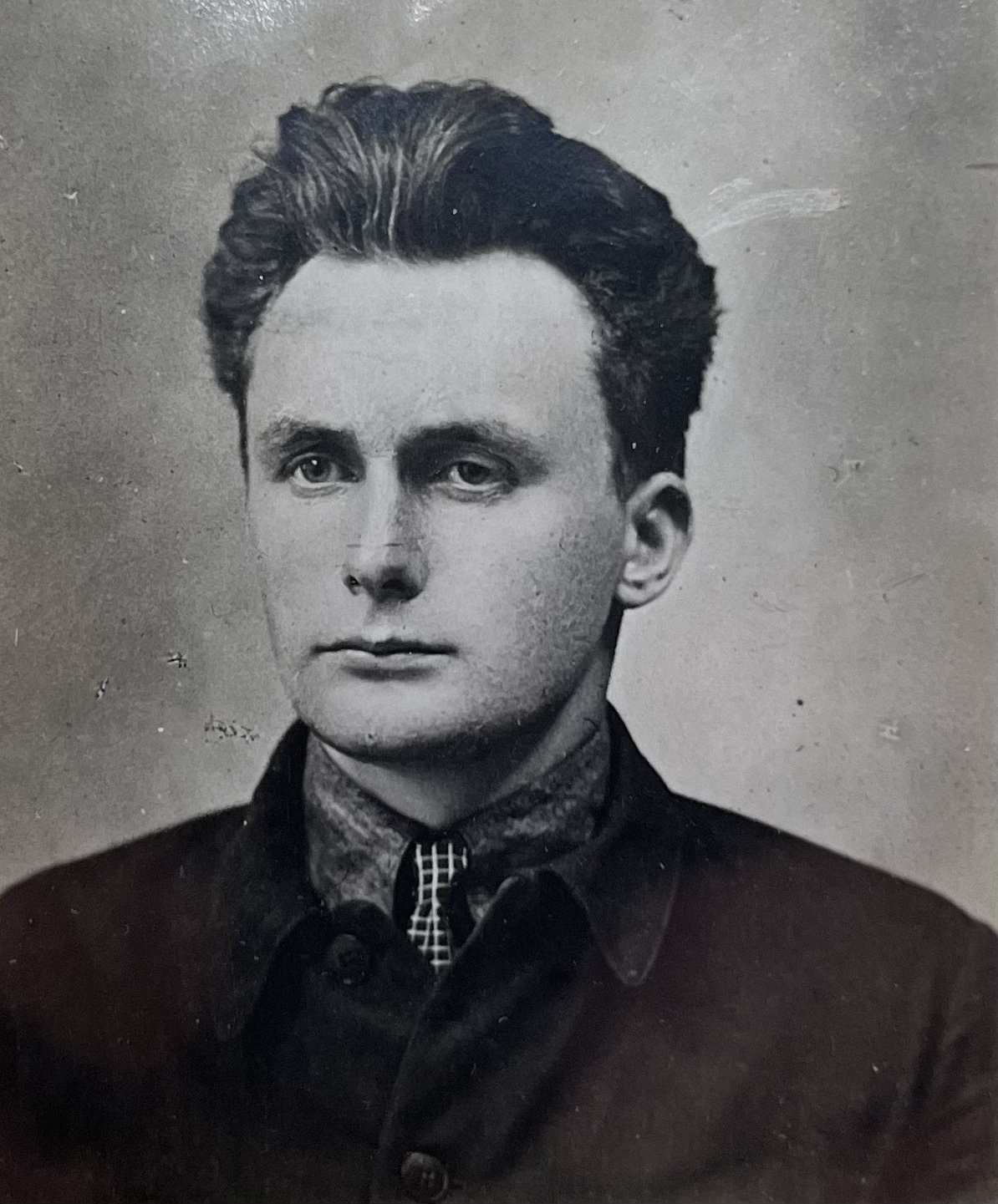
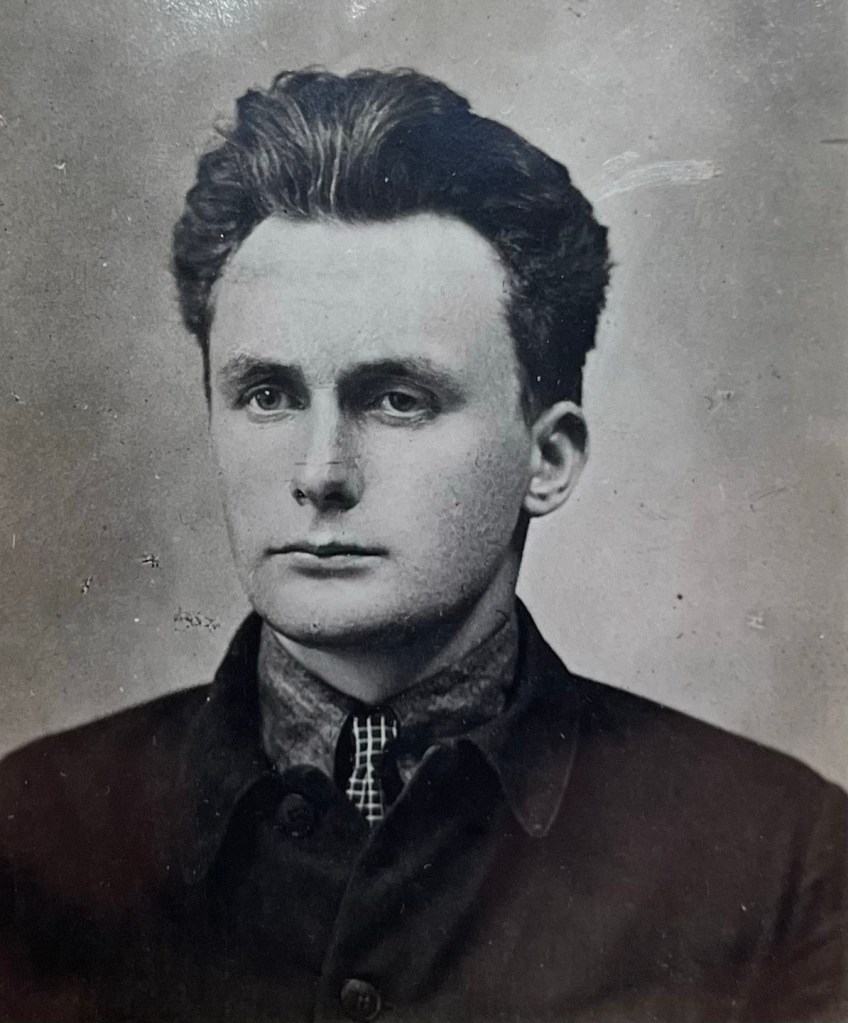
In November this year I finally saw some photographs of Anatole, one of which is reproduced at the top of this article. They were attached to his MI5 security file held at the National Archives. I spent the morning reading all about the six years he spent in Britain before he returned to the Soviet Union and the dreadful fate that awaited him. That afternoon I met, for the very first time, another of my dad’s cousins. It was Rab and Margaret’s daughter Linda. It had been Margaret who Nan had rang up after discovering what had happened to her husband in that summer in 1956. It was an emotional meeting and we covered a lot of ground in the few hours we were together. She could not believe I had found photographs of ‘Natte’ as he’d been known. He’d died long before she was born and she’d never seen a picture of him either. Of course she was familiar the story and knew that her aunt and cousin had got away by “the skin of their teeth.” When I showed her the photographs on my phone she was instantly struck by the resemblance to Greg who she’d known well and who died in 2019. I was glad I was able to show her these images. I wish that I could have shown them to my father. Above all, I wish I could have shown them to Greg.
Alan Stewart.
Thanks to Linda Stewart, Ian Stewart, Ruth Holliday and Maurice Casey for all their help.
The Stewart Family pictured in the mid 1920s: -R: Bob, Rab, Annie (Nan), William and Margaret.
To the best of my knowledge the last person in my family to still be fully committed to a Marxist-Leninist revolution died in 1978. He was my grandfather William Stewart and he was lovely. However, even though those that remain have spent the intervening forty-four years failing to overthrow the capitalist system, communism has loomed ever present in the background in our lives for all sorts of reasons. It is a bittersweet inheritance. I suppose there is nothing surprising in its presence as, from the inception of the CPGB in 1920, communism essentially became the family business for the next fifty years. Practically everyone was involved.
At the end of 1955 – a few months before Khrushchev would acknowledge the crimes of Stalin for the first time in his ‘secret speech’ MI5 picked up some office gossip about the Stewart family through one of the bugs it had placed in the offices at the Communist Party’s HQ in King Street, Covent Garden. Reuben Falber, who, when Bob Stewart finally retired in 1957, would go on to be responsible for distributing funds from Moscow, was overheard talking to fellow party worker Betty Reid about a recent scandal involving Bob’s nephew Greg – a Cambridge student who had just been unforgivably rude to one of the comrades at Central Books. Here’s part of the transcript in the security files:
‘They’re a family that-well, they’re a law unto themselves because you’ve got a combination of the old fellow’s prestige and money. BETTY asked where the money came from. Regret FALBER’s reply was whispered and could not be followed.
(From the MI5 Security File on Bob Stewart KV2/2790 – The National Archives)
The ‘old fellow’ is, of course, Bob Stewart and quite clearly the whole family had something of a reputation within communist circles. In fact, Betty Reid, in a conversation recorded about eight months later, was of the opinion that the Stewart children – William, Rab and Nan, had been “thoroughly spoiled all their lives.” This kind of attitude is elaborated further in an earlier document I came across in my grandfather’s security file on a recent visit to the National Archives. It’s dated 17th October 1932 and appears to be a memorandum from Special Branch to MI5 concerning the activities of Bob and his three children. I reproduce it here in full partly because I think it’s an interesting account of how the Stewarts and other similar families were viewed within the movement but mainly because I love the description of my grandfather.
The following information has been received.
WILLIAM STEWART, who used to drive the Soviet Ambassador’s car has given up driving altogether and is now employed in the Embassy as a ‘trusted’ man. He recently stated that he was engaged there on work of a secret nature, which included a little clerical labour.
His hours are from 5pm until 1am and his wife also has a job at the Embassy.
He is forbidden to undertake Communist Party of Great Britain work.
He now wears a small moustache, Charlie Chaplin style, which gives him an altered appearance, and carries an ash walking-stick. He often wears a light green shirt, brown jacket and shorts (at other times grey flannel trousers), light brown rabbit-skin hat, and brown shoes. He apes the appearance and mannerisms of a university student.
His father, ‘Bob’, is at present in Belfast where he is assisting the Irish Revolutionary Workers’ Party.
His brother, who lived with Ralph Edwin BOND, and was attached to St. Pancras Local Communist Party of Great Britain, has now secured a situation at Arcos Ltd. as also has his wife. Both have been transferred to Islington Local.
His sister, who was active in the Young Communist League of Great Britain, and who went to Russia on several occasions, has gone to live there permanently. She also was employed at Arcos and married a principal of that concern. As he has been recalled to Russia, she has accompanied him.
The state of affairs here outlined indicates how the movement is ‘exploited as a meal ticket’ (to use the phrase of certain disgusted genuine Communists) by certain fortunate families.
The CAMPBELL family is another case in point. The sum of over £20 weekly is received in John Ross Campbell’s home from Soviet sources.
The WATKINS’ are in the same position, whilst there is a host of others.
There is keen resentment in the ‘movement’ over this condition of things. It is freely expressed that no man and wife should be allowed to hold a situation while other ‘Comrades’ are unemployed. This objection has taken root and considerable trouble on the point seems likely to develop.
SUPERINTENDENT.
(From the MI5 Security File on William Stewart KV2/4494 – The National Archives)
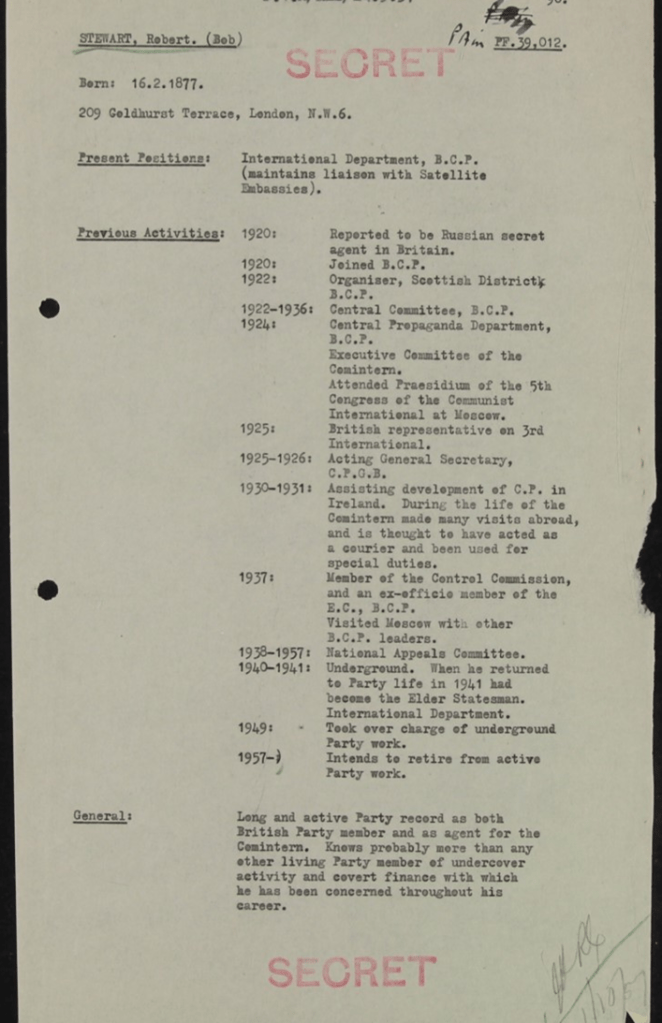
The document above is taken from the MI5 files now held at the National Archives in Kew. It’s from 1957 and gives a pretty comprehensive overview of Bob Stewart’s career in the Communist Party so far. Bob celebrated his eightieth birthday that year and most of the material the security services picked up from tapped telephones and bugged offices at the CPGB HQ in King Street, Covent Garden relate to him aiming to wind down and retire. There’s a decent summary of his professional life at the end.
“A long and active Party record as both British member and as agent for the Comintern. Knows probably more than any other living Party member of undercover activity and covert finance with which he has been concerned throughout his career.”
He’d spent quite a lot of the early years in Moscow, attended Lenin’s funeral and sat in meetings with Stalin. Then he spent time in Ireland trying to start up a Communist Party with the Irish labour hero Jim Larkin but little came of it. At one time, while the rest of the leading British communists were thrown in jail around the time of the General Strike, he became the CPGB’s Acting General Secretary. The Second World War years are a bit of a mystery but by the mid fifties the old man was very much on the security services radar again, though in this run down of activities they miss out his recent visit to China with Harry Pollitt where he met Mao Zedong.
Most of the surveillance work over the immediate years previously had been spent tailing him as he routinely visited satellite embassies and various address in the south of England. This was largely thought to be Bob moving different sums of Moscow cash around in order to keep King Street and The Daily Worker going. The issue of retiring and who he should hand over his responsibilities to was problematic as Bob wrote very little down, preferring instead to keep the details of all his undercover work in his head. There are several times in the transcripts where he is overheard by MI5 that he has been very lucky so far and didn’t want to go to prison at this time of his life. Indeed, at his advanced age he felt his memory was starting to fail and the past year had been exhausting. Revelations of Stalin’s crimes and how it affected his family personally had taken their toll. Eventually, Reuben Falber took over Bob’s work and if you want to find out what happened to the ‘Moscow gold’ just type his name into Google.
I don’t think Bob fully retired. There’s an album of photos from the 22nd Congress of the Communist Party of the Soviet Union in 1961 showing him mingling energetically with the delegates. He published his memoirs, Breaking the Fetters when he was ninety. Sensibly, but frustratingly it contains nothing of his undercover activities and only covers the early period of his life and the Party so there is little reflection on Stalinism. However, what does come through is his tremendous energy. The Communist Party in Britain formed in 1920. Bob was forty-five years old. All of this happened in the last half of his life. Before, there’d been thirty odd years of campaigning for the temperance movement, for trade unionism and against the First World War. The drive he had astonishes me.
I came to this story through grief. In 2018 my father, Michael, suddenly died of a heart attack at the age of 84. His passing brought to an end years of decline through vascular dementia. I had loved him very much and the idea that now there was only myself, my elder brother Ian and our mother was impossible to process. We did what most families do in that first year – come together for solace, then fracture painfully, then slowly heal. We did most of our grieving separately but I imagine it looked pretty similar. Sleep never seemed to arrive and I spent many nights in the spare room as my partner slept on searching through photographs, old letters and hunting down any recording or videos just so I could hear his voice again. He left very little trace on the internet – I picked up a few extra photographs from his days as a parish councillor, the odd story archived from the local paper from his days as the landlord of the village pub but very little else. Although it was in no way a reality, I felt I was losing him just as surely as the dementia had whittled down his ability to tell the stories he loved. God knows why I was looking for proof that he existed but, as is the way with these things, the death of a parent leads you to wanting to know more about where you come from and who your family are. And inevitably, you always leave it too late to ask the questions you need to ask. The gathering at my father’s funeral had been small. That’s not surprising for someone of my father’s age. He’d not been wealthy, he’d been an only child, both his parents had been dead for decades and illness had reduced his world. I’d always been aware that my family was perhaps more compact than my friends’ with all their cousins and uncles and aunts but, on my dad’s side, despite there being family out there somewhere, I can’t remember very much contact while I was growing up. Other than the affection he held for Bill and Jessica, his mother and father, and a few stories about his grandfather Bob I knew very little about his life before he was our Dad.
One insomniac night I was looking for more traces of him, and I finally found something more. I’d searched the National Archives collection and discovered the security service files relating to ‘Robert Stewart: A founder member of the British Communist Party…British representative on the Comintern and a member of its Executive. For many years he oversaw the British Communist Party’s secret apparatus including, it was thought, those of its members who passed military information to the Soviet Union’. Of course I’d grown up with the knowledge of who Bob Stewart was but here was acres of material – all scanned and, from what was once top secret, easily accessible. Skimming through one file I found this dated August 1933:
“I saw Bob Stewart yesterday. Bill’s wife is in hospital. She had a baby a couple of days ago. Bob didn’t know a thing until it arrived. Both are doing well.”
The extract was from a letter intercepted by MI5 and written by the union agitator and one of the few communist politicians to be elected to Parliament, Willie Gallacher. The baby was my father who was born a few weeks before. The letter is mentioned during some notes about Bob’s arrival from Holland. Not only is his correspondence and that of his friends being intercepted, his movement around the country and abroad are being closely monitored. I continued to search the files for any mention of my father, occasionally rewarded with a tantalising glimpse. By the time the surveillance crept into the 1950s they were bugging telephones and offices. Through the transcripts I had the intimate conversations of the side of the family I had vaguely heard about but never really knew.
So, what is to be done with all of this? And all the letters, photographs and souvenirs left behind that we inherited from Granddad after his death in 1978. The case full of stuff that convinced me that all my family were all Soviet agents when I was five. The answer is to read and remember and to try to understand. There’s a lot in Bob’s life that I admire but, as with any lifelong communist from the 1920s, sooner or later you have to confront the obscenity of Stalinism. At the moment, as I’m researching the ramifications of Khrushchev’s secret speech and the Hungarian uprising in 1956 its clear these events had huge repercussions for my great grandfather, his children and his grandchildren. I’m not sure Bob comes out of it well but that’s for later. For now, all that remains is to say – Dad, all this is for you. I wish you were here to show you what we’ve found out. I wish you were here to talk about it all. We miss you.










 Breaking the Fetters