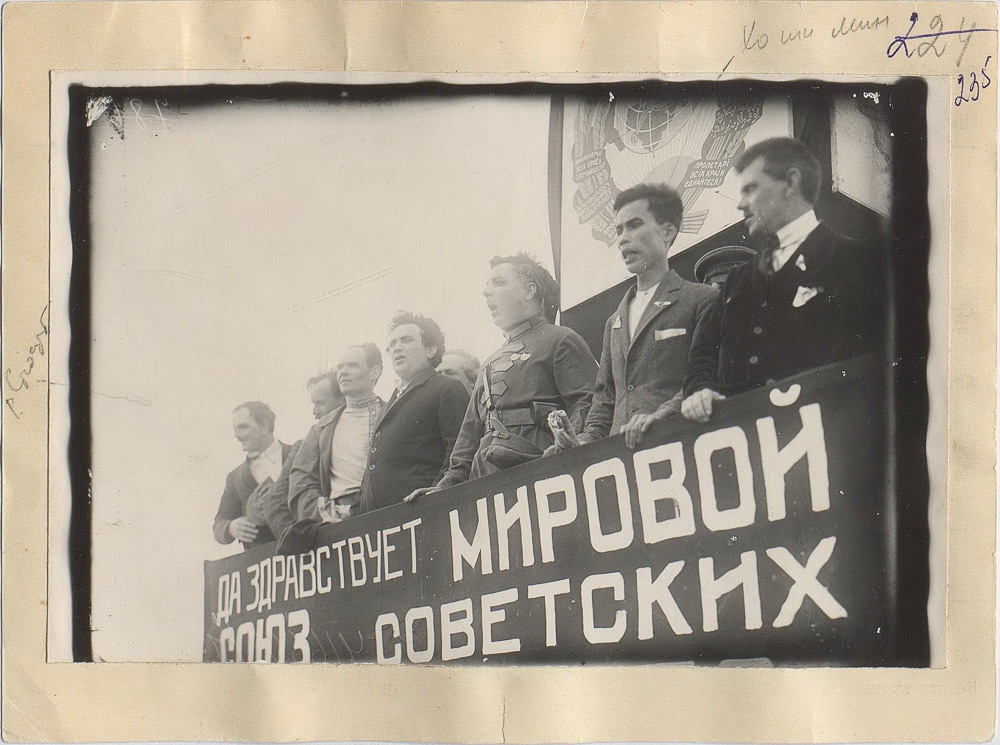
Partially visible behind L-R: Avel Yenukidze.
One of the benefits of researching a distinctive looking ancestor is that they’re easily recognisable to others studying the same topic. During the summer holidays, Maurice Casey, author of Hotel Lux (out now in paperback!) spotted Bob Stewart’s familiar broken face in a photograph taken in Moscow dating from 1924 when he was the CPGB representative to the Communist International. He could be seen, furthest left, in a group lined up behind a banner proclaiming, “ Long Live the Global Union Of Soviets!” Above them is a flag with a hammer and sickle in the centre of the globe which is framed by sheaves of wheat. The group look as if they’re in the middle of the chorus of The Internationale, The Red Flag or a similar revolutionary anthem. Bob has a broad smile on his face. Of the others, the only individual I could recognise was Grigory Zinoviev, the head of the Comintern, essentially my great grandfather’s boss at the time. In his email, Maurice pointed out the figure second from right, “a young delegate of the French Communist Party, originally born in French Indochina: today known as Ho Chi Minh.” Frankly I was stunned. Despite his attendance at Lenin’s funeral, late night consultations in the Kremlin with Stalin and his visit to China in the 1950s where he met Mao Zedong, I had no idea that Bob had ever encountered the man who would become one of the most influential leaders of the twentieth century. Even my teenage son was impressed having studied the Vietnam War in GCSE History. “They named a trail after him!” was his initial reaction. Yes – also an avenue, a square, several monuments across the world and a whole city.
The photograph encapsulated something I’ve grown to love about the communists of the 1920s. The optimism. The hope. The unwavering belief that they would change the existing state of things. Life would be better for millions. A lifelong abstainer from alcohol Bob would nevertheless would find life at the epicentre of this struggle intoxicating. It’s something I marvel at, especially in today’s atmosphere of grim resignation of successive governments that – no – nothing in society can ever be improved. Here’s more cuts. Here’s more crackdowns. Nothing to be done. The romance of this image of my forebear and his comrades – and it is Romantic – was only heightened when Liz Wood from the Modern Records Centre at Warwick University pointed out on Bluesky where the image had come from. It was taken on the 6th of July during a massive celebration when representatives from the French Communist Party symbolically handed over a tattered red flag which had flown over the Paris Commune in 1871 to be placed in Lenin’s mausoleum which was then under construction.
In an eyewitness account published in the US version of The Daily Worker the journalist Anna Louise Strong describes how a four hundred thousand strong crowd poured into the October Field just outside Moscow. The ceremony took place on the International Day of Co-operation and the first anniversary of the signing of the new Soviet constitution. I imagine it was also organised to rally the workers after an appropriate period of mourning for Lenin after his death in January that year. The solemn grief of the funeral which took place in ice and snow months before was replaced by sunshine and a carnival atmosphere.
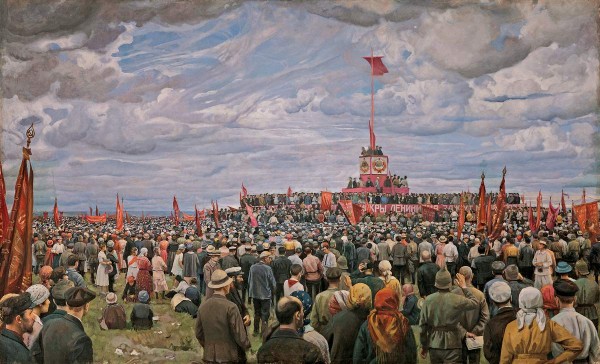
The fraying flag perforated by bullet holes had been taken down from the barricades of the Paris Commune over fifty years before and had been passed along various socialist groups in the intervening years in the manner of a religious relic. It had left the French capital with a farewell parade of one hundred thousand workers and was greeted on it’s arrival in the worker’s state by magnificent scenes captured stirringly in an oil painting by the artist I.I. Brodsky. I’m fairly sure Bob is depicted as one of the distant figures on the middle row of the tribune. It’s probably me being sentimental but it does correspond with the photograph.
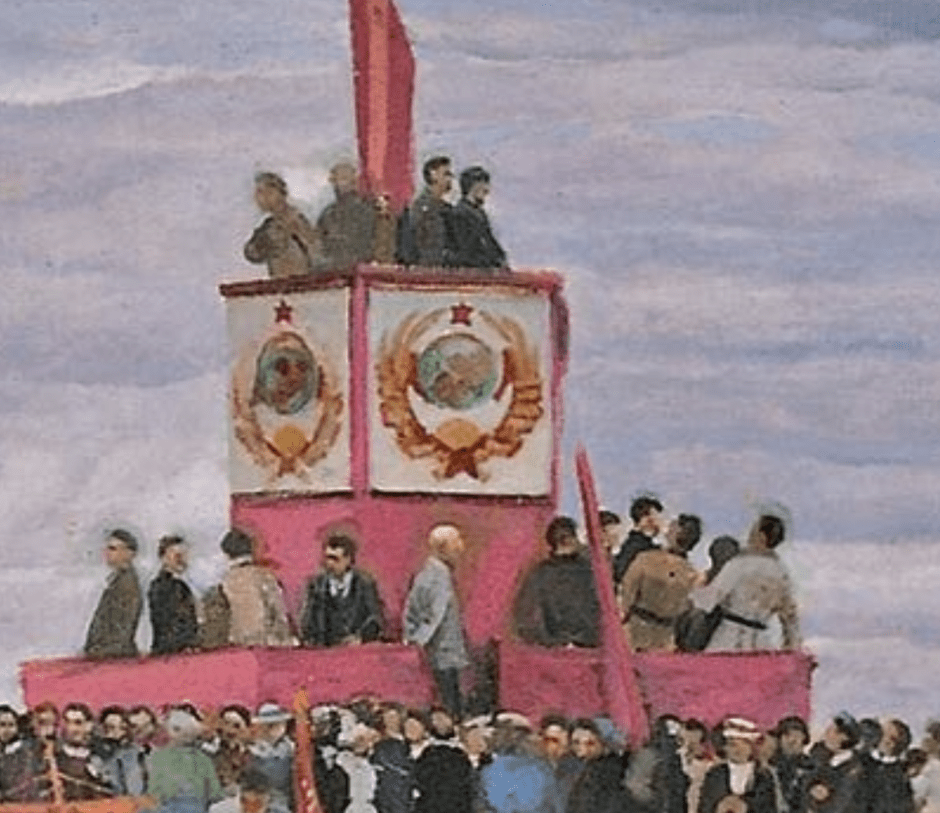
Strong’s narrative outlines the speeches, the songs, the performances and the sporting displays of this public holiday but at the centre of events is the handover of the scarlet standard.
“For nearly five hours they were marching 10 abreast into Hodinka field now named the Field of October. A great tribune 70 ft. square, with a pyramid of platforms one above the other, held the delegates of the Communist International, the central executive of Russia and the Moscow city government. Massed around the tribune were hundreds of encircling factory delegates bearing their factory banners of embroidered red silk or velvet topped with metal stars or sickles. Around these was a wide aisle and then came the hundreds of thousands of spectators with eight wide aisles formed through their midst by single lines of soldiers.
A festival spirit pervaded the assembly. Men and girls were raised aloft on the arms and shoulders of their friends, and balanced above the throngs. They led the cheers and salutations and even made speeches.
The worn red banner was borne down one of the aisles by the delegation of French Communists. It was lifted aloft to the highest platform of the tribune, where it was visible for half a mile away. President Kalinin received it.”
The next day a Russian newspaper carried the message, “We will give it back to France when we have carried it throughout the world.” A sentiment which should still make any self-respecting leftist go all husky and brave and, yes, I did find myself welling up. There had been a world to win. If only we could leave it there. But of course we can’t. When this photograph was taken, capturing my great grandfather full of confidence that a fairer society was just around the corner, very bad things had already happened. Very bad things were happening at that time. And very, very bad things were going to happen in the future.
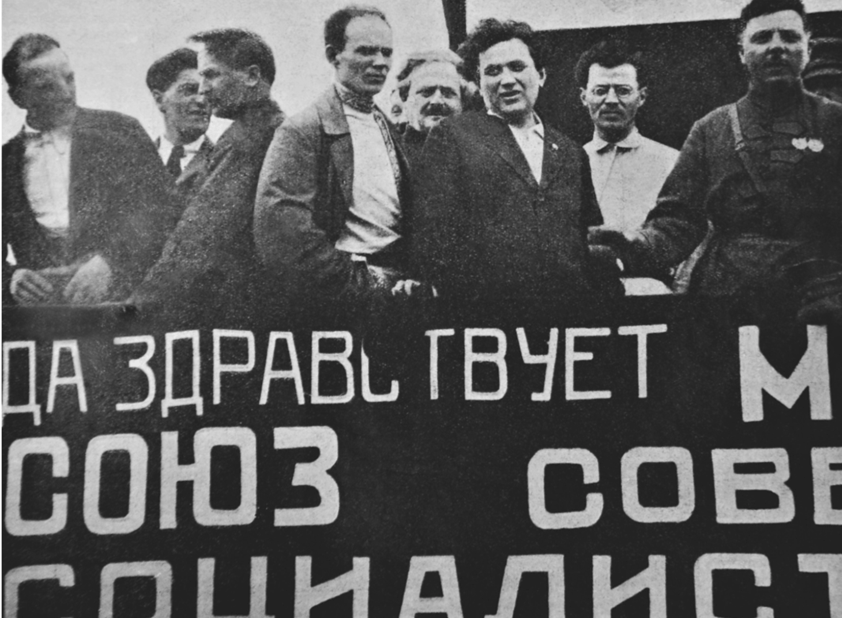
I’m currently working on the period in Bob’s life where this hopefulness turns to tragedy. The 1930s and 40s. A few enquiries on social media helped identify some of the other figures on the platform. Nikolai Antipov became Deputy Premier of the Soviet Union but during the Great Purge he was arrested, expelled from the Communist Party and sentenced to death. A similar fate was in store for Avel Yenukidze. Grigory Zinoviev, the Comintern Chairman, was tortured, forced to confess to outlandish crimes during the Trial of the Sixteen and shot in the back of the head. Apart from Bob and Ho Chi Minh, the only other identified person to survive until old age was Marshal Kliment Voroshilov who emerged from Stalin’s maniacal purging of military officers unscathed only because he was an enthusiastic participant in the process having personally signed 185 execution lists.
These names can be added to this list of Bob’s comrades, friends and family I made to try and make sense of the chaos of a few short years:
Aug 1936: Kamenev (and Zinoviev) executed.
January 1937: Karl Radek’s show trial. Murdered in prison in 1939.
February 1937: Sergo Ordzhonikidze kills himself.
March 1937: Arrest of David Petrovsky, a former Comintern liaison with CPGB and friend of many British communists including Bob. Shot in September.
June 1937: Grigory Kaminsky, The People’s Commissar for Health and Bob’s daughters’ brother-in-law was arrested. He was executed in February 1938.
August 1937: Rose Cohen, David Petrovsky’s wife and close family friend of Bob’s arrested. She had given up her British passport and become a Soviet citizen. Shot after a twenty minute trial in a closed court in November.
June 1938: Anatole Kaminsky, Bob’s son-in-law arrested. The family presumed he was dead but he was executed in 1941 as the Nazi forces began their attack on the USSR.
November 1938: Nannie Stewart, Bob’s daughter and Anatole’s wife makes it back to London alive with her baby son Greg.
The madness of it all. Whatever the words I find to relate all this, they will be inadequate.
Alan Stewart.
PS: Thanks (one again) to Maurice Casey and to Liz Wood and to anyone else on Bluesky or Twitter who helped identify Bob’s comrades on the platform. Anna Louise Strong’s account can be read in full here – ‘Tattered Red Flag of Paris Commune Flung to Breeze in Moscow as Workers Cheer’ by Anna Louise Strong from the Daily Worker. Vol. 2 No. 112. July 29, 1924. – Revolution’s Newsstand
 Breaking the Fetters