Breaking the Fetters Chapter 17: Red Agent in Glasgow.

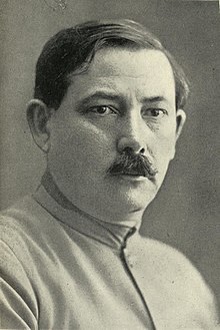
Mikhail Borodin

As the membership of the Communist Party grew and our organisation developed, better relations with the Labour Party were established in many districts. At the 1922 Labour Party Conference held in Edinburgh in June, the right wing on the National Executive Committee placed a change of rule on the agenda that would prevent such unity and indeed would go a long way towards isolating the Communists from the labour movement. The rule in question concerned the eligibility of delegates to local and national Labour Party conferences and the selection of candidates, and the changes read:

a) Every person nominated to serve as a delegate shall individually accept the constitution and principles of the Labour Party.

b) No person shall be eligible as a delegate who is a member of any organisation having for one of its objects the return to Parliament or any Local Governing Authority of a candidate or candidates other than such as have been endorsed by the Labour Party or have been approved as running in association with the Labour Party.

This change of rule, carried by a two-to-one majority at the conference, was directly aimed at the Communist Party and created a new position in the British labour movement. It was discussed by the Communist Party National Executive, who decided to recommend to their members that where it was necessary, such as in Trades and Labour Councils, Communists should accept the constitution of the Labour Party, and that where Communists were standing for parliamentary or local council elections they should be withdrawn unless there was agreement with the local Labour Party, thus fulfilling the conditions required by the change of rule.

To discuss the executive’s recommendations, I called a special extended meeting of the Scottish District Executive, but fate decreed that we were to have something more on our plate in this discussion. At this time Borodin, a member of the Communist International, was in Britain, and had previously visited a number of districts in England and Wales. He was a lawyer by profession, an erudite and well-informed man. He came to Britain to get an on-the-spot understanding and appreciation of British politics and the way in which the British Communist Party was working.

When I met him in Scotland he told me he wanted to meet people in the labour movement, to get to know them, their background and their attitude to politics. He said I was the only party organiser who had really been able to do this for him. I think that was flattery. He knew all the fine arts of winning people. I had a number of discussions with him and, while I was undoubtedly able to help him in assessing the Scottish political scene, he also greatly assisted me in reaching a deeper appreciation of the way a serious politician must work to win mass support. He patiently explained the value of international work, international trade union contact, international exchange of information in the cultural and educational fields, all of which was very new to me.

At the extended Scottish Executive meeting, Willie Gallacher spoke for the National Executive, emphasising the tactics of the right wing of the Labour Party to drive the Communist members out of the working-class movement, out of the Trades and Labour Councils and finally out of the trade unions. Naturally Mr. Brown, for that was the name Borodin used, asked to speak. He was quite critical of the way a number of Communist members were working. “When I saw the Communist delegates at the Labour Party Conference,” he said, “I thought- if this is how the party is handling the situation then it is manœuvring very poorly.” Borodin was a great story-teller, and went on to say: “It is easy not to get drunk when you pass every saloon bar, but to be good politicians our members must learn to enter these places and not get drunk. To be able to seek affiliation to the Labour Party, the greatest saloon bar I have ever seen, to drink in the bar without getting drunk, that is what is needed. No party can avoid these places.” He talked about the Glasgow Trades and Labour Council. “Here is a basic working-class organisation with 362 affiliations representing 126,116 members. We have fifteen Communists representing their organisations. What do they do? Are we to allow them to be thrown out or do they stay inside and conduct work for the unity of the working class and for working-class policy? Do we fight on ground favourable to the right wing Labour people or on ground favourable to the left wing? Revolutionary tactics demand they stay inside.”

Despite the support of Willie Gallacher, Johnnie Campbell and Mr. Brown for these proposals, there was much criticism in the ensuing discussion of the National Executive’s recommendations, particularly the one seeking to withdraw our candidates where we got no agreement with the Labour Parties. We had already selected candidates for the next general election. J. V. Leckie, Tommy Clark and Ned Douglas, all members of the Scottish Executive, and various other comrades, had a real go. Frankly I could see their point of view and said so in the discussion. At one o’clock in the morning it was voted that we adjourn the meeting on the understanding that we would re-assemble the following week and try and finalise the position.

But the next meeting did not last long. We had just started when the Glasgow Criminal Investigation Department intervened in force. There were dozens of policemen and plainclothes men-they must have been concealed on all the stairs round about. They burst into the meeting and commenced to take all our names and addresses until they came to Brown. “Who is he?” they asked me.”A Yugoslav journalist visiting Scotland, interested in the Scottish Labour Movement,” I answered truthfully. “He’s the man we want,” and they left, taking Borodin with them. This was not an entirely new experience for me, but I admit to being worried during the questioning because I was standing beside a little sideboard we had in the office, hoping they would just leave me there. Fortunately they did. In the sideboard lay Borodin’s briefcase and his private papers. He also left a beautiful big panama hat which would have been a major sensation in Sauchiehall Street any day. I can’t remember who fell heir to that. Once the police had left, we set to work. Goods, chattels and papers were taken away to safe custody.

We arranged for food to be taken to Duke Street Gaol where Borodin lay on remand awaiting trial. This the law allowed. We had a relay of comrades who carried out this duty very willingly and well. The privilege stopped and then he had to exist on the normal prison diet which, in those days, to Borodin, must have been really nauseous, a real punishment indeed only kail and porridge daily.

Our most important task was to find a lawyer to take charge of his defence. Our choice was an ex-bricklayer who had won his way into the legal profession; his name was Alex McGillivray. He worked night and day. In the course of the case Borodin and McGillivray developed a great admiration and a real affection for each other. I never heard a lawyer speak of a client with such profound comradely feeling. Even so, the defence was not a smooth run. Borodin was trained in American law and practice and Alex had great difficulty in persuading him that this would not take a trick in the much more subtle practices of the Scottish Court.

The newspapers made a meal of the incident. “Underground Agent of Communism Caught”; “Red Agent in Glasgow” were two of the headlines. On Wednesday, 3oth August 1922, Borodin appeared in the Glasgow Court. The Procurator Fiscal was J. D. Strathearn and Borodin was charged that, at 156 Vincent Street, Glasgow, he (a) failed to produce a passport to the Registration Officer; (b) failed to produce a registration certificate; (c) refused to answer questions.

The Procurator Fiscal said Mr. Brown, alias Borodin, was a Yugoslav journalist, in Britain without the knowledge or authority of his country. How he came to Britain was not known. The British Intelligence considered him a dangerous person because he was sent to this country to foster revolution and had been found in Glasgow about to deliver an address. The C.I.D. considered his arrest very important. He had previously been in Britain, but on this occasion had only been in Glasgow one day (a big build-up for the efficiency of the Glasgow C.I.D., but a lie). The Procurator Fiscal asked for a prison sentence and deportation. The sentence was six months’ imprisonment with deportation immediately on release.
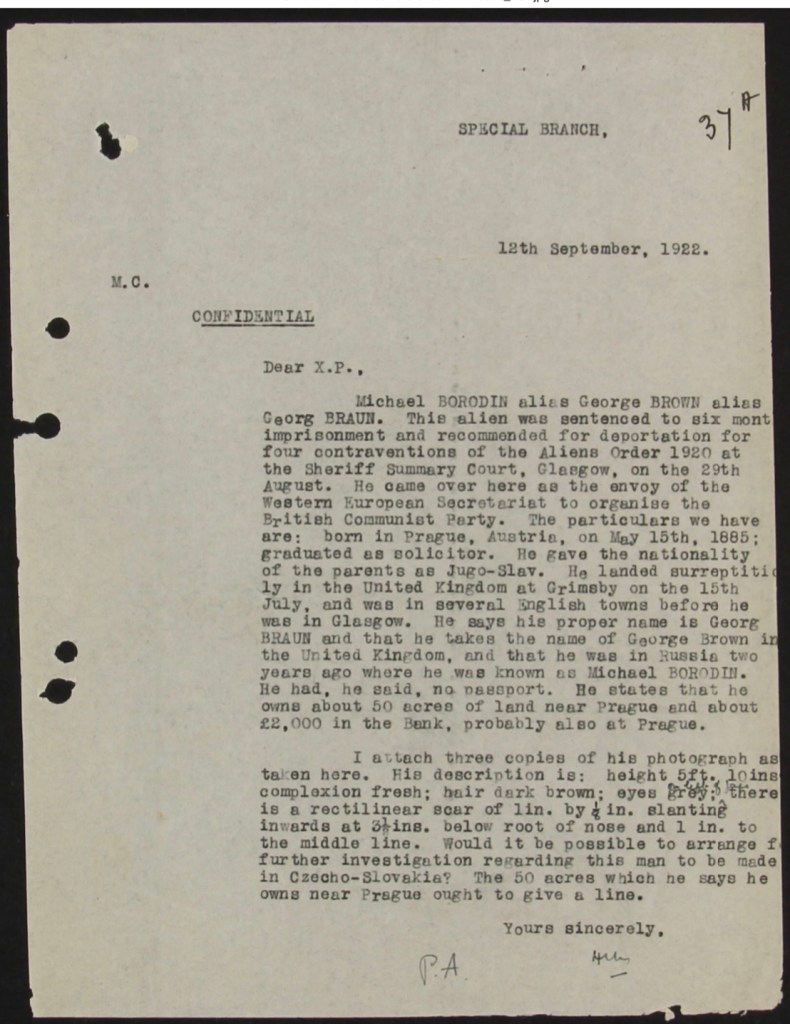
Note from Special Branch about Borodin’s imprisonment.


Borodin served his time in Barlinnie Prison in Glasgow. He did not like jail, a sentiment I strongly shared with him. He said Barlinnie was colder than Siberia and having sampled both he would be a good judge of that. We did our best to cheer him up while he was on remand, taking in food and news of the outside world. I remember buying one of those iron plates that hold hot water and keep the food warm, to take into prison. Probably because of the coldness of the prison, he always asked for hot food.

Borodin was unfortunate in prison. He worked in the laundry and was badly scalded on the feet and legs with boiling water. Six months pass slowly in prison but fast enough outside. I got special visits to see him and much of our discussion dealt with his deportation. He was like a bird in a cage and his release and deportation must have been a welcome relief to him.

I had to consult with the Russian Trade Delegation about Borodin’s deportation. They were stubborn and, in my opinion, unreasonable people and I became a real angry man. However, I finally persuaded them I was right and on his release off Borodin sailed.

I met Borodin again on my first visit to Moscow when I went there to work on a British Commission. Borodin was very helpful to me during this long survey. After this I was asked to return to Moscow to work at the Comintern headquarters. I was very reluctant and doubtful about my competence to do this work but Borodin pleaded with me to accept. “Bob,” he said, “you come. I will give you all the help you need.” When I arrived in Moscow some time later, with my wife and daughter, as a delegate from the British Communist Party to the Comintern, Borodin had gone, I think to China. Anyway, he was not there to give the “every help” he had promised.

Naturally the Borodin arrest had a profound effect on the Scottish Party. There was an inquisition amongst ourselves as to how the leak had taken place. I began to treat the work with greater carefulness. Afterwards, when the full story was known, we discovered that the leakage did not come from Scotland but from further South.
Breaking the Fetters Chapter 15: In Gaol Again.

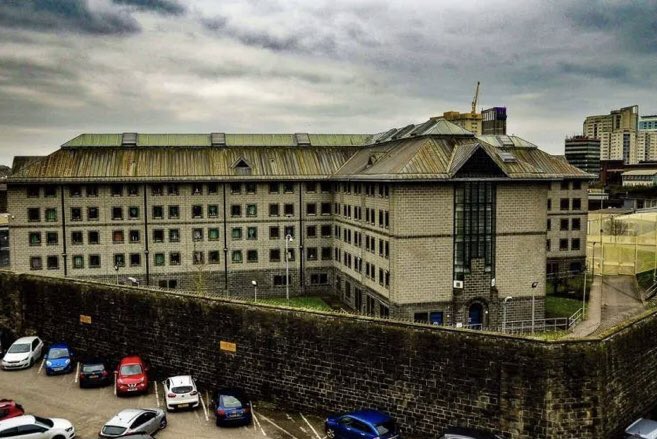
HMP Cardiff.

In 1921 I was attending the Party’s National Executive in London. It was close to May Day and McManus, who was booked to speak at a May Day meeting in South Wales, said he could not go and asked me if I would like to take his place. “Sure,” I said, “I have never been to South Wales and it will be a new experience.” As it turned out it was.

I went down by train to Aberdare but before reaching there the train stopped at a small station and along the platform came a group of fellows shouting, “Bob Stewart, Bob Stewart!” I stuck my head out of the window and said, “That’s me.” “Can you do a meeting for the Party in Mountain Ash tomorrow night?” they asked. “Yes, I’ll be there.” So, after the meeting in Aberdare I travelled to Mountain Ash. The meeting was in a cinema and was crowded out. As usual at the time, the “splits” were in the boxes taking notes of my speech, but this happened at all meetings so I ignored them. The meeting finished and the local fellows said they were very pleased with the attendance and the effect. The repercussions were then still unknown.

I returned to London, and on the following Saturday, 7th May 1921, came the police raid on the party offices at King Street, Covent Garden, when Inkpin the general secretary was arrested. The raid was made without a warrant, under the Emergency Regulations Act. It was carried out by Detective-Inspector Parker, acting under the instructions, so he said, of the Director for Public Prosecutions.

During the raid all personnel in the office were rounded up from their individual rooms and brought to the general office on the ground floor of the building. The rooms were ransacked and, while this was going on, the homes of the office workers, even those of the girl clerks, were being searched. The police authorities certainly put on all the trimmings to build the raid up into a first-class political scare.

When Inkpin came into the general office and he exploded at Parker for the unwarranted intrusion into private property. “I demand to see your warrant to search these premises,” he said. “I don’t need a warrant,” replied Parker. “I am acting under the Emergency Regulations.” Parker then started to question Inkpin about the publication and sale of the Communist Party pamphlet called The Statutes of the Communist International. “Who wrote the book?” asked Parker. “What do you mean who wrote it?” said Inkpin. “These are the Statutes adopted by the 2nd Congress of the Communist International.” “Where did the books come from?” persisted Parker. “They came from Moscow, from the Communist International,” replied Inkpin. During the interrogation Inkpin again protested to Parker about the manner in which the police were acting, forcing their way into all the rooms in the building, sorting out files of correspondence obviously with the intention of taking them away. But Parker brushed this aside and kept on asking questions about the pamphlet The Statutes of the Communist International. Inkpin continued to answer truthfully this was a record of the decisions of the Communist International which was sent by the International not only to Britain but to most countries throughout the world.

Now Detective Inspector Parker might have been a good man at detecting crime, but he did not seem to have the elementary knowledge required to comprehend the simple working of an international body. Maybe, of course, he had had his instructions not to try to understand. Anyway, after fifteen minutes of this sham he stopped asking questions and started giving instructions. To Inkpin he said, “I am going to arrest you under the Emergency Regulations Act No. 19. I am further going to search the premises and take possession of anything I think fit under an order signed by the Chief of Police.” He then turned to another detective and said, “Mr Hole, here is the order,” and to “Inkpin, “Come with me.” “What, without a warrant?” said Inkpin. “None necessary,” was the reply and he turned to leave. It was then he spotted me standing in a corner trying to look as inconspicuous as possible, but obviously not succeeding. “Who is that man?” he barked. “That’s Mr Stewart,” said Inkpin. “Get his name and address, and the name and addresses of all the others.” And with that little lesson of how democracy works in this land of the free he turned, taking Inkpin with him, and disappeared out of the door.

The place was alive with police and plain-clothes men. I ran from room to room trying to salvage what I could, but the police ransacked the place, almost everything went, even to the paper and the stencils. There were a number of spare files of our paper Communist and I knew that McManus had some papers ‘filed’ away for safety. I said to the policemen who were carting all the material away for examination., “Here, take these away; they are only in the damned way here. You’ll be doing something useful then.” “We don’t need these,” was the reply, “we have files of them ourselves.” So that saved something. After the raid, in the evening, I went out to try and contact some of the Executive members.  I went to the Corner House in the Strand and luckily, I bumped into a few of them and learned that there was to be a meeting at Bill Mellor’s house later to discuss what we could do under the circumstances. After the discussion, I had an argument with McManus because I said I thought that Mellor was deciding to leave us-to get out. McManus said I was a fool, but I was eventually proved right; William Mellor, despite all his thunder and aggressive revolutionary phrases, was afraid of being on the wrong side of the police authorities, and a short time after left the party.

After the meeting, I was sent to get a lawyer for Inkpin, to Torrington square, to see WH Thompson, a lawyer who was on the left. I found him in a strange way. I was ascending the stairs to his place when a young fellow came running past me. Suddenly, he stopped and said, “Jesus Christ! Bob Stewart!” “The latter’s right,” I replied. “What brings you here?” This fellow had been a conscientious objector in Wormwood Scrubs when I was there, so we wore the same old school tie. I explained the position. He worked for WH Thompson. He said, “He’s not here but I’ll tell you where to find him.  He has gone to see his girl friend,” and he gave me the address. I found WH, explained the position, where Inkpin was- Snowhill Prison- and he assured me that I could leave everything to him. I returned to my hotel in Villiers Street, near the Strand, a good evening’s work done. As I entered two big fellows ‘took’ me, one on each side. “Your name Stewart, Robert Stewart?” one of them said. “Yes, a good Scottish name.” “Well, we want you, we have a warrant out for your arrest.” Naturally, I thought it was in connection with the raid on the party office, but as soon as I got to Cannon Row Police Station I discovered I was booked at the request of the Welsh police for speeches made in Aberdare and Mountain Ash. So, I was stuck in a cell, arrested for sedition. I was interrogated by an inspector, a very clever fellow, to his own way of thinking. “Ah! I know you,” he said. “I have heard you speaking in Dumbarton.” “Up on the rock?” I asked. “Sure, there was always a big crowd there.” There was never a meeting on Dumbarton Rock in all history, so I continued to kid him but he twigged it and finally closed up.

Next day I was taken to Wales, to the Abercynon Gaol where I rested the night, and the day after I went before the magistrate. He was an old fellow, sitting at his desk. “Your name Robert Stewart?” he asked. “Yes, but what’s going on?” I replied. “You’re in Court.” “What Court? Only you, me and a policeman?” “Yes, and you are remanded to the Assizes.” And that was the strangest court I was ever in, but then the Welsh do many things in strange ways. Back I went to the cell and the policeman said, “I want to take your fingerprints.” “Not mine, I am no criminal, I draw the line at that.” “We’ll see about that,” he said and went off but he did not return for the fingerprints.

In due course I was taken to the Assizes at Pontypridd. A bunch of snuffy magistrates, local publicans and others of that ilk. The prosecutor was a little fellow called Lloyd. The charges were seditious speeches. Little Lloyd had a real go. He built up a terrible case against me, and said I should be ashamed to call myself a British subject, I was an agitator coming into the district in troublesome times stirring up strife and hatred, saying the miners were being treated worse than German prisoners and that Jimmy Thomas was a traitor to the working class- which appeared to be sedition, I don’t know why. In passing I may add that the selfsame Mr Lloyd was some time later pinched for embezzlement , but I suppose that that would not trouble his loyalty to Britain. The witnesses said their piece. The local secretary, who was a canny lad named Foot, was very good. But the other party witness, Billy Picton, undid the good work. Billy was one of the aggressive type; good in an industrial struggle, but not much use in a court of law. Asked about my reference to miners being treated worse than German prisoners, he replied, “Well, it’s bloody true, isn’t it?” – not very helpful in a court in which the scales have already been loaded against you. In the long run the trial came to an end. The magistrate said a lot of wise words, then asked if there was anything known about a past record. Innocent like, of course. Then out came the dossier. Tried, court-martialled; tried, court-martialled, on and on. When he finished reading out the record, I looked at him and said quietly, “A good record.” The magistrate said that this sort of thing must not be allowed to continue, it would not continue, and so on. The sentence would have to be appropriate to the offence. I would be made an example. The sentence was three months’ hard labour. Three months’ hard. You can do that, as the old lags say, on the door knob.

Well, there I was inside again. In Cardiff Gaol. Interesting, because Cardiff being a big seaport the gaol is very cosmopolitan- men from all nationalities are inside and going around the ring at exercise you saw all colours and all kinds of men. For the first three days I sat sewing a pillow case. That was my hard labour, putting in stitches and pulling them out again. Of course, reading the Bible in between. This was the compulsory reading, but a very valuable book for left wing propagandists. One day the artisan warder came to see me. “What the hell are you sewing pillowcases for?” he demanded. “You’re a carpenter, aren’t you?” I told him what I thought about his pillowcases, his prison and his magistrates, but he only laughed. He turned out to be a good sort. He didn’t like clergymen and that was an instant bond between us. The prison chaplain at Cardiff and I could not get on. Charlie Chaplin we called him. This was because of the way he walked, not because of his humour. One day in my cell he said to me, “Mr Stewart, in cases of your kind, it is the wives and children I am sorry for.” I said, “Don’t you try telling my wife you are sorry for her, because if you do you will end up being sorry for yourself.”

The artisan warder stopped the pillowcases lark and took me down to the workshop. There was method in this because part of the prison was being demolished and an old oak floor was being scrapped. “Can you do anything with this, Jock?” he asked me, showing me a bit of the wood. It was a good bit of oak. “You could make some nice things with that,” I said. And I did- bookcases, hallstands, cupboards, small stools and many other pieces of oak furniture found their way into the warder’s home from the floor of the Old Cardiff Gaol. I am quite sure the government got none of it.

One day the warder gave me a shout when I was working. “Come here, Jock, I have a job for you.” So, I picked up my tools. “No, no,” he said, “all you need is an oil can. We’re going round to the execution chamber to oil the joints of the hanging apparatus.” Two men, sentenced to death for murder, were to be hanged the next day. “I’ll not oil your bloody hanging apparatus.” “What! You not in favour of hanging?” “Oh yes I would hand prison warders at a bob a time,” I said; “the trouble is they usually hang the wrong people.” “Well come and see how it works,” he said. So off we went to the execution chamber. He oiled the necessary places then gave me a demonstration of the proper way to operate it by pulling the lever and pointing to the drop. He seemed to take delight in it.

One day towards the end of my term, in came Jock Wilson, the Welsh Party Organiser, to see me; well, really to tell me something- that I had become a parliamentary candidate because Alfred Irons, the MP, had died. A by-election was pending at Caerphilly and the party had decided to contest their first ever parliamentary election as a party and I had been chosen as the candidate. Well, anyway, being in gaol, I couldn’t speak back. There had been quite a barney with the prison authorities. A report in The Communist appeared as follows:

We had expected difficulties to be put in the way of Robert Stewart’s Candidature in the Caerphilly mining constituency. They have already begun, and the Prison Governor has taken a hand. We wished to know when Stewart would be released for the purpose of the election campaign.

The party had sent a letter to the Governor of Cardiff Gaol in the following terms:

Dear Sir,

I should be very much obliged if you would kindly let me know on what date Robert Stewart, the National Organiser of the Communist Party, whom we understand to be present in Cardiff Gaol, will be released.

Yours faithfully

(signed) Fred H. Peat, acting secretary

Back came the reply:

HM Prison,

Cardiff

23rd July, 1921

In reply to your letter of inquiry it is regretted that the information asked for cannot be given.

I am your obedient servant

(signed) HJ Perwin

One night before the end of my time I was pleasantly surprised when the head warder came and asked if I would like to be released a day early. “Fine,” I said. But really the authorities were afraid of a demonstration, because when I had been taken from Pontypridd to Cardiff Gaol to start my sentence there was a bus load of policemen in the front and a bus load of policemen behind all the way. Certainly a good few tons of policemen to hold mine nine stones of communism. No doubt they were also taking no chances when I was leaving.

Out of the gaol, I went to Alf Cook’s house to discuss the political situation, and I had just arrived when a telegram was delivered from Moscow informing us of the death of Bill Hewlett in a monorail accident in Russia. It had been a bad accident and Jim Stewart of Lochgelly was also injured. So, I had the sad task of making arrangements for someone to break the news to Mrs Hewlett.

Bob Stewart at His Majesty’s Pleasure in Cardiff.

Screenshot of some of the findings from the 1921 census.

The 1921 census, which went online earlier this year, is likely to be an invaluable resource for anyone researching their family history. It has to be said it was fairly easy to find Bob Stewart’s whereabouts on the night it was taken – the 19th June, 1921. My great grandfather was in Cardiff. More specifically in HM Prison Cardiff doing three months hard labour. The relationship to head of the house made me laugh- ‘inmate’. Bob’s occupation is listed as ‘organiser’ and his employer is ‘Communist Party’. However, his place of work was noted as ‘no fixed place’ indicating he was spending much of his time this early on into the CPs existence travelling- something that would characterise the next thirty years. Once he’d got out of the clink of course.

He’d been sentenced to jail for making seditious speeches in Aberdare and Mountain Ash – the most diabolical comments being that miners were treated worse than German prisoners. The hard labour consisted of sewing pillowcases until a prison warder got him turning an old oak prison floor into handmade furniture for the warder’s home. At the end of his sentence Bob had been selected as the Parliamentary candidate for the Communist Party in the Caerphilly by-election – their very first candidate.

This experience is the subject of a highly entertaining chapter from Bob’s memoirs which I’ve reproduced below. Just a few notes on some of the people who make an appearance. Albert Inkpin was the first General Secretary of the Communist Party and Arthur McManus was the first chairman.

Part of the digitised census showing Bob Stewart’s entry.

Chapter 15: In Gaol Again.

In 1921 I was attending the Party’s National Executive in London. It was close to May Day and McManus, who was booked to speak at a May Day meeting in South Wales, said he could not go and asked me if I would like to take his place. “Sure,” I said, “I have never been to South Wales and it will be a new experience.” As it turned out it was.

I went down by train to Aberdare but before reaching there the train stopped at a small station and along the platform came a group of fellows shouting, “Bob Stewart, Bob Stewart!” I stuck my head out of the window and said, “That’s me.” “Can you do a meeting for the Party in Mountain Ash tomorrow night?” they asked. “Yes, I’ll be there.” So, after the meeting in Aberdare I travelled to Mountain Ash. The meeting was in a cinema and was crowded out. As usual at the time, the “splits” were in the boxes taking notes of my speech, but this happened at all meetings so I ignored them. The meeting finished and the local fellows said they were very pleased with the attendance and the effect. The repercussions were then still unknown.

I returned to London, and on the following Saturday, 7th May 1921, came the police raid on the party offices at King Street, Covent Garden, when Inkpin the general secretary was arrested. The raid was made without a warrant, under the Emergency Regulations Act. It was carried out by Detective-Inspector Parker, acting under the instructions, so he said, of the Director for Public Prosecutions.

During the raid all personnel in the office were rounded up from their individual rooms and brought to the general office on the ground floor of the building. The rooms were ransacked and, while this was going on, the homes of the office workers, even those of the girl clerks, were being searched. The police authorities certainly put on all the trimmings to build the raid up into a first-class political scare.

When Inkpin came into the general office and he exploded at Parker for the unwarranted intrusion into private property. “I demand to see your warrant to search these premises,” he said. “I don’t need a warrant,” replied Parker. “I am acting under the Emergency Regulations.” Parker then started to question Inkpin about the publication and sale of the Communist Party pamphlet called The Statutes of the Communist International. “Who wrote the book?” asked Parker. “What do you mean who wrote it?” said Inkpin. “These are the Statutes adopted by the 2nd Congress of the Communist International.” “Where did the books come from?” persisted Parker. “They came from Moscow, from the Communist International,” replied Inkpin. During the interrogation Inkpin again protested to Parker about the manner in which the police were acting, forcing their way into all the rooms in the building, sorting out files of correspondence obviously with the intention of taking them away. But Parker brushed this aside and kept on asking questions about the pamphlet The Statutes of the Communist International. Inkpin continued to answer truthfully this was a record of the decisions of the Communist International which was sent by the International not only to Britain but to most countries throughout the world.

Now Detective-Inspector Parker might have been a good man at detecting crime, but he did not seem to have the elementary knowledge required to comprehend the simple working of an international body. Maybe, of course, he had had his instructions not to try to understand. Anyway, after fifteen minutes of this sham he stopped asking questions and started giving instructions. To Inkpin he said, “I am going to arrest you under the Emergency Regulations Act No. 19. I am further going to search the premises and take possession of anything I think fit under an order signed by the Chief of Police.” He then turned to another detective and said, “Mr Hole, here is the order,” and to “Inkpin, “Come with me.” “What, without a warrant?” said Inkpin. “None necessary,” was the reply and he turned to leave. It was then he spotted me standing in a corner trying to look as inconspicuous as possible, but obviously not succeeding. “Who is that man?” he barked. “That’s Mr Stewart,” said Inkpin. “Get his name and address, and the name and addresses of all the others.” And with that little lesson of how democracy works in this land of the free he turned, taking Inkpin with him, and disappeared out of the door.

The place was alive with police and plain-clothes men. I ran from room to room trying to salvage what I could, but the police ransacked the place, almost everything went, even to the paper and the stencils. There were a number of spare files of our paper Communist and I knew that McManus had some papers ‘filed’ away for safety. I said to the policemen who were carting all the material away for examination., “Here, take these away; they are only in the damned way here. You’ll be doing something useful then.” “We don’t need these,” was the reply, “we have files of them ourselves.” So that saved something. After the raid, in the evening, I went out to try and contact some of the Executive members.  I went to the Corner House in the Strand and luckily, I bumped into a few of them and learned that there was to be a meeting at Bill Mellor’s house later to discuss what we could do under the circumstances. After the discussion, I had an argument with McManus because I said I thought that Mellor was deciding to leave us-to get out. McManus said I was a fool, but I was eventually proved right; William Mellor, despite all his thunder and aggressive revolutionary phrases, was afraid of being on the wrong side of the police authorities, and a short time after left the party.

After the meeting, I was sent to get a lawyer for Inkpin, to Torrington square, to see WH Thompson, a lawyer who was on the left. I found him in a strange way. I was ascending the stairs to his place when a young fellow came running past me. Suddenly, he stopped and said, “Jesus Christ! Bob Stewart!” “The latter’s right,” I replied. “What brings you here?” This fellow had been a conscientious objector in Wormwood Scrubs when I was there, so we wore the same old school tie. I explained the position. He worked for WH Thompson. He said, “He’s not here but I’ll tell you where to find him.  He has gone to see his girl friend,” and he gave me the address. I found WH, explained the position, where Inkpin was- Snowhill Prison- and he assured me that I could leave everything to him. I returned to my hotel in Villiers Street, near the Strand, a good evening’s work done. As I entered two big fellows ‘took’ me, one on each side. “Your name Stewart, Robert Stewart?” one of them said. “Yes, a good Scottish name.” “Well, we want you, we have a warrant out for your arrest.” Naturally, I thought it was in connection with the raid on the party office, but as soon as I got to Cannon Row Police Station I discovered I was booked at the request of the Welsh police for speeches made in Aberdare and Mountain Ash. So, I was stuck in a cell, arrested for sedition. I was interrogated by an inspector, a very clever fellow, to his own way of thinking. “Ah! I know you,” he said. “I have heard you speaking in Dumbarton.” “Up on the rock?” I asked. “Sure, there was always a big crowd there.” There was never a meeting on Dumbarton Rock in all history, so I continued to kid him but he twigged it and finally closed up.

Next day I was taken to Wales, to the Abercynon Gaol where I rested the night, and the day after I went before the magistrate. He was an old fellow, sitting at his desk. “Your name Robert Stewart?” he asked. “Yes, but what’s going on?” I replied. “You’re in Court.” “What Court? Only you, me and a policeman?” “Yes, and you are remanded to the Assizes.” And that was the strangest court I was ever in, but then the Welsh do many things in strange ways. Back I went to the cell and the policeman said, “I want to take your fingerprints.” “Not mine, I am no criminal, I draw the line at that.” “We’ll see about that,” he said and went off but he did not return for the fingerprints.

In due course I was taken to the Assizes at Pontypridd. A bunch of snuffy magistrates, local publicans and others of that ilk. The prosecutor was a little fellow called Lloyd. The charges were seditious speeches. Little Lloyd had a real go. He built up a terrible case against me, and said I should be ashamed to call myself a British subject, I was an agitator coming into the district in troublesome times stirring up strife and hatred, saying the miners were being treated worse than German prisoners and that Jimmy Thomas was a traitor to the working class- which appeared to be sedition, I don’t know why. In passing I may add that the selfsame Mr Lloyd was some time later pinched for embezzlement , but I suppose that that would not trouble his loyalty to Britain. The witnesses said their piece. The local secretary, who was a canny lad named Foot, was very good. But the other party witness, Billy Picton, undid the good work. Billy was one of the aggressive type; good in an industrial struggle, but not much use in a court of law. Asked about my reference to miners being treated worse than German prisoners, he replied, “Well, it’s bloody true, isn’t it?” – not very helpful in a court in which the scales have already been loaded against you. In the long run the trial came to an end. The magistrate said a lot of wise words, then asked if there was anything known about a past record. Innocent like, of course. Then out came the dossier. Tried, court-martialled; tried, court-martialled, on and on. When he finished reading out the record, I looked at him and said quietly, “A good record.” The magistrate said that this sort of thing must not be allowed to continue, it would not continue, and so on. The sentence would have to be appropriate to the offence. I would be made an example. The sentence was three months’ hard labour. Three months’ hard. You can do that, as the old lags say, on the door knob.

Well, there I was inside again. In Cardiff Gaol. Interesting, because Cardiff being a big seaport the gaol is very cosmopolitan- men from all nationalities are inside and going around the ring at exercise you saw all colours and all kinds of men. For the first three days I sat sewing a pillow case. That was my hard labour, putting in stitches and pulling them out again. Of course, reading the Bible in between. This was the compulsory reading, but a very valuable book for left wing propagandists. One day the artisan warder came to see me. “What the hell are you sewing pillowcases for?” he demanded. “You’re a carpenter, aren’t you?” I told him what I thought about his pillowcases, his prison and his magistrates, but he only laughed. He turned out to be a good sort. He didn’t like clergymen and that was an instant bond between us. The prison chaplain at Cardiff and I could not get on. Charlie Chaplin we called him. This was because of the way he walked, not because of his humour. One day in my cell he said to me, “Mr Stewart, in cases of your kind, it is the wives and children I am sorry for.” I said, “Don’t you try telling my wife you are sorry for her, because if you do you will end up being sorry for yourself.”

The artisan warder stopped the pillowcases lark and took me down to the workshop. There was method in this because part of the prison was being demolished and an old oak floor was being scrapped. “Can you do anything with this, Jock?” he asked me, showing me a bit of the wood. It was a good bit of oak. “You could make some nice things with that,” I said. And I did- bookcases, hallstands, cupboards, small stools and many other pieces of oak furniture found their way into the warder’s home from the floor of the Old Cardiff Gaol. I am quite sure the government got none of it.

One day the warder gave me a shout when I was working. “Come here, Jock, I have a job for you.” So, I picked up my tools. “No, no,” he said, “all you need is an oil can. We’re going round to the execution chamber to oil the joints of the hanging apparatus.” Two men, sentenced to death for murder, were to be hanged the next day. “I’ll not oil your bloody hanging apparatus.” “What! You not in favour of hanging?” “Oh yes I would hand prison warders at a bob a time,” I said; “the trouble is they usually hang the wrong people.” “Well come and see how it works,” he said. So off we went to the execution chamber. He oiled the necessary places then gave me a demonstration of the proper way to operate it by pulling the lever and pointing to the drop. He seemed to take delight in it.

One day towards the end of my term, in came Jock Wilson, the Welsh Party Organiser, to see me; well, really to tell me something- that I had become a parliamentary candidate because Alfred Irons, the MP, had died. A by-election was pending at Caerphilly and the party had decided to contest their first ever parliamentary election as a party and I had been chosen as the candidate. Well, anyway, being in gaol, I couldn’t speak back. There had been quite a barney with the prison authorities. A report in The Communist appeared as follows:

We had expected difficulties to be put in the way of Robert Stewart’s Candidature in the Caerphilly mining constituency. They have already begun, and the Prison Governor has taken a hand. We wished to know when Stewart would be released for the purpose of the election campaign.

The party had sent a letter to the Governor of Cardiff Gaol in the following terms:

Dear Sir,

I should be very much obliged if you would kindly let me know on what date Robert Stewart, the National Organiser of the Communist Party, whom we understand to be present in Cardiff Gaol, will be released.

Yours faithfully

(signed) Fred H. Peat, acting secretary

Back came the reply:

HM Prison,

Cardiff

23rd July, 1921

In reply to your letter of inquiry it is regretted that the information asked for cannot be given.

I am your obedient servant

(signed) HJ Perwin

One night before the end of my time I was pleasantly surprised when the head warder came and asked if I would like to be released a day early. “Fine,” I said. But really the authorities were afraid of a demonstration, because when I had been taken from Pontypridd to Cardiff Gaol to start my sentence there was a bus load of policemen in the front and a bus load of policemen behind all the way. Certainly a good few tons of policemen to hold mine nine stones of communism. No doubt they were also taking no chances when I was leaving.

Out of the gaol, I went to Alf Cook’s house to discuss the political situation, and I had just arrived when a telegram was delivered from Moscow informing us of the death of Bill Hewlett in a monorail accident in Russia. It had been a bad accident and Jim Stewart of Lochgelly was also injured. So, I had the sad task of making arrangements for someone to break the news to Mrs Hewlett.