It’s a week since the founding conference of Your Party and the less said about the mess of factionalism and wasted opportunity the better. However, it did put me in mind of another gathering that attempted to harness the potential of Britain’s left- the formation of the Communist Party of Great Britain in 1920. Here’s an extract of my account of it from the book I’m writing about Bob Stewart.
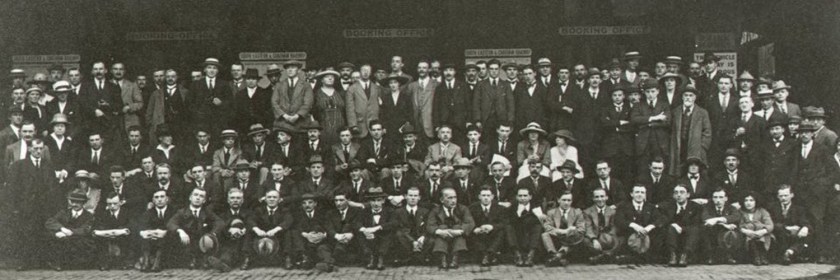
There’s a photograph in the CPGB archive at the People’s History Museum in Manchester depicting a large gathering outside London’s Cannon Street Hotel in 1920. It resembles the kind of yearly school photo they used to take at the better type of educational establishment during the early part of last century. The passing of a hundred years or so has lent these figures some semblance of respectability – if you didn’t know who they were then it would be hard to identify them as revolutionaries and a threat to the British state. Red flags and ushankas are conspicuous by their absence. The men are all in sober suits and ties and, for the most part, adhere to the code of the time that a gentleman is not fully dressed without a hat. The headgear on display ranges from formal looking homburgs, some egalitarian flat caps and even a couple of jaunty straw boaters. Possibly interlopers from the Fabians. The comparatively few women present look out from under wide brims and give the impression that they do not, under any circumstances, suffer fools gladly. Everyone looks as if they have something extremely important on their mind. Bob is there, instantly recognisable with his broken face, sitting on the cobbles front row, seventh from the left. As ever, he looks more serious and full of intent than anyone else. Everyone looks as if they have something extremely important on their mind. This was the Communist Unity Convention. Over a hundred and fifty delegates from all across the country drawn from over twenty different left wing groups. Although it was formalised the following year in Leeds, this last day of July was essentially the beginning of the Communist Party of Great Britain. The following day, as the conference continued at a second venue, the International Socialist Club on East Road, Bob was voted onto the Executive Committee and became its Scottish organiser.
It had been two and a half years since the October Revolution. The Red Army was engaged in a brutal civil war repelling counter revolutionary forces aided by Western European allies. This support stemmed from the worry that the worker’s state would default on loans made to Imperial Russia and that insurrection would spread across continents like a disease. Winston Churchill, then Secretary of State for War, voiced his antipathy in visceral terms. In conversation with the Prime Minister David Lloyd George, he was purported to have said, “One might as well legalise sodomy as recognise the Bolsheviks.” Publicly, he announced that the ideology should be “strangled in its cradle.” Right wing groups such as the British Empire Union toured the country to “campaign against Bolshevist propaganda.” A photograph in The Daily Mirror shows that this amounted to a small group of portly, middle aged men each resembling the cartoonish stereotype of a bowler hatted capitalist standing dourly in front of a carriage daubed with the slogan, ‘Britain for the British.’ The union flag was unfurled and one of their number meekly held a placard decrying the red menace. The ‘B’ word became the pejorative of the day. More often than not its application was ridiculous. Even Austen Chamberlain, the Tory Chancellor of the Exchequer of the coalition government had his 1920 budget described as containing “the seeds of Bolshevism.” Any prospect of the mildest wealth redistribution would draw similar accusations. Appealing for greater harmony between Liberal and Conservative MPs, Lloyd George called for a united front against socialism. He emphasised his commitment to restoring the country through a “fair reward for individual effort” and damned the Labour Party’s commitment to “the doctrine of common ownership” as essentially the same as Lenin’s hated vanguard party. An absurd comparison but thanks to the extension of the franchise, Labour had emerged as the official opposition and so would inevitably be subject to incessant outlandish claims such as this.
If it attracted so much invective, what was it that drew some people towards communism in the 1920s? The answer is simple. For many, the shattering experience of The Great War was capitalism’s greatest crisis. As the population attempted to forge some kind of normal life in the years that followed they were assailed by a raft of social problems. What people got in actuality was far from what they thought they had been promised. At the beginning of the 1918 General Election Campaign, the Prime Minister had acknowledged the dire situation for many in the country. The war had been like a “gigantic star shell” illuminating the land. It had lit up “all the dark places […..] that we have never seen before.” The past four years of conflict had shown the “appalling waste of human material” in the nation. If people had been fed and housed properly and had lived in healthy conditions a million more men would have been fit for the services whereas there were millions “below par.” This was to be put right. Children could not be brought up in these conditions. After a death toll of millions in the battlefields of Europe he warned that there were, “more lives being lost and maimed through the atrocious social conditions that prevail, than through the terrors of this war.” The work of the nation was summed up in the memorable line, “What is our task? To make Britain a fit country for heroes to live in.” Slums would be cleared, houses built and industry and agriculture revived. Stirred by this rhetoric, the electorate rewarded Lloyd George’s coalition with a landslide victory. The type of victory that, once the fuss has died down, can only ever disappoint and disillusion. Bob’s view was this:
“I came out of gaol in April 1919 and entered an entirely changed world from the one I had left. The heroes had returned from the war to find the golden promises of a land fit for heroes to live in had not materialised. Many were unable to find work. Many, when they found it, got low wages on which they could not adequately provide for their wives and children. The housing shortage became a serious social problem as the soldiers, married during the war, tried to set up house with their war-wives and young children. The landlords, taking advantage of the shortage, found ways and means to raise rents.
The Dundee I came back to had all these problems and more. Lack of work, low wages, unemployment, bad housing and a housing shortage, and to add to the confusion, thousands of war disabled demanding work and maintenance.”
The economy was nosediving and social reforms put in place as an insurance policy against another Petrograd were failing to lift people out of misery. In the light of this, communism offered a compelling vision of the world.
The birth of the CPGB was made possible by the creation of the Communist International. Also known as the Comintern or the Third International it was formed in Moscow in 1919 and it’s raison d’etre was to advocate for a world revolution. Lenin believed that, unless there was a successful socialist uprising in Europe, all that the Bolsheviks had achieved would be crushed by the military might of its capitalist neighbours. To protect itself it would establish communist parties across the world and provide funding, instruction and training. The parlous economic state of much of the continent and the memories of the war still fresh in people’s minds meant that there was fertile ground for radical militancy. There were many eager to learn from the one band of Marxist revolutionaries who had actually achieved what others spent so much time discussing in smoke filled rooms or shouting about in front of factory gates.
In Britain, those others were the myriad of leftist groups that weren’t the Labour Party or the ILP. Veterans of the trenches and veterans of the anti-war movement. Trade unionists and suffragettes. All haunted by the horrors of recent years and united, in the grand tradition of British radicalism, by an intense distrust of each other. That aside, there was a feeling, which Bob shared that, with things the way they were, there should be more progress politically towards socialism. All had been galvanised by the events of October 1917 and began to hold talks to foster greater cooperation. The Comintern began to court several of these parties and Lenin secretly donated £500, 000 towards setting up the CPGB. A phenomenal sum worth well over £10 million today. As Francis Beckett noted in his history of the CPGB, Enemy Within, “Without Lenin’s continual encouragement, and the careful distribution of Soviet money among groups which had always been starved of funds, the Communist Party would not have existed.” The Unity Convention, in the Italianate surroundings of a railway hotel, was the first fruition of that investment comprising of representatives from the British Socialist Party, the Socialist Labour Party, Sylvia Pankhurst’s Workers’ Socialist Federation and also from tiny organisations such as the Doncaster Worker’s Committee, Ferndale Socialist Society and Bob’s own band of socialist temperance campaigners. The sun had decided to shine after several days of rain. Things were looking up. The collapse of capitalism was surely imminent.
Amid a fug of pipe smoke, it was clear, when the first resolution was debated, that this new party would be closely modelled on the Russian one. The conference declared for a Soviet system as a means for the working class to achieve power. Lenin’s slogan, “All power to the Soviets!” from the October Revolution still had the capability to thrill or terrify. The term referred to the worker’s councils that had begun in 1905 and proliferated in 1917. Emerging from the factory floor, they were created to fight against the Imperial regime’s control of the workforce through strikes, direct action and also military force. After the Tsar’s abdication, the Petrograd Soviet played a key role in toppling the provisional government during the Bolshevik coup. Those gathered in the room were convinced something similar could be achieved in Britain and that this would lead to the dictatorship of the proletariat. This concept was also much discussed and Bob admitted to the delegates that he did not know much about it and doubted whether anyone else gathered there did either, an early indication of how impenetrable the language of the CPGB could alienate even the most sympathetic listener. Still, it was deemed a necessary step in order to achieve the party’s main aims – a society where the means of production would be communally owned and controlled. The conference also declared that they would ally themselves with the Communist International. Bob could not know at this point how this organisation would come to dominate his life.
There was a debate as to whether the Party should follow a Parliamentary route or whether it should be an armed revolutionary movement – the disenchantment many felt regarding the Labour Party’s reformist path was tangible. Not that it would prevent several futile attempts by the CPGB to affiliate with them in the immediate future. A social revolution could not be delivered through the ballot box alone. And yet, “electoral action [would provide a] valuable means of propaganda and agitation.” Any elected representatives from the CPGB would be considered as having a mandate from the Party rather than the constituency in which they happened to sit. The majority of attendees wanted to get councillors and MPs elected but there were a few who enthusiastically advocated “the use of the gun” to achieve their aims. Given his experiences of the past three years, Bob was not among them. He said he often found the people who wanted to “shoot it out” to be the “worst stayers in the movement” and felt that such people seemed “unable to cope with the hard day to day grind of politics.” Bob rebuked one such comrade with the memorable line, “A great many people talk about guns who would run away when they saw one. I am more interested in folks having brains in their heads.” Bob went on to outline his argument further.
“Whether guns come soon, late or not at all, there will be times when it is far more revolutionary to refuse to have anything to do with guns. I think the provisional executive which is to be set up by the conference will be far wiser to devote themselves to building up such organisation as will make it possible to win the maximum of our party policy with the minimum of violence.”
In his account of the conference, Francis Beckett relates a story about how Bob attempted to get the Communist party to go down the prohibitionist path. The temperance movement had struck a chord with many of the comrades – alcoholism being one consequence of the hardship suffered by the poverty stricken and several saw abstinence as an essential part of their socialism. To Bob, prohibition was a revolutionary tactic.
“After the main resolution was carried, the stout sincere man with a sober moustache walked solemnly to the platform to ask the new Party to come out in favour of suppressing the manufacture of alcoholic drinks. Few thought much of the idea, but they liked Bob Stewart, so they referred it to the executive for action. In seventy-one years no action was ever taken.”
Sadly, this moment was left unrecorded in his memoir, Breaking the Fetters.
Alan Stewart.
 Breaking the Fetters