Harry Pollitt and the Chamber of Bastards.

When we started this project on our great grandfather Bob Stewart, my brother and I both agreed that we thought there was much to admire about the man but also much to criticize. Although I’ve tried to steer clear of hagiography in my writing I probably haven’t been as critical on this blog as the subject deserves. Lately I’ve been working on Bob’s life during the Second World War. In my misremembered reading of Francis Beckett’s Enemy Within I had been under the impression that Bob had objected to the CPGB’s acceptance of the Molotov–Ribbentrop Pact – Stalin’s squalid arrangement with Hitler. Turns out I was wrong. He followed the Stalinist line. So disappointing. Below is part of the first draft of my chapter on this period. Thanks to Katherine Mackinnon from Glasgow, who sent me the material on Bob from About Turn – the transcript of the CPGB’s meeting about the non-aggression pact. I wouldn’t have been able to write about this without her help and you can find out about her work at kmackinnon.org.
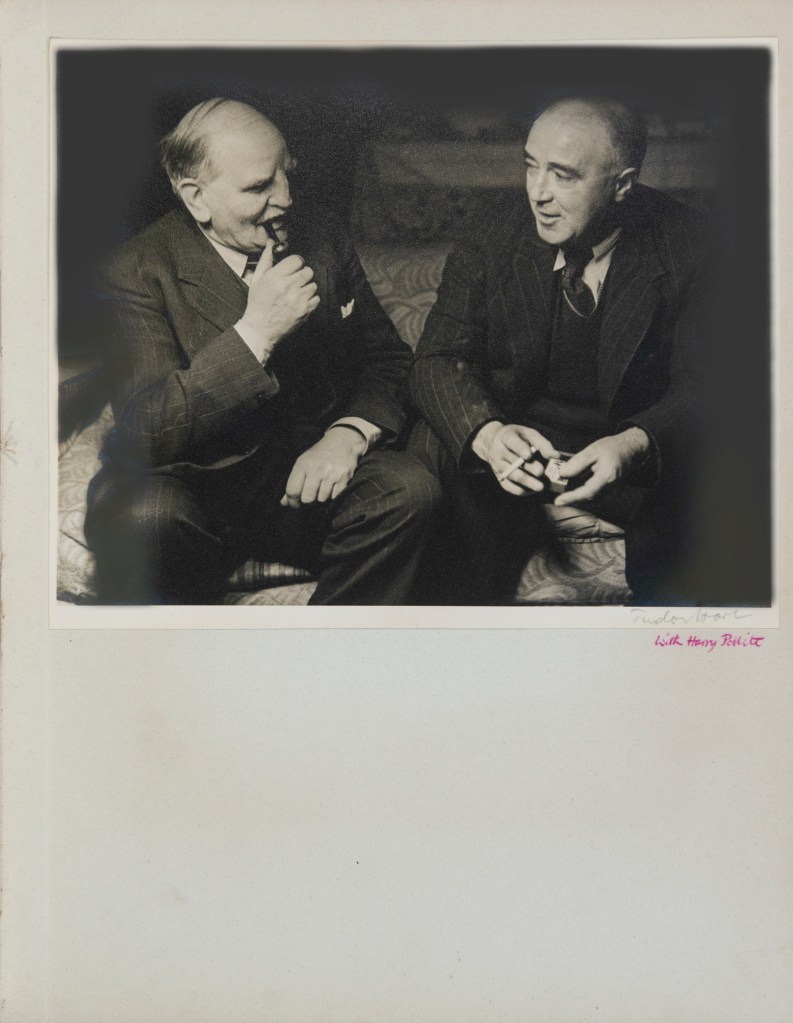
Bob Stewart and Harry Pollitt in 1947. Photograph taken by Edith Tudor Hart.

A spectre had been haunting Europe. The spectre of fascism. During the 1930s this new doctrine, fusing myths of noble past eras with a disturbing sense of victimhood, tantalised nations still shattered by The Great War. Many looked to Mussolini’s rise the decade before and sought to emulate his example. It was time for an iron hand. A need for discipline and national pride. Paramilitary uniforms accompanied political violence. Parties with an authoritarian distaste of the masses and enthralled with notions of racial purity flourished across the continent from Portugal to Romania. For a time it seemed unstoppable. Hitler had come to power in 1933, Franco took Spain few years later. In Britain, Oswald Mosley’s British Union of Fascists were given a sympathetic hearing in the press for several years and attracted a membership of around 50,000. Reactionaries aghast at liberal advances in society found themselves a natural home.

Anti-fascism was the impulse that caused a new generation to gravitate towards communism. Whereas Bob’s politics had progressed to Marx and Engels via temperance, trade unionism and the anti-war movement, younger comrades viewed the world in which they found themselves with horror. A rising tide of cry bully dictators and the terror they’d bring. Communists were added to the long list of scapegoats that fascists believed were polluting society. Inspired by the Nazis, Mosely often denounced Marx to his followers, in part because of the philosopher’s Jewish heritage. Communists were often at the forefront of disrupting the British Union’s rallies and stopping them marching through Jewish areas to intimidate the populace.  By the middle of the decade the Comintern encouraged communists across Europe to form popular fronts with other anti-fascist parties with the aim of halting the spread of the far right. The CPGB, having exhausted its approach of decrying everyone else on the left as ‘social fascists’ threw itself into this new line. Campaigns to aid republican Spain or to challenge Prime Minister Neville Chamberlain’s attempts to appease Adolf Hitler benefitted from drawing in a wider range of people. The party considered itself the bulwark against fascism. It had to be fought at every opportunity. Socialism or barbarism.  It was a rare edition of The Daily Worker that didn’t highlight the fact that Hitler was the greatest threat to the world.  Right up until the moment that he wasn’t. And everything turned upside down.

The volte -face was the Molotov–Ribbentrop Pact signed on the 23rd August 1939. A treaty of non-aggression, it committed the USSR and Germany to ensure neither country made alliances with an enemy of the other. Russia had been an implacable foe of Nazism; it now supplied the Wehrmacht with fuel and grain. Many made justifications that Stalin was buying time in order to build up his armed forces in order to more readily combat the threat from Hitler but the grubby deal included  not so secret plans to carve up parts of Europe  between them. Germany invaded Poland from the West on the 1st of September causing Britain to declare war. Sixteen days later the Soviet Union invaded Poland from the East. The British communists were caught in an unresolvable conundrum. Their opposition to fascism was genuine and strident but the leader they had held up as a paragon of all that was good and true, Joseph Stalin, was now arm in arm with Adolf Hitler.

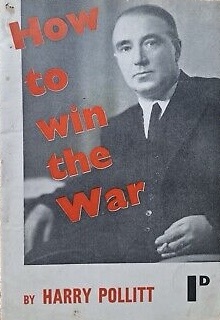
In the second week of hostilities, the CPGB’s leader, Harry Pollitt, published a pamphlet that laid out his party’s position explicitly:

“The Communist Party supports the war, believing it to be a just war. To stand aside from this conflict, to contribute only revolutionary-sounding phrases while the fascist beasts ride roughshod over Europe, would be a betrayal of everything our forebears have fought to achieve in the course of long years of struggle against capitalism…. The prosecution of this war necessitates a struggle on two fronts. First to secure the military victory over fascism, and second, to achieve this, the political victory over the enemies of democracy in Britain.

On the day these words appeared Pollitt received a telegram from Moscow giving him instructions that the war was to be opposed. Stalin had instructed Georgi Dimitrov, the current head of the Comintern and one of Bob’s travelling companions on his first visit to Russia, that communist parties abroad should condemn their governments’ involvement in the conflict as imperialistic and, to keep Hitler on side, he wanted anti-fascist rhetoric to be minimal. Foreign communist parties were expected to correct their line immediately. Douglas Springhall, the CI’s British representative was on his way back from Moscow to clarify matters. On his return there followed a series of bad tempered meetings of the CPGB’s Central Committee to thrash out what they should do about the change of circumstances. Although Bob was not a member of the committee at this time he was seen as a senior voice in the party and attended the final two sessions.

Against the new line were Pollitt, J.R. Campbell and the party’s only MP, Willie Gallacher, figures who Bob was closely aligned with. Everyone else on the committee favoured following Moscow’s instructions which, as a travel weary Springhall admitted in the first meeting, amounted to the CPGB to not only highlight the imperialist nature of the conflict but to actively work for Britain’s military downfall. Revolutionary defeatism. When pressed on the possibility of fascism being imposed from within or without as a consequence of this Springhall confessed he had raised this question at the Comintern but had received only non-committal answers. A state of affairs which should have made the majority pause but, instead, the lemming like desire to adhere to Stalin’s directive was too strong to resist.

The hardline theoretician Rajani Palme Dutt opened the next meeting on the 2nd of October. He was the main proponent of the Stalinist line and began by fashionably traducing an old comrade – Harry Pollitt. The new policy needed to be accepted by every party member with absolute conviction and those that had misgivings should be mercilessly cleared out. It was “foul slander” that the CPGB was changing because of the Soviet Union. The reversal was necessary because, “our line was the wrong line.” He implied that Pollitt was a half-hearted vacillator and that the crisis had unveiled “dangerous tendencies in our Party.”  The duty of a communist was not to disagree but to accept. Reading the transcript of Dutt’s speech what springs to mind is not a key moment in the liberation of the international working class but, instead,  a badly acted one man fringe theatre production of Animal Farm performed to a minuscule audience in a tatty room in Covent Garden. Which is what it was. Gallacher was outraged. Never before had he listened to a “more unscrupulous and opportunist speech.” Pollitt assured his opponent that he would not be intimidated, “I was in the movement practically before you were born, and will be in the revolutionary movement a long time after some of you are forgotten.”

When Bob spoke up it was to deplore the manner in which the topic was being discussed. He was glad not to have been present at the previous session and, in defence of Pollitt, he was wary of “sledge-hammer demands for whole-hearted convictions and solid and hardened Bolshevism and all this bloody kind of stuff.” Aiming a barb at Dutt, he emphasised that the tone he had struck at the beginning of the meeting was “not a good way to start.” It was a very difficult situation that they were facing and they had to find a way through. Clarity was essential. And he was unequivocal, “I am for the line.” Over eighty years later, I wish his words had been different. He qualified his support – the thesis the CPGB had received from the Comintern had been very short and he anticipated a longer explanation of why this policy was necessary and correct but he was willing to accept it in the meantime. Part of his reasoning stemmed from his background as a conscientious objector. If they could stop the war the communists would, “be doing a service to the people of Europe and the world in general.” He also reflected on Winston Churchill’s address as First Lord of the Admiralty which had been broadcast the previous night. It was a month into the war and the statesman had described Russia as,  “a riddle, wrapped in mystery, inside an enigma.” It only acted in its own self-interest. In Churchill’s analysis, this might not be a wholly undesirable trait. He might have wished that the Russian Army had acted as friends and allies of Poland rather than its invader, but the Soviets were standing where they were because it was, “necessary for the safety of Russia against the Nazi menace.” The invasion from the East had halted Germany’s designs on the Baltic states and Ukraine. A small silver lining. Bob imagined that the situation would bring about a “very definite searching of hearts even amongst the bourgeoisie.” His own contemplation had led him to an overly charitable reading of the situation.

“Is it not the case that in the workshops there is no serious antagonism at all to the Soviet Union having walked into Poland? In the first few hours there was, but after a little bit of thinking and after they saw the newspapers, with the peasants getting their landlords’ land, etc, then a different kind of attitude began to occur in the minds of the workers.”

Tens of thousands of Polish prisoners of war were murdered by Stalin’s secret police, 22, 000 in the Katyn massacre alone. The Soviet occupation was marked by mass deportations to Russian Gulags and brutal repression. Bob’s comments, even in these early weeks, were as shameful as they were misguided.

The meeting dragged on until the next day in a belligerent atmosphere  but it was clear the majority were prepared to support the Comintern directive whatever misgivings they may have had. The Second World War was a conflict between old Imperial powers and should be denounced and opposed by communists everywhere. I am thankful that my great grandfather was not a member of the committee and could not participate in the final vote on the resolution the next day. His friends Pollitt, Gallacher and Campbell remained consistent in their anti-fascism and voted against. Bob would have joined sixteen of his comrades in adopting  a position endorsing Stalin and Hitler’s marriage of convenience which spat in the face of all they had campaigned for over the last decade. Once the meeting was over, Pollitt was no longer the leader of the Communist Party of Great Britain though his last act was to ask that the record show that Gallacher had voted with the majority. As the party’s only presence in Parliament he had to be seen to be following the line. Dutt took over as General Secretary in all but name.

Walking out of King Street that evening, mithering over what had just occurred,  Bob would have been greeted by the sight of London’s preparations for war. Barrage balloons beginning to dot the skyline like eerie sentinels. Railway stations crammed with duffle coated school children weighed down with kitbags and boxed gas masks being shepherded onto hissing steam locomotives hauling them away to safety and homesickness. Late afternoon in autumn took on a gloomier aspect with the street lights and neon advertising  extinguished in the blackout. A depressing and maddening day. It would be the last time he’d visit CPGB HQ for months. He’d not been coming in very often for a while. Through the tapped telephones MI5 kept track of people trying to reach him. They were often told that it was no good enquiring for him, that the only way to get hold of him was to visit him at home. He did not come in these days. Was he ill? No. As time went on there seemed to be some confusion over his whereabouts. In November one caller asked whether Bob was in London and received the reply, “I think he is.” Time and time again people were informed he wasn’t in and nor was he likely to be. He was no longer at King Street. Had he washed his hands of the whole lot of them after the rift? Or had he gone to ground?

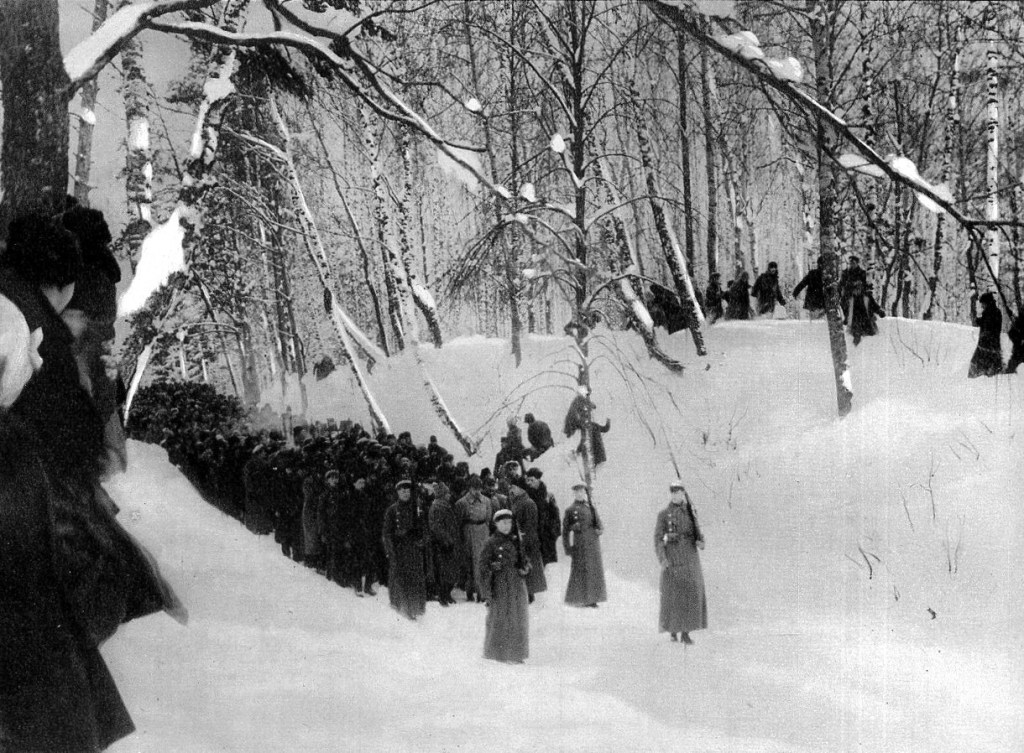
Harry Pollitt used the free time he had unexpectedly acquired to write his memoirs, Serving My Time. In its pages he described the moments he shared with  my great grandfather in 1924 when, surrounded by snow and ice, they attended Lenin’s funeral in Moscow. The event was of paramount importance to them both.

As Bob Stewart and I stood there, we pledged ourselves and the Communist Party to which we belong  to prove worthy of our trust , and to build up in Britain a revolutionary party of which we could be proud. And Comrade Lenin would desire no greater tribute, no greater memorial , than the building up of a Communist Party in Great Britain that will lead the working class in the age-long fight to smash capitalism and achieve the emancipation of the workers.

How long ago that must have seemed.

Alan Stewart.
Bob Stewart, Ho Chi Minh and the Tattered Red Flag of the Communards.

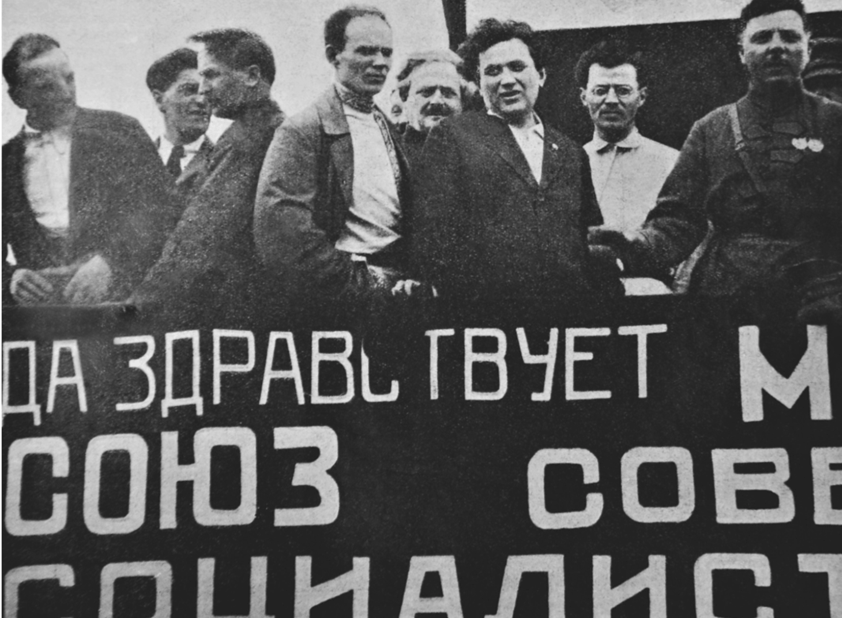
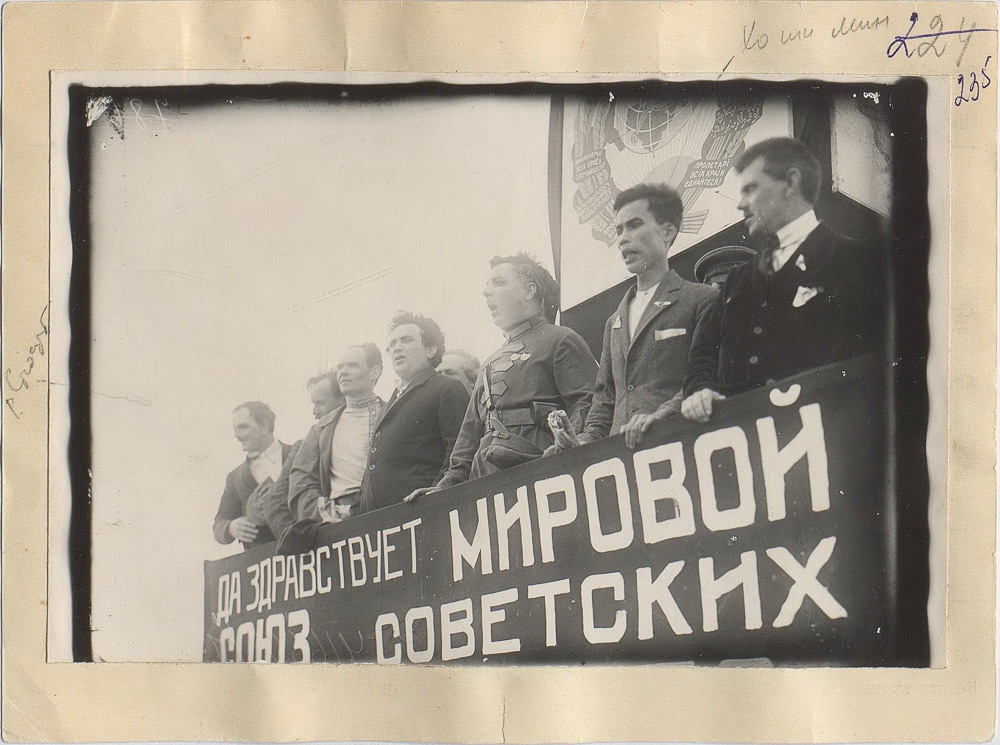
L-R: Bob Stewart, Unknown, Nikolai Antipov, Grigory Zinoviev, Kliment Voroshilov, Ho Chi Minh, Unknown.
Partially visible behind L-R: Avel Yenukidze.

One of the benefits of researching a distinctive looking ancestor is that they’re easily recognisable to others studying the same topic. During the summer holidays, Maurice Casey, author of Hotel Lux (out now in paperback!) spotted Bob Stewart’s familiar broken face in a photograph taken in Moscow dating from 1924 when he was the CPGB representative to the Communist International. He could be seen, furthest left, in a group lined up behind a banner proclaiming, “ Long Live the Global Union Of Soviets!” Above them is a flag with a hammer and sickle in the centre of the globe which is framed by sheaves of wheat.  The group look as if they’re in the middle of the chorus of The Internationale, The Red Flag or a similar revolutionary anthem. Bob has a broad smile on his face. Of the others, the only individual I could recognise was Grigory Zinoviev, the head of the Comintern, essentially my great grandfather’s boss at the time. In his email, Maurice pointed out the figure second from right, “a young delegate of the French Communist Party, originally born in French Indochina: today known as Ho Chi Minh.” Frankly I was stunned. Despite his attendance at Lenin’s funeral, late night consultations in the Kremlin with Stalin and his visit to China in the 1950s where he met Mao Zedong, I had no idea that Bob had ever encountered the man who would become one of the most influential leaders of the twentieth century. Even my teenage son was impressed having studied the Vietnam War in GCSE History. “They named a trail after him!” was his initial reaction. Yes – also an avenue, a square, several monuments across the world and a whole city.

The photograph encapsulated something I’ve grown to love about the communists of the 1920s. The optimism. The hope. The unwavering belief that they would change the existing state of things. Life would be better for millions. A lifelong abstainer from alcohol Bob would nevertheless would find life at the epicentre of this struggle intoxicating. It’s something I marvel at, especially in today’s atmosphere of grim resignation of successive governments that – no –  nothing in society can ever be improved. Here’s more cuts. Here’s more crackdowns. Nothing to be done. The romance of this image of my forebear and his comrades – and it is Romantic – was only heightened when Liz Wood from the Modern Records Centre at Warwick University pointed out on Bluesky where the image had come from. It was taken on the 6th of July during a massive celebration when representatives from the French Communist Party symbolically handed over a tattered red flag which had flown over the Paris Commune in 1871 to be placed in Lenin’s mausoleum which was then under construction.

In an eyewitness account published in the US version of The Daily Worker the journalist Anna Louise Strong describes how a four hundred thousand strong crowd poured into the October Field just outside Moscow. The ceremony took place on the International Day of Co-operation and the first anniversary of the signing of the new Soviet constitution. I imagine it was also organised to rally the workers after an appropriate period of mourning for Lenin after his death in January that year. The solemn grief of the funeral which took place in ice and snow months before was replaced by sunshine and a carnival atmosphere.

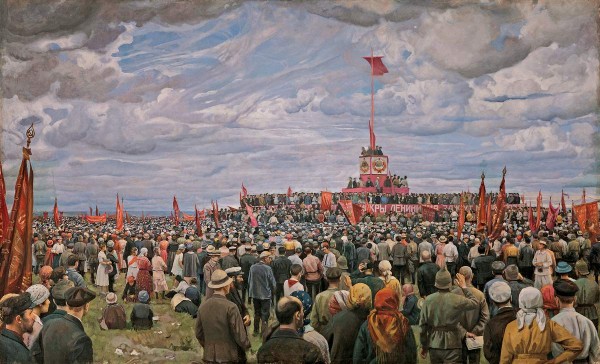
The Passing of a Banner to the Moscow Workers by the Communards on Khodynka Field in Moscow by Isaak Brodsky.

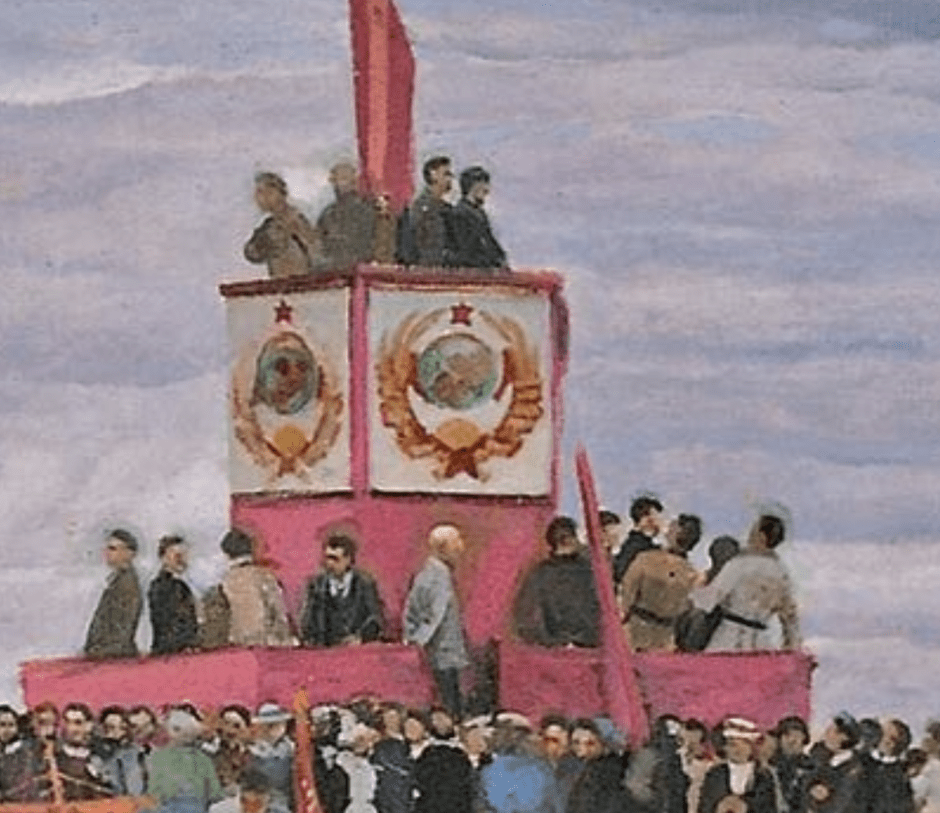
The fraying flag perforated by bullet holes had been taken down from the barricades of the Paris Commune over fifty years before and had been passed along various socialist groups in the intervening years in the manner of a religious relic. It had left the French capital with a farewell parade of one hundred thousand workers and was greeted on it’s arrival in the worker’s state by magnificent scenes captured stirringly in an oil painting by the artist I.I. Brodsky. I’m fairly sure Bob is depicted as one of the distant figures on the middle row of the tribune. It’s probably me being sentimental but it does correspond with the photograph.

Yeah, I reckon that’s Bob on the middle platform second left.

Strong’s narrative outlines the speeches, the songs, the performances and the sporting displays of this public holiday but at the centre of events is the handover of the scarlet standard.

“For nearly five hours they were marching 10 abreast into Hodinka field now named the Field of October. A great tribune 70 ft. square, with a pyramid of platforms one above the other, held the delegates of the Communist International, the central executive of Russia and the Moscow city government. Massed around the tribune were hundreds of encircling factory delegates bearing their factory banners of embroidered red silk or velvet topped with metal stars or sickles. Around these was a wide aisle and then came the hundreds of thousands of spectators with eight wide aisles formed through their midst by single lines of soldiers.

A festival spirit pervaded the assembly. Men and girls were raised aloft on the arms and shoulders of their friends, and balanced above the throngs. They led the cheers and salutations and even made speeches.

The worn red banner was borne down one of the aisles by the delegation of French Communists. It was lifted aloft to the highest platform of the tribune, where it was visible for half a mile away. President Kalinin received it.”

The next day a Russian newspaper carried the message, “We will give it back to France when we have carried it throughout the world.” A sentiment which should still make any self-respecting leftist go all husky and brave and, yes, I did find myself welling up. There had been a world to win.  If only we could leave it there. But of course we can’t. When this photograph was taken, capturing my great grandfather full of confidence that a fairer society was just around the corner,  very bad things had already happened. Very bad things were happening at that time. And very, very bad things were going to happen in the future.

Another image from the day. Bob Stewart furthest left.

I’m currently working on the period in Bob’s life where this hopefulness turns to tragedy. The 1930s and 40s. A few enquiries on social media helped identify some of the other figures on the platform. Nikolai Antipov became Deputy Premier of the Soviet Union but during the Great Purge he was arrested, expelled from the Communist Party and sentenced to death.  A similar fate was in store for Avel Yenukidze. Grigory Zinoviev, the Comintern Chairman, was tortured, forced to confess to outlandish crimes during the Trial of the Sixteen and shot in the back of the head. Apart from Bob and Ho Chi Minh, the only other identified person to survive until old age was Marshal Kliment Voroshilov who emerged from Stalin’s maniacal purging of military officers unscathed only because he was an enthusiastic participant in the process having personally signed 185 execution lists.

These names can be added to this list of Bob’s comrades, friends and family I made to try and make sense of the chaos of a few short years:

Aug 1936: Kamenev (and Zinoviev) executed.

January 1937: Karl Radek’s show trial. Murdered in prison in 1939.

February 1937: Sergo Ordzhonikidze kills himself.

March 1937: Arrest of David Petrovsky, a former Comintern liaison with CPGB and friend of many British communists including Bob. Shot in September.

June 1937: Grigory Kaminsky, The People’s Commissar for Health and Bob’s daughters’ brother-in-law was arrested. He was executed in February 1938.

August 1937: Rose Cohen, David Petrovsky’s wife and close family friend of Bob’s arrested. She had given up her British passport and become a Soviet citizen. Shot after a twenty minute trial in a closed court in November.

June 1938: Anatole Kaminsky, Bob’s son-in-law arrested. The family presumed he was dead but he was executed in 1941 as the Nazi forces began their attack on the USSR.

November 1938: Nannie Stewart, Bob’s daughter and Anatole’s wife makes it back to London alive with her baby son Greg.

The madness of it all. Whatever the words I find to relate all this, they will be inadequate.

Alan Stewart.
PS: Thanks (one again) to Maurice Casey and to Liz Wood and to anyone else on Bluesky or Twitter who helped identify Bob’s comrades on the platform. Anna Louise Strong’s account can be read in full here – ‘Tattered Red Flag of Paris Commune Flung to Breeze in Moscow as Workers Cheer’ by Anna Louise Strong from the Daily Worker. Vol. 2 No. 112. July 29, 1924. – Revolution’s Newsstand

Breaking the Fetters Chapter 20: Moscow and the Comintern.

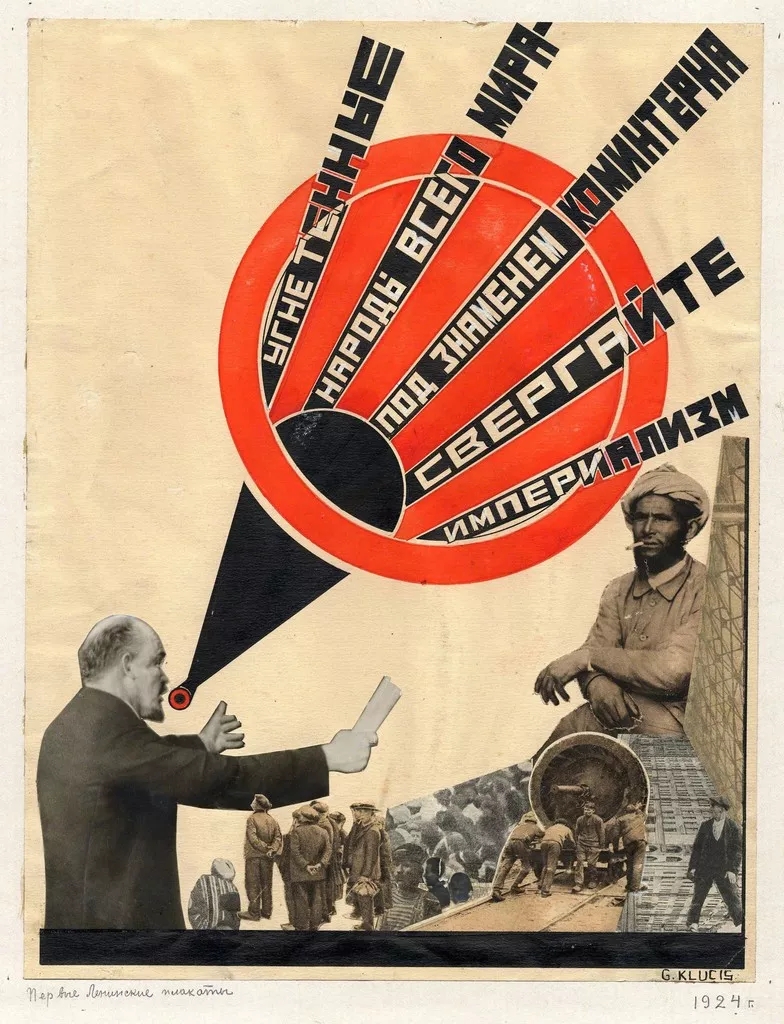
“The oppressed peoples of the whole world, under the banner of the Comintern, overthrow imperialism!” Soviet poster by Gustav Klutsis, 1924. Shamelessly nicked from @sovietvisuals.

I went to Moscow early in 1923 as British representative to the Communist International, or the Comintern as it was called more briefly. I was a bit diffident about accepting this job because I regarded myself as an apprentice in Communist Party work. My wife and daughter came with me and I left my two sons with my sister, so the arrangements were quite good. I liked the job very much. I was living in the heart of the revolutionary political world. I was meeting people who knew much better than I the main world political events and could interpret them much better. I was taking part in discussion with leading working-class politicians from all over the world, all with their special problems, and if at times I could not make a contribution at least I could listen and learn.

In the Comintern I did a fair amount of foreign work. Because I had a British passport, I was better able to cross frontiers and move about freely than many of the other foreign representatives. At this time, the Comintern was very much in its formative period and the communist parties of the various countries had serious conflicts of opinion on many political questions. There were many commissions in the work of the Comintern, trying to smooth the way and deal with the problems.

Troubles had grown in the Swedish Communist Party and the Comintern sent a delegation of which I was a member to help to sort things out. In Sweden I was known as Comrade XR (Executive Representative). Half the Swedish party were really right-wing social democrats, both in theory and action.

The party was led by Seth Hoglund, a social democrat who certainly put no R in revolution but had a very good anti war record. The party was split in two; the left-wing section was the more aggressive and was able to retain control of the party paper. Hoglund was a likeable chap, not in any way vicious but a true social democrat and for quiet, steady reform. The leadership afterwards passed to Samuelson and some others, but they too quarrelled and some left the party.

At this time Scandinavia was very important. Politically, despite some setbacks, the left forces were making good progress. There was also another practical reason. The Norwegian party had a good standing among the seamen, which enabled comrades to get across the seas illegally. Bill Gallacher, Sylvia Pankhurst and a number of others crossed the North Sea in this way. Irish sailors did the same before Eire became a state, ready to smuggle people across on the Irish boats. De Valera was got out of Lincoln Gaol and smuggled across in this way.

Many people with whom I worked and whom I met during my time at the Comintern are now dead. A few are still alive. Some made their political mark, some dropped out of political life in the development of the struggle, because being a Communist in politics is never easy, no matter in which country you are domiciled.

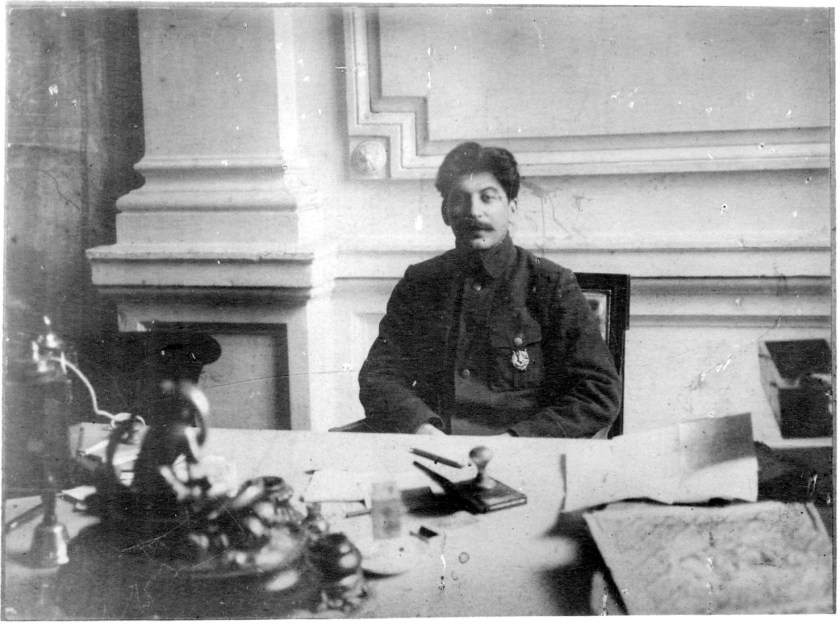
Stalin in the early 1920s- “quiet, painstaking and efficient.”

Naturally the reader will ask what I thought of Stalin. I always speak of people as I find them. I worked with Stalin on a commission on Germany after the defeat of the German party in 1923. I found him a quiet, painstaking and efficient chairman. He chaired the commission which was composed of members from all parties resident in Moscow and from the Russian party, which was represented by Kuibishev, who later became Minister for Planning in the Soviet Union. The discussion in the commission went on for weeks, and one interesting point was that after every session the delegates and their interpreters met singly with Stalin to make sure that if they had not spoken during the discussion, he would be aware of their views. In this way I had several talks with Stalin. I remember that one particular discussion he and I had dealt with the way in which the German party central committee worked. In my opinion there was too much bureaucracy and I said that certain changes in work should be considered. The Comintern could not enforce changes, since the national parties were independent; but the Comintern could, and did, make suggestions. At the end of our tête-a-tête Stalin made a number of pointed remarks and agreed with me on the need for change, but there was a great battle of personalities in the German party at that time. The need for unity was so important that one had to cut the suit according to the cloth and not seek changes that might possibly widen the division.

This commission usually started work about midnight. As a rule I was getting ready for bed when the telephone would ring, and then it was down to the Kremlin for an all-night sitting. They did not rush it, these people. Many of the Kremlin lads were long-distance men. I remember one night Terricini- the delegate from Italy I think his first name was Angelico, but he was certainly no angel -was delivering his point of view in French and doing it very well. He had been at it for over an hour and a half when Stalin intervened to say,

“Tovaritch Terricini, French is a beautiful language to listen to but it is now three o’clock in the morning.” Terricini nodded to show he had heard and then continued with his speech, as if no intervention had been made.

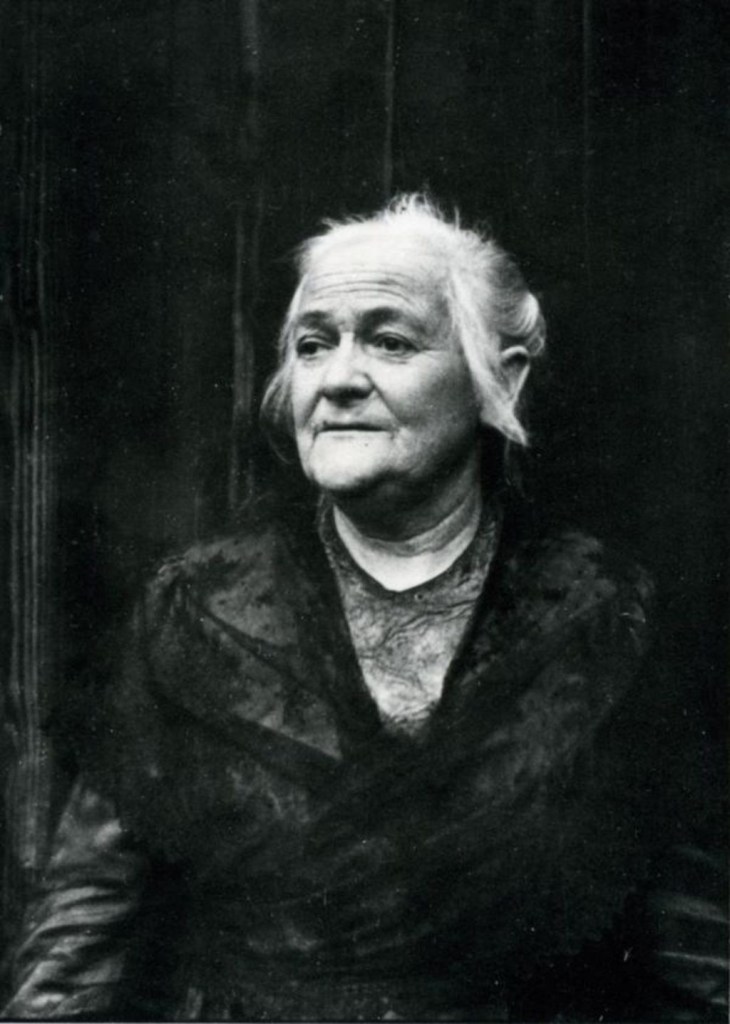
Clara Zetkin

During this German commission discussion, some leading members of the German party went after Clara Zetkin; they baited her unmercifully and this really sickened me. It was an exhibition of political cannibalism that should never be tolerated in working-class politics. Clara Zetkin may have had some weaknesses and faults we all have but she had many decades of selfless working-class struggle behind her and a great reputation both in the international communist movement and in Germany. I protested vigorously against the manner in which some of the German comrades were acting and, with several other delegates supporting me, Stalin said, “We hold a high opinion of Clara Zetkin, our Russian women have learned much from her work, and we will not permit this type of vilification.”

Radek was another member of the Comintern with whom I worked in close association When the first Labour Government was formed in January 1924, Radek, Theodore Roth-stein, Clara Zetkin, some others and myself, worked on a manifesto to be published in Britain in the name of the Communist International. Radek was the most remarkable reader I have ever come across. He had an insatiable appetite for newspapers and had a wide and fundamental knowledge of world politics. Lenin’s criticism of Radek was that he read too many bourgeois newspapers and I think he inferred that Radek was influenced by them. But Radek was most helpful to me. He was also a humorist with a ready answer to any question. He wore long side-whiskers, like the Ancient Mariner, but one day when I met him they were shaved off. “Oh, what’s happened to the growth?” I asked. “Got to go to Germany so I must have a disguise,” he replied. Another time when I was having a difference of opinion with Walton Newbold, who was once Communist M.P. for Motherwell, and was lamenting about it, he said, “Never mind Newbold, Bob, he not only sits on his arse, he sits on his brains as well.”

Kamenev, Zinoviev and other leaders of the Soviet party, Dimitrov from Bulgaria, Pieck from Germany and many others from other countries, I met both at work and socially, but as a rule the discussion was mainly political. I never found it easy or even practicable to discuss everyday “common-place” happenings through an interpreter. Language to me was always a great barrier and I am sure it is for everyone.

Radek was the one who spoke all languages. I heard him speak and communicate with ease with people of many nationalities. I never knew how many languages he spoke. He was a Pole by birth. He once said to me, “Bob, there are good Jews and bad Jews, and the worst of the bad Jews are Polish Jews and I am one of them.” I don’t think the part about Polish Jews is right, nor in my contact with Radek was it true of him. In Moscow, in all his work with me, he was a most able and helpful member of the Comintern.

Naturally, apart from the leading comrades I got to know in the course of my work, I also met the ordinary Russian people. A group of Russians I got to know fairly well consisted of teachers. This happened somewhat accidentally. One day my wife and I were having a walk in the suburbs, and as we passed a school the children were coming out. Some of the children, observing by our dress that we were foreigners, asked us questions. When they found out that we were British, a number of them had to try out their English on us. Because of this incident we became very well acquainted with the school and the teachers. I took any English delegations that came to Moscow to the school, and through this the pupils became the proud possessors of footballs, boots, sweaters and other sports equipment. I found the children most friendly and com-paniable, with no sullen shyness, and the teachers were born to their jobs aunties and uncles they were called. The school owned a huge boar, a real Goliath. One day I said to one of the children,

“Big boar.” “Da, bolshoi -bolshoi Curzon!”

(Lord Curzon was the most notorious anti-Russian British statesman of the period, the originator of the attempt to enforce the Curzon line).

Another school I used to visit was a school for musically gifted girls. The teacher was the first flautist of the Bolshoi Orchestra. The children gathered round in the most natural way and sang and played spontaneously, everything from folk drama to grand opera. Watching these girls, I began to realise the inborn musical understanding and appreciation of the Russian people, which has endured for centuries.

I remember the first time in my life I heard community singing. It was at the Agricultural Exhibition in Moscow in 1924 I was wandering around with Jim Larkin, the leader of the Irish Transport and General Workers’ Union, and we saw some people congregating near some seats. We strolled over to see what was happening. Out comes a fellow with a corduroy jacket and a pair of high boots curled up like a concertina. He stepped on to a small platform and started to sing, and away went the audience in wonderful community sing-ing. I couldn’t follow the words but there was no mistaking the real genuine feeling and natural musical ability of the crowd.

For the citizens of Moscow, however, it was not all singing and playing. Moscow was a political city, everyone talked politics. Even in the armed forces, the aim was to have politically understanding soldiers, sailors and airmen. Our party was a patron of some Russian regiments, and so got to know the officers and men. It was this political consciousness on the part of the Soviet soldiers, brought about by intense political discussions of day-to-day events, that created the understanding of the necessity to fight for the independence of the Soviet Union and the determination to crush the Nazi invaders in World War Two.

On the political side, I naturally attended conferences and meetings of the Russian Communist Party, and met with Russians from Stalin downwards. What struck me from the beginning was the business sense of the Russian political workers, very few of whom were business men. In these early days of Soviet rule, blacksmiths, mechanics, textile and other workers were pitchforked into top political jobs and had to adapt themselves to new work, sometimes dealing with old managements in production and, more important, themselves forming new managements in the big new factories. I remember Milnechesneski, who was an ordinary worker, telling me one day he was the biggest textile owner in the world -he had just been put in charge of the cotton textile industry.

In the countryside, many of the peasants were illiterate but, of course, while illiteracy is a great disadvantage, it does not mean lack of intelligence. The Russian peasant, who was intelligent enough to revolt against -and end serfdom, was also intelligent enough to combine with the Russian working class to end capitalism and also to end illiteracy among the peasant masses in the Soviet Union.

It was during my time in Moscow that a great tragedy befell the international working-class movement.

Lenin died in January 1924. I remember this well because I was then a member of the Executive Committee of the Comintern which was summoned immediately: firstly, to hear the announcement of Lenin’s death and also to make all the necessary arrangements for the funeral.

Harry Pollitt came over immediately from Britain to represent the British Communist Party at the funeral. It was desperately cold and both Harry and I felt it very much. It was forty degrees below zero. Fires were kindled in the streets and I remember seeing the militiamen’s horses going over and sticking their noses in the fire to melt the icicles. We were as cold as the horses but at least we could pull down our fur caps and peer out occasionally to see where we were going.

I was one of the delegation of the Comintern chosen to go to Gorky, where Lenin had died, to accompany his body back to Moscow. We left by train from Moscow at about 5am and then travelled by peasant sleigh from Gorky Station to Lenin’s house. From the station you could see the house down in the valley, but the road to it so twisted and turned that even by sleigh it took us a long time to reach it. At the house Lenin was laid on a bed wearing an ordinary Red Army man’s uniform with the Order of Lenin pinned to his breast. The house was full of people: leading members of the Russian Communist Party, of the Comintern, delegates from the factories and the professions, and amongst them all wandered a big black cat who had been a very great favourite with Lenin.

Lenin’s body being taken to Gorky station en route to Moscow.

The body was placed in the coffin and carried to the station en route for Moscow. Leading men from the party and the factories took turns to carry the coffin. On the journey, at every station, on the way, thousands of people waited to see the train pass. I do not think I ever saw so many tear-stained faces in my life. It was a very moving demonstration of the love the ordinary people for this great man.

When we got to Moscow I realised for the first time in my life what a mass demonstration really meant. Not a demonstration that was called, but one that came. Every conceivable foot of space was occupied. A great mass of people followed the coffin as it was borne from the station to the Dom Soyus (Hall of the Trade Unions), and from every side street and opening, mass upon mass of people converged with the main stream or waited their turn to do so. At the same time the digging was proceeding on the site of the mausoleum, so there was blasting and picking going on. All these streets were crowded with sad-eyed mourners. Every shop and hotel and all central places were ordered to keep open twenty-four hours a day so that people overcome by the cold could go in and thaw out.

Moscow has witnessed many varied scenes in her many centuries of troubled history; her ancient records must be filled with historic incidents, but never had such scenes been witnessed as during the days of Lenin’s lying in state and funeral. The Dom Soyus, a former palace of nobility, once the setting for the glitter and pomp of the aristocratic Tsarist circles, was the place where Lenin lay. Here his own people, the working masses of Russia, could pay their last tribute to the mighty leader of the Russian working class and the world proletariat. “Our Comrade Lenin” everyone said, as if he were a father or a brother.

For four days and nights, for mile after mile, people queued four abreast to pass the bier on which Lenin lay. Along with Harry Pollitt I took a turn on the guard of honour. I remember I was with Chicherin. The bier was surrounded by wreaths of flowers of every description, sent from all over Russia and indeed from all over the world. The magnificent hall with its white marble walls was a blaze of light, contrasting with the deep varied hues of the flowers, and on the balcony the band of the Red Guards played music befitting such a solemn occasion.

Delegations from all over Russia streamed into Moscow, joined the endless queues, and placed their wreaths as they passed the bier. But there were no kings or queens, no aristocrats and their ladies, no great admirals or field marshals with glittering medals. Only the endless stream of workers and peasants, soldiers and sailors with their wives and families. The queues never seemed to get less. Over a million had passed the bier and still the queues remained. It had been decided that on Saturday the doors must close at 12 noon. But on Saturday afternoon there were still hundreds of thousands of people waiting with banners and wreaths, still train after train arrived, pouring the delegations into Moscow from north, south, east and west. Every minute messages from all over the world came, telling the world-wide grief at the passing of this great working-class leader. Certainly, no king, no emperor, no bloody tsar has been honoured as Lenin, the leader of the world working class.

At 7am on Sunday came the final parting. Around the coffin stood the leaders of the Russian Communist Party and the Communist International, and with them, keeping her last vigil, was Krupskaya, Lenin’s wife and constant companion during thirty years of struggle. Lenin’s body was borne to the Red Square. As the coffin was raised the orchestra wailed the funeral march. After this a moment’s silence, then the International burst out, strongly and boldly sung. I thought then, this is the answer to the enemies of Leninism whose death was rekindling the hopes of new triumphs for imperialism. this is the answer of Lenin’s pupils, the Russian workers and peasants.

As the coffin was carried into the streets, crowds formed behind it. Leaders of the Party and trade unions took turns to shoulder the coffin along the Kremlin walls to the centre of the Red Square where the raised tribune was placed. The people filed past in millions until 4pm. Then silence just before the cannons crashed out the salute with a roar which could be heard in every corner of the world; factory sirens in every Russian city and village took up the salute; men, women and children stood still in silent homage. In every country throughout the world the workers paid their last respects to a great leader, who from small groups of Marxists had led the Russian workers forward to the formation of a mighty Communist Party and a mighty workers’ Republic and had laid the foundation by his leadership for a mighty Communist International.

The coffin was carried into the Mausoleum, Lenin’s final resting place. Queues formed again to pass the bier. It went on all night, all the next day and every day since. the years have passed and still the Russian workers and peasants and the visitors to Moscow from foreign lands pass the bier to pay homage to Lenin, the great working-class leader whose genius guided the people of downtrodden Russia and millions far beyond it, to break their chains and march to the not-so-distant communist society

Comrades: Anatole Naumovich Kaminsky (Part One).

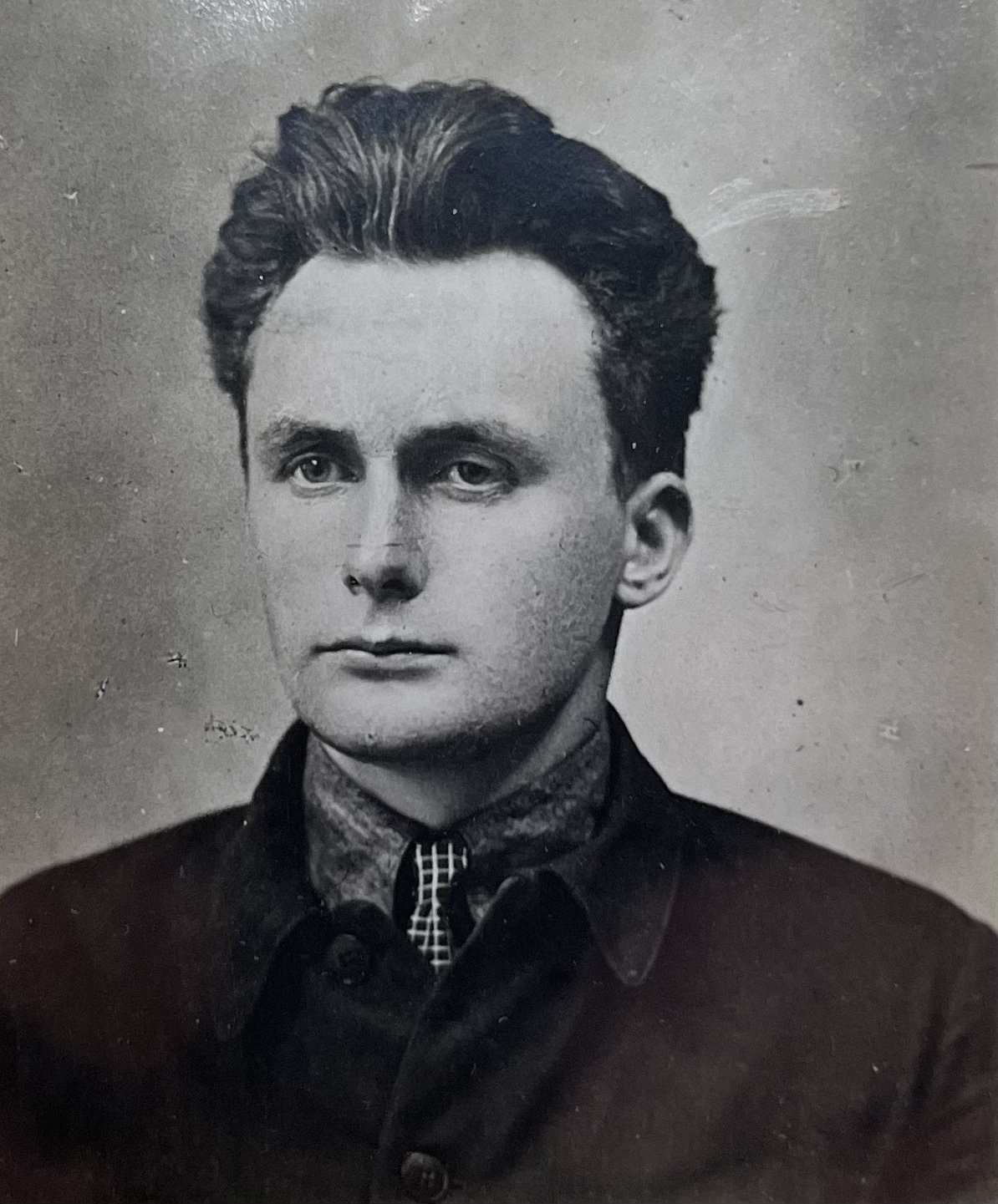
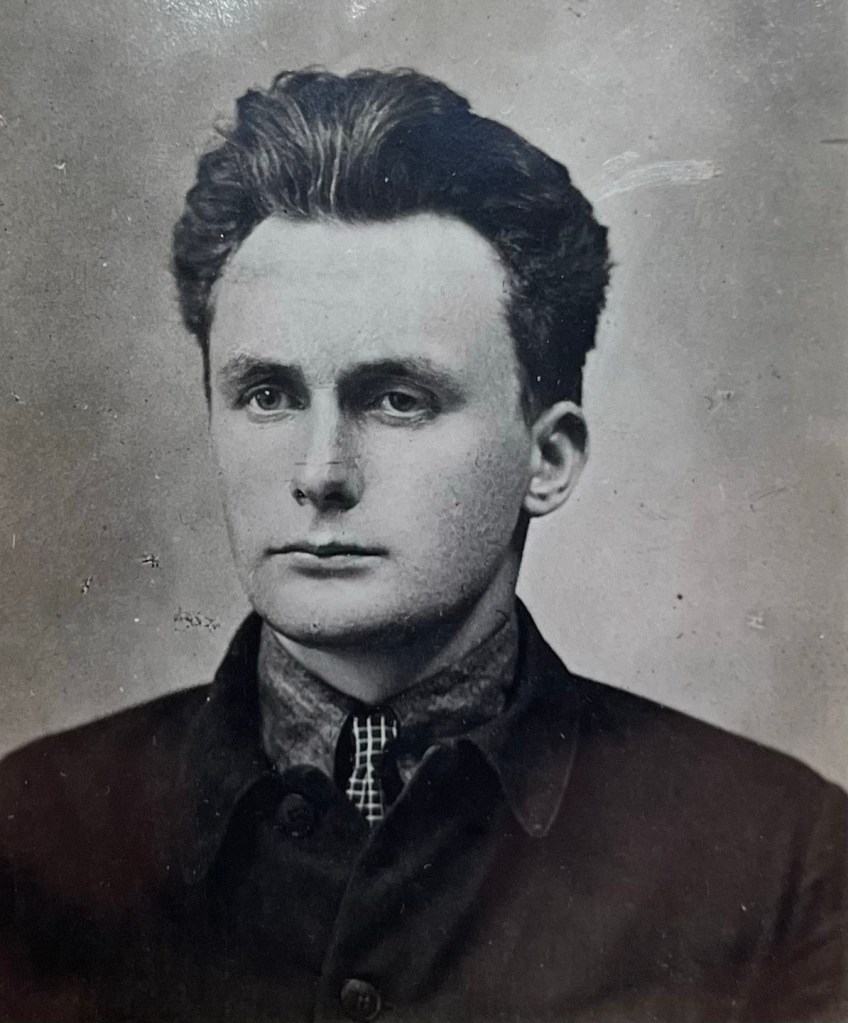
Anatomy Naumovich Kaminsky (1907-1941)

Where to begin? It’s a troubling, ultimately tragic part of the story and some of it is truly inexplicable. Perhaps the best way to deal with it is to set out the information as simply as I can.

What we knew was this. At some point in the early 1930s Bob Stewart’s daughter, Annie (my dad’s Aunt Nan) married a ‘Russian’ and they went to live in Moscow. We didn’t know his name nor had we ever seen a photograph of him. At some point Nan gave birth to a baby boy – my dad’s cousin Greg. Soon after this Nan’s husband was killed in Stalin’s purges. Nan fled with their infant child back to London. Information about her husband was almost impossible to come by. I have no idea how they managed to escape. In the years that followed, Nan remarried, had two more children and remained a member of the Communist Party until 1956.

For me, all of this was rather abstract. Dad had a lot of family somewhere out there but was rarely in contact with them. Until recently, apart from visits to my grandfather when I was a toddler, the only other person I’d ever met from my father’s side was Greg. That was at my brother’s wedding just over a decade ago. I only spoke to him briefly as I was on best man duties. All I can really remember is how strange it was to be speaking to somebody who bore such a strong resemblance to my dad and yet was someone who was to all intents and purposes a complete stranger. I never made the effort to remain in touch. I wish I had.

After my father died, I started reading through the security files on Bob Stewart that the National Archives had digitised and put online. Trying to find glimpses of who he was before he was our dad. To begin with, I knew very little about the Communist Party or our family. I tended to focus on the later files as during that period MI5 weren’t simply intercepting Bob’s post and tailing his movements but bugging his offices and tapping his phone. Rather than squinting at spidery 1920s handwriting and trying to work out what it all meant I could easily read the transcripts of conversations and, through their voices, almost begin to get to know these people who were long gone.

I started looking at the files collected during 1956. The year that Nikita Khrushchev gave a speech condemning the crimes of Stalin and the first official recognition about what had gone on in the decades before. At this time Nan was living in a large house in North London with her family and also her father who was nearing eighty but still involved in the secret side of the Communist Party of Great Britain. Most of the documents in that file focus on the general disquiet about the revelation in ‘secret speech’ felt by those at the CPGB’s HQ at Covent Garden. However, a more personal impact is outlined in the transcript of a phone call Nan made to her sister in law Margaret on 10th August 1956.

O/G call from NAN CAPLAN to MARGARET STEWART, BOB’S daughter in law. HARRY is back, and DRONA, (the father of NAN’s son GREGORY CAPLAN) was definitely shot in 1941. They are both shattered by it. HARRY came to see BOB and NAN insisted on seeing him. She says there is not one of the five brothers in KRONA’s (sic) family left. She threatened that if HARRY does not give her justice she’ll follow him to every meeting at which he speaks. BOB’s threatening to leave (The house? The party?) She would like her brother RAB STEWART to come and see her. BOB is going away next week so they will arrange it.
(KV2/2790 – Security File on Robert Stewart held at the National Archives.)

‘HARRY’ was Harry Pollitt, the leader of the CPGB, who had gone to Russia in part to find out what had happened to the family members of several of his own colleagues and friends. Of course, this transcript raises so many questions. How had they lived with this trauma for so long? How had they maintained their commitment to the CPGB in all that time in the face of it? What had they already known?

At this stage I still did not know the identity of Nan’s husband. From the battered suitcase that had been up in the loft, every old photograph or letter in Russian that I sifted through proved a dead end. So too did the references to KRONA or DRONA in the transcript- a nickname that didn’t seem to crop up elsewhere. However, later on in the files I did find a reference that linked Greg’s father to Grigory Kaminsky and this was the first real breakthrough in my search.

Grigory Kaminsky

Grigory Kaminsky was the People’s Commissar for Health of the Soviet Union between 1934 and 1937. He set up the Soviet health system, improved the production of medicine and medical training and battled malaria in the USSR. Evidently, he was also Nan’s brother-in-law. However, in 1937 he made speech in which he condemned the wrongful arrests of people and accused Lavrentiy Beria, the head of the NKVD, of counter revolutionary activities. As a result, he was arrested and then executed by firing squad in February 1938. Then, it seems, the NKVD went for the rest of his family.

Now I had a surname I went back to the earlier files from the 1920s and 1930s and managed to find documents that linked Anatole Naumovich Kaminsky and Annie Stewart together which speculated about whether they were married. So, now I knew who he was but still no idea of what he looked like or any real details of what had happened to him. My first port of call would have been to search for him through the Memorial website. Memorial is the Russian human rights organisation set up to investigate the crimes of the Stalin era and beyond. They’d amassed records of all known victims in a ceaseless effort to record every human rights violation. However, last year it was closed down after years of intimidation by the Putin regime. During one court hearing the state prosecutor announced that Memorial was “creating a false image of the Soviet Union as a terrorist state.”

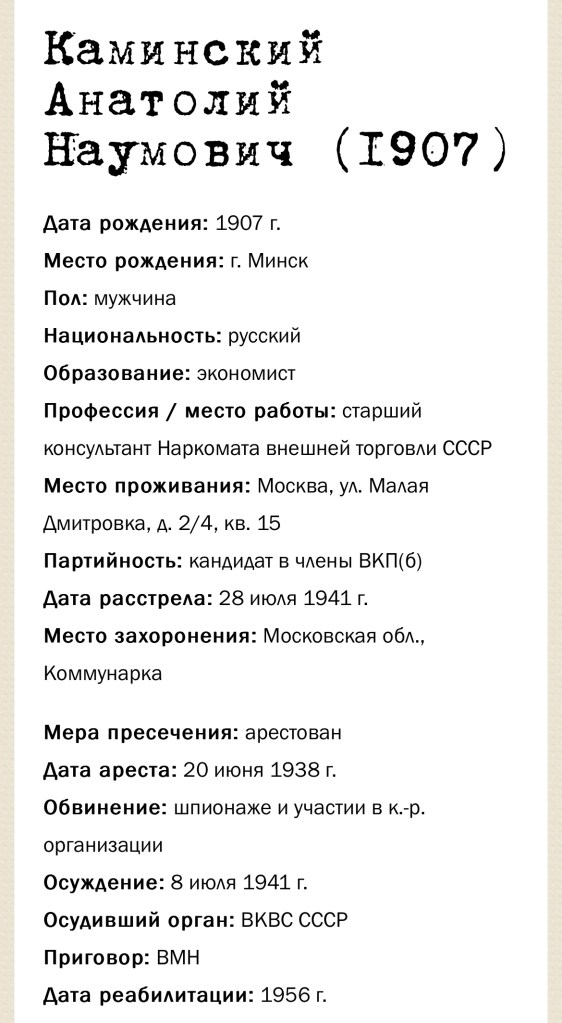
Screenshot of the information I found on Anatole Kaminsky. Apparently the information is from a database of “Victims of political terror in the USSR”; Moscow, execution lists -Kommunarka.

Despite Memorial being closed down I think I’ve still managed to find a record of what exactly had happened to Anatole. It appears that there are several websites that have ‘backed up’ the information held by Memorial and similar agencies and these have not all been shut down yet. Not being a Russian speaker, I can’t fully judge the reliabilty of the website I found but, as key parts of the information held on Anatole Kaminsky match what’s held in the MI5 files, I am reasonably sure that this is what happened.

On June 20th 1938 NKVD officers arrived at Anatole Kaminsky’s Moscow flat on the St. Malaya Dmitrovka. They arrested him on charges of espionage and participation in counter revolutionary organisations. He remained in custody for the next three years and was eventually convicted on 8th July 1941 shortly after the Nazis invaded the USSR. His sentence was noted down as ‘VMN’. This stood for ‘Vysshaya Mera Nakazaniya’ which translates as ‘the supreme measure of punishment’. In other words, the death penalty. On July 28th the sentence was carried out. They took him to the Kommunarka shooting ground on the outskirsts of Moscow where his body lies alongside thousands of other victims to this day. He was 34 years old.

Anatole was rehabilitated by the Khrushchev regime in 1956. Rehabilitation would have had to have been requested and I assume it was Harry Pollitt who put that in motion or it might have been Bob on his visit to Moscow in August that year. That’s as far as justice stretched.

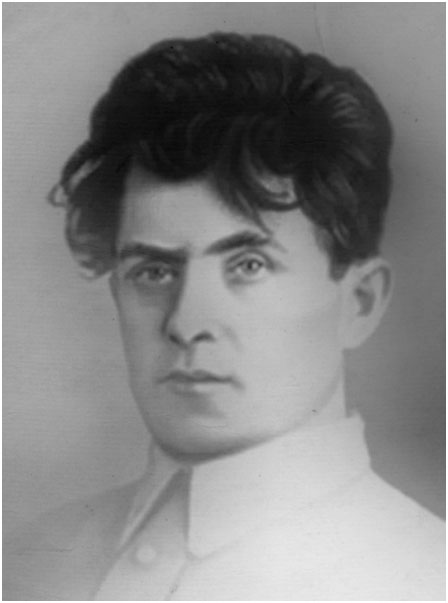
In November this year I finally saw some photographs of Anatole, one of which is reproduced at the top of this article. They were attached to his MI5 security file held at the National Archives. I spent the morning reading all about the six years he spent in Britain before he returned to the Soviet Union and the dreadful fate that awaited him. That afternoon I met, for the very first time, another of my dad’s cousins. It was Rab and Margaret’s daughter Linda. It had been Margaret who Nan had rang up after discovering what had happened to her husband in that summer in 1956. It was an emotional meeting and we covered a lot of ground in the few hours we were together. She could not believe I had found photographs of ‘Natte’ as he’d been known. He’d died long before she was born and she’d never seen a picture of him either. Of course she was familiar the story and knew that her aunt and cousin had got away by “the skin of their teeth.” When I showed her the photographs on my phone she was instantly struck by the resemblance to Greg who she’d known well and who died in 2019. I was glad I was able to show her these images. I wish that I could have shown them to my father. Above all, I wish I could have shown them to Greg.

Alan Stewart.

Thanks to Linda Stewart, Ian Stewart, Ruth Holliday and Maurice Casey for all their help.

The Case of the SS Stalingrad, the Polar Bear and the Barrels of Siberian Honey.

God, how my father loved to tell stories. At his funeral I spoke about the times in my twenties when I used to ring home and he would talk and talk to the point where I would put the receiver down and walk off for five minutes to make a cup of tea. When I picked up again, dad would still be going strong, never knowing he’d been speaking to empty space. In the week following his death I searched everywhere for any recording I had of him and his voice. I imagine a lot of people who don’t stop talking only ever think of themselves but I don’t think this was true of dad. He was interested in everything and everyone. Our friends became his friends and he was always happiest surrounded by people. In short – he was a lot of fun.

Unfortunately, in his last years vascular dementia dulled a lot of this. Buttonholing strangers for random conversations and endlessly repeated reminiscences of his wartime childhood were the norm for a while. Whereas in the past his stories entertained us, now they just made us apprehensive. They were to be policed and quietly managed. He had no filter. There would be myself, my partner and our small child together with my parents on a day out and when we sat down for lunch in a cafe dad would often turn his chair around and begin regaling the family behind us with his criticisms of ‘the colour bar’ in the 1960s, or the Napoleonic wars, whatever came to mind at that moment. These strangers would look bemused and often a little alarmed wondering why this person had attached themselves to their party before we got his attention to turn back to us. However, the illness didn’t dull his sense of the absurd. A few years before he died, during one of the rare times our small family was all together, he told a bizarre anecdote about his father trapped on a cargo ship with a polar bear drunk on Siberian honey. I had originally remembered the bear as being loose on a Russian submarine but my brother put me right – his memory of the story makes much more sense.

Although I can’t recall the exact words, dad’s tale left indelible images in my mind. Here’s my attempt at a retelling:

An icy breeze buffets the gulls gliding in the stone grey Leningrad skies. The docks seem busier than usual – all the activity focussed on a cargo ship berthed on the western side already sitting heavy in the water ready for its voyage. On the quayside, amongst the bedraggled dockworkers, stands a group of soldiers with rifles on their shoulders smoking and chatting nervously amongst themselves. Sailors weave past them, hats pulled down and jackets fastened tight against the Baltic air as they make the final preparations for their journey. Just one more item of cargo to load.

A crane rattles and wheezes into life. The crowds of dockers, soldiers and sailors all stop for a moment to gaze up at the large cage now being loaded on to the deck. Inside lies a huge mass of white fur which undulates slowly. Wheezing and snuffling sounds can be heard – the beast is heavily sedated. However, it is the large, black claws, each one the size of a hunting knife, that seizes the bystanders’ attention. This very large, very dangerous polar bear is on its way to London. It is a gift from Stalin himself.

With some difficulty sailors and dockworkers push and heave the massive drugged carnivore into a small compartment down in the hold where it settles down to snore away the effects of the anaesthetic. There is relief when the bar is shut down against the door and the key is turned – every man fully aware of the damage their cargo could do if it woke up and decided to clamp its jaws around their head. The final preparations are made for the journey and before long the steamship is manoeuvring its way out of the harbour towards the Gulf of Finland and out to the Baltic Sea on its way to England.

Unfortunately, the comrades haven’t read their AA Milne. In a oversight that they would soon regret, the sailors have stored a consignment of Siberian honey next to the sleeping bear. It may as well have been a powder keg. There are barrels and barrels of the stuff and, while a small group of off duty sailors sit around and pass the time playing cards, a pungent, earthy smell diffuses throughout the hold.

One of the sailors there is called Bill- a communist from Scotland. He’s there to make sure everything runs smoothly. That Stalin’s magnanimous gift is delivered without a hitch. As the cards are dealt once again, Bill becomes aware of a low growl and a scratching noise coming from the bear’s compartment. He ignores it as do the rest of the company and the game goes on. They imagine the bear is simply dreaming in the way they’ve seen their pet dogs chase rabbits in their sleep. But the bear is not dreaming. Instead the bear is emerging slowly from its slumber and has caught the scent of the wild honey.

Before long, the smell begins to intoxicate and torment the beast. It begins to get more and more agitated. To begin with the card players merely shout at it to keep the noise down before returning to their game. The growls get louder and then suddenly there is a thudding noise as the bear slams itself against the door in an effort to get to the barrels. It’s at this point the men stop playing and look nervously at each other. There is another thud. The sailors get up. While the others step warily back, Bill takes a few steps towards the bear’s compartment but instinctively stops. It is a very bad idea. Another thud accompanied by an almighty roar and the sailors scatter in panic. They shout to their comrades on deck that the bear is escaping. They shout to their comrades to bring rifles. Another thud and the sound of wood splintering. The sight of a claw, an eye, bared teeth. It’s only going to take a few more goes at battering the door before the bear escapes.

Bill shouts at the others to get out immediately and they scramble for to the steps that will take them up to the deck. Bill is the last to leave and, as he does so, the bear finally smashes through the door sending splintering wood everywhere. The sound it’s making is terrifying. It heads straight for the steps just as Bill gets onto the deck, the swipe of a paw missing his leg by inches. The ashen faced sailors are joined by their comrades as they look down the hatch, the bear snarling up at them. Someone brings along a rifle and attempts to push it into another’s hands. The man refuses. As does another. And another. Soon the whole crowd around the hatch are ignoring the chaos down below, shaking their heads and remonstrating with the man with the rifle. Not one of them is prepared to shoot the animal no matter how much danger they could be in or the damage that could be done. Shoot a gift from Stalin? How would you explain that? Staring at the floor they’d all rather take their chances with the bear.

Looking at the nervous crew Bill decides there is only one solution. He slams the hatch down and locks it, trapping the bear in the hold. The reaction down below is instantaneous- those on the deck can hear the animal going beserk. This seems to last an age- the sound of a bear wrecking every single barrel in the hold. Each smashed casing and the devouring of its contents propelling it into a further frenzy. What is to be done? Nothing it seems and most of the crowd drifts away from the hatch to worry and fret while leaving Bill and a comrade to stand guard. Eventually the bawling and growling gives way to huffing, slurping and chomping. Gradually these are replaced by a whimpering, the sound of a bear dropping to the floor and a heavy wheezing. Its a while before Bill opens the hatch. When he does, he is awed by the scenes of destruction that meet his eye. Every part of the bear’s fur seems matted and drenched with honey, its eyes rolled narcotically to the back of its head and its tongue lolling out of its slavering mouth. It is lying awkwardly on its back atop the wreckage of the entire consignment. Honey oozes out across the floor and splashes the walls. Bill will always remember this sight. A miracle no one was injured. With luck, they can now keep the bear sedated, clean up the mess and fix the worst of the damage. They can deliver their gift. Stalin need never know.

I can still remember the looks my brother gave me as we sat in a Chinese restaurant listening to Dad recount this tale. We hadn’t heard him in full flow for quite some time. It was more lucid than we were used to at that point but also more bizarre. And funny too. Much funnier than my attempt. He was more like his old self. Dad, for his part, maintained it was all true and that his father, Bill, had been one the sailors. It’s since become one of the main things we remember Dad by. Somehow typical of him but also, as it was one of the last of his tales he managed relay to us, more unique than ever. In the intervening years, the only other time I heard him talk at that length and detail was when we spoke on the phone a week before he died. For years all he’d managed was, “I’m being well looked after!” before passing the receiver back to Mum. In that last conversation he spoke for half an hour about how much he loved his parents, our Mum, my brother and me and our partners before speaking beautifully about his grandson. I knew then that it wouldn’t be long and it wasn’t a surprise when my mother rang distraught later that week. That last conversation will stay with me forever. However, the memory of it doesn’t make me laugh which is what Dad was so good at and which is why I have always wanted the polar bear story to be true.

I knew that grandad did work on Soviet steamships so there was a chance it could have happened. I had his discharge book which gave me the details of the ships he sailed on and their destinations but this stopped in 1927. Anyway, the Stalin element suggests that the incident took place in the 1930s but by that time my dad had been born and Bill had a chequered career ranging from working for the Soviet Embassy to being the catering manager at Tottenham Lido. When would he have had the time to go to Leningrad to load a polar bear onto a steamship in the first place?

I knew that if I started to pull at the threads of this tale it might not hold up. In fact it might unravel completely. All the same, I thought it was worth looking into. So, last year I sent an email to the Zoological Society of London. I began by explaining the story and apologising for it being so preposterous. The email continued:

I recently uncovered lot of documents detailing my grandfathers time on the SS Koursk- a steamship transporting goods from USSR to Britain which was operated by ARCOS during the 1920s. So, I have the Russian sailor part of the story but I don’t have the polar bear part. So, my question is. How would I find out whether the USSR gave London Zoo (or similar) a polar bear during the 1920s or 1930s? Is there any further information you could give me?

There might be no proof any of this happened. My dad told a lot of stories and this was one of the best. Wish I’d asked him more about it when he was alive.

The reply I received was remarkably unfazed as though they received requests like mine all the time. On reflection, I’m sure they do. They told me it would take a few days to research as the animal records weren’t kept in the Library and they needed to check with another department. A couple of weeks later I received the following:

Dear Alan,

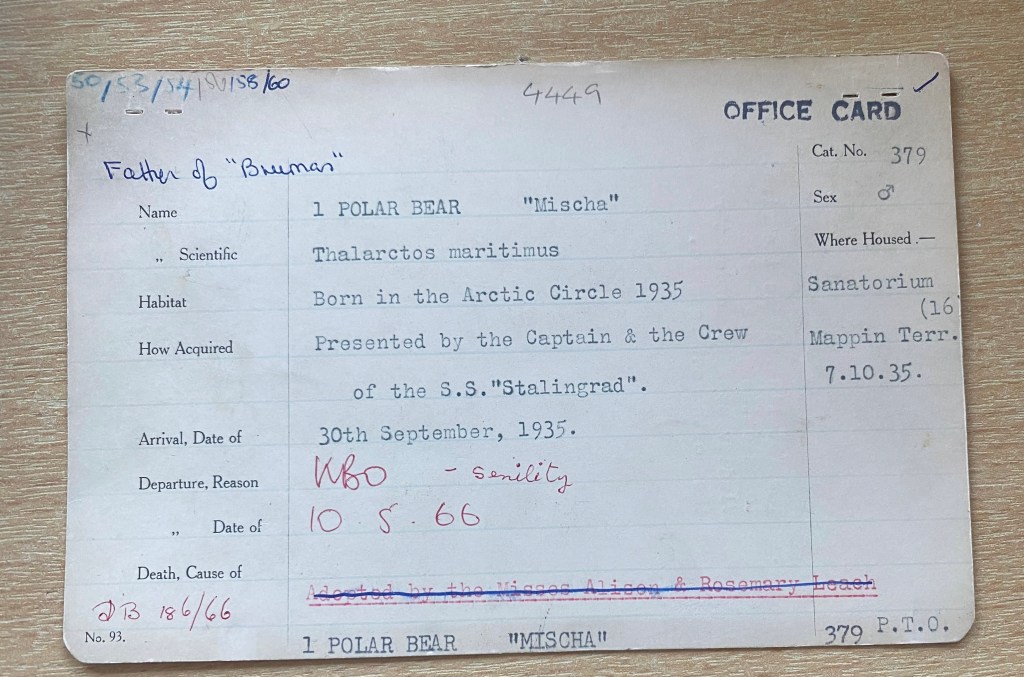
I have searched our animal record cards to locate the polar bear that was shipped from the Soviet Union. There was only one polar bear which seemed a possibility, but I cannot be sure that it is the polar bear that you were told about. I have attached a photograph of the record card to this email.

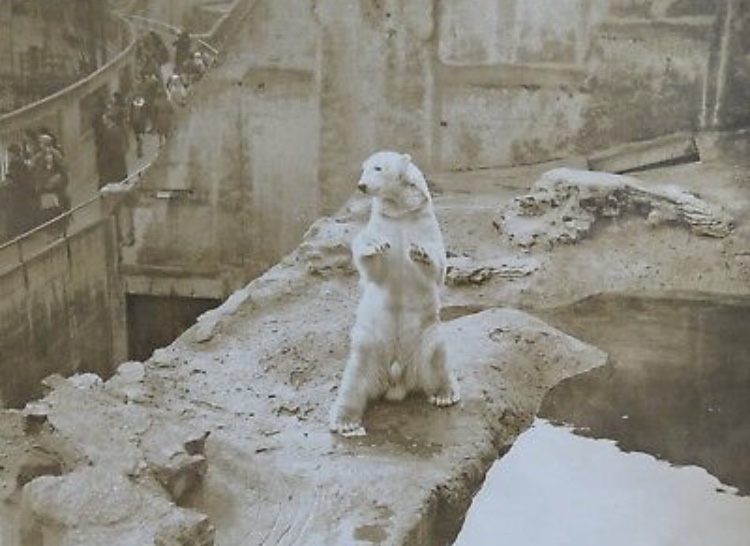
So, on 30th September 1935 Captain Melenkhov and the crew of the SS Stalingrad presented London Zoo with a male polar bear called Mischa. In all probability this was the bear I was looking for. I managed to find an image of Mischa fairly easily. Standing upright in the Mappin Terrace enclosure. A huge beast. One you definitely wouldn’t want to get too close to. He looks fairly benign but then look at the size of those paws and imagine the strength behind them. You know how bears are. They can turn on you just like that. Much later Mischa became a father to the much more famous Brumas -the first baby polar bear to be successfully reared in Britain and a huge hit with the public. His image adorning a seemingly endless range of memorabilia. So, this was the polar bear part of the tale- whether I’d be able to find the truth regarding its journey to England though was another matter entirely.

Mischa the Polar Bear at London Zoo.
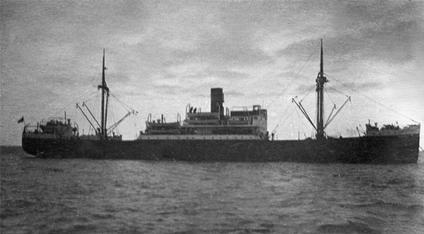
The SS Stalingrad

The SS Stalingrad, was a cargo-passenger ship built for ice navigation making regular trips across the Arctic Ocean and the North Atlantic transporting goods back and forth between Russia and the United Kingdom. That means it was more likely to sail out from Vladivostok, Murmansk and Archangel rather than the Baltic port of Leningrad. During the Second World War, while it was part of a convoy carrying munitions from the UK to Russia via Reykjavik, it was sunk by a torpedo from a German U-boat. 21 lives were lost.

However, though our grandad had served on similar vessels in the past, by 1935, having recently become a father, he was rarely at sea. Did he make it onto the SS Stalingrad at all? My brother thinks that if he made this trip it was a one off. Possibly because he could be trusted & spoke English. After all, his sister was working in Moscow, and his father was a Comintern Agent. However, I think now it’s just as likely that Bill Stewart wasn’t on the crew. That maybe he just had friends on board and that he met up with them when they docked at Surrey. That he had nothing to do with trying to calm down a raging, Stalinist bear, blitzed on honey in the middle of the Baltic but that he heard all about it later. Or, of course, he may have made the whole thing up.

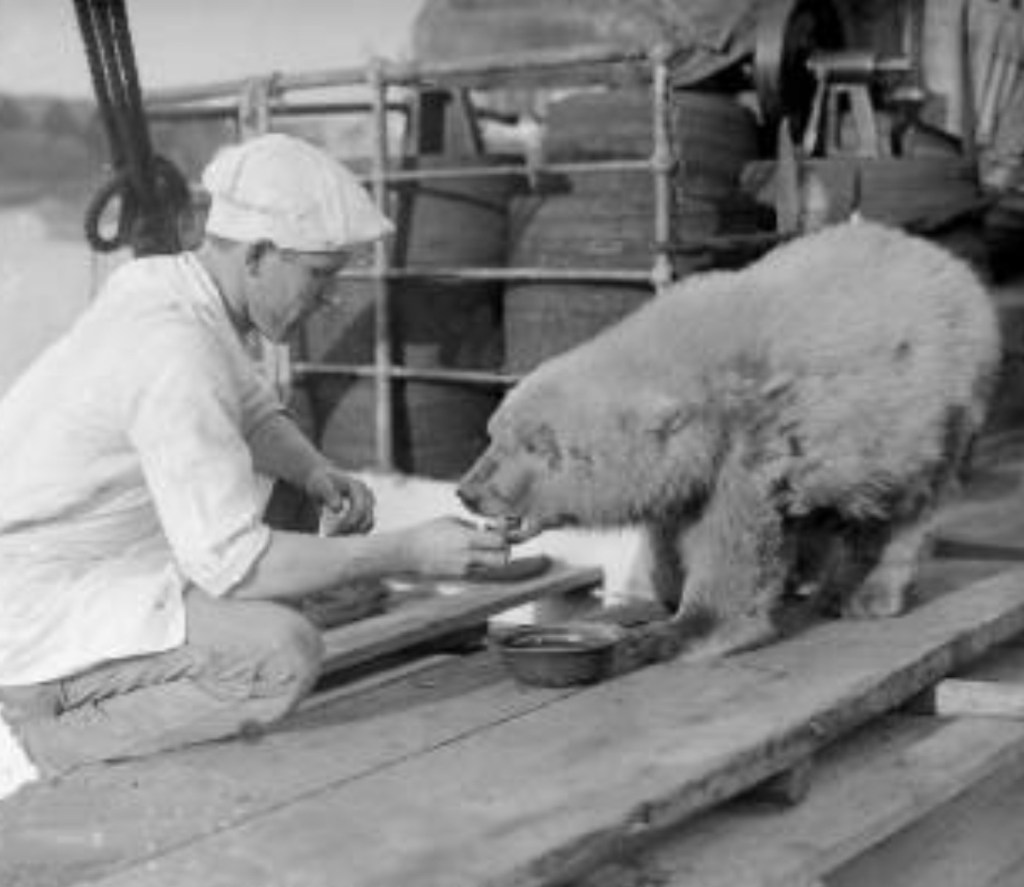
That first photograph I found of Mischa had lent a little bit of credence to the story and, as I put the whole thing aside for a few months wondering how to write about it, I just accepted that Russian sailors had stored an adult polar bear in the hold. There was something I’d missed on the card from London Zoo though. Next to the category ‘Habitat’ it said ‘Born in the Artic Circle in 1935’. I only noticed that, however, once I’d found another photograph of Mischa. This time on board the SS Stalingrad on its arrival in Britain that same year.

Mischa being fed on board the SS Stalingrad shortly before he as presented as a gift to the London Zoological Society. September 1935

Of course, Mischa hadn’t been a raging beast crammed into the hold ready to burst out and attack the crew until it was overcome by a stupor brought on by its gargantuan consumption of nectar. In reality one of the crew had picked up an infant bear of considerably less terrifying stature somewhere around the Arctic Circle during the ship’s voyage. Whether it was an orphan or not I do not know but Mischa clearly became a kind of ship’s mascot and the cute little thing might have been able to give you a nasty nip but would have found smashing through a compartment door next to impossible. Evidently Captain Melenkhov wasn’t sure what should be done with it on arrival in England and so presenting it to London Zoo seemed as good an idea as any. The story wasn’t true. It was wholly exaggerated. It was nonsense.

And then I realised what the story was. And I realised why my dad came to be telling it to us just as dementia started taking hold. When Mischa arrived in London, dad was a little over two years old. The tale of the polar bear drunk on Siberian honey was simply a story told by our grandfather Bill to his son Robin. Bill hadn’t been there. He may have had only the slightest connection to the whole incident but he made it his own. It was told to enchant, to amuse and to delight. To bring the teller and the listener closer together. I remember recounting a similar story to my toddler at a visit to the Natural History Museum once as we filed past a row of stuffed bears. “Look- that’s the bear that stole Daddy’s hair,” I said, going on to invent a suitably outlandish tale which my child, now a teenager, still remembers. My dad’s story was better though and the care he took to tell it showed the care our grandad took in embellishing it in the first place and none of it is surprising as clearly we are all a ludicrously sentimental lot in our family.

When I realised the whole saga was just a story told by Bill to Robin I cried for a bit. And then I was ok.

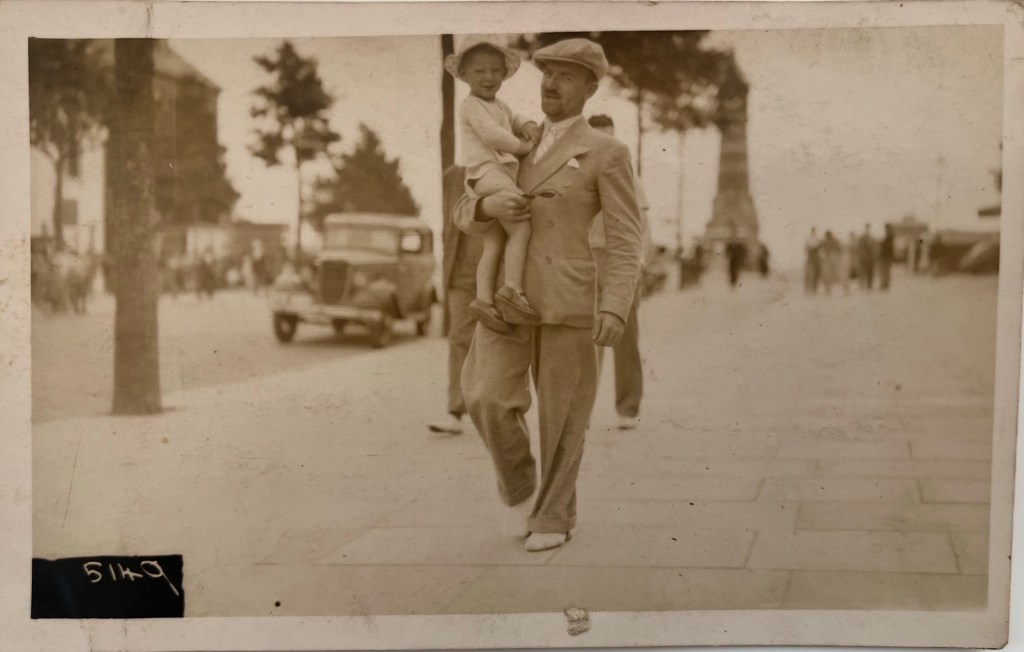
Our grandfather, Bill Stewart, our dad in his arms, sometime in 1935 or thereabouts.

Alan Stewart.