God, how my father loved to tell stories. At his funeral I spoke about the times in my twenties when I used to ring home and he would talk and talk to the point where I would put the receiver down and walk off for five minutes to make a cup of tea. When I picked up again, dad would still be going strong, never knowing he’d been speaking to empty space. In the week following his death I searched everywhere for any recording I had of him and his voice. I imagine a lot of people who don’t stop talking only ever think of themselves but I don’t think this was true of dad. He was interested in everything and everyone. Our friends became his friends and he was always happiest surrounded by people. In short – he was a lot of fun.
Unfortunately, in his last years vascular dementia dulled a lot of this. Buttonholing strangers for random conversations and endlessly repeated reminiscences of his wartime childhood were the norm for a while. Whereas in the past his stories entertained us, now they just made us apprehensive. They were to be policed and quietly managed. He had no filter. There would be myself, my partner and our small child together with my parents on a day out and when we sat down for lunch in a cafe dad would often turn his chair around and begin regaling the family behind us with his criticisms of ‘the colour bar’ in the 1960s, or the Napoleonic wars, whatever came to mind at that moment. These strangers would look bemused and often a little alarmed wondering why this person had attached themselves to their party before we got his attention to turn back to us. However, the illness didn’t dull his sense of the absurd. A few years before he died, during one of the rare times our small family was all together, he told a bizarre anecdote about his father trapped on a cargo ship with a polar bear drunk on Siberian honey. I had originally remembered the bear as being loose on a Russian submarine but my brother put me right – his memory of the story makes much more sense.
Although I can’t recall the exact words, dad’s tale left indelible images in my mind. Here’s my attempt at a retelling:
An icy breeze buffets the gulls gliding in the stone grey Leningrad skies. The docks seem busier than usual – all the activity focussed on a cargo ship berthed on the western side already sitting heavy in the water ready for its voyage. On the quayside, amongst the bedraggled dockworkers, stands a group of soldiers with rifles on their shoulders smoking and chatting nervously amongst themselves. Sailors weave past them, hats pulled down and jackets fastened tight against the Baltic air as they make the final preparations for their journey. Just one more item of cargo to load.
A crane rattles and wheezes into life. The crowds of dockers, soldiers and sailors all stop for a moment to gaze up at the large cage now being loaded on to the deck. Inside lies a huge mass of white fur which undulates slowly. Wheezing and snuffling sounds can be heard – the beast is heavily sedated. However, it is the large, black claws, each one the size of a hunting knife, that seizes the bystanders’ attention. This very large, very dangerous polar bear is on its way to London. It is a gift from Stalin himself.
With some difficulty sailors and dockworkers push and heave the massive drugged carnivore into a small compartment down in the hold where it settles down to snore away the effects of the anaesthetic. There is relief when the bar is shut down against the door and the key is turned – every man fully aware of the damage their cargo could do if it woke up and decided to clamp its jaws around their head. The final preparations are made for the journey and before long the steamship is manoeuvring its way out of the harbour towards the Gulf of Finland and out to the Baltic Sea on its way to England.
Unfortunately, the comrades haven’t read their AA Milne. In a oversight that they would soon regret, the sailors have stored a consignment of Siberian honey next to the sleeping bear. It may as well have been a powder keg. There are barrels and barrels of the stuff and, while a small group of off duty sailors sit around and pass the time playing cards, a pungent, earthy smell diffuses throughout the hold.
One of the sailors there is called Bill- a communist from Scotland. He’s there to make sure everything runs smoothly. That Stalin’s magnanimous gift is delivered without a hitch. As the cards are dealt once again, Bill becomes aware of a low growl and a scratching noise coming from the bear’s compartment. He ignores it as do the rest of the company and the game goes on. They imagine the bear is simply dreaming in the way they’ve seen their pet dogs chase rabbits in their sleep. But the bear is not dreaming. Instead the bear is emerging slowly from its slumber and has caught the scent of the wild honey.
Before long, the smell begins to intoxicate and torment the beast. It begins to get more and more agitated. To begin with the card players merely shout at it to keep the noise down before returning to their game. The growls get louder and then suddenly there is a thudding noise as the bear slams itself against the door in an effort to get to the barrels. It’s at this point the men stop playing and look nervously at each other. There is another thud. The sailors get up. While the others step warily back, Bill takes a few steps towards the bear’s compartment but instinctively stops. It is a very bad idea. Another thud accompanied by an almighty roar and the sailors scatter in panic. They shout to their comrades on deck that the bear is escaping. They shout to their comrades to bring rifles. Another thud and the sound of wood splintering. The sight of a claw, an eye, bared teeth. It’s only going to take a few more goes at battering the door before the bear escapes.
Bill shouts at the others to get out immediately and they scramble for to the steps that will take them up to the deck. Bill is the last to leave and, as he does so, the bear finally smashes through the door sending splintering wood everywhere. The sound it’s making is terrifying. It heads straight for the steps just as Bill gets onto the deck, the swipe of a paw missing his leg by inches. The ashen faced sailors are joined by their comrades as they look down the hatch, the bear snarling up at them. Someone brings along a rifle and attempts to push it into another’s hands. The man refuses. As does another. And another. Soon the whole crowd around the hatch are ignoring the chaos down below, shaking their heads and remonstrating with the man with the rifle. Not one of them is prepared to shoot the animal no matter how much danger they could be in or the damage that could be done. Shoot a gift from Stalin? How would you explain that? Staring at the floor they’d all rather take their chances with the bear.
Looking at the nervous crew Bill decides there is only one solution. He slams the hatch down and locks it, trapping the bear in the hold. The reaction down below is instantaneous- those on the deck can hear the animal going beserk. This seems to last an age- the sound of a bear wrecking every single barrel in the hold. Each smashed casing and the devouring of its contents propelling it into a further frenzy. What is to be done? Nothing it seems and most of the crowd drifts away from the hatch to worry and fret while leaving Bill and a comrade to stand guard. Eventually the bawling and growling gives way to huffing, slurping and chomping. Gradually these are replaced by a whimpering, the sound of a bear dropping to the floor and a heavy wheezing. Its a while before Bill opens the hatch. When he does, he is awed by the scenes of destruction that meet his eye. Every part of the bear’s fur seems matted and drenched with honey, its eyes rolled narcotically to the back of its head and its tongue lolling out of its slavering mouth. It is lying awkwardly on its back atop the wreckage of the entire consignment. Honey oozes out across the floor and splashes the walls. Bill will always remember this sight. A miracle no one was injured. With luck, they can now keep the bear sedated, clean up the mess and fix the worst of the damage. They can deliver their gift. Stalin need never know.
I can still remember the looks my brother gave me as we sat in a Chinese restaurant listening to Dad recount this tale. We hadn’t heard him in full flow for quite some time. It was more lucid than we were used to at that point but also more bizarre. And funny too. Much funnier than my attempt. He was more like his old self. Dad, for his part, maintained it was all true and that his father, Bill, had been one the sailors. It’s since become one of the main things we remember Dad by. Somehow typical of him but also, as it was one of the last of his tales he managed relay to us, more unique than ever. In the intervening years, the only other time I heard him talk at that length and detail was when we spoke on the phone a week before he died. For years all he’d managed was, “I’m being well looked after!” before passing the receiver back to Mum. In that last conversation he spoke for half an hour about how much he loved his parents, our Mum, my brother and me and our partners before speaking beautifully about his grandson. I knew then that it wouldn’t be long and it wasn’t a surprise when my mother rang distraught later that week. That last conversation will stay with me forever. However, the memory of it doesn’t make me laugh which is what Dad was so good at and which is why I have always wanted the polar bear story to be true.
I knew that grandad did work on Soviet steamships so there was a chance it could have happened. I had his discharge book which gave me the details of the ships he sailed on and their destinations but this stopped in 1927. Anyway, the Stalin element suggests that the incident took place in the 1930s but by that time my dad had been born and Bill had a chequered career ranging from working for the Soviet Embassy to being the catering manager at Tottenham Lido. When would he have had the time to go to Leningrad to load a polar bear onto a steamship in the first place?
I knew that if I started to pull at the threads of this tale it might not hold up. In fact it might unravel completely. All the same, I thought it was worth looking into. So, last year I sent an email to the Zoological Society of London. I began by explaining the story and apologising for it being so preposterous. The email continued:
I recently uncovered lot of documents detailing my grandfathers time on the SS Koursk- a steamship transporting goods from USSR to Britain which was operated by ARCOS during the 1920s. So, I have the Russian sailor part of the story but I don’t have the polar bear part. So, my question is. How would I find out whether the USSR gave London Zoo (or similar) a polar bear during the 1920s or 1930s? Is there any further information you could give me?
There might be no proof any of this happened. My dad told a lot of stories and this was one of the best. Wish I’d asked him more about it when he was alive.
The reply I received was remarkably unfazed as though they received requests like mine all the time. On reflection, I’m sure they do. They told me it would take a few days to research as the animal records weren’t kept in the Library and they needed to check with another department. A couple of weeks later I received the following:
Dear Alan,
I have searched our animal record cards to locate the polar bear that was shipped from the Soviet Union. There was only one polar bear which seemed a possibility, but I cannot be sure that it is the polar bear that you were told about. I have attached a photograph of the record card to this email.
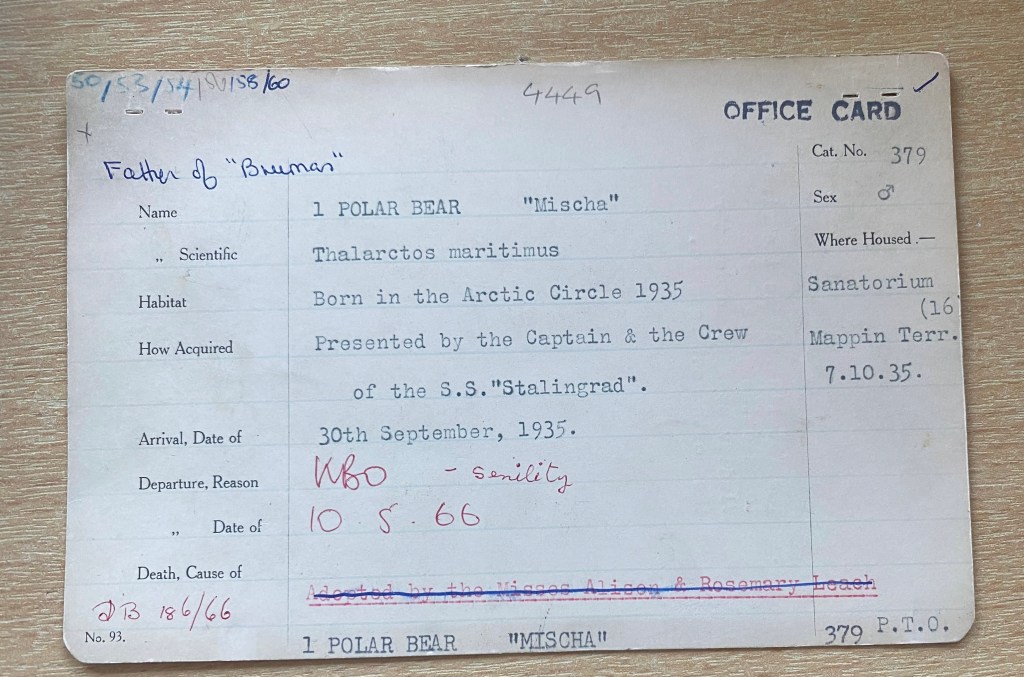
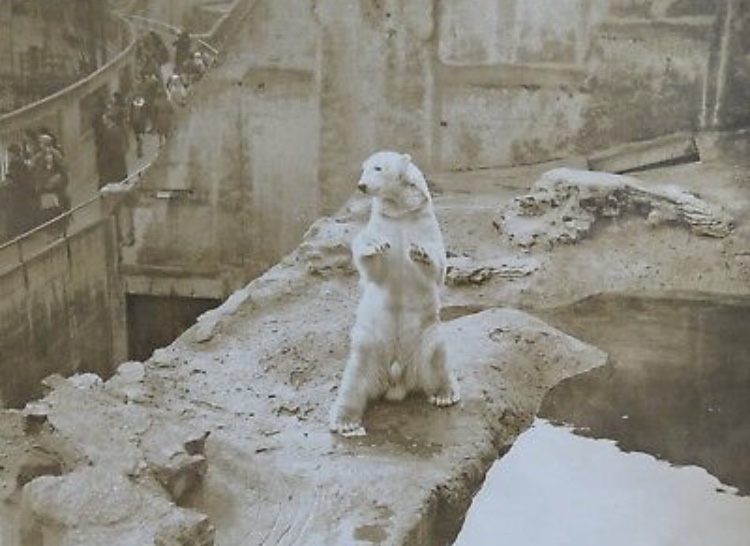
So, on 30th September 1935 Captain Melenkhov and the crew of the SS Stalingrad presented London Zoo with a male polar bear called Mischa. In all probability this was the bear I was looking for. I managed to find an image of Mischa fairly easily. Standing upright in the Mappin Terrace enclosure. A huge beast. One you definitely wouldn’t want to get too close to. He looks fairly benign but then look at the size of those paws and imagine the strength behind them. You know how bears are. They can turn on you just like that. Much later Mischa became a father to the much more famous Brumas -the first baby polar bear to be successfully reared in Britain and a huge hit with the public. His image adorning a seemingly endless range of memorabilia. So, this was the polar bear part of the tale- whether I’d be able to find the truth regarding its journey to England though was another matter entirely.
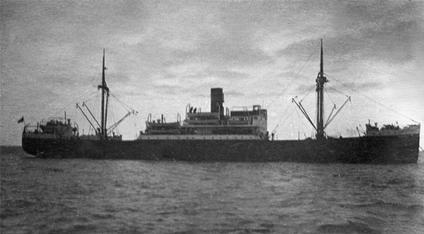
The SS Stalingrad, was a cargo-passenger ship built for ice navigation making regular trips across the Arctic Ocean and the North Atlantic transporting goods back and forth between Russia and the United Kingdom. That means it was more likely to sail out from Vladivostok, Murmansk and Archangel rather than the Baltic port of Leningrad. During the Second World War, while it was part of a convoy carrying munitions from the UK to Russia via Reykjavik, it was sunk by a torpedo from a German U-boat. 21 lives were lost.
However, though our grandad had served on similar vessels in the past, by 1935, having recently become a father, he was rarely at sea. Did he make it onto the SS Stalingrad at all? My brother thinks that if he made this trip it was a one off. Possibly because he could be trusted & spoke English. After all, his sister was working in Moscow, and his father was a Comintern Agent. However, I think now it’s just as likely that Bill Stewart wasn’t on the crew. That maybe he just had friends on board and that he met up with them when they docked at Surrey. That he had nothing to do with trying to calm down a raging, Stalinist bear, blitzed on honey in the middle of the Baltic but that he heard all about it later. Or, of course, he may have made the whole thing up.
That first photograph I found of Mischa had lent a little bit of credence to the story and, as I put the whole thing aside for a few months wondering how to write about it, I just accepted that Russian sailors had stored an adult polar bear in the hold. There was something I’d missed on the card from London Zoo though. Next to the category ‘Habitat’ it said ‘Born in the Artic Circle in 1935’. I only noticed that, however, once I’d found another photograph of Mischa. This time on board the SS Stalingrad on its arrival in Britain that same year.
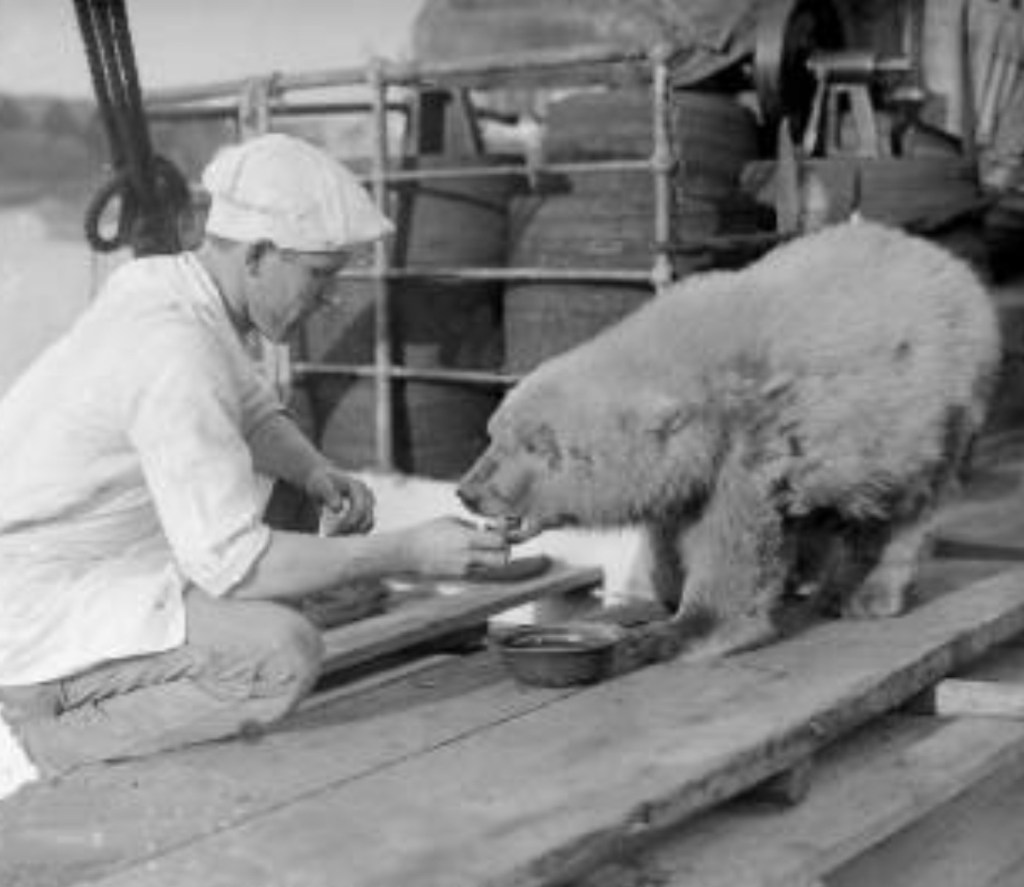
Of course, Mischa hadn’t been a raging beast crammed into the hold ready to burst out and attack the crew until it was overcome by a stupor brought on by its gargantuan consumption of nectar. In reality one of the crew had picked up an infant bear of considerably less terrifying stature somewhere around the Arctic Circle during the ship’s voyage. Whether it was an orphan or not I do not know but Mischa clearly became a kind of ship’s mascot and the cute little thing might have been able to give you a nasty nip but would have found smashing through a compartment door next to impossible. Evidently Captain Melenkhov wasn’t sure what should be done with it on arrival in England and so presenting it to London Zoo seemed as good an idea as any. The story wasn’t true. It was wholly exaggerated. It was nonsense.
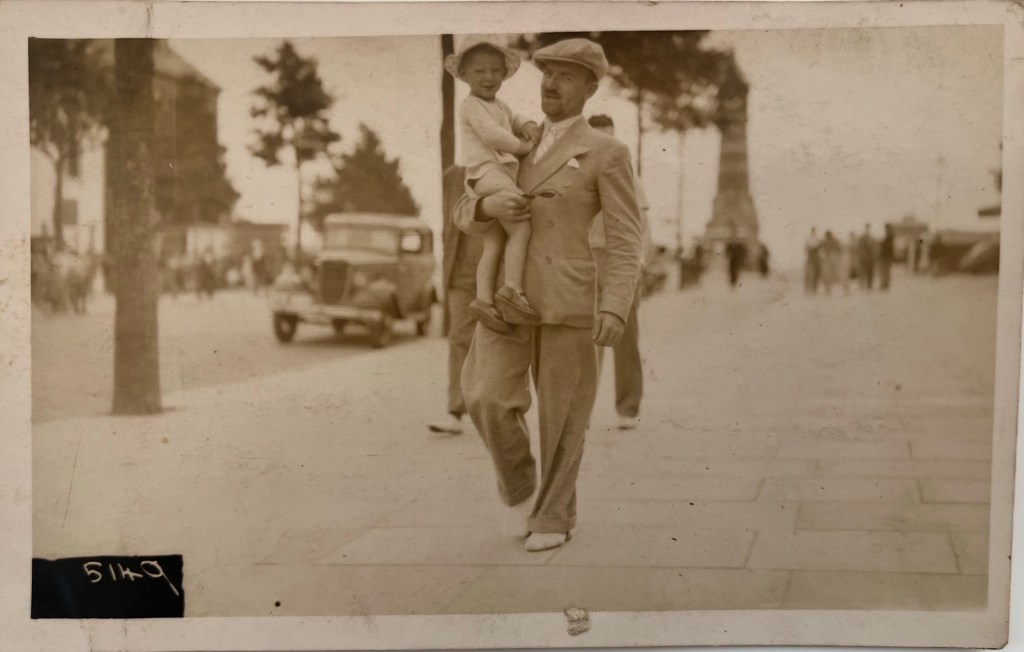
And then I realised what the story was. And I realised why my dad came to be telling it to us just as dementia started taking hold. When Mischa arrived in London, dad was a little over two years old. The tale of the polar bear drunk on Siberian honey was simply a story told by our grandfather Bill to his son Robin. Bill hadn’t been there. He may have had only the slightest connection to the whole incident but he made it his own. It was told to enchant, to amuse and to delight. To bring the teller and the listener closer together. I remember recounting a similar story to my toddler at a visit to the Natural History Museum once as we filed past a row of stuffed bears. “Look- that’s the bear that stole Daddy’s hair,” I said, going on to invent a suitably outlandish tale which my child, now a teenager, still remembers. My dad’s story was better though and the care he took to tell it showed the care our grandad took in embellishing it in the first place and none of it is surprising as clearly we are all a ludicrously sentimental lot in our family.
When I realised the whole saga was just a story told by Bill to Robin I cried for a bit. And then I was ok.
Alan Stewart.
 Breaking the Fetters