
Frankly, the 1920s do not seem very different to our own times. Huge inequality, increasing poverty and a government wholly indifferent to the situation, more concerned with preserving their interests and dismantling the rights of ordinary people. Liberal voices and the fourth estate hostile to any ideas that may remedy the situation. Perhaps the main difference between then and now is that, in the twenties, unemployment was the source of hardship whereas these days most people tipping into poverty are in work.
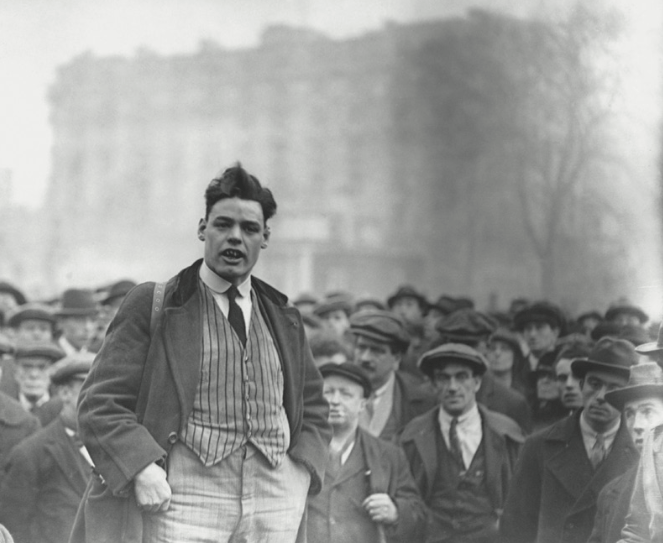
During the 1920s and 1930s there were numerous marches and protests to combat unemployment and hunger and my grandfather Bill Stewart was on one of the first. I recently discovered two documents that shed a little light on these times. One of them was my grandad’s own handwritten account of his experiences, written sometime in the 1970s for The Morning Star. The other was a letter to Bill from trade union legend Tom Mann- a colleague and friend of his father Bob Stewart.


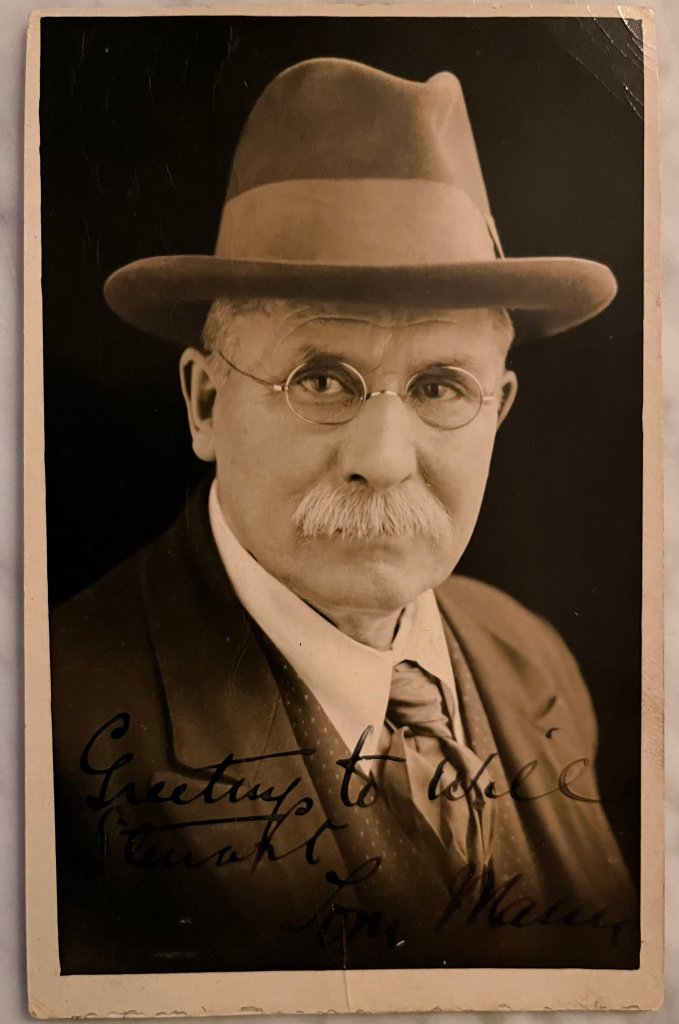
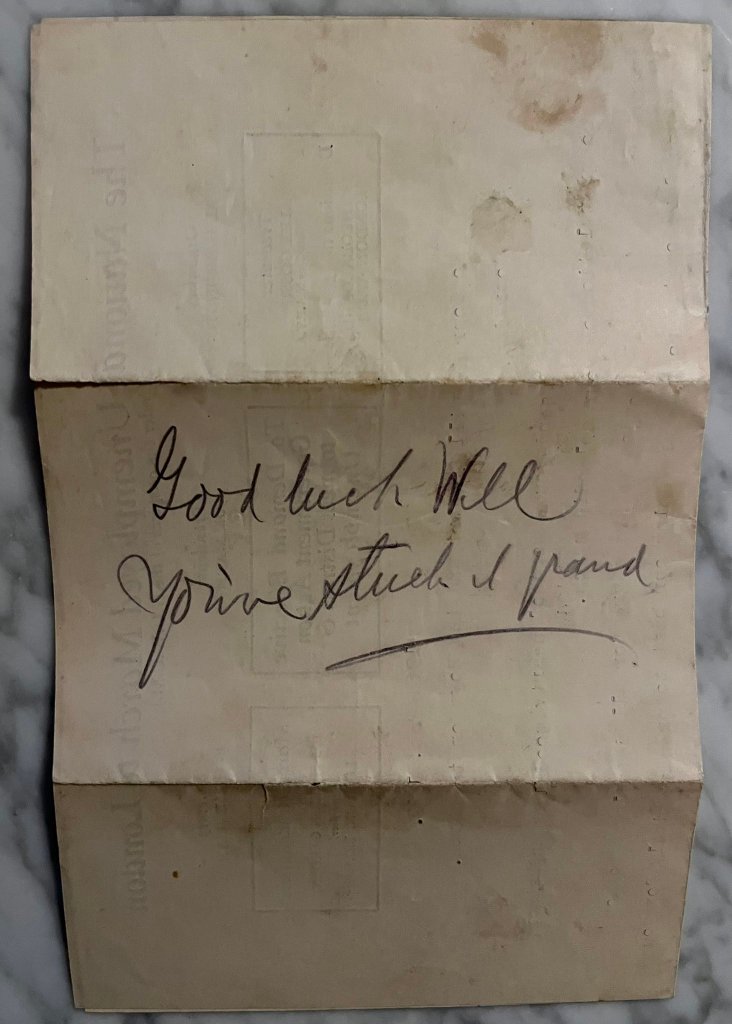
The envelope is addressed to ‘Comrade William Stewart – WITH THE MARCHING UNEMPLOYED’ to be picked up at the Aylesbury post office on or after the 20th February. The marchers had made it on foot from Glasgow to Buckinghamshire in a little less than a month. The letter is on the headed notepaper of the National Unemployed Workers Committees Movement – an organisation set up by the CPGB to highlight the conditions of the unemployed after the First World War and on the back Tom Mann has scrawled something along the lines of ‘Good luck Will- you’ve stuck it grand.’ There’s even a signed photograph. The letter reads:
To Comrade Will Stewart and the Boys on the March.
Dear Comrades,
I send you a word of hearty good luck and sincere congratulations on your splendid march.
In London we are eager for all details as to how you fare on the road. We
are doing our best to prepare nicely for you on your arrival.
You have done splendidly and are now within a few days of your destination. In spite of all obstacles you have achieved your purpose so far and we believe will carry it out to the letter.
I am hoping to meet you at Watford on Friday, continue in the
same spirit of Comradely devotion to our great cause and you will do much to bring about betterment now and the great Industrial and Social change for the future.
Hail to the Marchers;
Fraternally Yours,
Tom Mann
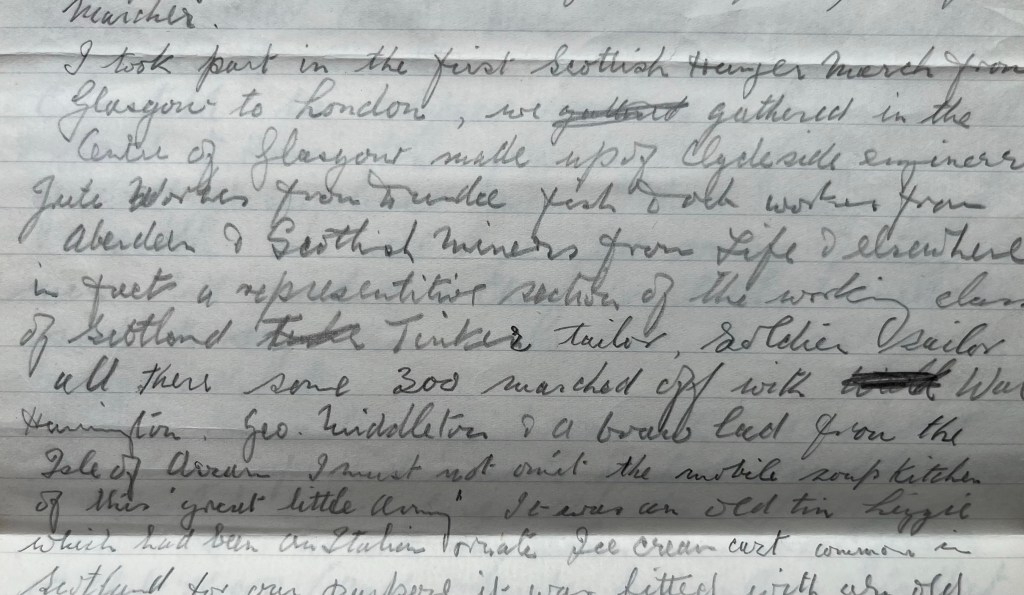
William Stewart’s own handwritten account seems to have been written sometime in the 1970s almost fifty years after the event. It sheds more light on what it was like to be on the march and the issues they faced on the way. Wal Hannington was a founding member of the CPGB and the head of the National Unemployed Workers’ Movement. If any one could identify the Geo Middleton mentioned I’d be extremely grateful.
I have just been reading your article in this morning’s Morning Star on the Hunger Marchers, and I think that apart from the actual primary importance of the political side of the campaign, please let us tell the up and coming militants what made an ‘Unemployable Person’ (as the title often was quoted) a Hunger Marcher.
I took part in the first Scottish Hunger March from Glasgow to London, we gathered in the centre of Glasgow made up of Clydeside engineers, jute workers from Dundee, fish and dock workers from Aberdeen Scottish miners from Fife and elsewhere in fact a representative section of the working class of Scotland. Tinker, tailor, soldier, sailor altogether some 300 marched off with Wal Hannington, Geo Middleton and a braw lad from the Isle of Arran. I must not omit the mobile soup kitchen of this ‘great little army’. It was an old tin Lizzie which had been an ornate ice cream cart common in Scotland. For our purpose it was fitted with an old wash house boiler (as used these days for cooking pigs swill) a few sacks of boiler coke and firewood and of course a ‘cook’ of whom more later.
The month of January was not best weatherwise in Scotland and as we progressed on our way snow was falling as we marched through Thornhill singing the old marching songs of the Movement in which we were soon to become as efficient as any body of marching troups and when London’s Trafalgar Square was reached our rendition of Macgregor’s Gathering and the Hunger Marchers song was worthy of a Red Army Choir.
I am transgressing, to get back to purport of these notes I must go back to our march across the border into Carlisle, here along a country road came the power of the law in the shape of a PC Sergeant and Chief Constable resplendent in blue and yards of black braid and a flashing silver nobbed cane. Wall gave the command to stand to attention coming abreast of the Chief Constable – he stepped forward saluted Wal and said ‘Mr Hannington you have a fine body of well disciplined men. I had visions of a rabble.’ Our well organised army of determined men had evoked a Chief Constable’s admiration. Sad to say this was not the case as we progressed.
What comradeship and warmth we received – the big splendid meals of hot vegetable soups and through Lancashire the tons of hotpot consumed as we lay down on school floors or club floors tired but proud with the great justification of the duty we were performing for our class. Proud of the bands of working class women who cooked and fed us at each halt on the way – of butchers who handed us joints of meat – bakers who gave us bread and buns – of the Co-op Womans Guild who organised their local Co-op resources on our behalf – of women, whose homes were full of their own unemployed fathers and sons, took and did washing for us.
Each marcher had an Army blanket which on the march was rolled and worn bandolier wise over our overcoats and with each man wearing an Army haversack we did look as if we meant business – marching in battalion formation of companies and sections, (we had no lack of military advisers- many of the lads were ex-servicemen).
Our commander and his deputy Wal Hannington and Geo Middleton respectively were tremendous, not forgetting the role they played – for want of a better name – political commissars.
To get back to my story and to emphasise the main purpose of writing is to show that it was in the organisation and the day to day problems and details dealt with by “Our Command’ without this the impact on the community would have been lost. All working class organisations rallied to us as the march continued south.
We had a cyclist courier on an old boneshaker who would ride ahead to alert local comrades of our impending arrival and make arrangements for our rest at night – all important when we had forced our march to some 30miles in one day on some occasions.
We were approaching Warwick – our scout or courier said we would have to go to the ‘Spike’ that night and he was not too sure of the ‘Workhouse Master’. As we marched in that evening there stood the Master well dressed in tweeds and stout brown brogues – the envy of the Army booted marchers. His eyes showed his amazement at our discipline quietly he said ‘this is not what I expected’ and he re-arranged all the quarters and implemented the meals after which he asked Wal and I to share his supper in his own quarters and as the meal of lamb and pickles progressed and Wal explained the reason and the purpose of what the march involved he grew in admiration and from a hostile attitude almost came to flattering of our efforts. He voluntarily waved the 3hour work rule then in force – (any person using the workhouse overnight was compelled to do such things as cleaning, wood chopping and coal carrying. This was not always the case as in later cases when a downright refusal had to be made at other workhouses). As Wal and I said good night to him and walked across to the main building and our floor space Wal said to me “Billy another couple of hours with that bloke I would have had him packing up and joining us.
On down through Lancashire among the lassies in their clogs and shawls ladling out mountains of hotpot full of meat scrounged off local butchers and cigarettes from their own meagre supplies – though on occasions a Tobacconist gave a supply of Woodbines, Shag and papers
What an army from Glasgow to London without a courtmartial! At no time was anyone reported for drinking such was the effect of good leadership and voluntary discipline in our day to day organisation of ordinary working blokes with intellect enough to understand how worthwhile this great effort was. Many had little knowledge of The Working Class Movement when the march started other than they were against the system that had unjustly degraded them but the hell of it had not broken the spirit that took them on the march.
One wee chap whose feet were a bit sore as we marched along half whispered to me ‘Hey Bill I’ve been thinking we missed a wee thing at the start of this — job – we should have sent a telegram to Budyonny to hae sent us some o his Red Cavalry horses – ma feet always walked better in stirrups? Later I learnt he had been in the Scots Greys.
The bedding down at night were like any barrack room except the arguments were on a higher plain and as the march progressed the full sense of class and political involvement came to the top and the knowledge of fully participating in the struggle of the masses and the need to implement their knowledge grew in their eagerness and enlightenment so that when London came everyman Jack was fully conscious of every facet of the political causes that prompted our actions as working class militants.
 Breaking the Fetters