Diane Keaton (1946-2025). Forget her superlative performances as Kay Adams in The Godfather movies. Forget Annie Hall. Remember her for her performance as Louise Bryant in Reds. That’s the one. We lost a comrade today.
Alan Stewart.
PS Obviously don’t forget her performances in The Godfather movies and Annie Hall but Reds is her best work and it is an amazing film.
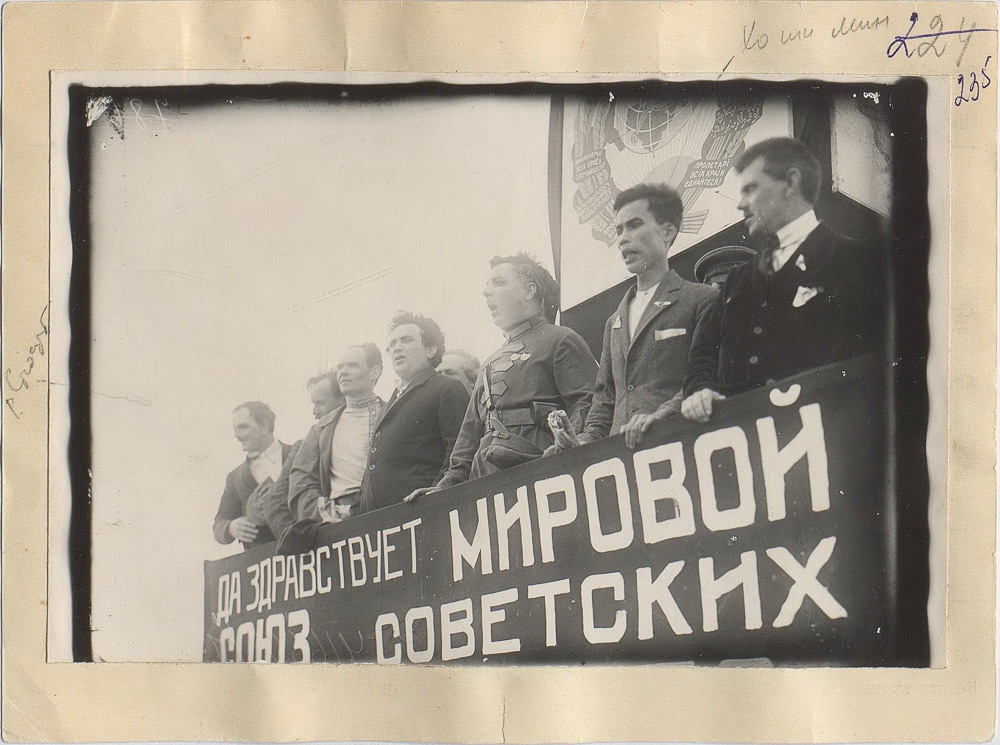
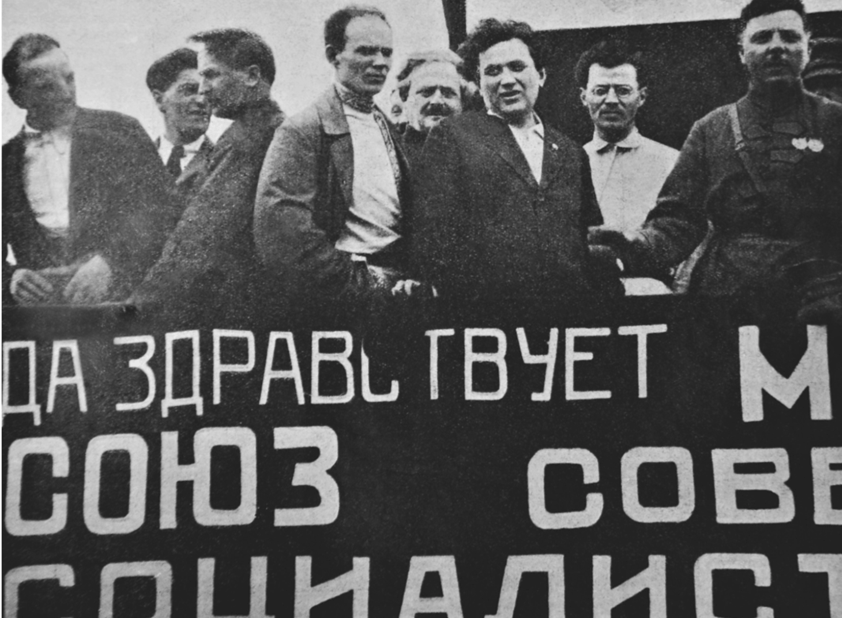
L-R: Bob Stewart, Unknown, Nikolai Antipov, Grigory Zinoviev, Kliment Voroshilov, Ho Chi Minh, Unknown. Partially visible behind L-R: Avel Yenukidze.
One of the benefits of researching a distinctive looking ancestor is that they’re easily recognisable to others studying the same topic. During the summer holidays, Maurice Casey, author of Hotel Lux (out now in paperback!) spotted Bob Stewart’s familiar broken face in a photograph taken in Moscow dating from 1924 when he was the CPGB representative to the Communist International. He could be seen, furthest left, in a group lined up behind a banner proclaiming, “ Long Live the Global Union Of Soviets!” Above them is a flag with a hammer and sickle in the centre of the globe which is framed by sheaves of wheat. The group look as if they’re in the middle of the chorus of The Internationale, The Red Flag or a similar revolutionary anthem. Bob has a broad smile on his face. Of the others, the only individual I could recognise was Grigory Zinoviev, the head of the Comintern, essentially my great grandfather’s boss at the time. In his email, Maurice pointed out the figure second from right, “a young delegate of the French Communist Party, originally born in French Indochina: today known as Ho Chi Minh.” Frankly I was stunned. Despite his attendance at Lenin’s funeral, late night consultations in the Kremlin with Stalin and his visit to China in the 1950s where he met Mao Zedong, I had no idea that Bob had ever encountered the man who would become one of the most influential leaders of the twentieth century. Even my teenage son was impressed having studied the Vietnam War in GCSE History. “They named a trail after him!” was his initial reaction. Yes – also an avenue, a square, several monuments across the world and a whole city.
The photograph encapsulated something I’ve grown to love about the communists of the 1920s. The optimism. The hope. The unwavering belief that they would change the existing state of things. Life would be better for millions. A lifelong abstainer from alcohol Bob would nevertheless would find life at the epicentre of this struggle intoxicating. It’s something I marvel at, especially in today’s atmosphere of grim resignation of successive governments that – no – nothing in society can ever be improved. Here’s more cuts. Here’s more crackdowns. Nothing to be done. The romance of this image of my forebear and his comrades – and it isRomantic – was only heightened when Liz Wood from the Modern Records Centre at Warwick University pointed out on Bluesky where the image had come from. It was taken on the 6th of July during a massive celebration when representatives from the French Communist Party symbolically handed over a tattered red flag which had flown over the Paris Commune in 1871 to be placed in Lenin’s mausoleum which was then under construction.
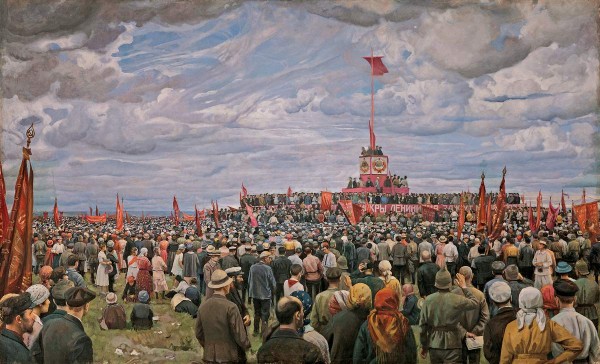
In an eyewitness account published in the US version of The Daily Worker the journalist Anna Louise Strong describes how a four hundred thousand strong crowd poured into the October Field just outside Moscow. The ceremony took place on the International Day of Co-operation and the first anniversary of the signing of the new Soviet constitution. I imagine it was also organised to rally the workers after an appropriate period of mourning for Lenin after his death in January that year. The solemn grief of the funeral which took place in ice and snow months before was replaced by sunshine and a carnival atmosphere.
The Passing of a Banner to the Moscow Workers by the Communards on Khodynka Field in Moscow by Isaak Brodsky.
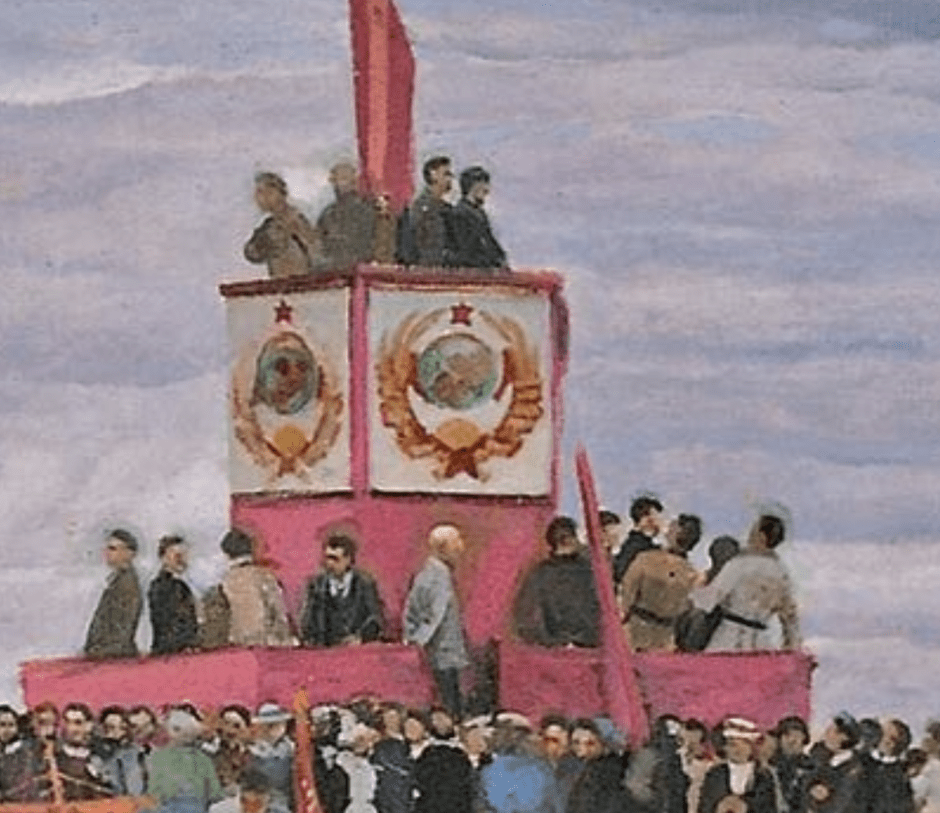
The fraying flag perforated by bullet holes had been taken down from the barricades of the Paris Commune over fifty years before and had been passed along various socialist groups in the intervening years in the manner of a religious relic. It had left the French capital with a farewell parade of one hundred thousand workers and was greeted on it’s arrival in the worker’s state by magnificent scenes captured stirringly in an oil painting by the artist I.I. Brodsky. I’m fairly sure Bob is depicted as one of the distant figures on the middle row of the tribune. It’s probably me being sentimental but it does correspond with the photograph.
Yeah, I reckon that’s Bob on the middle platform second left.
Strong’s narrative outlines the speeches, the songs, the performances and the sporting displays of this public holiday but at the centre of events is the handover of the scarlet standard.
“For nearly five hours they were marching 10 abreast into Hodinka field now named the Field of October. A great tribune 70 ft. square, with a pyramid of platforms one above the other, held the delegates of the Communist International, the central executive of Russia and the Moscow city government. Massed around the tribune were hundreds of encircling factory delegates bearing their factory banners of embroidered red silk or velvet topped with metal stars or sickles. Around these was a wide aisle and then came the hundreds of thousands of spectators with eight wide aisles formed through their midst by single lines of soldiers.
A festival spirit pervaded the assembly. Men and girls were raised aloft on the arms and shoulders of their friends, and balanced above the throngs. They led the cheers and salutations and even made speeches.
The worn red banner was borne down one of the aisles by the delegation of French Communists. It was lifted aloft to the highest platform of the tribune, where it was visible for half a mile away. President Kalinin received it.”
The next day a Russian newspaper carried the message, “We will give it back to France when we have carried it throughout the world.” A sentiment which should still make any self-respecting leftist go all husky and brave and, yes, I did find myself welling up. There had been a world to win. If only we could leave it there. But of course we can’t. When this photograph was taken, capturing my great grandfather full of confidence that a fairer society was just around the corner, very bad things had already happened. Very bad things were happening at that time. And very, very bad things were going to happen in the future.
Another image from the day. Bob Stewart furthest left.
I’m currently working on the period in Bob’s life where this hopefulness turns to tragedy. The 1930s and 40s. A few enquiries on social media helped identify some of the other figures on the platform. Nikolai Antipov became Deputy Premier of the Soviet Union but during the Great Purge he was arrested, expelled from the Communist Party and sentenced to death. A similar fate was in store for Avel Yenukidze. Grigory Zinoviev, the Comintern Chairman, was tortured, forced to confess to outlandish crimes during the Trial of the Sixteen and shot in the back of the head. Apart from Bob and Ho Chi Minh, the only other identified person to survive until old age was Marshal Kliment Voroshilov who emerged from Stalin’s maniacal purging of military officers unscathed only because he was an enthusiastic participant in the process having personally signed 185 execution lists.
These names can be added to this list of Bob’s comrades, friends and family I made to try and make sense of the chaos of a few short years:
Aug 1936: Kamenev (and Zinoviev) executed.
January 1937: Karl Radek’s show trial. Murdered in prison in 1939.
February 1937: Sergo Ordzhonikidze kills himself.
March 1937: Arrest of David Petrovsky, a former Comintern liaison with CPGB and friend of many British communists including Bob. Shot in September.
June 1937: Grigory Kaminsky, The People’s Commissar for Health and Bob’s daughters’ brother-in-law was arrested. He was executed in February 1938.
August 1937: Rose Cohen, David Petrovsky’s wife and close family friend of Bob’s arrested. She had given up her British passport and become a Soviet citizen. Shot after a twenty minute trial in a closed court in November.
June 1938: Anatole Kaminsky, Bob’s son-in-law arrested. The family presumed he was dead but he was executed in 1941 as the Nazi forces began their attack on the USSR.
November 1938: Nannie Stewart, Bob’s daughter and Anatole’s wife makes it back to London alive with her baby son Greg.
The madness of it all. Whatever the words I find to relate all this, they will be inadequate.
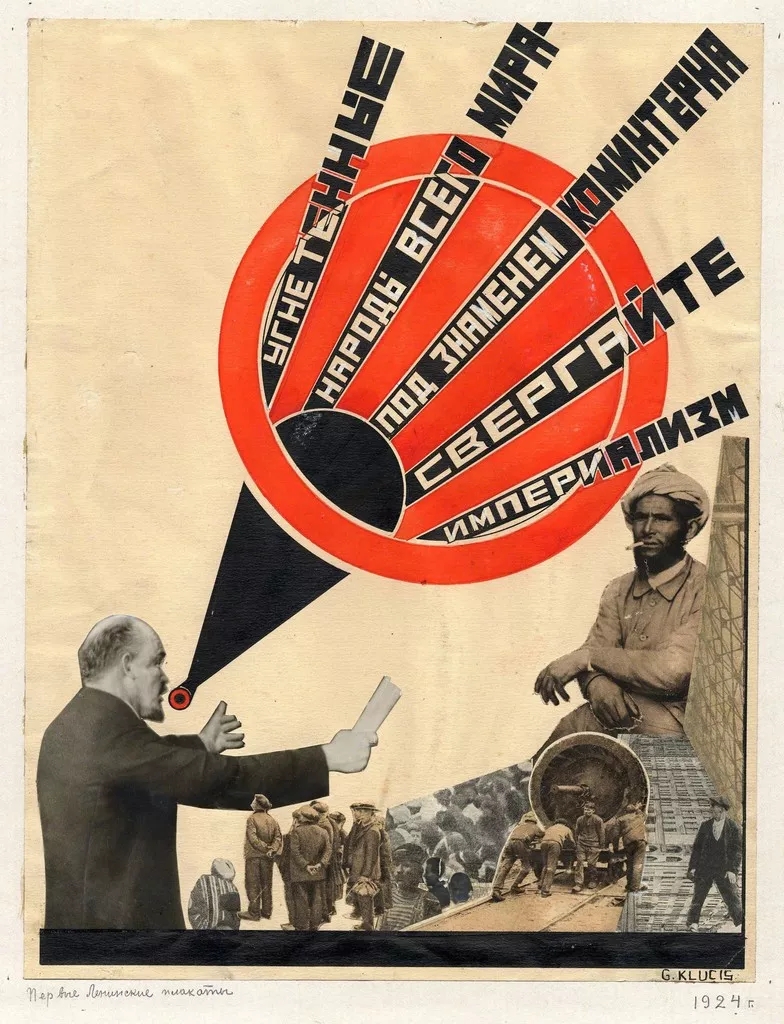
“The oppressed peoples of the whole world, under the banner of the Comintern, overthrow imperialism!” Soviet poster by Gustav Klutsis, 1924. Shamelessly nicked from @sovietvisuals.
I went to Moscow early in 1923 as British representative to the Communist International, or the Comintern as it was called more briefly. I was a bit diffident about accepting this job because I regarded myself as an apprentice in Communist Party work. My wife and daughter came with me and I left my two sons with my sister, so the arrangements were quite good. I liked the job very much. I was living in the heart of the revolutionary political world. I was meeting people who knew much better than I the main world political events and could interpret them much better. I was taking part in discussion with leading working-class politicians from all over the world, all with their special problems, and if at times I could not make a contribution at least I could listen and learn.
In the Comintern I did a fair amount of foreign work. Because I had a British passport, I was better able to cross frontiers and move about freely than many of the other foreign representatives. At this time, the Comintern was very much in its formative period and the communist parties of the various countries had serious conflicts of opinion on many political questions. There were many commissions in the work of the Comintern, trying to smooth the way and deal with the problems.
Troubles had grown in the Swedish Communist Party and the Comintern sent a delegation of which I was a member to help to sort things out. In Sweden I was known as Comrade XR (Executive Representative). Half the Swedish party were really right-wing social democrats, both in theory and action.
The party was led by Seth Hoglund, a social democrat who certainly put no R in revolution but had a very good anti war record. The party was split in two; the left-wing section was the more aggressive and was able to retain control of the party paper. Hoglund was a likeable chap, not in any way vicious but a true social democrat and for quiet, steady reform. The leadership afterwards passed to Samuelson and some others, but they too quarrelled and some left the party.
At this time Scandinavia was very important. Politically, despite some setbacks, the left forces were making good progress. There was also another practical reason. The Norwegian party had a good standing among the seamen, which enabled comrades to get across the seas illegally. Bill Gallacher, Sylvia Pankhurst and a number of others crossed the North Sea in this way. Irish sailors did the same before Eire became a state, ready to smuggle people across on the Irish boats. De Valera was got out of Lincoln Gaol and smuggled across in this way.
Many people with whom I worked and whom I met during my time at the Comintern are now dead. A few are still alive. Some made their political mark, some dropped out of political life in the development of the struggle, because being a Communist in politics is never easy, no matter in which country you are domiciled.
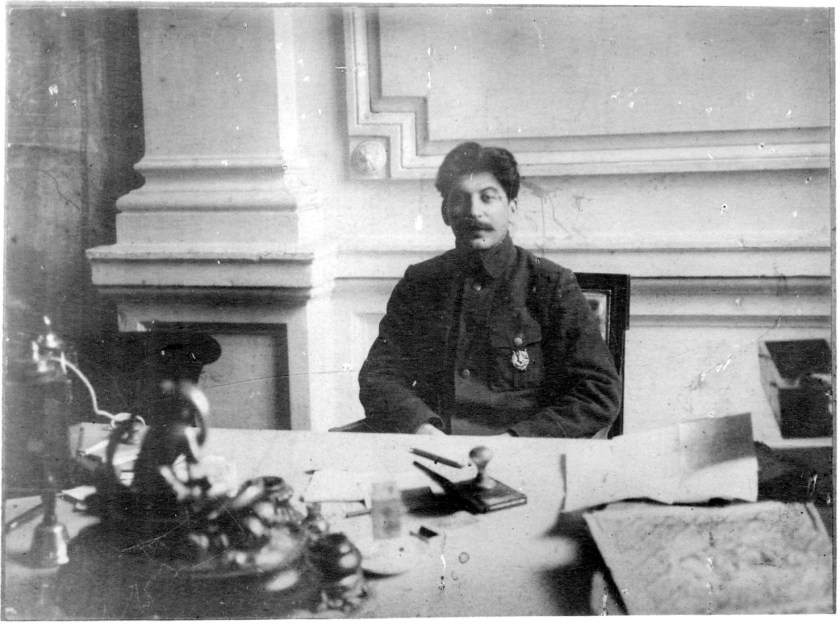
Stalin in the early 1920s- “quiet, painstaking and efficient.”
Naturally the reader will ask what I thought of Stalin. I always speak of people as I find them. I worked with Stalin on a commission on Germany after the defeat of the German party in 1923. I found him a quiet, painstaking and efficient chairman. He chaired the commission which was composed of members from all parties resident in Moscow and from the Russian party, which was represented by Kuibishev, who later became Minister for Planning in the Soviet Union. The discussion in the commission went on for weeks, and one interesting point was that after every session the delegates and their interpreters met singly with Stalin to make sure that if they had not spoken during the discussion, he would be aware of their views. In this way I had several talks with Stalin. I remember that one particular discussion he and I had dealt with the way in which the German party central committee worked. In my opinion there was too much bureaucracy and I said that certain changes in work should be considered. The Comintern could not enforce changes, since the national parties were independent; but the Comintern could, and did, make suggestions. At the end of our tête-a-tête Stalin made a number of pointed remarks and agreed with me on the need for change, but there was a great battle of personalities in the German party at that time. The need for unity was so important that one had to cut the suit according to the cloth and not seek changes that might possibly widen the division.
This commission usually started work about midnight. As a rule I was getting ready for bed when the telephone would ring, and then it was down to the Kremlin for an all-night sitting. They did not rush it, these people. Many of the Kremlin lads were long-distance men. I remember one night Terricini- the delegate from Italy I think his first name was Angelico, but he was certainly no angel -was delivering his point of view in French and doing it very well. He had been at it for over an hour and a half when Stalin intervened to say,
“Tovaritch Terricini, French is a beautiful language to listen to but it is now three o’clock in the morning.” Terricini nodded to show he had heard and then continued with his speech, as if no intervention had been made.
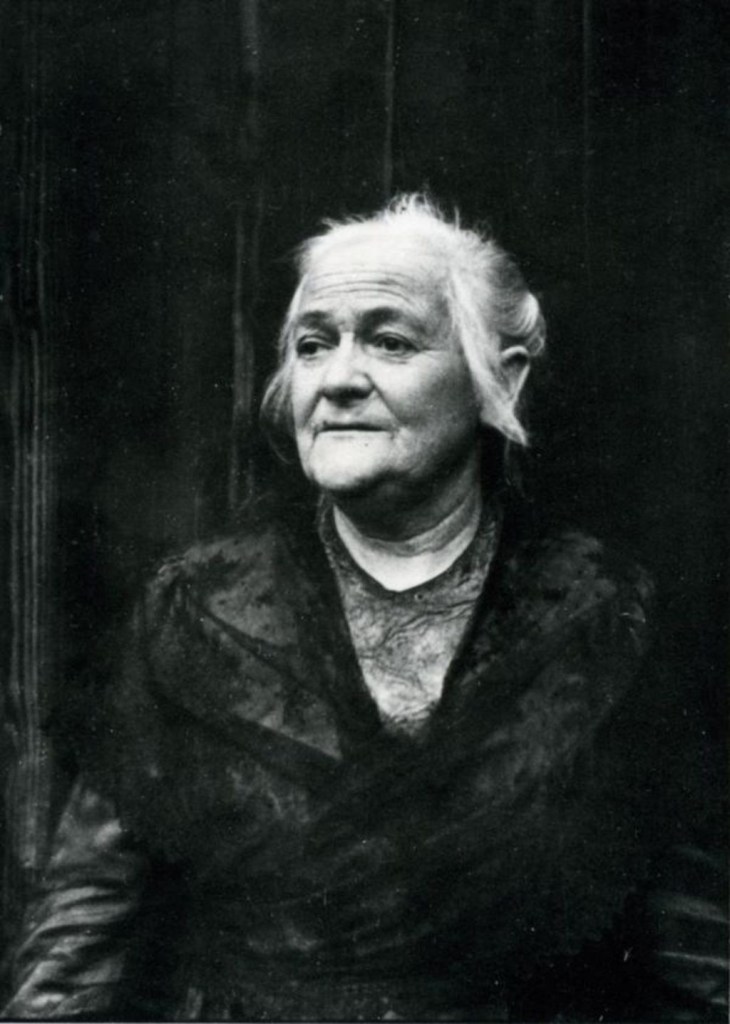
Clara Zetkin
During this German commission discussion, some leading members of the German party went after Clara Zetkin; they baited her unmercifully and this really sickened me. It was an exhibition of political cannibalism that should never be tolerated in working-class politics. Clara Zetkin may have had some weaknesses and faults we all have but she had many decades of selfless working-class struggle behind her and a great reputation both in the international communist movement and in Germany. I protested vigorously against the manner in which some of the German comrades were acting and, with several other delegates supporting me, Stalin said, “We hold a high opinion of Clara Zetkin, our Russian women have learned much from her work, and we will not permit this type of vilification.”
Radek was another member of the Comintern with whom I worked in close association When the first Labour Government was formed in January 1924, Radek, Theodore Roth-stein, Clara Zetkin, some others and myself, worked on a manifesto to be published in Britain in the name of the Communist International. Radek was the most remarkable reader I have ever come across. He had an insatiable appetite for newspapers and had a wide and fundamental knowledge of world politics. Lenin’s criticism of Radek was that he read too many bourgeois newspapers and I think he inferred that Radek was influenced by them. But Radek was most helpful to me. He was also a humorist with a ready answer to any question. He wore long side-whiskers, like the Ancient Mariner, but one day when I met him they were shaved off. “Oh, what’s happened to the growth?” I asked. “Got to go to Germany so I must have a disguise,” he replied. Another time when I was having a difference of opinion with Walton Newbold, who was once Communist M.P. for Motherwell, and was lamenting about it, he said, “Never mind Newbold, Bob, he not only sits on his arse, he sits on his brains as well.”
Kamenev, Zinoviev and other leaders of the Soviet party, Dimitrov from Bulgaria, Pieck from Germany and many others from other countries, I met both at work and socially, but as a rule the discussion was mainly political. I never found it easy or even practicable to discuss everyday “common-place” happenings through an interpreter. Language to me was always a great barrier and I am sure it is for everyone.
Radek was the one who spoke all languages. I heard him speak and communicate with ease with people of many nationalities. I never knew how many languages he spoke. He was a Pole by birth. He once said to me, “Bob, there are good Jews and bad Jews, and the worst of the bad Jews are Polish Jews and I am one of them.” I don’t think the part about Polish Jews is right, nor in my contact with Radek was it true of him. In Moscow, in all his work with me, he was a most able and helpful member of the Comintern.
Photographs by Henry Sara from Bob’s time in Moscow including some from the school he mentions here. See the ‘Comrades: Henry Sara’ post for more information.
Naturally, apart from the leading comrades I got to know in the course of my work, I also met the ordinary Russian people. A group of Russians I got to know fairly well consisted of teachers. This happened somewhat accidentally. One day my wife and I were having a walk in the suburbs, and as we passed a school the children were coming out. Some of the children, observing by our dress that we were foreigners, asked us questions. When they found out that we were British, a number of them had to try out their English on us. Because of this incident we became very well acquainted with the school and the teachers. I took any English delegations that came to Moscow to the school, and through this the pupils became the proud possessors of footballs, boots, sweaters and other sports equipment. I found the children most friendly and com-paniable, with no sullen shyness, and the teachers were born to their jobs aunties and uncles they were called. The school owned a huge boar, a real Goliath. One day I said to one of the children,
“Big boar.” “Da, bolshoi -bolshoi Curzon!”
(Lord Curzon was the most notorious anti-Russian British statesman of the period, the originator of the attempt to enforce the Curzon line).
Another school I used to visit was a school for musically gifted girls. The teacher was the first flautist of the Bolshoi Orchestra. The children gathered round in the most natural way and sang and played spontaneously, everything from folk drama to grand opera. Watching these girls, I began to realise the inborn musical understanding and appreciation of the Russian people, which has endured for centuries.
I remember the first time in my life I heard community singing. It was at the Agricultural Exhibition in Moscow in 1924 I was wandering around with Jim Larkin, the leader of the Irish Transport and General Workers’ Union, and we saw some people congregating near some seats. We strolled over to see what was happening. Out comes a fellow with a corduroy jacket and a pair of high boots curled up like a concertina. He stepped on to a small platform and started to sing, and away went the audience in wonderful community sing-ing. I couldn’t follow the words but there was no mistaking the real genuine feeling and natural musical ability of the crowd.
For the citizens of Moscow, however, it was not all singing and playing. Moscow was a political city, everyone talked politics. Even in the armed forces, the aim was to have politically understanding soldiers, sailors and airmen. Our party was a patron of some Russian regiments, and so got to know the officers and men. It was this political consciousness on the part of the Soviet soldiers, brought about by intense political discussions of day-to-day events, that created the understanding of the necessity to fight for the independence of the Soviet Union and the determination to crush the Nazi invaders in World War Two.
On the political side, I naturally attended conferences and meetings of the Russian Communist Party, and met with Russians from Stalin downwards. What struck me from the beginning was the business sense of the Russian political workers, very few of whom were business men. In these early days of Soviet rule, blacksmiths, mechanics, textile and other workers were pitchforked into top political jobs and had to adapt themselves to new work, sometimes dealing with old managements in production and, more important, themselves forming new managements in the big new factories. I remember Milnechesneski, who was an ordinary worker, telling me one day he was the biggest textile owner in the world -he had just been put in charge of the cotton textile industry.
In the countryside, many of the peasants were illiterate but, of course, while illiteracy is a great disadvantage, it does not mean lack of intelligence. The Russian peasant, who was intelligent enough to revolt against -and end serfdom, was also intelligent enough to combine with the Russian working class to end capitalism and also to end illiteracy among the peasant masses in the Soviet Union.
It was during my time in Moscow that a great tragedy befell the international working-class movement.
Lenin died in January 1924. I remember this well because I was then a member of the Executive Committee of the Comintern which was summoned immediately: firstly, to hear the announcement of Lenin’s death and also to make all the necessary arrangements for the funeral.
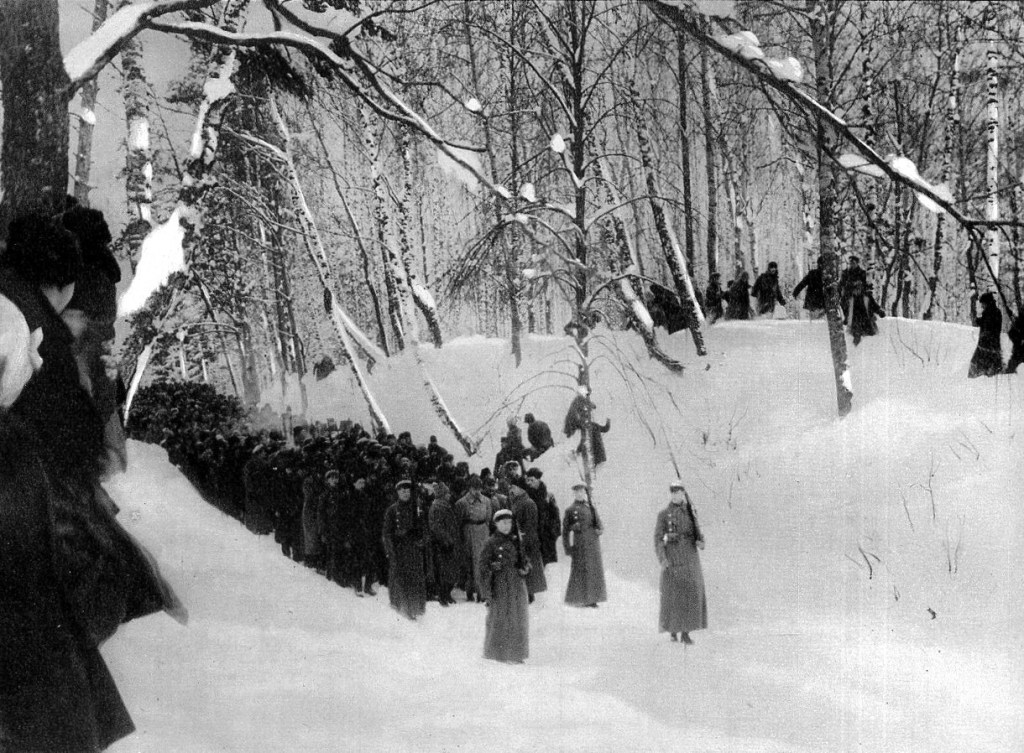
Harry Pollitt came over immediately from Britain to represent the British Communist Party at the funeral. It was desperately cold and both Harry and I felt it very much. It was forty degrees below zero. Fires were kindled in the streets and I remember seeing the militiamen’s horses going over and sticking their noses in the fire to melt the icicles. We were as cold as the horses but at least we could pull down our fur caps and peer out occasionally to see where we were going.
I was one of the delegation of the Comintern chosen to go to Gorky, where Lenin had died, to accompany his body back to Moscow. We left by train from Moscow at about 5am and then travelled by peasant sleigh from Gorky Station to Lenin’s house. From the station you could see the house down in the valley, but the road to it so twisted and turned that even by sleigh it took us a long time to reach it. At the house Lenin was laid on a bed wearing an ordinary Red Army man’s uniform with the Order of Lenin pinned to his breast. The house was full of people: leading members of the Russian Communist Party, of the Comintern, delegates from the factories and the professions, and amongst them all wandered a big black cat who had been a very great favourite with Lenin.
Lenin’s body being taken to Gorky station en route to Moscow.
The body was placed in the coffin and carried to the station en route for Moscow. Leading men from the party and the factories took turns to carry the coffin. On the journey, at every station, on the way, thousands of people waited to see the train pass. I do not think I ever saw so many tear-stained faces in my life. It was a very moving demonstration of the love the ordinary people for this great man.
When we got to Moscow I realised for the first time in my life what a mass demonstration really meant. Not a demonstration that was called, but one that came. Every conceivable foot of space was occupied. A great mass of people followed the coffin as it was borne from the station to the Dom Soyus (Hall of the Trade Unions), and from every side street and opening, mass upon mass of people converged with the main stream or waited their turn to do so. At the same time the digging was proceeding on the site of the mausoleum, so there was blasting and picking going on. All these streets were crowded with sad-eyed mourners. Every shop and hotel and all central places were ordered to keep open twenty-four hours a day so that people overcome by the cold could go in and thaw out.
Crowds at Lenin’s funeral. January 1924.
Moscow has witnessed many varied scenes in her many centuries of troubled history; her ancient records must be filled with historic incidents, but never had such scenes been witnessed as during the days of Lenin’s lying in state and funeral. The Dom Soyus, a former palace of nobility, once the setting for the glitter and pomp of the aristocratic Tsarist circles, was the place where Lenin lay. Here his own people, the working masses of Russia, could pay their last tribute to the mighty leader of the Russian working class and the world proletariat. “Our Comrade Lenin” everyone said, as if he were a father or a brother.
For four days and nights, for mile after mile, people queued four abreast to pass the bier on which Lenin lay. Along with Harry Pollitt I took a turn on the guard of honour. I remember I was with Chicherin. The bier was surrounded by wreaths of flowers of every description, sent from all over Russia and indeed from all over the world. The magnificent hall with its white marble walls was a blaze of light, contrasting with the deep varied hues of the flowers, and on the balcony the band of the Red Guards played music befitting such a solemn occasion.
Delegations from all over Russia streamed into Moscow, joined the endless queues, and placed their wreaths as they passed the bier. But there were no kings or queens, no aristocrats and their ladies, no great admirals or field marshals with glittering medals. Only the endless stream of workers and peasants, soldiers and sailors with their wives and families. The queues never seemed to get less. Over a million had passed the bier and still the queues remained. It had been decided that on Saturday the doors must close at 12 noon. But on Saturday afternoon there were still hundreds of thousands of people waiting with banners and wreaths, still train after train arrived, pouring the delegations into Moscow from north, south, east and west. Every minute messages from all over the world came, telling the world-wide grief at the passing of this great working-class leader. Certainly, no king, no emperor, no bloody tsar has been honoured as Lenin, the leader of the world working class.
At 7am on Sunday came the final parting. Around the coffin stood the leaders of the Russian Communist Party and the Communist International, and with them, keeping her last vigil, was Krupskaya, Lenin’s wife and constant companion during thirty years of struggle. Lenin’s body was borne to the Red Square. As the coffin was raised the orchestra wailed the funeral march. After this a moment’s silence, then the International burst out, strongly and boldly sung. I thought then, this is the answer to the enemies of Leninism whose death was rekindling the hopes of new triumphs for imperialism. this is the answer of Lenin’s pupils, the Russian workers and peasants.
As the coffin was carried into the streets, crowds formed behind it. Leaders of the Party and trade unions took turns to shoulder the coffin along the Kremlin walls to the centre of the Red Square where the raised tribune was placed. The people filed past in millions until 4pm. Then silence just before the cannons crashed out the salute with a roar which could be heard in every corner of the world; factory sirens in every Russian city and village took up the salute; men, women and children stood still in silent homage. In every country throughout the world the workers paid their last respects to a great leader, who from small groups of Marxists had led the Russian workers forward to the formation of a mighty Communist Party and a mighty workers’ Republic and had laid the foundation by his leadership for a mighty Communist International.
The coffin was carried into the Mausoleum, Lenin’s final resting place. Queues formed again to pass the bier. It went on all night, all the next day and every day since. the years have passed and still the Russian workers and peasants and the visitors to Moscow from foreign lands pass the bier to pay homage to Lenin, the great working-class leader whose genius guided the people of downtrodden Russia and millions far beyond it, to break their chains and march to the not-so-distant communist society





 Breaking the Fetters