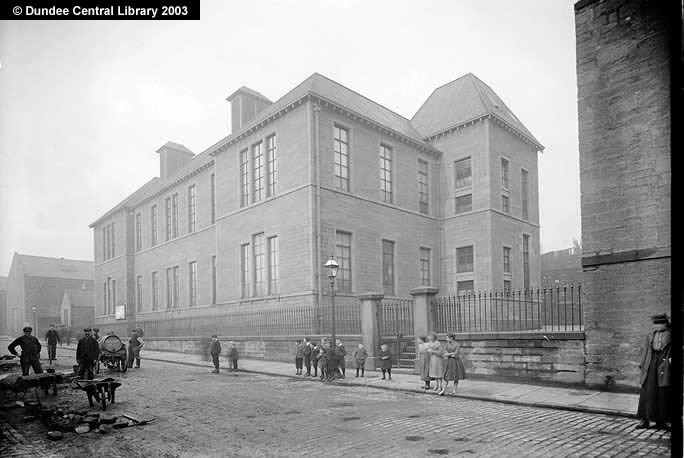
I went to school when I was seven years old. It was in the period that free education became law. Just before then, the fee was 1s. 1d a quarter. I was there until I was ten years old.
I can vividly recollect my first two teachers. They were sisters named Shaw. The elder was in charge and we nicknamed her “Tattie Shaw”. She had a thick black strap which she wielded with great power. I knew because I sold newspapers after school hours and to get quickly on my paper round, a necessity both to get the work done and to get the maximumm time for play, I climbed the school railings for a short cut. When caught I felt the full weight of the black strap brought down sharply on my bare hand. Still, I knew the newspapers must be speedily dispatched, so I continued in the fear of the black strap for many a day.
I remember another time when the strap tingled my fingers. A boy in my class named Tammy Soutar was my back neighbour one day. All pupils stood back to back when doing sums. Tammy was a very stupid fellow and as I finished my sums he asked me what to do. I said “swap slates” but, when caught, I was the one judged unable to do the sums and so I was punished for copying from Tammy Soutar. I was sure then there was no justice in this world.
Many years later, when my wife was canvassing for me at a municipal election, she knocked at “Tattie Shaw’s” door. She was invited inside, given a cup of tea and a donation with the request to keep it secret as the opposing candidate was also an old pupil of hers and a lawyer to boot.
When I reached ten years, in the natural course of events I became a half-timer. Monday, Wednesday and Friday at work, Tuesday and Thursday at school. The next week vice versa, but Saturday work till 2pm. This was law. When you reached thirteen you could leave school, if you had passed fifth standard. If not you had to remain until you were fourteen. At fourteen you left, no matter how uneducated or daft you were.
This meant working three days one week and two and a half the next. A short week’s pay was 2s 9d and a long week’s pay 3s 4d. In the spinning flat where I worked we sang:
“Oh dear me, the mull’s gaein’ fest,
Pour wee shifters canna get a rest,
Shifting bobbins coarse and fine,
Who wad work for twa and nine”
And work we certainly did. From six in the morning till six at night with two breaks for breakfast and dinner. Breakfast at 9am to 10am. Dinner at 2pm to 3pm.
I was a shifter in Mitchell’s mill. My work was to shift the full bobbins off the spinning frames and put the empty ones on. I remember my first day very well. I was so busy cleaning out the waste from under the machines I did not notice that the other lads had gone, so I got locked in. Many times in my life I have been involved in “lock-outs” and to be locked in on my first day at work was not a very significant start. I banged and banged again on the door, shouted at the top of my juvenile voice, but with no result. Fortunately for me it was Friday and the lads came back to clean the machines, so I was released.
At the mill I had an interesting “gaffer” (foreman), Jock Carey. He was a striking man, powerfully built with a big red beard. A typical Hielandman, I always thought.
The cleaning out of the jute waste under the spinning frames was done when the power was off. That meant we were expected to do it during our break. We devised a few tricks to get this done at times other than the break , keeping the break for our leisure time. One of the tricks was to set the waste on fire and put the power off. I became adept at these tricks, and after getting the cleaning done would dash off in the break on my own ploys.
But big Jock Carey rumbled me and soon found me another job. Every morning he bought the liberal newspaper, The Advertiser, published by the Leng Publishing House, and this he made me read to him every day. So started the daily reading sessions. Big Jock could read very well , but like many other Scotsmen he preferred other people to do his ‘work’ and so ‘Wee Bob’ became an official reader to ‘Big Jock’ . When the newspaper was not so interesting Jock brought in books and I had a go at these . These sessions gave me an appetite for reading and an appreciation of the written word that has never left me. It gave me a profound grounding in the art of expression which has stood me in good stead countless times in later life.
Apart from my half time job, I had another job ‘on the side’. I went out early in the morning wakening people for their work. This was done by knocking on their doors and I was called a ‘chapper’. There were no alarm clocks in those days, and many workers were glad of such a service because to be late for work meant loss of wages. I knocked on the doors with a mallet, or ‘mellie’ as we called it. A number of boys did chapping and woe betide any stranger who trespassed on our terrotory. If someone did we would hide in a dark alley with a well laden treacle-scone and push it in the trespasser’s face.
We charged twopence a week for chapping. anyone who missed paying it would not be chapped. Nor could they expect to cash in by hearing the chapper knock the next door neighbour. We covered our mellies with our bonnets so that the only people who could hear were in the house being chapped. I remained a chapper until I finished my apprenticeship.
Chapping money was very welcome and when saved up gave the possibility of a trip out of town. I never had any holidays but my pals and I had a few day trips. I remember one very well. A crowd of us had saved up our chapping money and we went to Edinburgh. I can recall the events of the day. First being thrown out of the Art Gallery for laughing at the nude statues and secondly, a rare event, having tea at a restaurant called the ‘Heave Awa”.
Most of my ’treats’ were connected with the Sunday School picnics and in the winter the ‘soirees’. I soon realised that to get the full number of picnics and soirées I had to join all the churches. So I went to the Free Kirk- this was the one to which I was supposed to belong. But I also went to the Episcopal Church and soon realised the only difference was that the English did their mumbling kneeling on hassocks. I also attended the Salvation Army, so that going to these in rotation I ensured myself of at least three summer and three winter treats a year.
The half-time school we attended was in the mill. There were two classrooms, forty pupils in each class and two teachers. One of them was adept at clouting you on the ear and as soon as your head came round she would wallop you on the other for good measure. I can’t remember if she was as adept at getting knowledge into the heads of the pupils, but like most schools we had our periodic examinations. I remember I had a ‘first’ in an examination on general knowledge. No doubt the reading sessions with Jock Carey had something to do with this achievement.
At the prizegiving day the bosses and their ladies came along to make the presentations. I was barefoot, as were all the other boys, and no doubt my clothes would be a little threadbare. I will always remember the look of disgust on My Lady’s face as she presented me with my ‘first’, a book 0f holy stories given, no doubt, to cleanse my soul.
We worked barefoot in the mill becasuse it was so hot. Some of the colder footed made and wore jute shoes which we called rovies. Because of the toughness of the jute fibre they were excellently hard-wearing footwear, and could be sold outside for a small sum. Another way of making an extra copper if you were not caught.
In the summer the school closed for five weeks. The dodge then was to present yourself for work, say you were fourteen years of age, and if you were taken on you were now working full time. When the five weeks ended you picked a fight with the ‘gaffer’, got the sack and returned to your half-time existence.
Trying to look back over the years, I must confess that half-time schooling did not result in half-time education. I can remember very little being taught in a manner which would be of lasting benefit to the pupils. I fully believe that the reading sessions with Jock Carey were of more benefit to me, and The Advertiser, being a progressive paper, may have sown good seeds. Still, to have had at that time compulsory education for worker’s children must have been progressive, and such legislation must have been near-revolutionary and a fine tribiute to the many working-class organisations in Scotland who struggled many years to enable such a breakthrough in the Scottish education system to take place.


So grateful that this is being published. Between the years of 7 and 10, I remember that I used to get up early after my mother but I was able to read the newspaper in the front room whilst she prepared a family breakfast in the kitchen. A lot easier than Bobs early years
LikeLiked by 1 person