Oh, Calton Gaol! Oh, Calton Gaol!
Sae sombre, grim and grey,
Within thy wa’s were gallant hearts,
Held captive many a day,
For they refused to bend the knee,
To tyrant’s cruel sway,
Their stand remembered aye shall be,
They stood for liberty.
Bob Stewart’s Prison Rhymes
The days wore on to my second court martial. Now I was really beginning to know the ropes. Culprits for the court were lined up outside the court-room in good time, in charge of a sergeant. There was the usual to-ing and fro-ing, standing to attention, saluting and so on. Yours truly, of course, was taking no part in the proceedings and a young soldier standing near me said, “Some funny things come up in times of war.” “No, no,” I replied. “No different from time of peace. Only different uniforms.” “You should be shot,” he came back. “Well, if I wait till you save up to buy a gun I don’t doubt I’ll have my old age pension before that.” After a turn down the line, he came back and said, “Christ! that was a good one!”
The sentence of the court conformed to regulations. “For failing to obey military order, etc., etc. . . One year’s imprisonment with hard labour ” (subsequently reduced to six months). In due course I was escorted Calton Gaol, Edinburgh , and handed over to the authorities. The authorities, by trial and error, had discovered by this time that even their notorious “glass-houses”, the military detention barracks with their “at the double” man breaking exercises, only stiffened the resistance of the objectors to military service. The refusal to obey the “lion-tamers” was having a bad effect on the other prisoners who became inclined to emulate them, and so the government made a virtue out of necessity, and a show of their “humanity”, by transferring the objectors to civil jails.
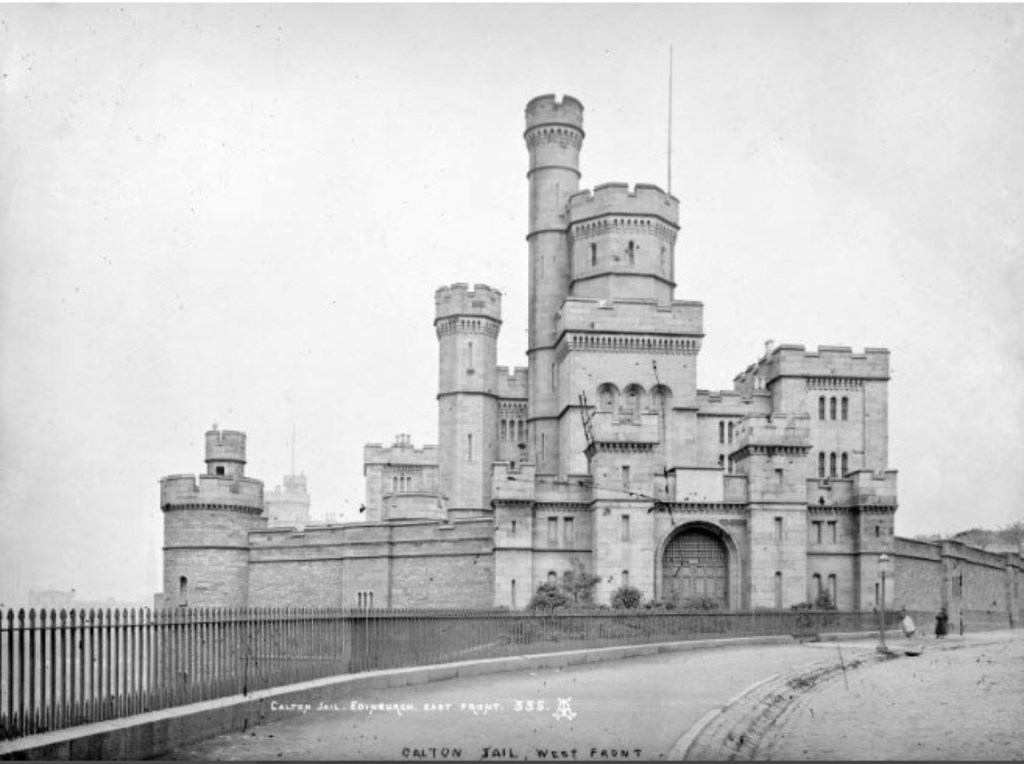
Calton Gaol was grim and grey, old and forbidding both inside and out. Reception was not quite so noisy as the Scrubs. I remember the warder fussing around, listing the King’s property in my possession, which tended to get less and less as I passed through the guard-rooms where other soldiers were
always short of kit.
“Whit’s your size in buits?” Try them on. “Have you had a bath?” Oh, aye, you look clean. “Where’s your moleskins?” In Scottish prisons the dress includes moleskin breeches tied at the knees with tape, long stockings which never matched, rough cotton shirt (Kirkcaldy strip to the trade), moleskin jacket, glengarry cap, and of course a badge with hall and cell number. “Oh, Stewart, whit’s your religion? “I haven’t any.” “Ye maun hae a religion, a’body has in here.” “Well, here’s one that doesn’t.” “Well I’ll just mak’ ye a Quaker, there’s a lot o’ your kind Quakers.’ So down on my cell card alongside age, height, etc., goes Quaker. Now comes the chaplain. What are you in for?” “Me? Twelve months.” “That’s not what I mean. What have you done?” “Oh, I refused to do anything.” I think he then began to tumble to the position so he went outside and looked at the card. “I see you are a Quaker.” “Not me, I neither quake nor shake.” “It says so on your card.” “Ah yes, I had a soldier’s suit on yesterday but
that did not make me a soldier.” So ended the spiritual ministrations and Quaker was crossed out and atheist inserted in a bold hand.
A favourite prison tale is told of this chaplain, who was alleged to be fond of a
“wee drap”. One of his congregation became suddenly religious and requested the chaplain to read a bit chapter to him as he had no glasses. This the chaplain
did with great pleasure but he was not so happy when he heard the convert’s explanation–that next to the taste of rum the smell can be comforting.
To supplement the swashbuckling sermons of the professional chaplain who wielded the Sword of Gideon over us on Sunday mornings, we had a diversion to amateurism on Sunday afternoons with an Evangelist; accompanied by a lady
organist.
Here is the routine. When the fleshpots were removed after dinner came the order: “Stools down to the Hall for Bible Class!” Down we clattered to the Hall, and set our stools, spaced well apart to avoid conversation between prisoners (it
did not!).
Mr. Bannerman the preacher opened the service with prayer (that was a signal for whispers). Then came a hymn accompanied by a wheezy harmonium. A bit doleful, but it revealed to me where the griddlers, back court and street singers had received their training. Then the prisoners recited texts from the Bible, still more doleful, but it gave the prisoners a feeling of participation which they enjoyed. Then a short sermon, a bit weepy. Another hymn or two, then an announcement that anyone who recited the 15th Chapter of St. Luke without a mistake would receive a Bible on release. On my second Sunday I gave St. Luke full voice! I got that Bible when released.
There were always “Conchies” passing in and out of Calton Gaol, many of them religious, who enjoyed reciting texts. I thought I might diversify the service a bit, so started to quote the poets: Tennyson, Burns, Shelley. Other “Conchies” soon followed suit with their favourites, from Omar Khayyam to Walt Whitman. It got too much for Mr. Bannerman, who said we must take only texts from the Bible. I think he had been taken to task by his superior. After that we had a bit of difficulty in persuading some of the lads not to utter some of the rather bawdy texts from the Good Book which might offend the lass at the music box.
One Sunday we had visitors from outside to see what we looked like. As usual the texts were invited. After a few regulars had said their piece I took a turn with: “Woe unto you Scribes and Pharisees–Hypocrites” etc., etc! That tore it! I think the visitors were taking it to heart. The outcome came the next Sunday when Mr. Bannerman told us we were getting into a rut with our texts, so we must take them in future from the 19th Psalm, which had plenty of verses, but it was deadly dull. So I tried my hand at making my own texts. They sounded much the same, and there were no complaints.
One day I was sitting in my cell at Calton when the door opened and in comes the warder. “I wonder at you, Stewart,” he says, “all these nice people who come to see you, your wife, your wee lassie and the others, all such nice people.” “Well, what of it?” I asked, puzzled. “On your card it says you are
an atheist and I thought all atheists were thieves, robbers, devils or whoremongers.” “How many atheists have you in this jail?” I asked. “Only you,” he answered. “Well, if all the others are Christians it doesn’t say very much for Christianity, does it? So the poor old joker went out, locked the door and made off quite confused.
It was in Calton Gaol I first heard of the March Revolution in Russia. One day I was going round the exercise ring when in beside me came my old pal Dave Donaldson who had just been convicted again and given another dose. “There’s been a revolution in Russia. They’ve set up Workers’ and Soldiers’ Councils,” he whispered. “There will be a revolution here in six months.” “Hae ma doots,” I said, but the warder put an end to our observations on this epoch-making event.
Time marches on. Sometimes much better than the army. My time came to an end, and I was sent for by the chief warder, the Governor being away. “Well, Stewart,” he says, “you are to get another chance to shoot the Germans.” “Look, brother,” I replied, addressing him in good trade union language, “if
ever I take it into my head to go shooting it won’t be Germans I’ll be looking for.” “And who will you be looking for?” “Warders.” And with that I moved to my third court martial.
 Breaking the Fetters