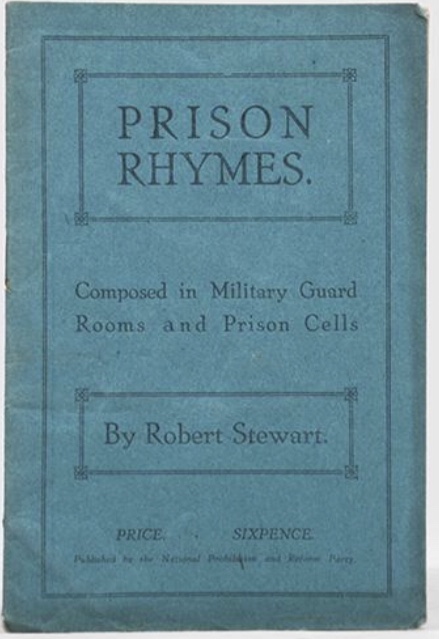
“…the author of these verses -Mr Robert Stewart- the man of lucid and terse prose, the very matter of fact economist, having the leisure of the prison cell thrust upon him, turns to Rhyme, and with apt and happy effect expresses not merely his hatred of War, but his whole-souled antagonism to the basic cause of War. Because of his trenchant condemnation of the Capitalistic system and of the Capitalistic Governments whose machinations had inevitably produced the terrible holocaust of death, Mr Stewart was arrested in December 1916, and remained imprisoned in guard-room or gaol until April 1919. But stone walls and iron bars can only hold the body captive, and the spirit of the man never flinched and never faltered-a fact that may be gathered from a perusal of his verses. two passions seem to me to inspire them all-a passion of veneration of love for humanity and a passion of hatred towards every circumstance, convention and condition which operates to the detriment of the human race.”
G. Anderson from the Foreword to Robert Stewart’s Prison Rhymes (1919).
When the First World War began Bob Stewart spent most of his energies agitating against it. By 1916 the government had passed the Military Service Acts which imposed conscription on all males of military age with few exceptions. Eventually, Bob was called up to fight. He refused and so this led to a series of court martials and a large amount of time spent at his majesty’s pleasure in Wormwood Scrubs, Calton Gaol, Edinburgh Castle and Dundee Gaol. He was eventually released in 1919 several months after the end of hostilities.
Surviving copies are rare and few come up for sale. I saw one advertised at the end of last year but £650 seemed a bit steep and I didn’t have it spare. In the late eighties my brother rang up the Communist Party of Great Britain to ask if they had one and they kindly sent a photocopy which is the only version we’ve ever seen. I imagine the original is now in the People’s History Museum in Manchester with the rest of the CPGB archive.
For the most part the poems are written in Scots dialect and are largely concerned with protest, socialist agitation and reflections on the isolation of prison life. I’m not making any great claims for the collection as poetry but it is a good example of popular socialist pamphleteering . It was published in 1919 in order to raise funds for Bob’s party – the Socialist Prohibition Fellowship (formerly the Prohibition and Reform Party). As Bob explains in his memoirs:
“…meetings packed out Sunday nights in the Foresters Hall. They were always packed out, with hundreds left outside. Invariably there was a queue to get in an hour before starting time to make sure of a seat. my Prison Rhymes now became a best seller. So with the money from the collections and the booklet we were doing very well financially.”
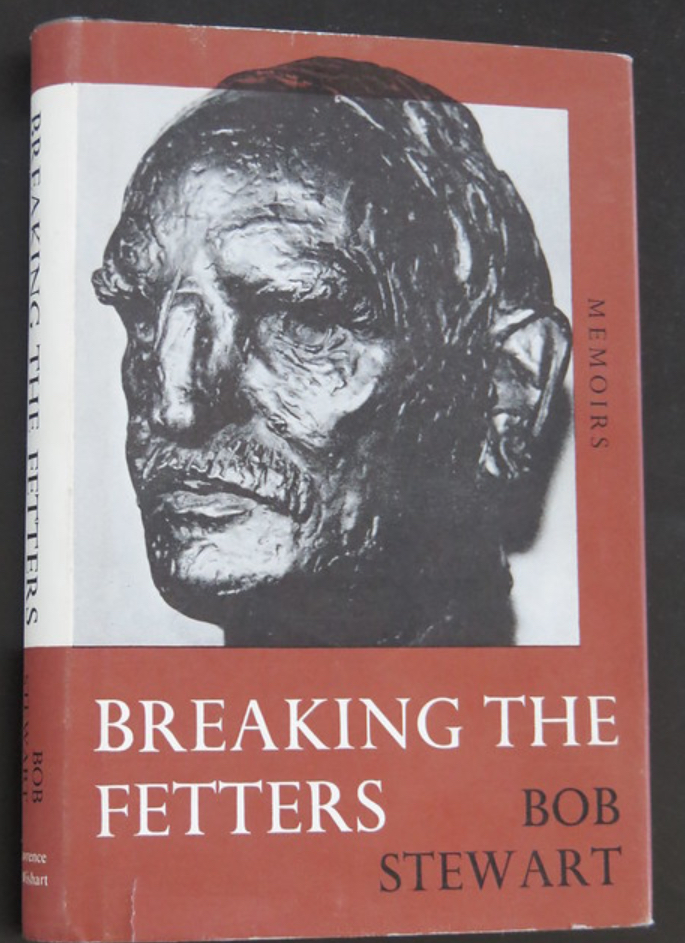
Bob Stewart, Breaking the Fetters, Lawrence & Wishart 1967
I’ll be posting some of the poems on here over the next few months. The first one, ‘Little Nan’ is about Bob’s daughter Annie Walker Stewart or Aunt Nan as my father knew her. She would have been six at the time of publication and the poem reflects Bob’s sadness of being separated from her for most of the preceding three years. Like all of Bob’s children she would eventually become a committed member of the CPGB though Khrushchev’s speech in 1956 together with matters closer to home brought all that crashing down.
When I started looking into my family’s past I quickly realised I knew rather less than I thought I did. Consequently, I’ve read nothing but communist history for the past eighteenth months – each successive book (most of them red and with the obligatory hammer and sickle on the cover)- pushing me forward into new directions and new avenues to explore. A lot of the reading has been deathly but some of it has been a joy. Finding out that The Daily Worker used to carry a cartoon strip for children featuring the character of ‘Micky Mongrel the Class Conscious Dog’ for example, was a particular highlight.
“Child communist readers were treated to seeing ‘Micky’ in a variety of activist roles, whether ‘whitewashing’ communist political slogans, leafleting, picketing outside the dog biscuit factory, or fighting a range of class enemies that included the boss ‘Bertram the bulldog’, the reformist Labour leader ‘Lionel lapdog’, or the headmaster ‘Mr Mastiff’, who just happened to be very fond of wielding the cane.”
(Thomas Linehan, Communism in Britain 1920-39: From the Cradle to the Grave, MUP 2007- page 36)
I’ve found that you need to come across gems like this to keep you going when you’ve come across the phrase ‘dialectical materialism’ for the umpteenth time. However, although an understanding and knowledge of communism is vital to this project, it is first and foremost, a work of family history. In this respect, Alison Light’s Common People has proved to be an important and inspirational text. Light’s name cropped up a few times in the research I was doing. She’d edited Raphael Samuel’s posthumous ‘The Lost World of British Communism’ and provided a foreword for Yvonne Kapp’s autobiography and so that’s how I first came to this book which focuses on her own family story and reflects on the process of immersing yourself in the past. Prompted by the death of her father, it is her investigation into her ancestors starting with her grandparents. Beautifully written throughout it becomes a memorable evocation of the lives of working people over the last two centuries.
There are two moments I’d like to draw attention to and quote at length. Here’s the first:
“Secrets and lies are a staple ingredient of family history. Every family has its skeletons in the closet, its black sheep, the children born the wrong side of the blanket, the fortune swindled, the prison sentence hidden. The stories of poorer people and migrants are especially likely to unravel or be full of loose ends: disappearing husbands and wives, children left behind or brought up by relatives, relationships that were never officially registered, trails that go cold. As a ‘family detective’ the family historian expects to track down the facts about a person, follow the plot of a life and unveil the truth behind familial myths. In the record offices in Britain I got used to hearing other researchers relaying their family legends. In the cloakrooms or lobbies, over paper cups of vile instant coffee from the machines, another fevered searcher, high on an archive hit, would buttonhole me like the Ancient Mariner, and I would listen, slightly glazed to yet another astonishing revelation that meant so much to the teller and next to nothing to me.”
(Alison Light, Common People, Penguin 2015- page 128)
I recognise myself as the buttonholing researcher here- far too many times I’ve done the same thing over the last year and so I’d like to get my apologies in early. On this blog I hope the material we uncover will be of interest to as many people as possible but both my brother and I are aware that it could just be us two that find all this endlessly fascinating. However, if that is the case it’s still enough. The way each new discovery resonates and shifts our perspective is reward enough. As Light observes:
“Family historians are always stumbling over uncanny coincidences. Magical thinking is part of our stock in trade. The place once unbeknownst to us, or which we passed heedlessly every day, suddenly becomes luminous with significance, uniting disparate people and random moments, making them radiate and rhyme. Since family history moves in a psychological dimension, it is always plangent, resonating with loss, and coincidences are like ley lines mysteriously transforming the map of time. Such discoveries find pattern and meaning in what otherwise threatens to be mere accident, but they also seem to offer evidence of commonality. Family history knows that everyone- and everything- is ultimately, and intimately, connected. And there is truth in this.”
(Page 249)
My hope is that the articles we post here will ‘offer evidence of commonality’. That what is particular to our family history will resonate with others. After all, everyone and everything is connected.
As I explained in the previous post I had been putting off reading Bob’s memoirs for quite some time fearing they would be the grim ramblings of an old tankie. Thankfully, he turned out to be very good company and an early indication of this occurred when he recounted his experiences in South Africa. Shortly after he married his wife Margaret in 1902 he was looking for work and finding very little. He heard of opportunities out in Pretoria and Cape Town and set out for a new life. His first night in Pretoria marked his experience of the whole country.
“I was out with my two pals, Henderson, the fellow who had sent me my fare, and another called Scott, who had also came from Dundee. We were walking along the street when we came to a junction and met some Africans coming up the other street. They were big fellows and going on quietly, minding their own business. Suddenly, Henderson, who was a quite a small fellow, about five feet three inches tall, lashed out with his boot at these Africans and kicked one to the ground. I reacted by taking a swing at him and clouting him on the jaw, then demanded to know why he wanted to kick a man like that. He gazed at me in amazement…I got a lecture on how the black man must be kept in his place and all the blah blah that we are so familiar with at the present time. But the lecture had no effect on me. I could not understand the line of reasoning…”
The racism in South Africa disgusted Bob as he explains, “I very soon discovered that the colour bar in South Africa was not only an idea in some people’s minds. It was a way of life.” Segregation- even down to separate black and white temperance lodges- he regarded with horror. The ‘present time’ he talks about was the late sixties where growing opposition to apartheid, the Civil Rights movement in America and the debates around race relations in Britain were increasingly taking centre stage. Bob’s reaction to his former friend’s behaviour was instinctive and right. He deserved that clout. I admire that Bob’s beliefs were somewhat ahead of their time and consistently held throughout his life. Remember, this took place in the first decade of the twentieth century. In the year after Bob wrote these words Enoch Powell made his ‘Rivers of Blood’ speech and, as dangerous and damaging to the country as it was, I’m heartened that an ailing man in his nineties would still have regarded the ideas behind it as so much ‘blah, blah.’
Sad to say, as I type these words the day after England’s defeat in the Euros, after witnessing some of the racism of some ‘fans’ on the streets and online, there is still a very long way to go.
Despite Bob Stewart – the communist spy being a background presence throughout my life I never once took my copy of his autobiography ‘Breaking the Fetters’ off the shelf and read it until my mid forties during the first COVID-19 lockdown. To be honest I’d been reluctant to tackle it for a long time fearing an unreadable droning of a stern and unrepentant Marxist-Leninist full of words and phrases that I still don’t fully understand like ‘surplus value’ and ‘commodity fetishism’. I’d imagined the kind of person who, just at the point when everyone wants to leave a three hour meeting, starts bringing up endless points of order while everyone else coughs and sighs while dying inside. It was a surprise and a relief to find that spending a few hours with him, through the years, through his printed words was, by and large, a joy. I found someone with a deep sense of justice, of compassion and who possessed a sense of humour as dry as the bar at the temperance movement’s Victory Lodge.
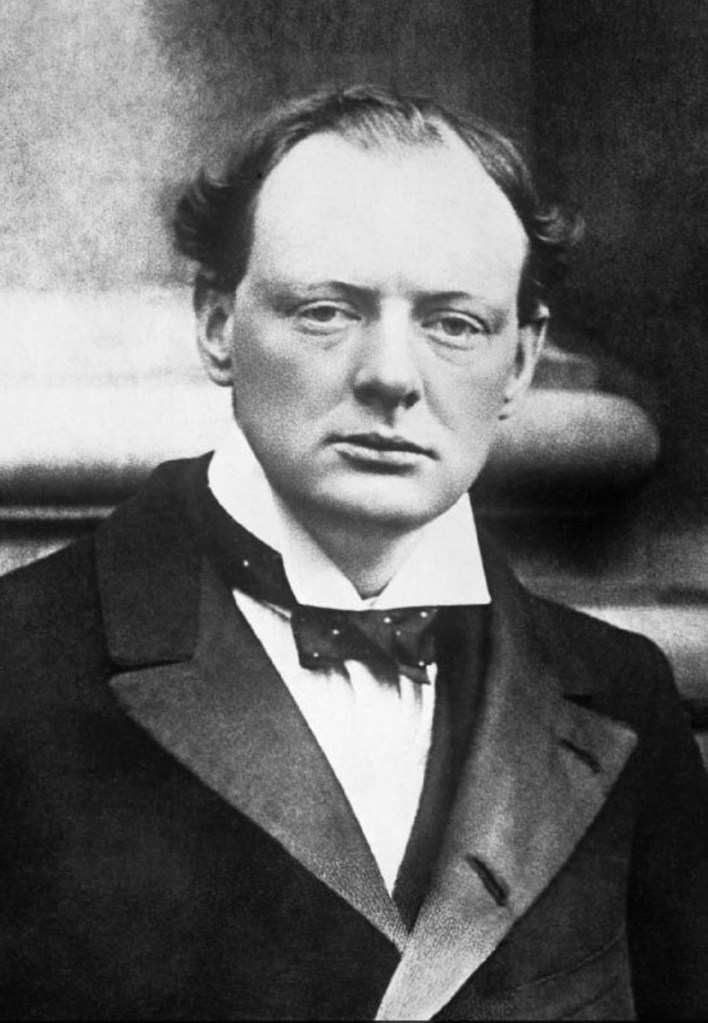
A highlight was Bob’s encounter with Winston Churchill early on in the future Prime Minister’s career. Surreally, so many years after his death, Churchill looms larger in our national consciousness now than at any other point in my lifetime. Towering historical figure he may be but he’s now revered in a way he simply wasn’t in his own time. The heavy jowelled, bulldog appearance synonymous with British grit and determination in the face of the enemy to those convinced they fought them on the beaches even though they were born in 1963 and the closest they’ve got to combat was watching ‘The Dambusters’ endlessly just because you can’t say the dog’s name these days. Voice any slight criticism of the Harrow and Sandhurst alumni and his conduct regarding Gallipoli, or striking miners in Tonypandy or famine in Bengal is tantamount to treason. There’s a whole generation of people out there who believe that the scene in ‘Darkest Hour’ where Gary Oldman in bald cap and fat suit is riding on the London Underground and a representative cross section of the population travelling with him offer him their unanimous wholehearted emotional support is literally true. But it wasn’t like that. It never is. Whole nations rarely take serving politicians to their hearts- they cause too much damage on the way. Watch the footage of crowds at Walthamstow Stadium booing the great man while canvassing for votes in the general election that followed our victory in the Second World War. Look at how decisively the electorate booted him out that year. Churchill on the 5th of July 1945 represented a return to the old way of life and he was comprehensively rejected.
Whatever your views on him however, there is one pillar of Winston’s appeal that is ingrained into the British psyche– his herculean capacity and tolerance for the grape and the grain. He was, by all accounts, a sot. One of the greatest drinkers of the twentieth century. If you locked Oliver Reed, Peter O’Toole, Richards Burton and Harris and, oh, let’s say Dylan ‘Drink Canada Dry’ Thomas together with the nation’s favourite Prime Minister in the Coach and Horses overnight I know which one would I would bet on being the last one standing when the owner came to open up in the morning. It wouldn’t be the actors and it wouldn’t be the poet. Churchill would still be there pouring himself a whiskey mouthwash and ignoring the smoking ban. So, when my great grandfather met Churchill for the first time in 1908 they were not only political opposites– the one being an advocate for the cause of the working class, the other a patrician born into the highest levels of the aristocracy- they were divided on what Bob considered the most moral question of the time – the production and sale of alcoholic beverages. The temperance movement had got Bob early and it was the damage that drink caused in working class communities that most concerned him.
Bob had recently returned from South Africa and his miserable experiences in Pretoria and Cape Town cemented his wish to fight the exploitation of ordinary working people and so he decided to go into politics full time. Up to this point he writes that his life had, “consisted of finding a job, trying to keep it, trade union work, organising in the temperance movement, speaking and debating on radical platforms and reading and trying to assimilate the new revolutionary socialist ideas.” The polar opposite of the life of an aristocratic, high Tory grandee such as Churchill. Bob became a full-time organiser for the Scottish Prohibition Party and in 1908 he was elected to Dundee Town Council where he worked to alleviate the effects of endemic unemployment and hunger through organising soup kitchens, food donations and tree planting schemes to provide much needed work. Around this time Winston Churchill, eight years into his Parliamentary career and enjoying an opportunistic dalliance with Asquith’s Liberal Party found himself having to contest a by-election in Dundee. This was occasioned by him having been promoted to the cabinet by being appointed President of the Board of Trade and this required him, due to the regulations of the period, to face the electorate again in his constituency of North West Manchester. Embarrassingly, he lost to the Tory candidate. At this point, he was parachuted in to contest a seat in Dundee. For Churchill the stakes were high – if he didn’t win then his future in politics was in doubt. Young Winston threw himself into his campaigning with his customary energy but Bob, working as election agent for the Prohibition Party candidate couldn’t help but notice “the gulf between Churchill’s oratory and the living reality” on the streets where meetings were held. While in a packed Drill Hall Churchill declared, “Britain has great imperial strength. We have belted the world with free institutions!” my great grandfather pointed to the Sherriff Court next door, the salvation Army Home for fallen women across the street, the Parish Council Lunatic Department next to that and the nearby Curr Night Refuge for homeless people. Tick off any of Beveridge’s five great evils – want, disease, ignorance, squalor and idleness – it was as unlikely then as now that any tory in a liberal disguise would throw a life belt or offer so much as a sticking plaster to those in suffering. Let alone the institutions of empire. That said, and true to the eternal frustration of the left whereby the proletariat inevitably vote against their own bloody interests, Churchill romped home with a comfortable majority. “How do you think it’s going?” he asked Bob at the count. “You’re in by a mile, worse luck,” was my ancestor’s reply.
Nevertheless, earlier on that evening – with his future in the balance – Churchill was agitated. Bob noticed him alone twisting little rubber bands around his fingers until they snapped and pacing the floor. Seizing the opportunity of the seasoned temperance campaigner he struck up a conversation with him while the Liberal votes started to pile up and the aristocrat’s cabinet position was increasingly secured. What concerned Bob most would be what his opponent would do in Parliament to bring the banning of the sale of strong drink into law. Eventually the Lord Provost sidled up to the veteran temperance campaigner and remarked, “I understand you’ve been trying to convert Winnie to prohibition. By Christ! Bob, you never give up!” In his memoir Bob, laconically observes:
“He said it in a voice of admiration for my courage and with the certainty that I was on a forlorn quest. As later years proved, Churchill and the prohibition of strong drink were poles apart.”
The understatement in that last sentence serves as an elegant example of his humour. Bob looked on as the electorate hoisted Churchill onto their shoulders at the moment of victory and then deposited him in is automobile outside and then proceeded to carry him- in his car – down the street. No doubt much strong drink was taken that night. However, this anecdote also highlights one of the problems of those in the temperance movement. That of separateness, of being apart. Your concern for the less fortunate making you holier than thou. Bob found it hard to understand the pleasures drink can bring – the release, the freedom, the escape. At one level it shows an inability to understand the people you’re supposed to be representing – clearly the path the Communist Party of Great Britain was on when Bob was writing his memoirs in the mid-sixties. However, by the time Bob was heading into his forties he wasn’t yet a communist, nor did the organization that he would dedicate the rest of his life to exist. It would take the First World War to bring that about.
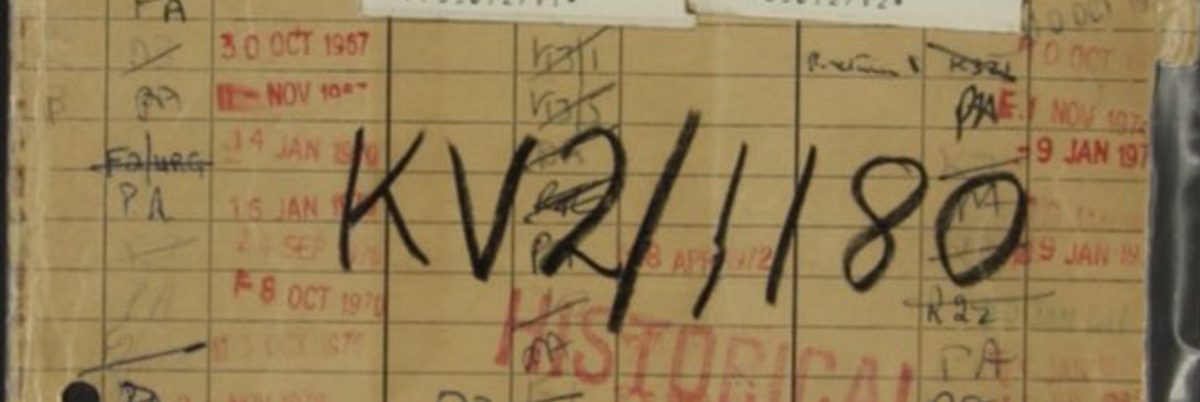
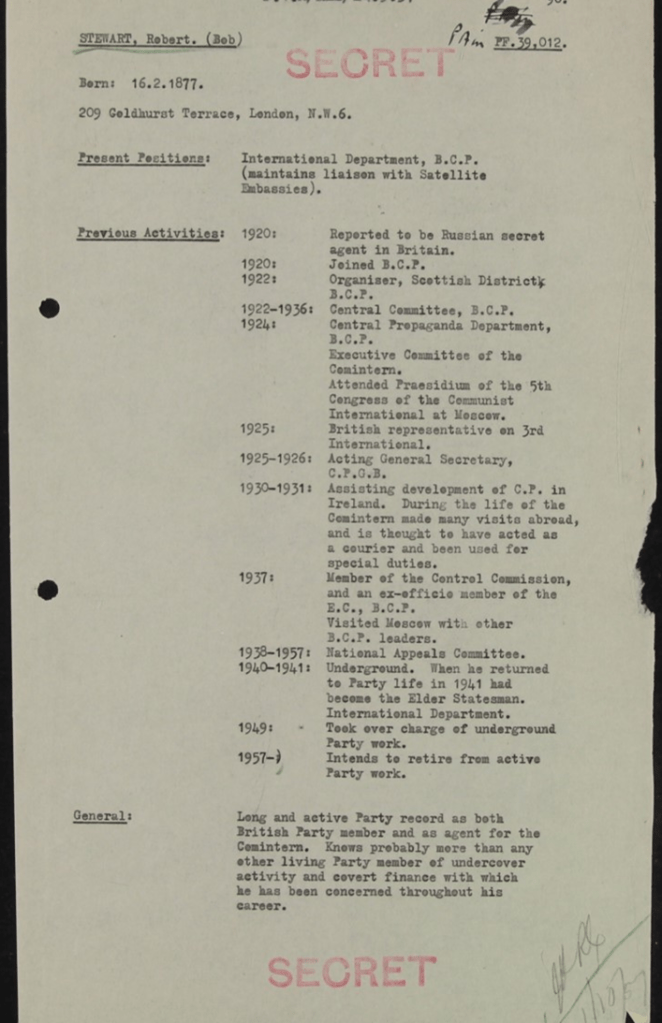
The document above is taken from the MI5 files now held at the National Archives in Kew. It’s from 1957 and gives a pretty comprehensive overview of Bob Stewart’s career in the Communist Party so far. Bob celebrated his eightieth birthday that year and most of the material the security services picked up from tapped telephones and bugged offices at the CPGB HQ in King Street, Covent Garden relate to him aiming to wind down and retire. There’s a decent summary of his professional life at the end.
“A long and active Party record as both British member and as agent for the Comintern. Knows probably more than any other living Party member of undercover activity and covert finance with which he has been concerned throughout his career.”
He’d spent quite a lot of the early years in Moscow, attended Lenin’s funeral and sat in meetings with Stalin. Then he spent time in Ireland trying to start up a Communist Party with the Irish labour hero Jim Larkin but little came of it. At one time, while the rest of the leading British communists were thrown in jail around the time of the General Strike, he became the CPGB’s Acting General Secretary. The Second World War years are a bit of a mystery but by the mid fifties the old man was very much on the security services radar again, though in this run down of activities they miss out his recent visit to China with Harry Pollitt where he met Mao Zedong.
Most of the surveillance work over the immediate years previously had been spent tailing him as he routinely visited satellite embassies and various address in the south of England. This was largely thought to be Bob moving different sums of Moscow cash around in order to keep King Street and The Daily Worker going. The issue of retiring and who he should hand over his responsibilities to was problematic as Bob wrote very little down, preferring instead to keep the details of all his undercover work in his head. There are several times in the transcripts where he is overheard by MI5 that he has been very lucky so far and didn’t want to go to prison at this time of his life. Indeed, at his advanced age he felt his memory was starting to fail and the past year had been exhausting. Revelations of Stalin’s crimes and how it affected his family personally had taken their toll. Eventually, Reuben Falber took over Bob’s work and if you want to find out what happened to the ‘Moscow gold’ just type his name into Google.
I don’t think Bob fully retired. There’s an album of photos from the 22nd Congress of the Communist Party of the Soviet Union in 1961 showing him mingling energetically with the delegates. He published his memoirs, Breaking the Fetters when he was ninety. Sensibly, but frustratingly it contains nothing of his undercover activities and only covers the early period of his life and the Party so there is little reflection on Stalinism. However, what does come through is his tremendous energy. The Communist Party in Britain formed in 1920. Bob was forty-five years old. All of this happened in the last half of his life. Before, there’d been thirty odd years of campaigning for the temperance movement, for trade unionism and against the First World War. The drive he had astonishes me.
I came to this story through grief. In 2018 my father, Michael, suddenly died of a heart attack at the age of 84. His passing brought to an end years of decline through vascular dementia. I had loved him very much and the idea that now there was only myself, my elder brother Ian and our mother was impossible to process. We did what most families do in that first year – come together for solace, then fracture painfully, then slowly heal. We did most of our grieving separately but I imagine it looked pretty similar. Sleep never seemed to arrive and I spent many nights in the spare room as my partner slept on searching through photographs, old letters and hunting down any recording or videos just so I could hear his voice again. He left very little trace on the internet – I picked up a few extra photographs from his days as a parish councillor, the odd story archived from the local paper from his days as the landlord of the village pub but very little else. Although it was in no way a reality, I felt I was losing him just as surely as the dementia had whittled down his ability to tell the stories he loved. God knows why I was looking for proof that he existed but, as is the way with these things, the death of a parent leads you to wanting to know more about where you come from and who your family are. And inevitably, you always leave it too late to ask the questions you need to ask. The gathering at my father’s funeral had been small. That’s not surprising for someone of my father’s age. He’d not been wealthy, he’d been an only child, both his parents had been dead for decades and illness had reduced his world. I’d always been aware that my family was perhaps more compact than my friends’ with all their cousins and uncles and aunts but, on my dad’s side, despite there being family out there somewhere, I can’t remember very much contact while I was growing up. Other than the affection he held for Bill and Jessica, his mother and father, and a few stories about his grandfather Bob I knew very little about his life before he was our Dad.
One insomniac night I was looking for more traces of him, and I finally found something more. I’d searched the National Archives collection and discovered the security service files relating to ‘Robert Stewart: A founder member of the British Communist Party…British representative on the Comintern and a member of its Executive. For many years he oversaw the British Communist Party’s secret apparatus including, it was thought, those of its members who passed military information to the Soviet Union’. Of course I’d grown up with the knowledge of who Bob Stewart was but here was acres of material – all scanned and, from what was once top secret, easily accessible. Skimming through one file I found this dated August 1933:
“I saw Bob Stewart yesterday. Bill’s wife is in hospital. She had a baby a couple of days ago. Bob didn’t know a thing until it arrived. Both are doing well.”
The extract was from a letter intercepted by MI5 and written by the union agitator and one of the few communist politicians to be elected to Parliament, Willie Gallacher. The baby was my father who was born a few weeks before. The letter is mentioned during some notes about Bob’s arrival from Holland. Not only is his correspondence and that of his friends being intercepted, his movement around the country and abroad are being closely monitored. I continued to search the files for any mention of my father, occasionally rewarded with a tantalising glimpse. By the time the surveillance crept into the 1950s they were bugging telephones and offices. Through the transcripts I had the intimate conversations of the side of the family I had vaguely heard about but never really knew.
So, what is to be done with all of this? And all the letters, photographs and souvenirs left behind that we inherited from Granddad after his death in 1978. The case full of stuff that convinced me that all my family were all Soviet agents when I was five. The answer is to read and remember and to try to understand. There’s a lot in Bob’s life that I admire but, as with any lifelong communist from the 1920s, sooner or later you have to confront the obscenity of Stalinism. At the moment, as I’m researching the ramifications of Khrushchev’s secret speech and the Hungarian uprising in 1956 its clear these events had huge repercussions for my great grandfather, his children and his grandchildren. I’m not sure Bob comes out of it well but that’s for later. For now, all that remains is to say – Dad, all this is for you. I wish you were here to show you what we’ve found out. I wish you were here to talk about it all. We miss you.
Alan Stewart.
Some names that will eventually find their way here – The Discovery, Winston Churchill, V.I. Lenin, Joseph Stalin, Tom Mann, Harry Pollitt, Willie Gallacher, Jim Larkin, Edith Tudor-Hart, The Cambridge Five, Yvonne Kapp, Phil Piratin, Mao Zedong, Matayas Rakosi, Edith Bone and Eileen Palmer.


 Breaking the Fetters