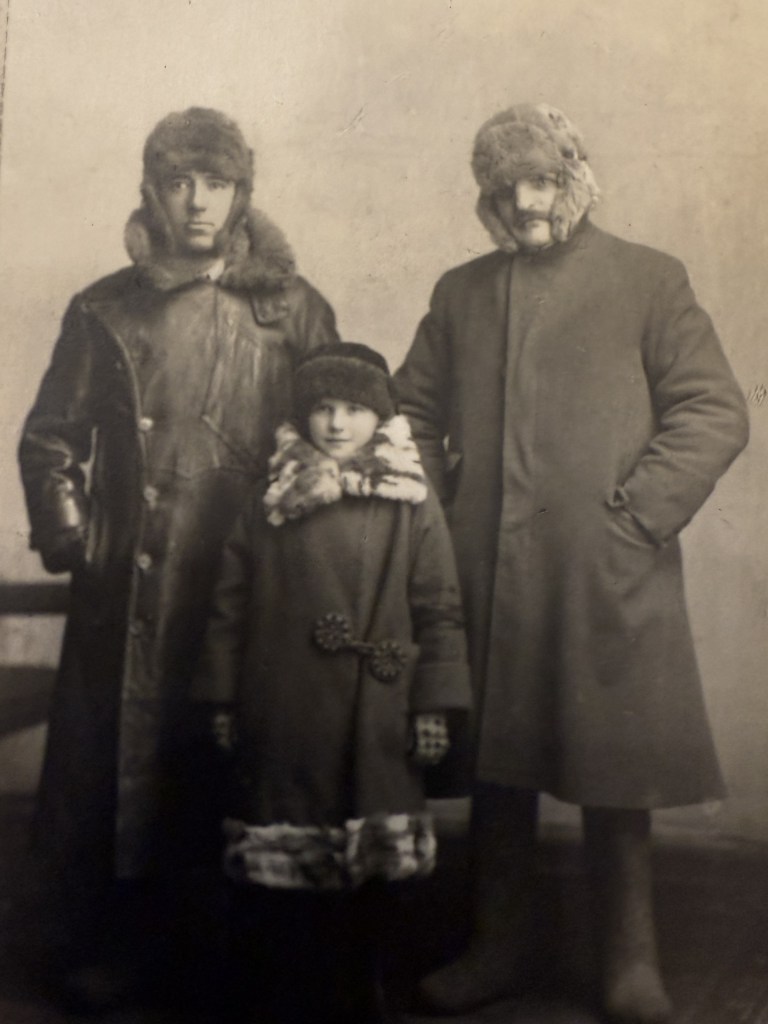
L-R Bob, Annie and Margaret Stewart. Photograph probably taken in Moscow around 1924.
Today’s post is about Bob Stewart’s youngest child, his daughter Annie who was my dad’s aunt.
Annie, otherwise known Little Nannie or Nan was born in Dundee on 30th November 1913. Her earliest memories would have been those of her father imprisoned for refusing to fight; her mother bringing up the family with the assistance of a legion of aunts and the contempt in which the general public held conscientious objectors such as Bob. Whether there was sympathy for the family among her neighbours I do not know but the common opinion that ‘conchies’ were cowards and traitors would have been part of the atmosphere that she grew up in. There was talk in the press of banning COs from positions such as teaching lest they contaminate the young and many, many similar stories. A law was even passed in which they could be disenfranchised. Bob actually lost his vote in 1921, shortly after the Caerphilly by-election, when a jute merchant, John Willison, petitioned for him to be removed from the electoral register on the grounds that he had refused military service. Willison, a prominent Dundee Unionist, stressed that there was no political party behind his application and that he bore no ill will against Mr Stewart, it was simply that men of his ilk were “embittering people against doing their duty” and should face, “the full measure of the law.” So, from the time she was learning to walk to her first years at school Annie would have understood that her family stood for something and that the attacks these principles drew had to be stood up to.
L-R Harry Pollitt, Annie Stewart and Bob Stewart.L-R Harry Pollitt, Margaret Stewart, Bob Stewart, Annie Stewart and Rose Cohen.
It was an unusual childhood. The Bolshevik revolution took place when she was four and it shaped the rest of her life. How could it not? In his study of CPGB members, Communism in Britain, 1920 – 39: From the Cradle to the Grave, Thomas Linehan points to the idea that the communist upbringing of ‘red diaper’ babies would help them withstand the future demands of capitalism but would also help prepare them physically and mentally to play a future role in the party organisation. It’s difficult not to view Annie as an example of this tendency. Bob went to work for the Comintern in 1923 and took Nan with him. At that time, travelling to the Soviet Union was not an easy task and not entirely legal. Whatever route Bob, Margaret and Annie took to get to their destination they would have risked arrest at certain stages and the journey would have been arduous and uncomfortable. The strangeness of leaving Dundee behind and settling in Moscow at the age of ten must have been overwhelming. In a Henry Sara slide taken at the Pushkin School she looks a little ill at ease and awkward amongst her classmates. However, the experience left her able to speak Russian – a language her parents never managed to learn.
Pushkin School: Nannie Stewart fifth from the right in the front row. Bob and Margaret just about visible in the back row. (Henry Sara Archive, Warwick Modern Records Centre)
The young Annie’s fluency with Russian is the focus of this remarkable news report in the Aberdeen Press and Journal dated 3rd June 1925:
WOMEN COMMUNISTS
Police Raid Glasgow Meeting.
GREETINGS IN SCOTS AND RUSSIAN.
Glasgow police raided yesterday the conference there of women Communists.
A demand for the names of the delegates failed to produce the desired results, and a request that each representative should speak produced remarks in braid Scots, Esperanto and Russian.
GLASGOW, Tuesday. Glasgow police raided the congress of women Communists in St Mungo Hall, Glasgow, to-day, five minutes before the dispersal of the meeting. Forty uniformed and plain-clothes men surrounded the hall, the plain clothes men entering the congress room. The visit of the police was regarded by the women as a comedy.
The plain-clothes men entered by the South York Street door. They swept aside the inner guard, and were confronted by Mr William Gallacher, who objected to the intrusion, and only four detectives and the aliens’ officer entered the congress room.
A Bit of Scots.
Immediately the presence of the police was known the women rose and greeted them by singing the “Internationale.” When quiet was restored, the police demanded the names of all the delegates present. This was refused, and the officers then asked that all the women present speak in turn, the request being made apparently for the purpose of detecting any foreign accent. This caused some hilarity, and Mrs Helen Crawfurd who presided shouted in braid Scots, “It’s a braw, bricht, meen-licht nicht the nicht, pipe clay, up the lum. Camarachanchoo.” Greetings in Esperanto were given by a delegate of Irish birth from Alexandria and an 11 year old girl, Nannie Stewart, daughter of the Communist candidate for Dundee at the last general election addressed the detectives in Russian. With her parents, she lived for some time in Russia and had been a pupil in a Russian school for about a year.
The officers then withdrew. Their search was obviously for the purpose of discovering if any foreign delegates, whose presence had been banned by the Home Office, were in the meeting.
The Girl’s Greeting.
Little Nannie Stewart told the Press that what she had said to the police was, “I don’t know what you mean, and I don’t care.” Asked what the police replied, she said, “I don’t think they understood me, because they never answered.” A remarkable sidelight on the intensity of the Communist instruction of the young was revealed in her remark, “They are a lot of moral cowards, any way.” The statements in Esperanto were interpreted simply as, “I thank you for your visit.”
Some of the women Communists were in terror, and Mrs. Crawfurd remarked, facetiously, that she thought it was a great compliment to the women’s section of the Communist Party that, while four detectives were considered sufficient for the main congress the previous day, over 30 officers were sent to the women’s conference. Others laughingly described the raid as “A rare sporting finish.”
The police refused to make any official statements.
I adore this article. As much as her youthful commitment to Marxist-Leninist revolution is apparent in this encounter, many decades later she became a resolute anti-communist – even going so far as to join the Conservative Party. And, after what she experienced – her husband murdered in Stalin’s purges with her and their baby son escaping by the skin of their teeth – who could blame her?
After Bob, Annie is the most important character in the book I’m writing. It wasn’t until recently that I realised I have never seen a photograph of her as an adult. I will have to do some more digging.
Alan Stewart.
PS – Many thanks, once again, to Maurice J Casey. This time for turning up the photographs of the Stewart family and their friends in Moscow in a newly discovered cache of letters belonging to Rose Cohen. For the upteenth time buy his book Hotel Lux!
Dundee Jail. Bob Stewart wrote most of the poems in Prison Rhymes here.
In the "Clink"-Edinburgh Castle

On jam and bread and bully beef,
They feed us in the clink,
There's a guard that's got the wind up,
And not a drop to drink.
We are short of fags and matches
And squeezed in very tight,
But we don't go short of scratches
When the flea-bags' come at night.

We are exercised each morning,
Deep down in Castle moat,
We play football and pitch and toss
And get the sergeant's goat.
We throw kisses to the ladies
And curses at the Yanks,
And when they pitch us cigarettes
There's mutiny in the ranks.

When the lovely war is over
And we're back at 'joyful' work,
When we've hypnotised old "Jerry"
And camouflaged the Turk,
When we meet again in "civvies"
What a tale we'll have to tell,
Of the clink up in the Castle,
Good old forty-second Hell.

Bob Stewart's Prison Rhymes
So I did my time in Dundee and with my remission I came up for my fourth court martial. Back to Edinburgh and this time to the Castle, with “Bobby” Moncrieff in charge. “Ha-ha,” they all warned with glee, “wait till Bobby Moncrieff gets hold of you.” But I knew Bobby, he was one of the family from Perth who made their fortune in ink. He was in command of the Dundee-Perth regiment of the Black Watch. I used to watch him march the jute workers through Dundee, men with the lowest wages in the country, hardly a bite in their belly, and Bobby howling at them “Bout turn!” “Forward march!” trying to make them into big brawny soldiers fit to be killed. Oh, I knew him all right, and I had known many of his kind in my time. But he didn’t put the fear of death into me.
However, I arrived at the Castle and got shoved into the guard-room. The sergeant said to the corporal, “Search that man.” “Not necessary,” I replied, “I’ll turn out my pockets.” So I counted my money, took out a box of matches and counted them. “What are you doing?” the sergeant hollered. “The Black Watch has a reputation! “I know,” I answered, “that’s why I’m counting my matches.” Soon I am shoved into another room with all the other delinquents. Like every other place, you soon make friends. First the meal. Beef and potatoes are served. But no fork and knife. “Where’s the tools?” I asked. No answer. So I sit, and the other lads, possibly hungrier than myself, ask, “Aren’t you going to eat it?” “Not without tools.” “Can we eat it?” “Better leave it till we sort this out.”
Back comes the sergeant. “Not eating the food, Stewart?” he says. “No, and I won’t until I get a fork and knife.” “Well, we will get you some sandwiches.” When the sandwiches came there was a rush for the plate of beef and potatoes that certainly did not say much for the culture practised in the British Army.
Into the guard-room came a wee drummer boy. I remember him well because he was so tiny. A jockey of jockeys, you might say. A bit nosey, he starts his own investigations. “What are you in for?” he asked me. “Because I won’t fight.” “Why won’t you go and fight?” “Because it’s not my quarrel.” “Christ, it’s no’ mine either:” Round and round he goes, asking his questions and getting his answers, until he comes to a fellow sitting very despondent and taking no heed of the proceedings. “How long have you been absent?” asks the nipper. No reply. Then he looks into the fellow’s face. “You’re no’ absent, he said, “you’re lost!” The lighter moments come and very often can linger much longer in memory than the tribulations. I did see Bobby Moncrieff but he must have been in a subdued mood. The war weariness was weighing heavily on everyone, even the Top Brass were feeling the weight of the loss of millions of good lives.
So I am again sentenced and returned to Dundee Gaol.
It was in Dundee Gaol I had a real barney with one of the religious mentors. The normal chaplain had gone to the front to administer religion to the soldiers, because you can’t very well preach the old adage “Fix your bayonet and say Be Holy or I’ll make you holy” if you don’t sometimes obey it yourself. Anyway, that honest little chaplain was succeeded by a little guy called McDonald. A little weasel. He and I never got on. Coming through the prison one day while I was whitewashing the walls, he said, “That’s a nice clean job you’re making of the walls, Stewart.” “I’m not cleaning the walls,” I replied, “I’m covering up the dirt.”
But I really detested him because he took advantage of his pulpit every Sunday to have a go at the Bolsheviks. Telling how Lenin ate children, Trotsky shot all the workers, and so on. The microbes eating each other up. I was sorely tempted to have a go at him, but Dave Donaldson was waiting to go out for another court martial, which is always a break, you understand, so I had to bide my time. When Dave went the storm broke.
The Weasel commenced his usual sermon with the evil doings of the Bolsheviks, then got on to his main theme, “They must be crushed like rats, etc., etc.” I could stand it no longer, so I jumped up. “You dirty miserable little coward,” I said, “standing up there in your coward’s castle maligning men who can’t speak back. Well, here’s one that speaks back, you dirty contemptible little rascal! They should put you in a prison cell not a prison pulpit.” During this outburst he sat down too surprised to say a word and he never rose again. It must be the shortest prison service on record in British prisons.
We were all marched out. One of the warders who knew me said, “You must write to the Prison Commissioners, Bob, complaining of the chaplain using his pulpit for political purposes.” “No,” I replied, “I have done what I wanted to do. Let it rest meantime.” Next came the Head Warder. “You’ll have to apologise to the chaplain,” he said. “That’s what I’m waiting for,” I replied. “Send him up here.” But he never came and the matter ended there.
During my stay in Dundee Jail I fancied myself as a poet and wrote a number of prison rhymes. I can make an apology for these because prison is not the best place to practise literary ambitions. However, when I came out of jail, the Prohibition and Reform Party published them in pamphlet form and they were a best-seller. Many thousands of copies were sold, giving a much-needed boost to the party funds.
The library in Dundee Gaol was composed of a few old copies of monthly and quarterly magazines. When I first asked for a book the warder said, “Christ, nobody reads here.” It was at this time that, through questions in Parliament and outside pressure, certain concessions were granted, so that newspapers and books could be sent to friends in prisons. An exception was The Tribune, published with great difficulty by the No-conscription Fellowship, which was the most hounded and persecuted little paper at that time. It was then edited by a group of women, amongst whom was Joan Beauchamp, who became the wife of W. H. Thompson, a famous expert on Compensation Law and Labour Law questions. The Socialist Monthly was also banned. Despite this banning, we still got these papers. I took up the question of supplies of newspapers with the Prison Commissioners, and finally we got a number of daily and weekly newspapers and a number of books as well. In fact, one of the new governors, on occasions, borrowed my books from me.
We got one or two of the warders, particularly the female warders, interested, and were able to circulate rationalist, progressive and socialist literature quietly in prison. Now and again our privileges were threatened when the newspapers turned up where they ought not to be, but we weathered the storms.
News from the outside only adds to the impatience and yearning for release-it was always galling to be divorced from activity as well as from home and friends.
It was while I was doing my term for the fourth court martial that the war finished, but still I was confined to gaol. Month after month was passing and not a word said about my release. One day I was communing with myself. “What am I doing in here? It was in April 1919. I was going with a bucket of water and a brush to clean some windows. “Ach,” I said, “I’m finished.’ So I went back to my cell and the warder hurried after me. “What’s up?” “I’m finished.” “What do you mean, you’re finished? “I’m through. I’m not going to do another damned thing. I’m not going to work, eat or drink in this prison.” Up came the Governor, but I held my ground. “I’m finished,” I said. “There’s neither sense nor reason for my being here. The war ended months ago and to keep me here is sheer malice. I am not going to continue.” That started the ball rolling and in a few days Dave Donaldson and I were out. They called a cab to take us home.
My first reception was from my little daughter, who on seeing us ran to her mother saying there were two dirty- looking soldiers coming into the house. But we had a real party to celebrate the occasion. So many people came that we had to borrow trestle-tables from the co-operative shop next door to accommodate all the guests.
So that was the end of the court martials. More prison sentences were to come, but I didn’t know that then. Left-wing politics in the twenties were not be to a bed of roses after all.
Duffy, he got huffy,
And says he to little John,
“You've got no business talkin'
When you're out at exercise,
I've tould you that, I'm sure, until I'm sick."
“Ach, Duffy dear, recall the days,When you were human too,
Before you took a screw’s job in the nick.”
"There's got to be no more of it
Or else I'll lock you up;
Will yez promise that ye won't talk any more?"
“Ach bless yer heart, I couldn't promise,such a stupid thing,
I'd be speakin' to mesilf behind the door."
Bob Stewart’s Prison Rhymes
I was taken from Calton Gaol to East Linton to await my third court martial. The officer in charge there was a Broughty Ferry man (Broughty Ferry is a suburb of my home town, Dundee) and he asked me, “Is it true, Stewart, that while you were in Calton you got home at weekends?”‘ “If it is,” I answered, “I never noticed it.” “Well, that’s what they said in the Ferry.” “It isn’t the only lie they told about me in the Ferry.” As the Ferry was, and still is, the stronghold of Toryism since it became the home and playground of jute millionaires, I was certain I was right, but if anyone believed that conscientious objectors got weekends out from Calton Gaol they would believe anything.
Keeping me company in the line of court martials was a very fine man called Alex McCrae. A little chap who had been in Smyrna when the war broke out. When he came home to Britain he had declared his conscientious objection. His wife, a very pretty lass who was active in the No-conscription Fellowship, came to East Linton the day I arrived, to see her husband. Knowing this, McCrae asked the Broughty Officer in Charge if he could have a night out with his wife, which was granted. So when I arrived at East Linton I got a seat at a table set for four, McCrae, two of God’s own, Christadelphians I think, and myself. Knowing McCrae would be absent, these two others shared the third meal between them and never said “Would you like an extra bite?” I was so enraged that I rounded on them. “I don’t know which Bible class you were brought up in but there’s not a prostitute in the whole of Glasgow as mean as you two.’
Then off I went to Leith Street School for the court martial. The two men in charge were rankers, had risen from the ranks to this exalted position, and didn’t they let everyone know it. My wife arrived and they refused to let her see me. I got to know and demanded to see the orderly sergeant. “This is a bloody lousy trick,” I said, “keeping my wife and kid from seeing me.” “I know,” he replied, “but it’s that fellow Cross (the ranker), he refused permission. But hang around and I think it will be all right when he goes.” And it was.
But at the court martial I got my own back good and proper. It was a real field day. Edinburgh Castle was the headquarters of Scottish Command and most defaulters passed that way. So there we were, a huge crowd in Leith Street, sergeants, corporals, privates, all in the queue; and there in the court- the Colonel and his henchmen.
Command: “Prisoners and escorts in!” So in we march, and are ranged in front of the Court. The Chairman said, “I am Colonel so-and-so, this is Captain —-and this is Lieutenant —-. By regulation I have to ask you, each one separately, if you are satisfied with the composition of the Court.” He didn’t say what would happen if anyone objected. Then he went on. “Sergeant —-, are you satisfied?” “Yes, sor.” Then it came to Private Stewart. No answer. A repeat, a bit louder, and still no answer. So he passes on until the queue is finished then bawls out, “All except Stewart.” At least there is no “Private” this time. He then turned direct to me and shouted, “Are you satisfied?” “Before we come to that I would like to ask you a question,” I said. “What is it?” “How much notice should an accused get before he is court martialled?” “Well, that depends on the conditions.” “In the present conditions?” I asked. “Twenty-four or forty eight hours.” “What happens if you don’t get any notice?” I asked. Suddenly he whipped round on them lieutenant. “Did this man get notice? “Didn’t think it was necessary,” replied the lieutenant. “Case adjourned–prisoner and escort out!” shouted the colonel. “Wait here, Lieutenant.” My escort was standing, his eyes like glass, and the order had to be repeated. When we reached the corridor he was besieged by his mates. “What happened? What did he get?” “Made a bloody mess o’ them, case adjourned.” “Holy jees!” So the story buzzed around the escorts and accused, and all seemed highly pleased. Then the door opened and out came the lieutenant in a furious rage. “Take him back to barracks,” he shouted; then howled, “And see he gets no privileges.”
So we reach the street and then I find the escort is blazing mad. He had schemed that he could leave me after sentence and visit his wife who lived in Leith, only a mile away. “Well,” I said, “that’s tough on you, you haven’t done anything wrong. Why should you be deprived of a night with the wife? Why not buzz off and I will meet you in the morning?” “Can I trust you?” “Sure, I’ll be at the station in the morning.” So off he went to see his wife and I to see an old pal, Jimmie Leven, who lived out in Gorgie. There I had a great welcome, a bath and a good feed. In the evening Jim and I went to a Peace Committee meeting and I made such an impassioned speech that the secretary thought the war had come to his meeting.
I was soon back again and this time no mistake. All regulations duly observed – ‘Refused to Parade’ was the charge. So I was sentenced to two years’ imprisonment with hard labour (later remitted to one year). I was sent to the state prison in Edinburgh Castle. But I was not long there. My mother was much too old to make the journey to Edinburgh but naturally she wanted to see her youngest son as many times as she could. So she came a few times, and in the process discovered that the Governor came from the same part of the country as she did. When she had said good-bye to me, the Governor invited her into his office to chat–as we Scots say, “Hame crack ower farms and farmers, cattle and crops, lairds and tenants and the hamely fare o’ the countryside.” I remember my mother telling me about him saying to her, “What I canna understand, wumman, hoo wi’ a maither like you Robert’s an atheist.” “Aye;” she replied, “he was aye a great Bible student.”
My mother died while I was in the state prison, but military regulations would not allow me permission to attend the funeral. There was much local feeling about this because my mother was greatly respected by all her neighbours, and protests were made to the Lord Provost of Dundee. He did intervene and said he would vouch for my return. I was then transferred to civil imprisonment again in Calton Gaol for a few hours, and taken under a most inhuman warder to Dundee, where I arrived too late to see my mother buried; but I met the family, among them my two soldiering brothers who had managed to get leave. The warder was in a hurry to get back to Edinburgh and so he dumped me in Dundee Gaol. More deputations to the Lord Provost and the upshot was that it was decided I would do the rest of my time in Dundee. Dundee was a smaller prison than Calton, and at that time, much to the chagrin of the warders, not fully occupied. How well I remember their glee at reception of new prisoners. Not that they were more devoted to duty or softer-hearted than the turnkeys at Calton, but the massacres in Europe were eating up hosts of men, and patriotic as the warders naturally were, they were not at all anxious to be called up to the front for service.
As a matter of record, I helped some of them make out their claims for exemption on compassionate, domestic or other grounds. So the warder who locked me up for resisting military service then asked my assistance to fill up his application form for exemption so that he could continue to lock me up!
Jute being the staple industry of Dundee, the situation in its prison was more or less the same. Teasing jute ropes, making and sewing sacks for coal, copper, meat-packing, etc. The working day was ten hours, sixty sacks, sides and bottoms, being the daily norm: a smaller number of coal sacks, which were heavy and hard to bore with the needle. Of course, all material was hand sewn, there were no machines, and the work was primitive and not very economic. At times my work was in association with a fellow called Tammy Sword, a local worthy doing his fifty-second sentence for being drunk and disorderly. When he got really drunk he boasted that it took half a dozen policemen to carry him to gaol, where he was more at home than in his own home.
The warders appreciated Tammy’s capacity as a sewer. He set a hard pace for his fellow prisoners, but he had a soft spot for me. “Dinna sew any, Bob,” he would say,”tak’ some o’ mine to mak’ up your lot.” Dave Donaldson and I were couriers in a romance with his sweetheart, who was doing time in the female part of the gaol. Dave was working with the artisan warder who did the maintenance work, and so was able to move around. In this way amorous notes were exchanged between Tammy and his lass with great regularity. Dave Donaldson was a beam and scale maker, and was handy at pipe fitting and whatever small smithy work had to be done. When necessary I was his labourer. We changed over when there was a carpenter’s job to be done, I then becoming the skilled man. We painted and whitewashed too, and were getting quite proud of our skill until Willie Findlay, another “conchie” and a painter by trade, came to do his hard labour. Then we sadly gave in and admitted that painting was a trade.
Viscount Peel, for the Government, said these men, conscientious objectors, must not be released, as their purpose was to abolish conscription.
I hear the sounding tread, my Lords, Of many a million feet, As the toilers of the earth, my Lords, March down to your defeat. To destroy your laws and statutes, That have made of earth a hell, And in memory of the gallant hearts You stifled in the cell.
Bob Stewart’s Prison Rhymes
So I was booked for a crime: Refusing to go on parade.
Details of my civil trial were handed over to the Chairman, Colonel in Charge. “Stewart,” he said, “take my advice, behave yourself and soldier properly.’ I replied, “I am old enough to be responsible for my own behaviour, and as for soldiering, certainly not in this war.” “Right, you leave me no alternative,” he said. “One hundred and twelve days with hard labour.”
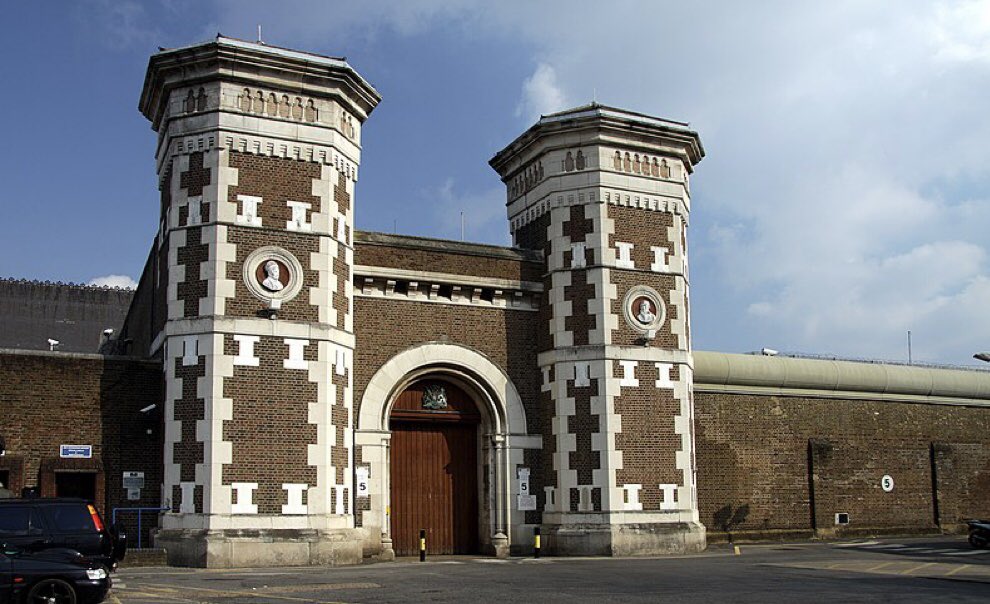
So that was it, one hundred and twelve of the best in Wormwood Scrubs.
Arriving in London, I was handed over by my military escort to the civil authority which in fact was much less civil than the army. I shook hands with the military escort and was handed over to the Scrubs’ gate warder. Then, as nowadays, the warders liked to be called officers, but a screw by any other name is still only a turnkey, himself under just as close a surveillance as the prisoners in his charge. They differ a lot. Some are sadistic and cruel, extra officious and bent on promotion. Others, under their official skin, are reasonably human. All of them are fearful of the economic consequences of losing their steady and comparatively lazy occupation which carries a pension with it. So they sweat to keep their record clean.
The Scrubs was one of the largest and in consequence most regimental of what were known in official jargon as ‘His Majesty’s Prisons’, which of course he never used as a personal residence. I was turfed into a reception cell to await disposal. It was a dirty, begrimed hole, some thirteen feet long and six and a half broad, its dingy walls covered by names of former occupants and an occasional word of advice, like “Sleep on it”, and some uncomplimentary remarks about officers and prison food. Scribbling on walls seems to be a favourite occupation of the Britisher in prison, possibly arising from, or maybe giving rise to, our high literary accomplishments as a nation. In one cell that I afterwards occupied, a previous occupant had written with a needle on the brickwork an almost complete catalogue of the books in the prison library. It must have been a long and tedious task.
I got a pint of skilly for breakfast and a concoction which would have horrified my wife, called soup, for dinner. Late afternoon I was officially received, my height and weight were taken, my personal possessions together with every article of kit enumerated to the barking of a head warder, then a bath in three or four inches of tepid water, and a suit of prison clothes, not ready to wear but already well worn. Then we were lined up to pass the doctor, face to the wall, while the warder shouted “Stand apart, stop talking.” In to the medico, one at a time, “Shirt up and trousers down for the doctor.” Amusing but strange to me that members of this humane profession should lend themselves to this farcical medical examination and humiliation of their fellows.
“Get them books, get up them stairs.” Them books were one Bible and one Prayer Book, which are the compulsory library of each prisoner during his stay except when on punishment.
So I became a number on the third corridor of the D hall, which at the time was entirely occupied by the “conchies”, that is those who had been tried in civil courts handed over to the military, court martialled and sentenced.
At the Scrubs, what was named the Supreme Appeal Tribunal held its sessions to re-examine each case lest any more-than-usually flagrant injustice had been perpetrated by the lesser tribunals. It was presided over by one of the Salisbury family, Lord James Edward Hubert Gascoyne-Cecil, 4th Marquess of Salisbury. This was to guarantee true impartiality, as such members of the British aristocracy would be sure to distinguish true conscientiousness from mere honest refusal of men to be conscripted to fight any enemy selected for them. In reality, the tribunal’s business was to separate the “sheep” from the “goats” by offering an alternative to prison sentence, in the shape of the Home Office work schemes, or removal to Dartmoor or Wakefield, where the locks were removed from the cell doors and a certain amount of freedom of association allowed. Those who refused to submit to alternative service, which meant voluntary service in the prosecution of the war, were condemned to the established routine of serving sentences in civil prisons, repeated court martials and further sentences. They were known as the “absolutists” who resisted all attempts to make them conform to any measures of military discipline.
So I go before the Supreme Tribunal, the Marquess of Salisbury in the chair. “I have your papers here, Stewart,” he said. “Nothing much we can do with you.” “Good,” I replied. “You can do without me altogether if you like.” But he did not like. My impression of him was that impartiality was not his strong point. So at the Scrubs I was to be for one hundred and twelve days without a visitor or a letter. Many letters came but were held back and I only received them when my time expired.
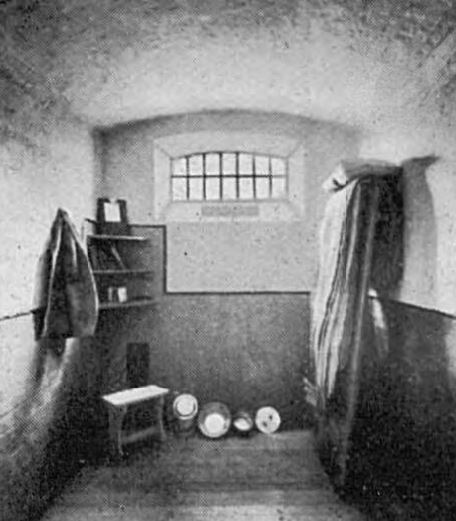
A cell in Wormwood Scrubs few years before Bob’s time there.
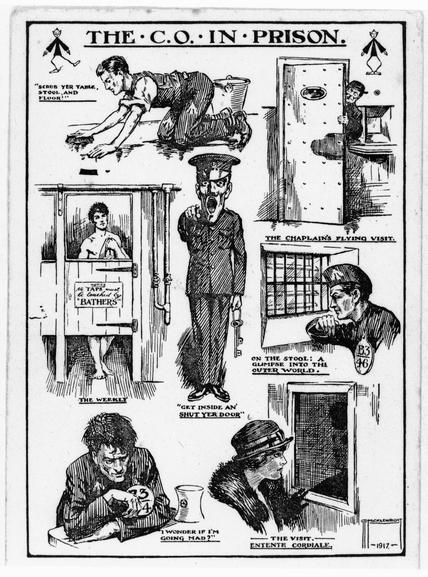
My new abode was the usual brick-walled domicile, thirteen feet by about seven feet. Its furnishing, a six feet by thirty-inch board bed. Top and bottom sheets of canvas, one or two blankets according to season, a bedcover, a small table under a pane of obscure glass through which a flicker of gaslight shone, sufficient to strain your eyes when reading. A small shelf for books, and a pint pot, a tin basin and a jug for water, a minute portion of soap, a very small weekly supply of toilet paper and a slop pot for natural necessities. A window in the outer wall with twenty-one very small panes of obscure glass. Woe betide any prisoner who was caught (as many were) trying to get a cock-eyed view of the outside world by standing on the stool provided to be sat on and not stood on. A copy of the prison regulations and diet sheet was hung on the wall. A mark on the centre of the wall, I learned, indicated where the prisoner should stand when the Governor made his inspection, at which time the prisoner must place his cap on top of his bed.
Religion is a very important part of prison routine. In fact you can hardly get into prison unless you have a religion. In the Scrubs, because it was so big, they had a “bunch’ of chaplains. The one I saw was a big red-faced fellow. “Religion?” he asked me curtly. “Don’t need one,” I answered just as curtly. “Don’t you believe in God?” “Which one?” That did it. “No chapel,” he shouted to his aide and that was my religious interview at an end.
I soon ran into my first bit of trouble. As I have said, the screws regard themselves as officers and like to be called Sir. I have never said Sir to anyone in my life, and certainly did not see why I should make an exception for the screws in the Scrubs. One of them said to me, “Call me Sir.” “Why?” I asked. Well, there is no direct answer to that but it meant I did two weeks in very, very solitary confinement. After that I went to sewing mail bags for an hour or two a day and also did a bit of artisan work as a joiner. We had exercise once a day, and with the large contingent walked from nowhere to nowhere and back again. What a silly exhibition.
After the first fortnight a prisoner is staged–that is, he is now considered fit to work in association. You are marched before the inspector. “What was your occupation in civil life?” “Agitator.” “What, no trade?” “Yes, carpenter.” “Could you earn a living at it?” “I could earn more than I get in here.” So I am passed to the carpenter’s shop and am given a test, then set to labour, making furniture and fitments for the H.M. Office of Works. Now there were greater opportunities of getting to know my fellow victims.
When we were working, on a platform overlooking us all paced the disciplinary warder who had no responsibility for work. He was the watch dog and his growling and barking often annoyed the artisan warder more than it did the prisoners. Artisan warders were, in my experience, more intelligent and less cunning than their mates. Their job was to get the work completed and in the process they had to discuss problems with the working prisoner. Thus there was formed an association. All tools, of course, were checked, and at the end of the work locked up in a cupboard with drawings of each tool to show where it should be put (like kids in a kindergarten). Pencils had to be sharpened by the disciplinary warder on the bridge–he painted one end and notched the other lest the lead be pinched for writing purposes. There was a powered saw and a planer but the grindstone was hand-driven. It may have been meant for punishment but actually it made gossip a bit easier, as one had to hold the tool while another turned the grinder.
Here it was I first met Dick Penifold of Brighton, who afterwards became a devoted member of the Communist Party and a leader in the co-operative movement. I remember when we were given one week’s solitary confinement and loss of one day’s remission. It was Good Friday. On exercise I contrived to fall behind Dick and whispered, “You’ll get an Easter Egg with a red flag on it for tea.” Dick laughed too loud and we were carpeted before the Governor next morning. Result, no association for one week, loss of eight marks and one day’s remission, which meant nothing.
Although a prison day seems much longer than the normal twenty-four hours, the one hundred and twelve days passed and my stay in the Scrubs came to an end. So I was taken to the Governor and then to reception to be transported to Dreghorn in Scotland for my next court martial. But the escort did not turn up and I had to do an extra day. Just my luck, overtime without pay.
Next day, in breezed a bright little corporal, well polished and full of himself, to take me to Scotland.
When I asked what had detained my escort the day before, he rattled off a story about how the escort had fallen among thieves, and bad lassies, which I guessed was bunkum. When later on I met the missing escort I got the true story. The alleged robbery was a cover-up for some inefficient book-keeping, which together we sorted out, greatly to his relief. Some years after the close of that war I was speaking at Buchanan Street, Glasgow to a very appreciative audience. At the close a neatly but poorly clad middle-aged man said: “You won’t remember me!” “No, laddie, I canna place you.” “I was the escort that got lost in London. “The uniform made you look a bit smarter!” “Oh, aye, Bob. I didn’t believe you when you said you’ll need to be a real hero to live in Lloyd George’s Land Fit for Heroes’, but by Jesus you were right!”
He was with millions on the dole- the forgotten men.
When the little fellow and I got outside the gates at the Scrubs I dumped my kitbag on the sidewalk. “What are you doing?” he asked. “I’m not carrying it,” I replied. “It’s not my kitbag, it belongs to the king, let him carry it.” So there and then began a first-class row, not about the king, he was unimportant, but about the more mundane problem of who should carry the kitbag. Finally we made a deal. We would take turn about and leave it at King’s Cross Station in the left luggage until train time. The wee fellow wanted to see London but was not too keen to do the sights accompanied by such a scruffy soldier as myself.
We were an incongruous couple, my smart escort and I, to be parading in public, but queer sights are common in London and except when we lined up at a theatre queue, small attention was paid to us. Then my escort showed off the handcuffs to show our relationship, or the absence of it, to the girls whom he was trying to impress. I don’t think he made much headway because at this time, in 1917, people were showing signs of war weariness and accustomed to seeing even dirtier conscripts than I. I don’t remember much about the show that night except that one of the performers was a countryman of mine, Harry Lauder, that much lauded Scots comedian who made a large fortune out of representing his fellow countrymen as either half drunk or half daft. He achieved further fame and fortune, a knighthood and a castle, and was a welcome guest at the tables of the great when he took to occasional anti-Labour tirades. During the show I wrote postcards to my wife and friends and was so busy that when “the King” was played the whole audience dutifully rose except me; but as the escort was more concerned with a young lass and getting her address for future purposes he did not notice the incident.
The show being over we left for King’s Cross, lifted the offending kitbag and boarded the train for my native heath. Into the guard-room on arrival at the barracks, where my escort explained that our late arrival was due to the prisoner being sick. As I was not asked for an explanation or opinion it passed, although by the manner in which my escort explained to the lieutenant the delights of London I very much doubt whether he was believed.
This officer was an agreeable chap who had been wounded and shell shocked. During his convalescence he was appointed to a non-combatant labour corps composed of conscientious objectors who were prepared to fit into military requirements which entitled them to pay, and their wives to allotments. This corps was usually an odd assortment of Christians from every sect- Orthodox, Auld Kirk, Free Kirk, Quakers, Christadelphians, Episcopalians, Roman and other Catholics, and other idealists, I.L.Pers and other near-socialists, and many who objected to killing or being killed in war. I always found them rather timid and less friendly than the regular soldiers with whom I fraternised in various guard-rooms.
I met one bright exception to this rule, although I have now forgotten his name. We were introduced by a corporal from Leith, a ship’s painter in civil life, who brought him into the guard-room saying, “Here’s a pal for you, Stewart, he wouldn’t eat his bloody dinner so now he’s for it.” He really was a fine pal, and well read, he knew Shakespeare’s tragedies, comedies, histories, sonnets and all. I learned much about literature from him and we had as good a time as ever I had in the guard-room, and not without fierce debates about politics. He was a member of the I.L.P, and I tried hard to cure him of that mixture although my own politics were mixed enough then. It transpired from the prisoner’s story that the rations were being cut, which he thought was being done by two officers in charge who were then helping themselves, and taking a “load” on their weekends home. To my query, “Well, what about it?” he replied, “This crowd will not stand up to the officers.” No one would bell the cat.
I suggested a round robin and after days of patient work a typist orderly was found with courage enough to type the complaint, which was then signed by quite a number, and was sent on my advice to Scottish Command. Long afterwards, I learned through the grapevine that an enquiry had been held and the officers in question transferred. They were an objectionable pair of super-patriotic bullies, dressed up in their brief authority, full of swank and swagger well behind the lines.
When War's insane alarming blast
With discord rent the air,
And rage of lust and devilry
Convulsed earth's bosom fair,
When workers, forced from useful toil,
To waste the wealth they'd made,
Were fed and clad and gun equipped,
To ply the warrior’s trade.
Bob Stewart’s Prison Rhymes.
With the enactment of the Military Service Acts in 1916, military service was imposed on all males of military age. Prior to that date, Britain’s armies were alleged to be composed of volunteers, a veneer that concealed the fact that unemployment, poverty and low wages had for a long time been the main recruiting officers for the fighting services. Very few artisans ever joined the army voluntarily, so that in the main it was recruited from the unskilled labouring and agricultural workers.
The technique of modern war, developed from 1914, demanded the widening of the pool to include the more highly skilled engineers and other craftsmen. The terrible wastage of officers and men could not be quickly replaced by the ballyhoo of pipe and brass bands, by clerical sermonising, or by indirect pressure, so compulsion by law came to fill the gap.
To sugar the pill and provide cover for “indispensables”, one-man businesses, etc., clauses were included in the Acts by which military service tribunals could grant exemptions. To meet religious susceptibilities, a clause enabled tribunals to exempt from military service those who had a conscientious objection to the shedding of human blood or taking of life. It was under this latter clause that many of the people not protected by other exemption clauses filed their exemption claims, which were generally rejected, and in the end some ten thousand “conchies,” as they came to be called, were tried in civil courts and handed over to the military authorities, where if they did not submit to military service they were court martialled and sentenced to prison.
My own case will illustrate what happened.
After my appeal to the tribunal had been rejected, as I was not a member of any religious or semi-religious organisation but a well-known socialist and anti-militarist, it being assumed that only religious people like Quakers, Christadelphians, priests in holy orders and their like could aspire to a conscientious objection to killing their fellow men, I was called to present myself for military service, which I refused to do. Then came the law in the shape of two local detectives to take me to the police court to be charged with “absent without leave”. However, the Chief Constable, who prosecuted, asked for a remand for a week, which gave me a little more time to prepare my wife to carry on my trade union and other work and also for me to put in a few more “no-conscription” meetings, much to the annoyance of the local respectables, who if they couldn’t get me shot at least expected me to be put out of sight for a long time.
However it was back to the police court again, where a military guard was already waiting to take me over. After the preliminaries, an officer from the recruiting office took the witness stand to prove that on a given day I was ordered to appear and did not do so. I was therefore marked absent and a warrant issued for my arrest. He looked rather pleased with himself, as did the magistrate, but their expressions changed when I asked, “Under what regulations do you mark a man absent?” “Under the King’s Regulations,” was the reply. “Under which one?” I persisted. The beak looked blank. The assessor said, “Can you help us, Mr. Stewart?” a rather unusual form of address to a prisoner at the bar. So I helped them by quoting the appropriate paragraph from the manual of military law which contains the King’s Regulations, in which it was clearly stated that a man could not be posted absent until twenty-one days had expired from the date of his call-up. Naturally the word of a prisoner cannot be taken as final, so a messenger hurried to the Sheriff Court next door to find a copy of the manual, which of course bore out my contention. The magistrate and his assessor consulted and it was then announced, “I am afraid we can’t convict.” So out again I went free, to the great glee of a small crowd who had gathered to see what would happen to Stewart, and the extreme chagrin of the military escort, beautifully polished, a straight slim soldier, handcuffs at the ready, waiting for me to be convicted. “Aye laddie,” I said. “You’re too early,” and off I went.
So the responsible military authority had to start all over again with my call-up, the time allowance and the other routine. Actually it was by sheer accident that I had discovered this paragraph, which I came across when I was looking for a way out for another man who had declared his conscientious objection, and had asked me to assist in the preparing of his case.
Dudhope Castle.
But time is inexorable, and everything was in order on the next occasion, when I was duly convicted, handed over to the guard and taken to Dudhope Castle, an ancient and dilapidated building which served as the local military prison, there to await an escort to my regiment.
During the period of conscription, my wife and other women were busy in assisting other objectors who were arrested, bringing them food while they were waiting to be transferred to their regiments. So it was no surprise to me when a guard told me, “Your wife’s ootside, Bob, and she’s brought you a parcel,” which he handed over to me. This instantly made me quite popular. I once told Sir Borlase Childs, Director of Personnel to the War Office, that “Soldiers are either one of two things, hard up or fed up” – and when they are hard up, tea and cakes are very acceptable. So we had a good feed and a wee concert in the guard-room, a nice introduction, but not a typical one, to my military career.
Next morning in came the Provost Sergeant, who had an evil reputation, and with him the Officer of the Day. “Shun!”‘ shouts the sergeant, and everyone shuns except me. The officer looked horrified. He turned to have a word with the sergeant, who told him who I was, and then they made a speedy exit. Immediately, in marches the sergeant and two privates. “Stewart!’ he shouts. “That’s me.”‘ “Out!’ And out I went into solitary confinement, no doubt to teach me a lesson to shun when ordered to do so.
So down I went into the infamous “rat-pit” all on my lonesome. Not that I minded very much, because I always get on very well in my own company. Then I have furious arguments with myself as to whether I am doing right or wrong, and if nothing else, it helps to pass the time. So in the rat-pit I remained, but not for long. A few days later an escort came to take me to my regiment at Hamilton Barracks, about seventy miles from Dundee.
On arrival at the barracks, I was, after examination of the necessary papers, dumped in the guard-room where about a dozen others, mostly absentees, were sleeping or playing cards. I can recall this well because it was Hogmanay, the evening of the 3rst December, which is a night to celebrate in Scotland. In the guard-room were over a dozen soldiers, all patriots absent without leave, or in on some other charge. There was one, Charlie by name, a bit of a Glasgow comic, who was keeping a wound in good condition so that he would not have to return too quickly to his regiment. So we stand around for a bit and then the old arguments come up.
“Why don’t you go to the war?”
“Because it’s not my war.”
And then comes the serious discussion about the reasons and necessity for wars. But Charlie could not prevent his mind wandering to the sesonal celebrations. “Christ, ” he said, “in Glasgow there’s my faither, my maither and my big braither and sister, a’ the neebours roondaboot, they will a’ be in the hoose. And there’s my picture above the mantelpiece and they’ll be saying ‘Well, here’s tae ye, Charlie’, plenty o’ nips in the bottle, and here’s me in this bloody place and canna get even a drink o’ water. What a bloody rotten Hogmanay, what a bloody rotten war.”
We bedded down at last under the scruffy blankets and in the morning I wrote a postcard home to my wife saying I was well, the company was friendly but the blankets were lousy. The censor scored that bit out but the blankets were removed for delousing that day.
Next morning I was served out with kitbag and clobber. This accompanied me from barracks to prisons and back again, and grew lighter and lighter with each move until, at my discharge in 1919, only the suit and cap were left to comply with the order of return. But more of that to come. It came to my turn to be ordered on parade, which I ignored, and was conducted under guard to the orderly room where a very young officer barked “Attention!” “Not me, laddie,” I replied, and so I was remanded for my first court martial.






 Breaking the Fetters