If they were asked to recognise the name of Luke Akehurst most sensible people of voting age in the United Kingdom would struggle. How I envy them their Eden-like innocence. Unfortunately for me, I’m one of those people who, without wanting to, seems to possess a perverse desire to keep abreast of every single development of the infighting within the Labour Party forevermore. It is not good for your health. For those of you don’t know Akehurst, he is a figure on the right wing of the party who sits on its NEC whose responsibilities seem to be chiefly to boil the piss of everyone to the left of Liz Kendall. He’s the secretary of a group called ‘Labour to Win’ which is ironic given that his extreme factionalism is likely to steer the party to an even greater electoral disaster than the one Jeremy Corbyn delivered in 2019.
Why even mention the man at all? Distressingly, it’s because earlier this year I found myself in the frankly uncomfortable position of being in agreement with him. Ruined my day to be honest. To elaborate, he had been asked what his problem with the hard left was. Among his reasons was the following:
“…silly exaggerated left rhetoric drives voters away from Labour.”
He’s right. If you’re on the left there are words you’ll use and love. Words such as ‘comrade’, ‘solidarity’ and ‘class struggle’. The problem is, most people who don’t view themselves as left wing- and that’s most voters in the country- loathe this type of thing. The workers of the world may have nothing to lose but their chains but they won’t vote for you in the United Kingdom if your language is couched in socialist tradition. Polling showed many of the policies of Corbyn’s Labour were popular but in no way would many people want to associate themselves with a group whose idea of a good time is a hearty chorus of ‘The Red Flag’.
Where myself and Mr Akehurst differ however is that while I do think ‘left language’ is ill advised when courting the floating voter I think the actual concepts of comradeship, solidarity and class struggle are important for a democratic socialist party. I’m not sure the Secretary of Labour to Win could stretch to that.
At this point you’d be forgiven for wondering what all this has to do with Francis Beckett’s book ‘Enemy Within- The Rise and Fall of the British Communist Party.’ In the first Covid-19 lockdown when I started this project I needed a single volume history of the CPGB to help make sense of all the security files and letters I was poring over. I immediately went for ‘A Centenary For Socialism-Britain’s Communist Party 1920-2020’ which was published by the current version of the party to coincide with its anniversary celebrations. It would be an understatement to say I found it hard going. Having to wade through sentences such as, “Lenin gave added expression to this paradigm of oppression by nations and national colonialism as part of the general struggle of the working class and working people against imperialism” and the general uncritical, almost hagiographic approach to its subject was alienating and exhausting. Perhaps I’m being unfair. After all, it’s hard to write about the CPGB without this kind of language and to be fair the companion volume , ‘Red Lives – Communists and the Struggle for Socialism’ is superb.
After this disappointment my brother recommended Beckett’s book which first came out in 1995 shortly after the CPGB wound up earlier that decade. The contrast was stark. Beckett seems to have achieved the impossible – a book about the far left which is also a pleasure to read. Sympathetic where it’s justified – Harry Pollitt’s activities during the Spanish Civil War and critical when needed – the CPGB’s inability to be independent of Moscow. It is engagingly written throughout and shot through with a dry wit. The history of the CPGB is labyrinth subject but Beckett helps you understand why people were drawn to the Party while also exploring the tragedy at the heart of it. Having read little else other than books on communism over the last couple of years I wouldn’t hesitate to recommend this book alongside Raphael Samuel’s ‘The Lost World of British Communism’ as necessary starting points.
Below is an extract from the book describing Bob Stewart at the conference where the Communist Party of Great Britain was formed in 1920.
There was the first stirring of a debate which was to cause a lot of trouble over the next seventy-one years. Did the CP stand for armed revolution or not? One excited delegate proclaimed ‘the historic and revolutionary value of a gun in the hands of a man of the working class’, only to be magisterially rebuked by Bob Stewart of Dundee: ‘A great many people talk about guns who would run away when they saw one. I am more interested in folks having brains in their heads.’ Bob Stewart had spent several years in prison for opposing the First World War, and knew more about hardship and violence than most. He led the smallest and oddest of the groups which formed the CP, the Socialist Prohibition Fellowship. After the main resolution was carried, the stout sincere man with a sober moustache walked solemnly to the platform to ask the new Party to come out in favour of suppressing the manufacture of alcoholic drinks. Few thought much of the idea, but they liked Bob Stewart, so they referred it to the executive for action. In seventy-one years no action was ever taken.
Yet banning the demon drink struck a chord with many Communists. Many hard, poverty-stricken lives were tolerable only through a haze of beer. Three Scottish founder-Communists, Stewart, Jack Murphy and Willie Gallacher, remembered their deprived childhoods being blighted further by drunken fathers. They not only abstained all their lives, but saw abstaining from alcohol as part of their socialism.
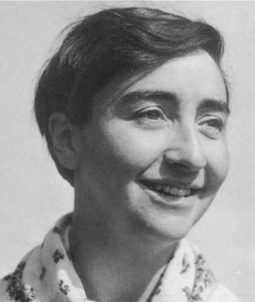
At the end of last year I was sorting through a large box of correspondence dating from the 1930s and onwards. In amongst them was a handful of letters addressed to Bill Stewart who was my grandfather. They stood out due to the immaculate clarity of the handwriting and the fierce affection they displayed for my family, in particular Bob. They were all signed by an ‘Yvonne’ who lived in the red enclave of Highgate not too far from the cemetery where Karl Marx is buried. It turned out they were from Yvonne Kapp, not someone I had ever heard of, certainly my father had never told me about her even though he comes in for a great deal of flattery in them. I have to admit that, starting with the letters and then digging deeper, Kapp is someone I’ve become almost infatuated with during the course of my research and I am sad that I never met her. She lived an extraordinary life.
Dating from the early 1970s the overwhelming sense that these letters convey is of age and infirmity. Bill is getting over a serious illness, Yvonne is recovering from a fall, Bob is blind and installed in a care home. There is an acknowledgment of things slowly coming to end and of putting affairs in order. A deep love and attachment is clear though the odd resentment surfaces occasionally. The first, from April 1972 is innocuous enough.
Dear Bill,
Thank you so much for sending the snapshots & your nice letter. The snaps are wonderfully good & I wish Bob could enjoy them. I thoroughly enjoyed meeting Robin on that occasion; what a very nice chap he is.
Unfortunately, I can’t go to see Bob at present as, a fortnight ago, I fell & broke my ankle – both sides of it- & shan’t be able to put that foot to the ground for 6 to 8 weeks. It’s not too painful now, but I’m helplessly moored to the bed. Still, I send letters to Bob by the nice young woman whom we’ve laid on to attend him twice a week.
I’m enclosing the publisher’s announcement of my book which will be out on May 25th. Do ask for it at your local library- & get Robin to do the same at his if you can find the time.
With very best wishes,
Yours ever,
Yvonne.
I’m assuming the snaps were from Bob’s 95th birthday celebrations though try as I might I have not been able to find any copies of these photos so far. Robin is my father, always known by his middle name on his side of the family but as I never really knew any of them I only ever heard him called ‘Mike’ or ‘Michael’ or, of course, ‘Dad’. The book she refers to is the first part of her two volume biography of Eleanor Marx, described by Eric Hobsbawn as, “one of the few unquestionable masterpieces of 20th-century biography.” It’s certainly the work she is best known for, completed in her seventies after ten years researching and writing.
The second letter is dated New Year’s Day 1973- the year of Bob’s death. Things seem far more urgent. Bob is growing frailer and Kapp is urging Bill to make the journey from Colchester to London to see his father before it’s too late. Bill wasn’t in the best of health either. He died in 1978 when I was about four years old. I have few memories of him save for a lovely old man in stripy pyjamas in a hospital bed whose moustache was all tickly when I kissed him. Of a tiny, dark house full of treasures and of long night time drives back from Essex to Suffolk where I only now realise how my own father must have felt whilst leaving an ailing parent as I’ve now made so many similar journeys myself. I think I remember his funeral- a haze of adults’ knees, mumbling and, in my mind, a red flag draped over the coffin. That could just be my imagination. His decorative Indian elephant bell that I adored was given to me afterwards has been a constant companion in every move I’ve made since leaving home – always kept safe.
Dear Bill,
Forgive me for not having been able to answer your letter before. I came back from my “summer holiday” just before Xmas, since when I’ve visited Bob a couple of times, ln the first of which I read him your letter, of course. He was sorry to hear of your illnesses & does hope you are now fully recovered.
He himself is growing very frail, Bill, and I hope that you will make a trip to see him very soon. His courage is unimpaired & he never complains, but feel he has to make an effort to appear as cheerful as he always is when I am there & that underneath it, he feels very tired & rather sad. His muscular strength is reduced; he finds it difficult to move about even in the room & with help & as time passes, he loses his sense of direction in his total blindness. I have never known anyone as brave & as good as Bob, I love him, dearly as you know, but now I worry about him a good deal & I wish I could do more to help him in his lonely old age. Please go and see him when you can manage it.
Wishing you a happy New Year & with Bob’s love to you.
Yours ever,
Yvonne
The next letter was written in March 1974 around sixth months after Bob’s death and his funeral at Golders Green Crematorium. Kapp’s grief is still very raw and her anger at others failing to remember his birthday on the 16th February in commemoration is palpable. She refers to papers and photos that have gone missing and of course it’s impossible to tell what may have been lost but we do at least still have an album of cards and messages from his 90th birthday celebrations that she seems to think has gone forever. The striking thing about this letter for me is her description of Bob as, “the finest human being I have ever known” something she would reiterate when she came to write her memoirs at the close of the 1980s. The letter closes with some comments on the problems of completing the second volume of the Eleanor Marx biography and the difficulties on living on the proceeds of the first. I don’t think much has changed for writers in the almost fifty years since she made those comments.
Dear Bill,
Thankyou for your letter. I was glad to hear from you though sorry that your health is so bad & prevents you getting out and about.
I must say I was rather surprised that, of all people who swilled and guzzled at Bob’s birthday parties year after year, I was the only one, apparently, to remember them with gratitude- or remember him on that occasion, only five months since he has gone. I still miss him very much. Though the last 3-4 months were painful to go through, I would not have foregone my weekly visits to him for anything on earth. Indeed, during the period when he was first moved to the Nursing Home, I went twice a week so that he should not feel too unfamiliar in new surroundings. Bill Brooks- and his family too- was wonderful to the very end & so thoughtful & considerate of Bob’s wellbeing.
It is horrid that his photographs disappeared. For a long time at Fenstauton Avenue, he had them with many other photos & papers of interest at the top of his cupboard & I often asked him whether I shouldn’t take them away to keep them safely: all his 90th birthday greetings cards in a folder & a mass of other stuff. But as long as he was entirely clear in his mind, he wanted them left there. Then, as you know, he was moved to the Home at a rather critical stage when he was rather confused, & I never saw any of those papers again. But I am not very much surprised. After all, if members of his loving family could steal from a blind man a new suit he had only worn 3 or 4 times, on the grounds that he had told them to take a suit – he meant the old one- for “jumble”, then nothing can surprise one.
However, these things – papers, photos, clothes- are not important. It is Bob, the man, the finest human being I have ever known, who remains in one’s loving memory & nothing can add to that or subtract from what he has left behind in one’s heart or what he gave us all in his lifetime.
I am getting on with Vol 2 of Eleanor, but it is a slow task as I’m not so young myself. However, it will be finished before the year is out – quite a long time before, I hope, as it is going quite well. – & in the meantime, the more people you can encourage to read Vol 1 the better, as it is quite a hard struggle to live & work on the proceeds. (Not even a Phase 3 for writers!) At least each time that a library (or anyone) buys a copy – never mind how often it is lent out- I get 45p.
Take care of yourself & when you write to Robin, give him my kind regards. I took to him very much when we met at those famous (forgotten) birthday parties & you have a fine lad there.
With love to you,
Yvonne.
In the final letter I have, the grief remains The target of her anger is Bob’s daughter Nan, who I mentioned in the previous post ‘Prison Rhymes’. Since 1956, while the rest of the family had maintained their commitment to communism, she had travelled further and further away from them politically. The reasons for this are not surprising. In the early 1940s her first husband, a Russian apparatchik and the father of her son Gregory, was shot in one of Stalin’s purges. Nan and her baby son, my dad’s cousin, managed to escape the USSR but almost inexplicably the details of her husband’s fate were unclear and she remained a member of the Communist Party. Everything came out years later in 1956 after the ‘secret speech’ where Khrushchev admitted Stalin’s crimes. The trauma this caused within the family, often overheard by MI5 on tapped phones and bugged offices is the current focus of my research. By 1978, Nan has done the unthinkable. She has become a member of the Conservative Party and Yvonne Kapp is furious.
Dear Bill,
Thank you for your letter and sending me one from the Millers. I was so glad to hear from you and Robin and to know that he is settled in such a pleasant place. One day I shall try to visit him there.
I wish you yourself were feeling stronger and in better health.
The news of Nan’s preposterous move had reached me before you wrote. I’ve heard a few sick jokes in my time but Nan as a member of the Tory party is about the sickest. I’m glad that, whatever your parents suffered at her hands one way and another, they did not live to see this.
It was sad going to Peter Kerrigan’s funeral just before Xmas. What a terrible year the last one was. So many dear friends departed. I suppose that at my age it’s inevitable, but that doesn’t ease the sorrow. Let’s hope that 1978 will have less sadness to record.
Anyway, I wish you all the best for 1978 and – herewith returning the Millers’ kind letter- send you my love,
Yours always,
Yvonne.
1978 was the year my grandfather died. Kapp, born in same year as him lived to the age of 96 – the exact same age Bob was when he died. She passed away on June 22nd 1999. Eric Hobsbawm wrote an admiring obituary in The Guardian in which he described her as “self-reliant, tough, faithful, ladylike and quietly proud to the end” before adding, “She had good reason to be.”
……….
Clearly, the almost forty year friendship between Yvonne Kapp and Bob Stewart was a profound and important one. It began in 1934 when she was housing refugees who, a year into Hitler’s seizure of power, were already fleeing Nazi Germany for London. One such refugee, as with many in the same position, seemed particularly damaged and traumatised and was proving difficult to cope with. He was arranging for suspicious packages to be sent to her address, ranting about the prospect of being expelled from the German Communist Party, demanding money and threatening suicide. Kapp, at this point an active communist, didn’t know what to do and was frightened his death was potentially on her hands. Someone suggested she should go and see Bob for advice at the party’s headquarters in King Street, Covent Garden. He listened patiently and helped her work out the best course action to take. In her memoir, Time Will Tell, she outlines the “permanent legacy” of this situation.
Bob who had been a joiner and a cabinetmaker in Dundee, was a foundation member of the British Communist Party in 1920. He and his wife, Meg, became honoured guests in my house shortly after that first meeting and we spent many Sundays visiting them. With Meg’s death in the early 1950s and his advancing age- for he was over sixty when I first put my head round his door- his life took a melancholy turn, not made happier by retirement and the gradual onset of blindness, so that I visited him as often as I could and he would come to us on Christmas Day. At one point I took him to see an ophthalmologist who told him that his eyes had done their work and there was no cure for his failing sight.
He was always resolutely cheerful and uncomplaining, put on so brave an air of being in good spirits, took so lively an interest in what was happening in the world and, though unable to read newspapers, held so clear-headed a view of events as they unfolded (including, in 1968, when he was over ninety, telling young people- in their sixties – that the invasion of Czechoslovakia by Russian tanks, was a terrible mistake), that it was an education to be in his company and a privilege to be his friend. As his strong body lost some of its resilience, and to his blindness were added other infirmities, the Party arranged at considerable expense for him to live in a kindly if rather slapdash home for old people. There I went to see him every week during his last years and did so almost to the end though, as ill luck would have it, when he died at the age of ninety-six in 1973, I was away on holiday.
Bob, the wisest of men and also the most generous and great hearted, was the first person I had ever known who was truly good, all through. I could not have had a better teacher. His was the permanent legacy my shifty lodger left me.
(pp185-6 Yvonne Kapp, Time Will Tell, Verso 2003)
……….
One of the things that I most admire about this friendship is the unexpectedness of it all. Bob was working class Dundee bred joiner who had endured great poverty and left school at twelve. Kapp on the other hand was the privileged bohemian, bisexual daughter of wealthy upper class German Jewish immigrants twenty six years his junior. Reading her memoir the 1920s were a particularly heady time for her. While Bob was organising for worldwide revolution and heading off to Moscow as a representative on the Comintern, she made an early marriage to the artist Peter Kapp; headed off on a walking tour of Europe; wrote scandalous novels under the pseudonym Yvonne Cloud and dived head first into the artistic and literary world of London. In her afterword to Time Will Tell, Charmian Brinson notes:
…there is much about Yvonne’s life that reflects the intellectual, cultural and political climate of the age in which she lived, with Bloomsbury (in the shape of her friend Quentin Bell) juxtaposed with Harry Pollitt or, on an international plane, with Helene Weigel (for some years, Yvonne advised Weigel on English translations of Brecht). Figures as diverse as Rebecca West, Noel Coward, Frances and Vera Meynell, Max Beerbohm, Clifford Allen, John Collier, Melanie Klein, Nancy Cunard, CK Ogden, Rudolf Olden, John Strachey, Paul Robeson, John Heartfield, Kate O’Brien, Herbert Morrison, Jack Tanner, Jocelyn Brooke and Ilya Ehrenburg people these pages.
(p291 Time Will Tell – Charmian Brinson- Afterword-Reflections on Yvonne Kapp)
While I would love more gossip on Noel Coward who regularly came to the Kapp’s for post performance suppers after The Vortex at the Comedy Theatre, my favourite anecdote in Kapp’s memoir involves the future star of Bride of Frankenstein Elsa Lanchester and her husband and fellow screen legend Charles Laughton. The Kapps met Lanchester through joining the 1917 Club and through The Cave of Harmony- a cabaret Elsa ran and performed at. Yvonne and Elsa became close for a number or years but Kapp is scathing in her assessment of Laughton.
In that same year of 1929 Elsa Lanchester married Charles Laughton. She told me he was wonderful but, though prepared to believe her, i found that he seemed to quench her fiery spirit and mocking wit. An adoring wife, she kept the best of herself – like the choicest morsel of food and the heart of the lettuce- for Charles. He, to my irritation, could not so much order a cup of tea without playing the part of a man ordering a cup of tea.
(p86 Yvonne Kaapp, Time Will Tell, Verso)
She goes on to dismiss Laughton as a “great ham” and laments seeing less and less of Elsa until she became a “virtual stranger” who avoided former friends due to her troubled personal life.
As the 1920s gave way to the 1930s Yvonne Kapp became more and more political and her life changed direction. As Hobsbawm notes in his obituary of her:
Hitler and the Nazi tyranny in Germany turned her into a communist and this gave sense and stability to her life. Through her work with refugees it also brought her together with the former member of the Bertolt Brecht collective, Margaret Mynatt, the later inspirer and editor of the English tradition on of the Collected Works of Marx and Engels, with whom she shared her life until Margaret’s death in 1977.
(Eric Hobsbawm – Yvonne Kapp, The Guardian 28th June 1999)
The first volume of the Eleanor Marx biography, Family Life was dedicated to Margaret Mynatt. When it came out in 1976, the second volume, The Crowded Years, was dedicated to the memory of Bob.
……….
POSTSCRIPT: In learning more about Yvonne Kapp, I found the work of Alison Light, Charmian Brinson and Sally Alexander to be essential. Also, Yvonne Kapp’s Eleanor Marx and Time Will Tell are both published by Verso who, at the present time always seem to have a sale on so it’s worth heading over to http://www.versobooks.com to pick up a bargain.
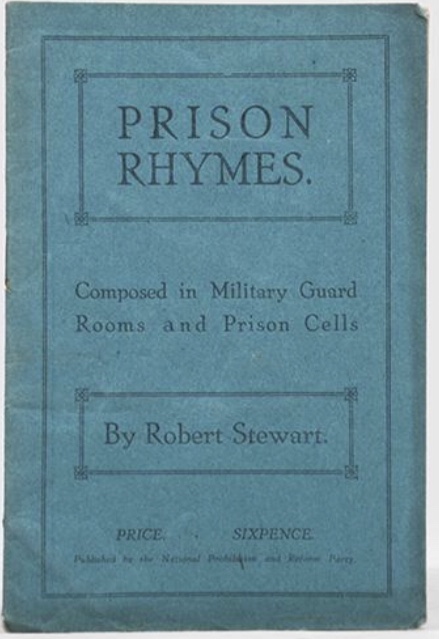
“…the author of these verses -Mr Robert Stewart- the man of lucid and terse prose, the very matter of fact economist, having the leisure of the prison cell thrust upon him, turns to Rhyme, and with apt and happy effect expresses not merely his hatred of War, but his whole-souled antagonism to the basic cause of War. Because of his trenchant condemnation of the Capitalistic system and of the Capitalistic Governments whose machinations had inevitably produced the terrible holocaust of death, Mr Stewart was arrested in December 1916, and remained imprisoned in guard-room or gaol until April 1919. But stone walls and iron bars can only hold the body captive, and the spirit of the man never flinched and never faltered-a fact that may be gathered from a perusal of his verses. two passions seem to me to inspire them all-a passion of veneration of love for humanity and a passion of hatred towards every circumstance, convention and condition which operates to the detriment of the human race.”
G. Anderson from the Foreword to Robert Stewart’s Prison Rhymes (1919).
When the First World War began Bob Stewart spent most of his energies agitating against it. By 1916 the government had passed the Military Service Acts which imposed conscription on all males of military age with few exceptions. Eventually, Bob was called up to fight. He refused and so this led to a series of court martials and a large amount of time spent at his majesty’s pleasure in Wormwood Scrubs, Calton Gaol, Edinburgh Castle and Dundee Gaol. He was eventually released in 1919 several months after the end of hostilities.
Surviving copies are rare and few come up for sale. I saw one advertised at the end of last year but £650 seemed a bit steep and I didn’t have it spare. In the late eighties my brother rang up the Communist Party of Great Britain to ask if they had one and they kindly sent a photocopy which is the only version we’ve ever seen. I imagine the original is now in the People’s History Museum in Manchester with the rest of the CPGB archive.
For the most part the poems are written in Scots dialect and are largely concerned with protest, socialist agitation and reflections on the isolation of prison life. I’m not making any great claims for the collection as poetry but it is a good example of popular socialist pamphleteering . It was published in 1919 in order to raise funds for Bob’s party – the Socialist Prohibition Fellowship (formerly the Prohibition and Reform Party). As Bob explains in his memoirs:
“…meetings packed out Sunday nights in the Foresters Hall. They were always packed out, with hundreds left outside. Invariably there was a queue to get in an hour before starting time to make sure of a seat. my Prison Rhymes now became a best seller. So with the money from the collections and the booklet we were doing very well financially.”
Bob Stewart, Breaking the Fetters, Lawrence & Wishart 1967
I’ll be posting some of the poems on here over the next few months. The first one, ‘Little Nan’ is about Bob’s daughter Annie Walker Stewart or Aunt Nan as my father knew her. She would have been six at the time of publication and the poem reflects Bob’s sadness of being separated from her for most of the preceding three years. Like all of Bob’s children she would eventually become a committed member of the CPGB though Khrushchev’s speech in 1956 together with matters closer to home brought all that crashing down.
Despite Bob Stewart – the communist spy being a background presence throughout my life I never once took my copy of his autobiography ‘Breaking the Fetters’ off the shelf and read it until my mid forties during the first COVID-19 lockdown. To be honest I’d been reluctant to tackle it for a long time fearing an unreadable droning of a stern and unrepentant Marxist-Leninist full of words and phrases that I still don’t fully understand like ‘surplus value’ and ‘commodity fetishism’. I’d imagined the kind of person who, just at the point when everyone wants to leave a three hour meeting, starts bringing up endless points of order while everyone else coughs and sighs while dying inside. It was a surprise and a relief to find that spending a few hours with him, through the years, through his printed words was, by and large, a joy. I found someone with a deep sense of justice, of compassion and who possessed a sense of humour as dry as the bar at the temperance movement’s Victory Lodge.
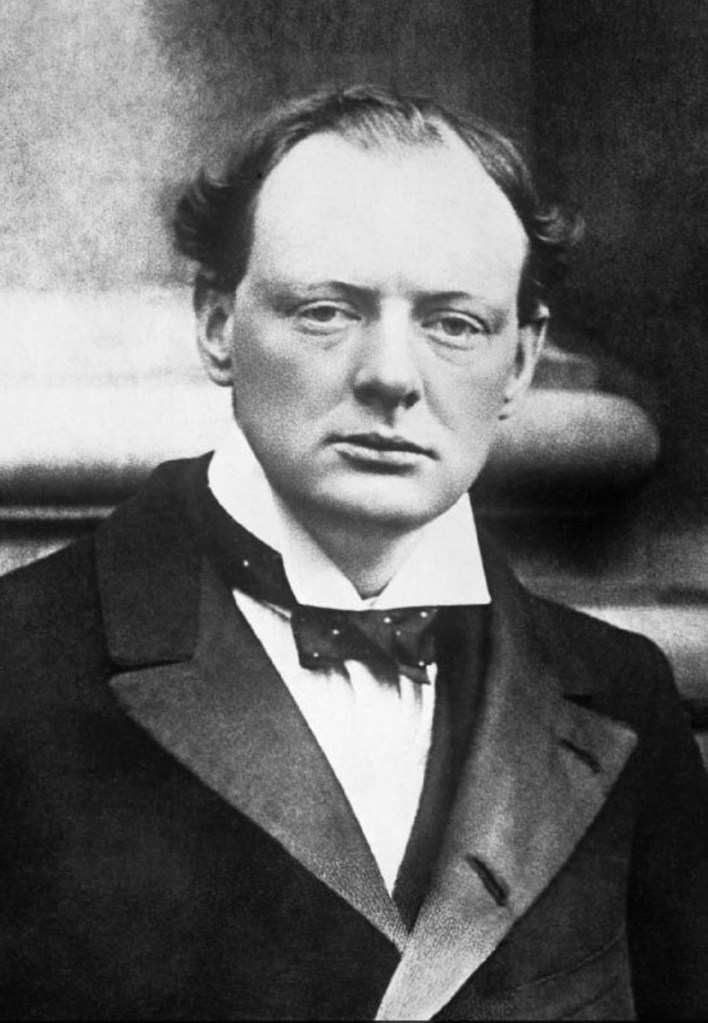
A highlight was Bob’s encounter with Winston Churchill early on in the future Prime Minister’s career. Surreally, so many years after his death, Churchill looms larger in our national consciousness now than at any other point in my lifetime. Towering historical figure he may be but he’s now revered in a way he simply wasn’t in his own time. The heavy jowelled, bulldog appearance synonymous with British grit and determination in the face of the enemy to those convinced they fought them on the beaches even though they were born in 1963 and the closest they’ve got to combat was watching ‘The Dambusters’ endlessly just because you can’t say the dog’s name these days. Voice any slight criticism of the Harrow and Sandhurst alumni and his conduct regarding Gallipoli, or striking miners in Tonypandy or famine in Bengal is tantamount to treason. There’s a whole generation of people out there who believe that the scene in ‘Darkest Hour’ where Gary Oldman in bald cap and fat suit is riding on the London Underground and a representative cross section of the population travelling with him offer him their unanimous wholehearted emotional support is literally true. But it wasn’t like that. It never is. Whole nations rarely take serving politicians to their hearts- they cause too much damage on the way. Watch the footage of crowds at Walthamstow Stadium booing the great man while canvassing for votes in the general election that followed our victory in the Second World War. Look at how decisively the electorate booted him out that year. Churchill on the 5th of July 1945 represented a return to the old way of life and he was comprehensively rejected.
Whatever your views on him however, there is one pillar of Winston’s appeal that is ingrained into the British psyche– his herculean capacity and tolerance for the grape and the grain. He was, by all accounts, a sot. One of the greatest drinkers of the twentieth century. If you locked Oliver Reed, Peter O’Toole, Richards Burton and Harris and, oh, let’s say Dylan ‘Drink Canada Dry’ Thomas together with the nation’s favourite Prime Minister in the Coach and Horses overnight I know which one would I would bet on being the last one standing when the owner came to open up in the morning. It wouldn’t be the actors and it wouldn’t be the poet. Churchill would still be there pouring himself a whiskey mouthwash and ignoring the smoking ban. So, when my great grandfather met Churchill for the first time in 1908 they were not only political opposites– the one being an advocate for the cause of the working class, the other a patrician born into the highest levels of the aristocracy- they were divided on what Bob considered the most moral question of the time – the production and sale of alcoholic beverages. The temperance movement had got Bob early and it was the damage that drink caused in working class communities that most concerned him.
Bob had recently returned from South Africa and his miserable experiences in Pretoria and Cape Town cemented his wish to fight the exploitation of ordinary working people and so he decided to go into politics full time. Up to this point he writes that his life had, “consisted of finding a job, trying to keep it, trade union work, organising in the temperance movement, speaking and debating on radical platforms and reading and trying to assimilate the new revolutionary socialist ideas.” The polar opposite of the life of an aristocratic, high Tory grandee such as Churchill. Bob became a full-time organiser for the Scottish Prohibition Party and in 1908 he was elected to Dundee Town Council where he worked to alleviate the effects of endemic unemployment and hunger through organising soup kitchens, food donations and tree planting schemes to provide much needed work. Around this time Winston Churchill, eight years into his Parliamentary career and enjoying an opportunistic dalliance with Asquith’s Liberal Party found himself having to contest a by-election in Dundee. This was occasioned by him having been promoted to the cabinet by being appointed President of the Board of Trade and this required him, due to the regulations of the period, to face the electorate again in his constituency of North West Manchester. Embarrassingly, he lost to the Tory candidate. At this point, he was parachuted in to contest a seat in Dundee. For Churchill the stakes were high – if he didn’t win then his future in politics was in doubt. Young Winston threw himself into his campaigning with his customary energy but Bob, working as election agent for the Prohibition Party candidate couldn’t help but notice “the gulf between Churchill’s oratory and the living reality” on the streets where meetings were held. While in a packed Drill Hall Churchill declared, “Britain has great imperial strength. We have belted the world with free institutions!” my great grandfather pointed to the Sherriff Court next door, the salvation Army Home for fallen women across the street, the Parish Council Lunatic Department next to that and the nearby Curr Night Refuge for homeless people. Tick off any of Beveridge’s five great evils – want, disease, ignorance, squalor and idleness – it was as unlikely then as now that any tory in a liberal disguise would throw a life belt or offer so much as a sticking plaster to those in suffering. Let alone the institutions of empire. That said, and true to the eternal frustration of the left whereby the proletariat inevitably vote against their own bloody interests, Churchill romped home with a comfortable majority. “How do you think it’s going?” he asked Bob at the count. “You’re in by a mile, worse luck,” was my ancestor’s reply.
Nevertheless, earlier on that evening – with his future in the balance – Churchill was agitated. Bob noticed him alone twisting little rubber bands around his fingers until they snapped and pacing the floor. Seizing the opportunity of the seasoned temperance campaigner he struck up a conversation with him while the Liberal votes started to pile up and the aristocrat’s cabinet position was increasingly secured. What concerned Bob most would be what his opponent would do in Parliament to bring the banning of the sale of strong drink into law. Eventually the Lord Provost sidled up to the veteran temperance campaigner and remarked, “I understand you’ve been trying to convert Winnie to prohibition. By Christ! Bob, you never give up!” In his memoir Bob, laconically observes:
“He said it in a voice of admiration for my courage and with the certainty that I was on a forlorn quest. As later years proved, Churchill and the prohibition of strong drink were poles apart.”
The understatement in that last sentence serves as an elegant example of his humour. Bob looked on as the electorate hoisted Churchill onto their shoulders at the moment of victory and then deposited him in is automobile outside and then proceeded to carry him- in his car – down the street. No doubt much strong drink was taken that night. However, this anecdote also highlights one of the problems of those in the temperance movement. That of separateness, of being apart. Your concern for the less fortunate making you holier than thou. Bob found it hard to understand the pleasures drink can bring – the release, the freedom, the escape. At one level it shows an inability to understand the people you’re supposed to be representing – clearly the path the Communist Party of Great Britain was on when Bob was writing his memoirs in the mid-sixties. However, by the time Bob was heading into his forties he wasn’t yet a communist, nor did the organization that he would dedicate the rest of his life to exist. It would take the First World War to bring that about.
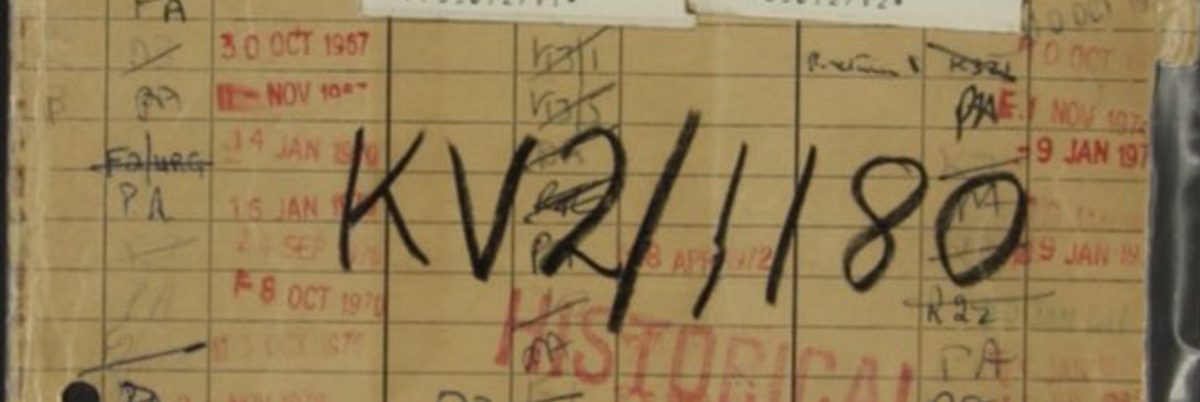
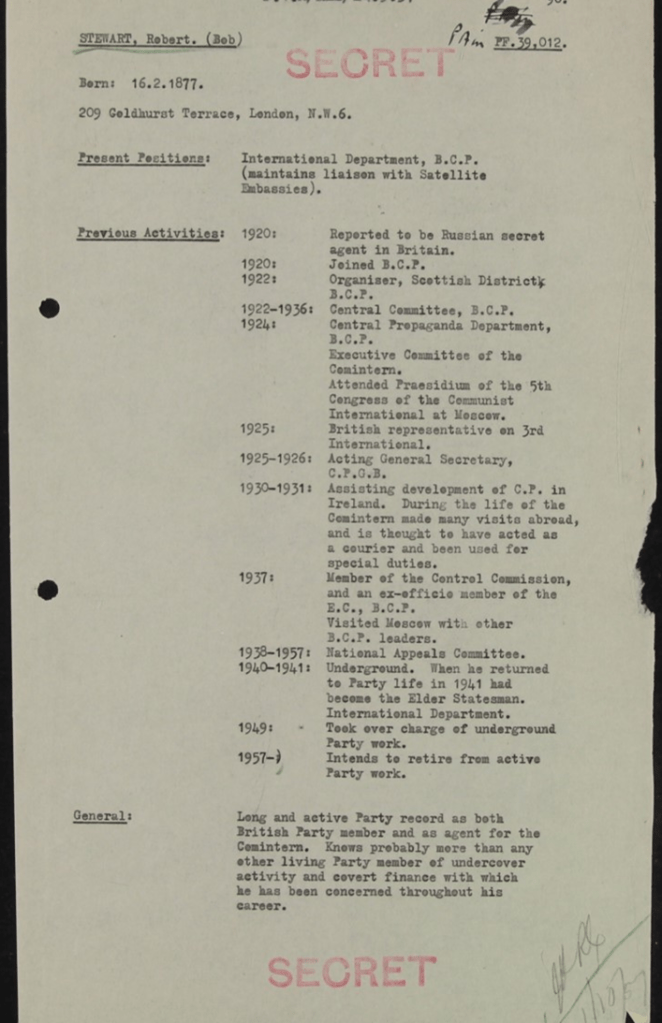
The document above is taken from the MI5 files now held at the National Archives in Kew. It’s from 1957 and gives a pretty comprehensive overview of Bob Stewart’s career in the Communist Party so far. Bob celebrated his eightieth birthday that year and most of the material the security services picked up from tapped telephones and bugged offices at the CPGB HQ in King Street, Covent Garden relate to him aiming to wind down and retire. There’s a decent summary of his professional life at the end.
“A long and active Party record as both British member and as agent for the Comintern. Knows probably more than any other living Party member of undercover activity and covert finance with which he has been concerned throughout his career.”
He’d spent quite a lot of the early years in Moscow, attended Lenin’s funeral and sat in meetings with Stalin. Then he spent time in Ireland trying to start up a Communist Party with the Irish labour hero Jim Larkin but little came of it. At one time, while the rest of the leading British communists were thrown in jail around the time of the General Strike, he became the CPGB’s Acting General Secretary. The Second World War years are a bit of a mystery but by the mid fifties the old man was very much on the security services radar again, though in this run down of activities they miss out his recent visit to China with Harry Pollitt where he met Mao Zedong.
Most of the surveillance work over the immediate years previously had been spent tailing him as he routinely visited satellite embassies and various address in the south of England. This was largely thought to be Bob moving different sums of Moscow cash around in order to keep King Street and The Daily Worker going. The issue of retiring and who he should hand over his responsibilities to was problematic as Bob wrote very little down, preferring instead to keep the details of all his undercover work in his head. There are several times in the transcripts where he is overheard by MI5 that he has been very lucky so far and didn’t want to go to prison at this time of his life. Indeed, at his advanced age he felt his memory was starting to fail and the past year had been exhausting. Revelations of Stalin’s crimes and how it affected his family personally had taken their toll. Eventually, Reuben Falber took over Bob’s work and if you want to find out what happened to the ‘Moscow gold’ just type his name into Google.
I don’t think Bob fully retired. There’s an album of photos from the 22nd Congress of the Communist Party of the Soviet Union in 1961 showing him mingling energetically with the delegates. He published his memoirs, Breaking the Fetters when he was ninety. Sensibly, but frustratingly it contains nothing of his undercover activities and only covers the early period of his life and the Party so there is little reflection on Stalinism. However, what does come through is his tremendous energy. The Communist Party in Britain formed in 1920. Bob was forty-five years old. All of this happened in the last half of his life. Before, there’d been thirty odd years of campaigning for the temperance movement, for trade unionism and against the First World War. The drive he had astonishes me.
I came to this story through grief. In 2018 my father, Michael, suddenly died of a heart attack at the age of 84. His passing brought to an end years of decline through vascular dementia. I had loved him very much and the idea that now there was only myself, my elder brother Ian and our mother was impossible to process. We did what most families do in that first year – come together for solace, then fracture painfully, then slowly heal. We did most of our grieving separately but I imagine it looked pretty similar. Sleep never seemed to arrive and I spent many nights in the spare room as my partner slept on searching through photographs, old letters and hunting down any recording or videos just so I could hear his voice again. He left very little trace on the internet – I picked up a few extra photographs from his days as a parish councillor, the odd story archived from the local paper from his days as the landlord of the village pub but very little else. Although it was in no way a reality, I felt I was losing him just as surely as the dementia had whittled down his ability to tell the stories he loved. God knows why I was looking for proof that he existed but, as is the way with these things, the death of a parent leads you to wanting to know more about where you come from and who your family are. And inevitably, you always leave it too late to ask the questions you need to ask. The gathering at my father’s funeral had been small. That’s not surprising for someone of my father’s age. He’d not been wealthy, he’d been an only child, both his parents had been dead for decades and illness had reduced his world. I’d always been aware that my family was perhaps more compact than my friends’ with all their cousins and uncles and aunts but, on my dad’s side, despite there being family out there somewhere, I can’t remember very much contact while I was growing up. Other than the affection he held for Bill and Jessica, his mother and father, and a few stories about his grandfather Bob I knew very little about his life before he was our Dad.
One insomniac night I was looking for more traces of him, and I finally found something more. I’d searched the National Archives collection and discovered the security service files relating to ‘Robert Stewart: A founder member of the British Communist Party…British representative on the Comintern and a member of its Executive. For many years he oversaw the British Communist Party’s secret apparatus including, it was thought, those of its members who passed military information to the Soviet Union’. Of course I’d grown up with the knowledge of who Bob Stewart was but here was acres of material – all scanned and, from what was once top secret, easily accessible. Skimming through one file I found this dated August 1933:
“I saw Bob Stewart yesterday. Bill’s wife is in hospital. She had a baby a couple of days ago. Bob didn’t know a thing until it arrived. Both are doing well.”
The extract was from a letter intercepted by MI5 and written by the union agitator and one of the few communist politicians to be elected to Parliament, Willie Gallacher. The baby was my father who was born a few weeks before. The letter is mentioned during some notes about Bob’s arrival from Holland. Not only is his correspondence and that of his friends being intercepted, his movement around the country and abroad are being closely monitored. I continued to search the files for any mention of my father, occasionally rewarded with a tantalising glimpse. By the time the surveillance crept into the 1950s they were bugging telephones and offices. Through the transcripts I had the intimate conversations of the side of the family I had vaguely heard about but never really knew.
So, what is to be done with all of this? And all the letters, photographs and souvenirs left behind that we inherited from Granddad after his death in 1978. The case full of stuff that convinced me that all my family were all Soviet agents when I was five. The answer is to read and remember and to try to understand. There’s a lot in Bob’s life that I admire but, as with any lifelong communist from the 1920s, sooner or later you have to confront the obscenity of Stalinism. At the moment, as I’m researching the ramifications of Khrushchev’s secret speech and the Hungarian uprising in 1956 its clear these events had huge repercussions for my great grandfather, his children and his grandchildren. I’m not sure Bob comes out of it well but that’s for later. For now, all that remains is to say – Dad, all this is for you. I wish you were here to show you what we’ve found out. I wish you were here to talk about it all. We miss you.


 Breaking the Fetters