Oh, Calton Gaol! Oh, Calton Gaol! Sae sombre, grim and grey, Within thy wa’s were gallant hearts, Held captive many a day, For they refused to bend the knee, To tyrant’s cruel sway, Their stand remembered aye shall be, They stood for liberty.
Bob Stewart’s Prison Rhymes
The days wore on to my second court martial. Now I was really beginning to know the ropes. Culprits for the court were lined up outside the court-room in good time, in charge of a sergeant. There was the usual to-ing and fro-ing, standing to attention, saluting and so on. Yours truly, of course, was taking no part in the proceedings and a young soldier standing near me said, “Some funny things come up in times of war.” “No, no,” I replied. “No different from time of peace. Only different uniforms.” “You should be shot,” he came back. “Well, if I wait till you save up to buy a gun I don’t doubt I’ll have my old age pension before that.” After a turn down the line, he came back and said, “Christ! that was a good one!”
The sentence of the court conformed to regulations. “For failing to obey military order, etc., etc. . . One year’s imprisonment with hard labour ” (subsequently reduced to six months). In due course I was escorted Calton Gaol, Edinburgh , and handed over to the authorities. The authorities, by trial and error, had discovered by this time that even their notorious “glass-houses”, the military detention barracks with their “at the double” man breaking exercises, only stiffened the resistance of the objectors to military service. The refusal to obey the “lion-tamers” was having a bad effect on the other prisoners who became inclined to emulate them, and so the government made a virtue out of necessity, and a show of their “humanity”, by transferring the objectors to civil jails.
Calton Gaol was grim and grey, old and forbidding both inside and out. Reception was not quite so noisy as the Scrubs. I remember the warder fussing around, listing the King’s property in my possession, which tended to get less and less as I passed through the guard-rooms where other soldiers were always short of kit.
“Whit’s your size in buits?” Try them on. “Have you had a bath?” Oh, aye, you look clean. “Where’s your moleskins?” In Scottish prisons the dress includes moleskin breeches tied at the knees with tape, long stockings which never matched, rough cotton shirt (Kirkcaldy strip to the trade), moleskin jacket, glengarry cap, and of course a badge with hall and cell number. “Oh, Stewart, whit’s your religion? “I haven’t any.” “Ye maun hae a religion, a’body has in here.” “Well, here’s one that doesn’t.” “Well I’ll just mak’ ye a Quaker, there’s a lot o’ your kind Quakers.’ So down on my cell card alongside age, height, etc., goes Quaker. Now comes the chaplain. What are you in for?” “Me? Twelve months.” “That’s not what I mean. What have you done?” “Oh, I refused to do anything.” I think he then began to tumble to the position so he went outside and looked at the card. “I see you are a Quaker.” “Not me, I neither quake nor shake.” “It says so on your card.” “Ah yes, I had a soldier’s suit on yesterday but that did not make me a soldier.” So ended the spiritual ministrations and Quaker was crossed out and atheist inserted in a bold hand.
A favourite prison tale is told of this chaplain, who was alleged to be fond of a “wee drap”. One of his congregation became suddenly religious and requested the chaplain to read a bit chapter to him as he had no glasses. This the chaplain did with great pleasure but he was not so happy when he heard the convert’s explanation–that next to the taste of rum the smell can be comforting.
To supplement the swashbuckling sermons of the professional chaplain who wielded the Sword of Gideon over us on Sunday mornings, we had a diversion to amateurism on Sunday afternoons with an Evangelist; accompanied by a lady organist.
Here is the routine. When the fleshpots were removed after dinner came the order: “Stools down to the Hall for Bible Class!” Down we clattered to the Hall, and set our stools, spaced well apart to avoid conversation between prisoners (it did not!).
Mr. Bannerman the preacher opened the service with prayer (that was a signal for whispers). Then came a hymn accompanied by a wheezy harmonium. A bit doleful, but it revealed to me where the griddlers, back court and street singers had received their training. Then the prisoners recited texts from the Bible, still more doleful, but it gave the prisoners a feeling of participation which they enjoyed. Then a short sermon, a bit weepy. Another hymn or two, then an announcement that anyone who recited the 15th Chapter of St. Luke without a mistake would receive a Bible on release. On my second Sunday I gave St. Luke full voice! I got that Bible when released.
There were always “Conchies” passing in and out of Calton Gaol, many of them religious, who enjoyed reciting texts. I thought I might diversify the service a bit, so started to quote the poets: Tennyson, Burns, Shelley. Other “Conchies” soon followed suit with their favourites, from Omar Khayyam to Walt Whitman. It got too much for Mr. Bannerman, who said we must take only texts from the Bible. I think he had been taken to task by his superior. After that we had a bit of difficulty in persuading some of the lads not to utter some of the rather bawdy texts from the Good Book which might offend the lass at the music box.
One Sunday we had visitors from outside to see what we looked like. As usual the texts were invited. After a few regulars had said their piece I took a turn with: “Woe unto you Scribes and Pharisees–Hypocrites” etc., etc! That tore it! I think the visitors were taking it to heart. The outcome came the next Sunday when Mr. Bannerman told us we were getting into a rut with our texts, so we must take them in future from the 19th Psalm, which had plenty of verses, but it was deadly dull. So I tried my hand at making my own texts. They sounded much the same, and there were no complaints.
One day I was sitting in my cell at Calton when the door opened and in comes the warder. “I wonder at you, Stewart,” he says, “all these nice people who come to see you, your wife, your wee lassie and the others, all such nice people.” “Well, what of it?” I asked, puzzled. “On your card it says you are an atheist and I thought all atheists were thieves, robbers, devils or whoremongers.” “How many atheists have you in this jail?” I asked. “Only you,” he answered. “Well, if all the others are Christians it doesn’t say very much for Christianity, does it? So the poor old joker went out, locked the door and made off quite confused.
It was in Calton Gaol I first heard of the March Revolution in Russia. One day I was going round the exercise ring when in beside me came my old pal Dave Donaldson who had just been convicted again and given another dose. “There’s been a revolution in Russia. They’ve set up Workers’ and Soldiers’ Councils,” he whispered. “There will be a revolution here in six months.” “Hae ma doots,” I said, but the warder put an end to our observations on this epoch-making event.
Time marches on. Sometimes much better than the army. My time came to an end, and I was sent for by the chief warder, the Governor being away. “Well, Stewart,” he says, “you are to get another chance to shoot the Germans.” “Look, brother,” I replied, addressing him in good trade union language, “if ever I take it into my head to go shooting it won’t be Germans I’ll be looking for.” “And who will you be looking for?” “Warders.” And with that I moved to my third court martial.
Viscount Peel, for the Government, said these men, conscientious objectors, must not be released, as their purpose was to abolish conscription.
I hear the sounding tread, my Lords, Of many a million feet, As the toilers of the earth, my Lords, March down to your defeat. To destroy your laws and statutes, That have made of earth a hell, And in memory of the gallant hearts You stifled in the cell.
Bob Stewart’s Prison Rhymes
So I was booked for a crime: Refusing to go on parade.
Details of my civil trial were handed over to the Chairman, Colonel in Charge. “Stewart,” he said, “take my advice, behave yourself and soldier properly.’ I replied, “I am old enough to be responsible for my own behaviour, and as for soldiering, certainly not in this war.” “Right, you leave me no alternative,” he said. “One hundred and twelve days with hard labour.”
So that was it, one hundred and twelve of the best in Wormwood Scrubs.
Arriving in London, I was handed over by my military escort to the civil authority which in fact was much less civil than the army. I shook hands with the military escort and was handed over to the Scrubs’ gate warder. Then, as nowadays, the warders liked to be called officers, but a screw by any other name is still only a turnkey, himself under just as close a surveillance as the prisoners in his charge. They differ a lot. Some are sadistic and cruel, extra officious and bent on promotion. Others, under their official skin, are reasonably human. All of them are fearful of the economic consequences of losing their steady and comparatively lazy occupation which carries a pension with it. So they sweat to keep their record clean.
The Scrubs was one of the largest and in consequence most regimental of what were known in official jargon as ‘His Majesty’s Prisons’, which of course he never used as a personal residence. I was turfed into a reception cell to await disposal. It was a dirty, begrimed hole, some thirteen feet long and six and a half broad, its dingy walls covered by names of former occupants and an occasional word of advice, like “Sleep on it”, and some uncomplimentary remarks about officers and prison food. Scribbling on walls seems to be a favourite occupation of the Britisher in prison, possibly arising from, or maybe giving rise to, our high literary accomplishments as a nation. In one cell that I afterwards occupied, a previous occupant had written with a needle on the brickwork an almost complete catalogue of the books in the prison library. It must have been a long and tedious task.
I got a pint of skilly for breakfast and a concoction which would have horrified my wife, called soup, for dinner. Late afternoon I was officially received, my height and weight were taken, my personal possessions together with every article of kit enumerated to the barking of a head warder, then a bath in three or four inches of tepid water, and a suit of prison clothes, not ready to wear but already well worn. Then we were lined up to pass the doctor, face to the wall, while the warder shouted “Stand apart, stop talking.” In to the medico, one at a time, “Shirt up and trousers down for the doctor.” Amusing but strange to me that members of this humane profession should lend themselves to this farcical medical examination and humiliation of their fellows.
“Get them books, get up them stairs.” Them books were one Bible and one Prayer Book, which are the compulsory library of each prisoner during his stay except when on punishment.
So I became a number on the third corridor of the D hall, which at the time was entirely occupied by the “conchies”, that is those who had been tried in civil courts handed over to the military, court martialled and sentenced.
At the Scrubs, what was named the Supreme Appeal Tribunal held its sessions to re-examine each case lest any more-than-usually flagrant injustice had been perpetrated by the lesser tribunals. It was presided over by one of the Salisbury family, Lord James Edward Hubert Gascoyne-Cecil, 4th Marquess of Salisbury. This was to guarantee true impartiality, as such members of the British aristocracy would be sure to distinguish true conscientiousness from mere honest refusal of men to be conscripted to fight any enemy selected for them. In reality, the tribunal’s business was to separate the “sheep” from the “goats” by offering an alternative to prison sentence, in the shape of the Home Office work schemes, or removal to Dartmoor or Wakefield, where the locks were removed from the cell doors and a certain amount of freedom of association allowed. Those who refused to submit to alternative service, which meant voluntary service in the prosecution of the war, were condemned to the established routine of serving sentences in civil prisons, repeated court martials and further sentences. They were known as the “absolutists” who resisted all attempts to make them conform to any measures of military discipline.
So I go before the Supreme Tribunal, the Marquess of Salisbury in the chair. “I have your papers here, Stewart,” he said. “Nothing much we can do with you.” “Good,” I replied. “You can do without me altogether if you like.” But he did not like. My impression of him was that impartiality was not his strong point. So at the Scrubs I was to be for one hundred and twelve days without a visitor or a letter. Many letters came but were held back and I only received them when my time expired.
A cell in Wormwood Scrubs few years before Bob’s time there.
My new abode was the usual brick-walled domicile, thirteen feet by about seven feet. Its furnishing, a six feet by thirty-inch board bed. Top and bottom sheets of canvas, one or two blankets according to season, a bedcover, a small table under a pane of obscure glass through which a flicker of gaslight shone, sufficient to strain your eyes when reading. A small shelf for books, and a pint pot, a tin basin and a jug for water, a minute portion of soap, a very small weekly supply of toilet paper and a slop pot for natural necessities. A window in the outer wall with twenty-one very small panes of obscure glass. Woe betide any prisoner who was caught (as many were) trying to get a cock-eyed view of the outside world by standing on the stool provided to be sat on and not stood on. A copy of the prison regulations and diet sheet was hung on the wall. A mark on the centre of the wall, I learned, indicated where the prisoner should stand when the Governor made his inspection, at which time the prisoner must place his cap on top of his bed.
Religion is a very important part of prison routine. In fact you can hardly get into prison unless you have a religion. In the Scrubs, because it was so big, they had a “bunch’ of chaplains. The one I saw was a big red-faced fellow. “Religion?” he asked me curtly. “Don’t need one,” I answered just as curtly. “Don’t you believe in God?” “Which one?” That did it. “No chapel,” he shouted to his aide and that was my religious interview at an end.
I soon ran into my first bit of trouble. As I have said, the screws regard themselves as officers and like to be called Sir. I have never said Sir to anyone in my life, and certainly did not see why I should make an exception for the screws in the Scrubs. One of them said to me, “Call me Sir.” “Why?” I asked. Well, there is no direct answer to that but it meant I did two weeks in very, very solitary confinement. After that I went to sewing mail bags for an hour or two a day and also did a bit of artisan work as a joiner. We had exercise once a day, and with the large contingent walked from nowhere to nowhere and back again. What a silly exhibition.
After the first fortnight a prisoner is staged–that is, he is now considered fit to work in association. You are marched before the inspector. “What was your occupation in civil life?” “Agitator.” “What, no trade?” “Yes, carpenter.” “Could you earn a living at it?” “I could earn more than I get in here.” So I am passed to the carpenter’s shop and am given a test, then set to labour, making furniture and fitments for the H.M. Office of Works. Now there were greater opportunities of getting to know my fellow victims.
When we were working, on a platform overlooking us all paced the disciplinary warder who had no responsibility for work. He was the watch dog and his growling and barking often annoyed the artisan warder more than it did the prisoners. Artisan warders were, in my experience, more intelligent and less cunning than their mates. Their job was to get the work completed and in the process they had to discuss problems with the working prisoner. Thus there was formed an association. All tools, of course, were checked, and at the end of the work locked up in a cupboard with drawings of each tool to show where it should be put (like kids in a kindergarten). Pencils had to be sharpened by the disciplinary warder on the bridge–he painted one end and notched the other lest the lead be pinched for writing purposes. There was a powered saw and a planer but the grindstone was hand-driven. It may have been meant for punishment but actually it made gossip a bit easier, as one had to hold the tool while another turned the grinder.
Here it was I first met Dick Penifold of Brighton, who afterwards became a devoted member of the Communist Party and a leader in the co-operative movement. I remember when we were given one week’s solitary confinement and loss of one day’s remission. It was Good Friday. On exercise I contrived to fall behind Dick and whispered, “You’ll get an Easter Egg with a red flag on it for tea.” Dick laughed too loud and we were carpeted before the Governor next morning. Result, no association for one week, loss of eight marks and one day’s remission, which meant nothing.
Although a prison day seems much longer than the normal twenty-four hours, the one hundred and twelve days passed and my stay in the Scrubs came to an end. So I was taken to the Governor and then to reception to be transported to Dreghorn in Scotland for my next court martial. But the escort did not turn up and I had to do an extra day. Just my luck, overtime without pay.
Next day, in breezed a bright little corporal, well polished and full of himself, to take me to Scotland.
When I asked what had detained my escort the day before, he rattled off a story about how the escort had fallen among thieves, and bad lassies, which I guessed was bunkum. When later on I met the missing escort I got the true story. The alleged robbery was a cover-up for some inefficient book-keeping, which together we sorted out, greatly to his relief. Some years after the close of that war I was speaking at Buchanan Street, Glasgow to a very appreciative audience. At the close a neatly but poorly clad middle-aged man said: “You won’t remember me!” “No, laddie, I canna place you.” “I was the escort that got lost in London. “The uniform made you look a bit smarter!” “Oh, aye, Bob. I didn’t believe you when you said you’ll need to be a real hero to live in Lloyd George’s Land Fit for Heroes’, but by Jesus you were right!”
He was with millions on the dole- the forgotten men.
When the little fellow and I got outside the gates at the Scrubs I dumped my kitbag on the sidewalk. “What are you doing?” he asked. “I’m not carrying it,” I replied. “It’s not my kitbag, it belongs to the king, let him carry it.” So there and then began a first-class row, not about the king, he was unimportant, but about the more mundane problem of who should carry the kitbag. Finally we made a deal. We would take turn about and leave it at King’s Cross Station in the left luggage until train time. The wee fellow wanted to see London but was not too keen to do the sights accompanied by such a scruffy soldier as myself.
We were an incongruous couple, my smart escort and I, to be parading in public, but queer sights are common in London and except when we lined up at a theatre queue, small attention was paid to us. Then my escort showed off the handcuffs to show our relationship, or the absence of it, to the girls whom he was trying to impress. I don’t think he made much headway because at this time, in 1917, people were showing signs of war weariness and accustomed to seeing even dirtier conscripts than I. I don’t remember much about the show that night except that one of the performers was a countryman of mine, Harry Lauder, that much lauded Scots comedian who made a large fortune out of representing his fellow countrymen as either half drunk or half daft. He achieved further fame and fortune, a knighthood and a castle, and was a welcome guest at the tables of the great when he took to occasional anti-Labour tirades. During the show I wrote postcards to my wife and friends and was so busy that when “the King” was played the whole audience dutifully rose except me; but as the escort was more concerned with a young lass and getting her address for future purposes he did not notice the incident.
The show being over we left for King’s Cross, lifted the offending kitbag and boarded the train for my native heath. Into the guard-room on arrival at the barracks, where my escort explained that our late arrival was due to the prisoner being sick. As I was not asked for an explanation or opinion it passed, although by the manner in which my escort explained to the lieutenant the delights of London I very much doubt whether he was believed.
This officer was an agreeable chap who had been wounded and shell shocked. During his convalescence he was appointed to a non-combatant labour corps composed of conscientious objectors who were prepared to fit into military requirements which entitled them to pay, and their wives to allotments. This corps was usually an odd assortment of Christians from every sect- Orthodox, Auld Kirk, Free Kirk, Quakers, Christadelphians, Episcopalians, Roman and other Catholics, and other idealists, I.L.Pers and other near-socialists, and many who objected to killing or being killed in war. I always found them rather timid and less friendly than the regular soldiers with whom I fraternised in various guard-rooms.
I met one bright exception to this rule, although I have now forgotten his name. We were introduced by a corporal from Leith, a ship’s painter in civil life, who brought him into the guard-room saying, “Here’s a pal for you, Stewart, he wouldn’t eat his bloody dinner so now he’s for it.” He really was a fine pal, and well read, he knew Shakespeare’s tragedies, comedies, histories, sonnets and all. I learned much about literature from him and we had as good a time as ever I had in the guard-room, and not without fierce debates about politics. He was a member of the I.L.P, and I tried hard to cure him of that mixture although my own politics were mixed enough then. It transpired from the prisoner’s story that the rations were being cut, which he thought was being done by two officers in charge who were then helping themselves, and taking a “load” on their weekends home. To my query, “Well, what about it?” he replied, “This crowd will not stand up to the officers.” No one would bell the cat.
I suggested a round robin and after days of patient work a typist orderly was found with courage enough to type the complaint, which was then signed by quite a number, and was sent on my advice to Scottish Command. Long afterwards, I learned through the grapevine that an enquiry had been held and the officers in question transferred. They were an objectionable pair of super-patriotic bullies, dressed up in their brief authority, full of swank and swagger well behind the lines.
When War's insane alarming blast
With discord rent the air,
And rage of lust and devilry
Convulsed earth's bosom fair,
When workers, forced from useful toil,
To waste the wealth they'd made,
Were fed and clad and gun equipped,
To ply the warrior’s trade.
Bob Stewart’s Prison Rhymes.
With the enactment of the Military Service Acts in 1916, military service was imposed on all males of military age. Prior to that date, Britain’s armies were alleged to be composed of volunteers, a veneer that concealed the fact that unemployment, poverty and low wages had for a long time been the main recruiting officers for the fighting services. Very few artisans ever joined the army voluntarily, so that in the main it was recruited from the unskilled labouring and agricultural workers.
The technique of modern war, developed from 1914, demanded the widening of the pool to include the more highly skilled engineers and other craftsmen. The terrible wastage of officers and men could not be quickly replaced by the ballyhoo of pipe and brass bands, by clerical sermonising, or by indirect pressure, so compulsion by law came to fill the gap.
To sugar the pill and provide cover for “indispensables”, one-man businesses, etc., clauses were included in the Acts by which military service tribunals could grant exemptions. To meet religious susceptibilities, a clause enabled tribunals to exempt from military service those who had a conscientious objection to the shedding of human blood or taking of life. It was under this latter clause that many of the people not protected by other exemption clauses filed their exemption claims, which were generally rejected, and in the end some ten thousand “conchies,” as they came to be called, were tried in civil courts and handed over to the military authorities, where if they did not submit to military service they were court martialled and sentenced to prison.
My own case will illustrate what happened.
After my appeal to the tribunal had been rejected, as I was not a member of any religious or semi-religious organisation but a well-known socialist and anti-militarist, it being assumed that only religious people like Quakers, Christadelphians, priests in holy orders and their like could aspire to a conscientious objection to killing their fellow men, I was called to present myself for military service, which I refused to do. Then came the law in the shape of two local detectives to take me to the police court to be charged with “absent without leave”. However, the Chief Constable, who prosecuted, asked for a remand for a week, which gave me a little more time to prepare my wife to carry on my trade union and other work and also for me to put in a few more “no-conscription” meetings, much to the annoyance of the local respectables, who if they couldn’t get me shot at least expected me to be put out of sight for a long time.
However it was back to the police court again, where a military guard was already waiting to take me over. After the preliminaries, an officer from the recruiting office took the witness stand to prove that on a given day I was ordered to appear and did not do so. I was therefore marked absent and a warrant issued for my arrest. He looked rather pleased with himself, as did the magistrate, but their expressions changed when I asked, “Under what regulations do you mark a man absent?” “Under the King’s Regulations,” was the reply. “Under which one?” I persisted. The beak looked blank. The assessor said, “Can you help us, Mr. Stewart?” a rather unusual form of address to a prisoner at the bar. So I helped them by quoting the appropriate paragraph from the manual of military law which contains the King’s Regulations, in which it was clearly stated that a man could not be posted absent until twenty-one days had expired from the date of his call-up. Naturally the word of a prisoner cannot be taken as final, so a messenger hurried to the Sheriff Court next door to find a copy of the manual, which of course bore out my contention. The magistrate and his assessor consulted and it was then announced, “I am afraid we can’t convict.” So out again I went free, to the great glee of a small crowd who had gathered to see what would happen to Stewart, and the extreme chagrin of the military escort, beautifully polished, a straight slim soldier, handcuffs at the ready, waiting for me to be convicted. “Aye laddie,” I said. “You’re too early,” and off I went.
So the responsible military authority had to start all over again with my call-up, the time allowance and the other routine. Actually it was by sheer accident that I had discovered this paragraph, which I came across when I was looking for a way out for another man who had declared his conscientious objection, and had asked me to assist in the preparing of his case.
Dudhope Castle.
But time is inexorable, and everything was in order on the next occasion, when I was duly convicted, handed over to the guard and taken to Dudhope Castle, an ancient and dilapidated building which served as the local military prison, there to await an escort to my regiment.
During the period of conscription, my wife and other women were busy in assisting other objectors who were arrested, bringing them food while they were waiting to be transferred to their regiments. So it was no surprise to me when a guard told me, “Your wife’s ootside, Bob, and she’s brought you a parcel,” which he handed over to me. This instantly made me quite popular. I once told Sir Borlase Childs, Director of Personnel to the War Office, that “Soldiers are either one of two things, hard up or fed up” – and when they are hard up, tea and cakes are very acceptable. So we had a good feed and a wee concert in the guard-room, a nice introduction, but not a typical one, to my military career.
Next morning in came the Provost Sergeant, who had an evil reputation, and with him the Officer of the Day. “Shun!”‘ shouts the sergeant, and everyone shuns except me. The officer looked horrified. He turned to have a word with the sergeant, who told him who I was, and then they made a speedy exit. Immediately, in marches the sergeant and two privates. “Stewart!’ he shouts. “That’s me.”‘ “Out!’ And out I went into solitary confinement, no doubt to teach me a lesson to shun when ordered to do so.
So down I went into the infamous “rat-pit” all on my lonesome. Not that I minded very much, because I always get on very well in my own company. Then I have furious arguments with myself as to whether I am doing right or wrong, and if nothing else, it helps to pass the time. So in the rat-pit I remained, but not for long. A few days later an escort came to take me to my regiment at Hamilton Barracks, about seventy miles from Dundee.
On arrival at the barracks, I was, after examination of the necessary papers, dumped in the guard-room where about a dozen others, mostly absentees, were sleeping or playing cards. I can recall this well because it was Hogmanay, the evening of the 3rst December, which is a night to celebrate in Scotland. In the guard-room were over a dozen soldiers, all patriots absent without leave, or in on some other charge. There was one, Charlie by name, a bit of a Glasgow comic, who was keeping a wound in good condition so that he would not have to return too quickly to his regiment. So we stand around for a bit and then the old arguments come up.
“Why don’t you go to the war?”
“Because it’s not my war.”
And then comes the serious discussion about the reasons and necessity for wars. But Charlie could not prevent his mind wandering to the sesonal celebrations. “Christ, ” he said, “in Glasgow there’s my faither, my maither and my big braither and sister, a’ the neebours roondaboot, they will a’ be in the hoose. And there’s my picture above the mantelpiece and they’ll be saying ‘Well, here’s tae ye, Charlie’, plenty o’ nips in the bottle, and here’s me in this bloody place and canna get even a drink o’ water. What a bloody rotten Hogmanay, what a bloody rotten war.”
We bedded down at last under the scruffy blankets and in the morning I wrote a postcard home to my wife saying I was well, the company was friendly but the blankets were lousy. The censor scored that bit out but the blankets were removed for delousing that day.
Next morning I was served out with kitbag and clobber. This accompanied me from barracks to prisons and back again, and grew lighter and lighter with each move until, at my discharge in 1919, only the suit and cap were left to comply with the order of return. But more of that to come. It came to my turn to be ordered on parade, which I ignored, and was conducted under guard to the orderly room where a very young officer barked “Attention!” “Not me, laddie,” I replied, and so I was remanded for my first court martial.
It was commonly said that the First World War came like a bolt from the blue. That was true for the mass of the population, but it was not true for the government of the day or for the socialists.
In 1912, as I remember, a tremendous campaign was waged by the government for what was then called National Service. The chief propagandist for this was Lord Roberts, “Bobs”. who of course was reputed to have won the South African war. It is never the common soldiers who win wars. Lord Roberts did a tour of the whole country with all the biggest halls in the big towns put at his disposal. When he came to Scotland I followed him around, holding meetings immediately after him. My meetings were naturally in the open air, but nevertheless we got big audiences. We were quite clear in our minds what the intention of the government was and impressed upon the people that the demand for national service was only the introduction to military conscription, no matter how they dressed it up. The workers would be conscripted for war when war came.
On the 4th of August 1914, war against Germany was declared. I spent the following two years, up until the time of my arrest, speaking on anti-war platforms against the prosecution of the war. In this period it was very difficult, but our little organisation in Dundee, and in a number of places throughout Scotland, kept going from the first day war was declared.
Our job was made more difficult by the division in the labour movement. The members of the Labour Party were at sixes and sevens in their attitude to the war. The Labour Party then was described as a federation, consisting of trade unions, trades councils, socialist societies and local parties. The co-operatives were not, at that time, a political party, nor was there individual membership of the Labour Party. That came in 1918. In the Labour Party, the Independent Labour Party claimed 60,000 members, the British Socialist Party 10,000 members and the Fabians 2,000 members. A variety of socialist societies like the Clarion Fellowship, the Church Socialist League, the Herald League, etc., were with the Second International, but with the outbreak of the war, and despite excellent decisions on international solidarity passed before war was declared, the Second International was torn to tatters.
Of the press, the Daily Citizen and the Daily Herald cracked up either before the war or in 1914, and then the Herald became a weekly. Other weeklies were the Labour Leader, Justice, the Clarion, New Age, New Statesman, the Railway Review and a number of small local weeklies run mostly by the I.L.P. There was the Irish Worker run by Connolly and Larkin in Dublin. There were fifty monthlies and a number of trade union journals. But the vast mass of the material published was reformist. Little of it was written from the Marxist standpoint of scientific socialism, although many anti-war articles continued to find a space.
Roughly speaking, on the first real test for socialist internationalism, the red flags turned to tartan with the complete collapse of the Second International and the triumph of the right-wing pro-war people in the British Labor Movement. In Scotland, the I.L.P. called a truce, although a number of their members continued to conduct anti-war propaganda. Forward, the I.L.P. paper Tom Johnstone’s rag-bag I used to call it–had a peculiar line. One writer, who wrote under the pseudonym of “Rob Roy’ was for the war lock, stock and barrel, yet Tom Johnstone and others confined themselves to exposures of the kind of thing that comes up in any war-paying too much for guns, not getting good guns for the money paid, and so on.
On the 4th August, the day on which war was declared. I was at a meeting in Peterhead speaking for the Prohibition and Reform Party. The meeting was on the links facing the prison and anyone who couldn’t make a good socialist speech looking at that view didn’t know anything about socialism. I was quite a popular speaker in Peterhead because I had made it my job to become acquainted with the fishermen’s problems. The Peterhead fishermen had what they called a Parliament, which they held on the dockside. A good democratic practice that could well be emulated in many places at the present time. This Peterhead Parliament had endured for over 100 years. I used to go down to the dockside and listen to the parliamentary discussion, and many things I learned, both in policy and procedure. Because of my interest in their affairs I was always a welcome visitor.
We had a very big meeting on the links that day and I was just getting into my stride when I was drowned out by the music of a passing band.
“What on earth’s that?” I said.
“It’s the Naval Reserve going to the station,” came the reply from the audience.
Of course in most fishing centres there were a good number of men of the Naval Reserve. They got a retainer, which added to their income and acted as a sweet little pill to recruiting. I stopped the meeting and we all followed the band and the reserves to the station. Wives and mothers were weeping, but most people didn’t know what it was all about. Wars are always sprung on the people. They don’t know their enemies until they are told. They certainly are not allowed to pick their enemies, otherwise a lot of people would disappear. The band was from the Salvation Army and I always remember the tune, “Lead Kindly Light”. Where they were being led I tried to tell them when we resumed the meeting on the links.
In the evening we held another meeting in the Fish Market, which was crowded despite the rain. My chairman was a fisherman called Mitchell, the first fisherman socialist and rationalist I ever met. A very clever man, who according to Dr. Williamson, superintendent of the fish hatchery Aberdeen, was one of the best scholars in marine zoology he had ever had. Mitchell worked on the trawlers, was torpedoed during the war and lost. I remember the introduction to my speech that night. I said: “Whatever else may transpire in the coming war, you will all learn in the course of it or in its aftermath that it is a capitalist war. It is not worth sacrificing the bones of your domestic cat, or your pet canary, even less those of your husbands, brothers and sons.”
When war was declared, many of the lower-paid workers volunteered, which was natural enough because a soldier’s pay was better than a labourer’s. It also had an appeal to the wives because their army separation allowance came regularly, whereas sometimes the wages didn’t. But in the main the artisans and better-paid workers stayed at the work bench, and it was here in the factories and in the industrial field that the government’s problems began to show.
There were several threats of strikes in 1914, but the call came for industrial truce. The right-wing leaders of the unions tried hard to hold the workers in check, the slogan being “The country is in danger’, but they never tried to explain what part of the country the workers actually owned. I don’t know of any honest working man who got anything out of the war.
The industrial truce meant handcuffing the workers. In July 1915 came the Munitions of War Act which meant that it was a penal offence to leave your work without the consent of your employer, and, worse, also a penal offence to refuse to take a new job, whatever the rate of pay. Offenders against the Act could appeal to the Munitions Tribunals where the chairman had the final say. No appeal against his decision could be accepted. There was the dilution of labour and imported labor imposed by the government with the assistance of the trade union leaders. Then came the rent increases and the steep rise in the cost of living. The militants had certainly plenty to battle against.
As the war proceeded, the lefts in the labour movement began to fight back, particularly in the workshop. Industrial unionism, a principle which had been gaining ground in industry for some years, began to find a real practical expression. Best known were the Workers’ Committees on the Clyde, the formation and activity of which are graphically described in Willie Gallacher’s book Revolt on the Clyde and in his Last Memoirs. These grew out of the shop stewards movement, which early in the war was operating as a parallel force with the district committees and local branches.
As the months passed, the war became less and less popular, and the anti-war meetings better appreciated and better attended. Naturally the position of a speaker was very difficult because we often had in the audience people stricken with anguish through the loss of husbands or sons. One also had to fight against the clever official attitude to the war. “We are against war in general but not this particular one. We are not to blame for this war, it was forced on us by the Germans in their lust for expansion” and so on. This was the main stock-in-trade of the Labour people.
The capitalist need for labour meant that the doors of national and regional committees were opened to Labour men and women. They were used in recruiting campaigns and helped to get conscription accepted. They helped to organise the demonstrations with brass bands, pipe bands, flute bands, popular singers, variety artists and top spellbinders like Ben Tillet and Bottomley. The latter was all for a business man’s government and himself made good business out of it. He was not only one of the top speakers at the recruiting meetings, but one of the best paid.
In politics there was the usual intrigue. The position at the front was not too good. We, of course, had the world’s best generals and the best armies; we always have; but for some unknown reason we were retreating. So Lloyd George squeezed out Asquith because he was too tame, which was no doubt true because he was a man somewhat above the battle. He was a lawyer with a fine gift of words, who in the constituency of East Fife could hold his constituents enthralled with the necessity of changing the kitchen arrangements in the House of Commons. All very well in its way, but not good enough for a main post in a capitalist war cabinet.
On 7th December 1916, Lloyd George became prime minister and secured the support of Conservative, Labour and about half of the Liberal M.P.s in the House. Bonar Law and Balfour, much to everyone’s surprise, agreed to serve under Lloyd George. The prosecution of the war was taken out of the hands of the cabinet and entrusted to a war council of five, headed by Lloyd George himself. Henderson, the Labour leader, was a member of the war council, being a Minister without Portfolio. Another Labour leader, Barnes, was Pensions Minister, a post held by Henderson in the preceding Asquith coalition.
Unfortunately they did not go in on their own but took the Labour Party with them. “Prosecute the war to end war!””Fight for a land fit for heroes to live in!’ are samples of the slogans that began to be propagated in the labour movement. There were oceans of condemnation for German imperialists and none for their British counterparts: but that came as the casualty lists grew bigger and bigger.
The volunteers began to dry up, so the Derby Scheme was introduced. This was named after Lord Derby, its initiator. Fighting for his country meant a lot to Lord Derby, who owned a very large slice of it. In this scheme men who had not already volunteered could attest themselves as ready to enlist and were given a khaki armlet to put on their sleeve so that people would know they were patriots although not yet in the firing line. None of them had any desire to be there because it was being forced home to them every day that war in the trenches was no picnic but a deadly business in the slaughter of human beings who did not know what the war was about. As the volunteers dried up there came the recruitment of special battalions. There were sportsmen’s battalions and, for the smaller men, bantam battalions. I said at the time that if the war lasted long enough they would be recruiting canary battalions.
The capitalist capacity to divide and conquer operated in every field to try and win the acceptance of the Military Service Acts. Single men versus married men; big business men against small business men; the indispensable workers against the dispensable. The times I have sat at the tribunals and watched managers of jute works come in with about a dozen workers to state their case. Dispensable or indispensable? The workers were never asked their opinions. They had no right to an opinion. The manager had a right to an opinion, the tribunal had a right to an opinion, in fact they said they had the most right and used it too; and if they were a Court of Appeal they knew their job was to turn down the appeal, which they invariably did. Men must be found for the front, and no trick to achieve that end was left out.
The Military Service Acts brought the big fight against conscription. In the true British tradition, unity was scorned-not one organisation but a whole number were in the struggle. There was the Anti-Conscription League, mainly fathered by the trade unions; the No-Conscription Fellowship; the Fellowship of Reconciliation; the Society of Friends. There were Socialist objectors, Christian objectors, Quaker objectors. Objection was the word that counted and the government had a great objection to any kind of objector. The conscientious objectors were quite voluble in their objection to the war and the Christian objectors did valuable work in their objection to conscription. Naturally the official leaders of the church did not take that line. They are part of the establishment of capitalist governments, and as a consequence have the job of bringing in God on the side of the establishment they are working for. This is covered up with beautiful language, texts from both the Old and New Testaments, and for them it is quite easy to justify service for war, just as it is easy to warrant resistance to war. You pay your money and take your choice. Well, you get your Bible and take your choice anyway.
In the case of the conscientious objector it was the refusal to serve that was the important thing, not the opinions held against war. Refusal to serve was penal and you were entitled to be treated as an enemy.
In 1915 the local organiser of the Scottish Horse and Motormen’s Union was called up and the job fell vacant. I applied for it and got it, the pay being 30s a week. This gave me the opportunity to do my work during the day and attend anti-war meetings in the evening. It also meant I got back into the Trades Council as a delegate and was able to play a part there against conscription. We had quite big meetings in Dundee at the time, in the Albert Square, and sometimes, in bad weather, indoors. At the Square a number of forces men would drift into the audience, men from the Black Watch, the Camerons or Argylls and often a sailor or two, so one had to be careful in speech; but in dealing with human beings, and usually seeing the human side of problems, I became quite skilful in speaking. After all, soldiers and sailors are human beings and certainly they were getting tired of the war. They came and went. Many only travelled one way. Naturally they were being led by the very best generals but that did not prevent the human sacrifices of Passchendale and the Somme. After the wars, when the memoirs are written, we hear, of course, of the idiots who were leading the armies, but during the wars this is kept a close secret. The hospitals became filled to capacity with the wounded but the war went on.
Of course war is a profitable business for some, and while they babbled about the war to end war and so on, some of the business people were in no hurry to end it. Many people like this I knew in Dundee–I could give names but I won’t because of libel actions people for whom the war was an extremely profitable business. Fortunately I am long-living and have an extremely good memory for such things.
When I sailed for South Africa I got a present of a pocket book and a little money from the Templars, a Gladstone bag and a set of razors from the joiners in the Yard. At Cape Town, where I landed, my first visit was to my sister who was housekeeper to A. B. Reid, one of the protégés of Cecil Rhodes. Rhodes was the big imperialist and had a vast amount of satellite firms under his control- building works, contracting firms of all descriptions, transport firms and so on. A. B. Reid was one of the biggest building contracting men in South Africa. I met him during the visit to my sister’s and he advised me to stay in Cape Town and said he would give me work. However, I had promised my friend in Pretoria to go there and to me a promise is something you keep.
Bob’s pocket book. A gift from the Dundee branch of the IOGT.
My first night in Pretoria I ran into the race question. I was out with my two pals, Henderson, the fellow who had sent me my fare, and another called Scott, who also came from Dundee. We were walking along the street when we came to a junction and met some Africans coming up the other street. They were big fellows and going along quietly, minding their own business. Suddenly Henderson, who was quite a small fellow, about five feet three inches tall, lashed out with his boot at these Africans and kicked one to the ground. I reacted by taking a swing at him and clouting him on the jaw, then demanded to know why he wanted to kick a man like that. He gazed at me in amazement. “Do you not know that Kaffirs must stand back and let us pass?” and I got a lecture on how the black man must be kept in his place and all the blah blah that we are so familiar with at the present time. But the lecture had no effect on me. I could not understand the line of reasoning that because the colour of a man’s skin was black he could not pass in front of you. I had never had a spare pair of boots until my apprenticeship was finished and therefore such “superior” thinking was foreign to my nature, and no doubt the reading of socialist and temperance books, which always had an international content, would wipe out any thought of a colour bar.
But I very soon discovered that the colour bar in South Africa was not only an idea in some people’s minds. It was a way of life. On public transport, in places of entertainment, even in churches, there was segregation, special places for whites and others for the blacks, and to my horror even the Templars had white and black lodges.
My first job was in the railway workshops but after a few weeks hundreds of men were stood off because for some reason supplies of material and money from Britain were stopped. So back I was, unemployed again. I worked on odd jobs for the farmers on the veldt, building stables and doing all sorts of joinery work. I also worked for a few weeks finishing bungalows and villas for British officers. The war had finished long ago, but it looked as if they were anchored. Another place to find work was in the rising shanty towns. Here ordinary British soldiers took over an African woman each, set up in a shack and sent her to work washing and cleaning for the whites, while they frequented the white clubs and pubs buying and selling land script. If one tenth of the tales I had to listen to at boarding house tables and in the “scoff”‘ houses were true, then many of the whites by their own boasting were a far from reputable lot.
But as the weeks passed it became brutally apparent to me that Pretoria was a place men were not coming to, but rather getting out of very fast. The cost of living was high and unemployment was rising rapidly. So I followed the exodus and made for the Cape, where living was cheaper although wages were lower. By this time I had had to flog nearly half my toolkit to keep going and the sun-tan of the promised land had begun to wear off- if it had ever taken on.
Back in Cape Town I attended the joiner’s trade union branch and the Templars lodge and got up-to-date with the local position- state of work, employers and so on. I was elected as a delegate to the Cape Town Trades Council and on occasions was on deputations to the ministries during industrial disputes, of which there were many, but the trade unions were still weak and ineffective. This weakness was aggravated by the attitude of the whites to the organisation of the coloured and black workers. My experience was that generally speaking the whites were not only against the blacks coming into the white trade unions but in many cases against the blacks and coloured being organised at all. There was a commonly held idea that they were too stupid to organise effective trade unions.
One morning, to the horror of all “decent” people, the blacks who loaded and unloaded the ships at Cape Town did not turn up for work. They also bunkered the ships running with their heavy loads of coal on their backs up the gangways. It made me sweat to look at them. They had a grievance, a very old one. They said, maninga sabenzi i kouna mali, too much work too little money. So they stayed on their location. The bosses tried to persuade them to go back to work, but always got the same answer, we want more money. The police, both black and white, surrounded the location. The parsons of all the churches prayed and entreated. The authorities offered the time-honoured dodge of setting up a committee of inquiry. It was all of no avail. The blacks stayed quietly on their location and waited. Finally the bosses gave way and granted extra wages. This burst the bubble that the blacks were unable to organise.
I landed a job in a wood yard at Mowbray. A shipload of timber had come in and I had to supervise a gang of Africans who piled the wood, classified as firsts, seconds and thirds, in the sheds. I was constantly in trouble because I was told I did not drive the blacks hard enough. I saw they did their work; there was certainly no slacking; they worked hard and I rather liked them. They were a happy crowd and I noticed that they ate together and that many of them shared their meal pack with their less fortunate mates, something that seldom happened with the white tradesmen.
In the Cape wages were lower than up country. At this time Kruger, the Boer leader, had decreed that no white man should work for less than £1 a day, a very good wage then. But British contractors got over this by contracting men in Britain, Sweden and elsewhere for much lower rates, paying their fares to South Africa and then holding the men to their contracts while they were there. Because of this wages were lower in the Cape, approximately 14s. a day for tradesmen. Certainly the Kruger decree was never applied, but 14s. a day was a good wage if you could get steady work.
Unemployment got so bad that demands were made for relief work for the unemployed. The Cape Town Trades Council waged a campaign on this and eventually succeeded. The unions paid unemployment pay, which was only IOS. a week and lasted for only thirteen weeks. Even the cheapest board for a single man was (2 a weck. It was because of this impossible position and the campaign waged by the Trades Council that relief work was started by the authorities.
Usually the relief work was strenuous manual labour, making new roads, excavation for new buildings, and such like. This is where many of the Africans got their own back. Firstly, because they had the same relief rates as the whites and, secondly, they were much better used to the handling of a pick and a shovel and the whites could not keep pace; no doubt this made a dent in some of the superior attitudes.
I was never reduced to relief work though many times I was next door to it. I passed through several jobs that lasted only a few weeks , keeping body and soul together. then came the news that there was to be an industrial exhibition in Cape town. All joiners heard this news with glee. We went down to the site and saw the foreman. Yes! He required plenty of joiners, but he said “What rate were you expecting?” “The standard rate,” I replied. There was a heated argument with the foreman who offered 10s. a day, a figure well under the standard. We could not shift the foreman. In face of this I suggested we hold a meeting and after some discussion it was agreed that a deputation go to see the management and make it clear that if the standard rate was not paid there would be no joiners to build the exhibition. The deputation soon returned with the answer. No more than 10s. a day. So I said, “Let’s all walk off the job,” and to give a lead my pal, a fellow joiner named Forest, and myself walked off. But we were the only ones who did. The rest stayed put. The men who stayed were good trade unionists but the employment situation was so bad they weren’t prepared to fight.
One night, feeling very low, I went to the Templars and found a cricket match on. I was asked to play and at the finish got talking to another player from the opposing side, Australian, “How’s business?”‘ he asked. No one asked “How’s work? “I haven’t got any,” I replied. “I got sacked and I have no job at the moment.” He then told me a friend of his was fitting out a restaurant for his fancy woman and could do with a man to do various joinery jobs. Naturally I gobbled at this and was introduced to the friend, a shipping agent, who was satisfied I could make the necessary alterations to the restaurant.
I measured up the job, started with the wood available, and sent an order to the saw mills at Salt River for more. Things were looking up. Then, out for a walk at lunch time, I ran into another joiner, a member of the union, who was really miserable. “Christ! If I could only get another job I would tell the swine of a foreman where to get off,” he said. “Well,” I replied, it was. “I have a bit of a job myself,” and I explained what “You can have half of it if you want.” “Good, wait there a minute and I’ll be back.” He went off like a shot and when he returned a few minutes later he was a different man. I don’t know what he said or did to the foreman but he certainly relieved himself of a burden.
The shipping agent and I got along very well. A lot of furniture and prefabricated counters, etc., came out from London. These had to be put together. There were ovens to be put in the kitchen, sinks and other plumbing work to do. In fact all the building tradesmen in my digs got into the scheme. Masons worked on the walls and cut out fireplaces, plumbers worked at the water fittings, joiners fixed the floors, counters, fretwork arches and so on. This kept us going for a few weeks. I had the right to purchase most of the material and came to an agreement with the suppliers from which I got a 5 per cent commission which supplemented my wages.
I never met the shipping agent’s fancy woman and I do not know how she fared as a restaurateur, but she got a first-class place, and several building trades workers gave her thanks for supplying them with work during very hard times.
I made up my mind while doing this job that I had had enough of South Africa. During my stay I had tried to send some money home to my wife in Dundee, but although I didn’t smoke and was strictly teetotal it was hard going. My wife, working in Dundee, was finding it difficult to make ends meet, so I decided to return home. With the money from the restaurant job I had enough for the steerage fare home.
On the boat home I found many like myself, some had been even worse off. The promised land had not fulfilled its promise. Many had done a spell of relief work and were bitter about their experiences. One interesting fellow I met was a Cornishman. Cornishmen are very common in South Africa, particularly in the gold mining areas. No doubt their tin mining experience had some value. When a Cornishman got a job he wasn’t long in asking the gaffer if he could find a job for his cousin Jack. So Cornishmen in South Africa are all called Cousin Jacks. This Cornishman on the boat had been the first to take a group of Chinese down the mines. There was a tremendous political row in Britain at the time about imported Chinese labour in South Africa: This was not only a reactionary racialist matter continuing the dirty ‘Yellow Peril’ scare launched by the German Käiser in 1900, but also a strong protest expressed in the resolutions of British trade unions and socialist organisations against indentured Chinese labour kept in compounds which they regarded as a form of slavery. But the Chinese never had intentions of working in the mines for low wages. At this time the African natives were prohibited from drinking intoxicating liquor so the Chinese got into a racket of making the liquor and selling it very profitably to the Africans.
The Cornishman gave me some very graphic details of life in the gold mines. The duration of life was not long even for the white artisans. For the natives it was only a matter of months or at best a few years. The dust, lack of sanitation, intolerable labour conditions and disease were dreadful reapers of human life, white or black.
I returned home more convinced than ever that a change in economic and social conditions was necessary. South Africa was certainly a land of promise for men of capital and money, but for ordinary workers like me it was hell. The great weakness of the workers’ organisations, trade unions and co-operatives, meant that in any labour dispute the boss invariably won. I had left Dundee well equipped with tools and clothes, a book of Burns’ poems and the Bible, transport paid for and all looking rosy. I squared my debt for my outward passage, left South Africa minus half my tools and arrived home a wiser and much more experienced man.
The 1929 National Unemployed March from Glasgow to London arriving at Hyde Park.
Frankly, the 1920s do not seem very different to our own times. Huge inequality, increasing poverty and a government wholly indifferent to the situation, more concerned with preserving their interests and dismantling the rights of ordinary people. Liberal voices and the fourth estate hostile to any ideas that may remedy the situation. Perhaps the main difference between then and now is that, in the twenties, unemployment was the source of hardship whereas these days most people tipping into poverty are in work.
During the 1920s and 1930s there were numerous marches and protests to combat unemployment and hunger and my grandfather Bill Stewart was on one of the first. I recently discovered two documents that shed a little light on these times. One of them was my grandad’s own handwritten account of his experiences, written sometime in the 1970s for The Morning Star. The other was a letter to Bill from trade union legend Tom Mann- a colleague and friend of his father Bob Stewart.
Letter from Tom Mann to William Stewart.
The envelope is addressed to ‘Comrade William Stewart – WITH THE MARCHING UNEMPLOYED’ to be picked up at the Aylesbury post office on or after the 20th February. The marchers had made it on foot from Glasgow to Buckinghamshire in a little less than a month. The letter is on the headed notepaper of the National Unemployed Workers Committees Movement – an organisation set up by the CPGB to highlight the conditions of the unemployed after the First World War and on the back Tom Mann has scrawled something along the lines of ‘Good luck Will- you’ve stuck it grand.’ There’s even a signed photograph. The letter reads:
To Comrade Will Stewart and the Boys on the March.
Dear Comrades, I send you a word of hearty good luck and sincere congratulations on your splendid march.
In London we are eager for all details as to how you fare on the road. We are doing our best to prepare nicely for you on your arrival.
You have done splendidly and are now within a few days of your destination. In spite of all obstacles you have achieved your purpose so far and we believe will carry it out to the letter.
I am hoping to meet you at Watford on Friday, continue in the same spirit of Comradely devotion to our great cause and you will do much to bring about betterment now and the great Industrial and Social change for the future.
Hail to the Marchers; Fraternally Yours,
Tom Mann
Part of William Stewart’s handwritten account of the 1929 Unemployment March from Glasgow to London.
William Stewart’s own handwritten account seems to have been written sometime in the 1970s almost fifty years after the event. It sheds more light on what it was like to be on the march and the issues they faced on the way. Wal Hannington was a founding member of the CPGB and the head of the National Unemployed Workers’ Movement. If any one could identify the Geo Middleton mentioned I’d be extremely grateful.
I have just been reading your article in this morning’s Morning Star on the Hunger Marchers, and I think that apart from the actual primary importance of the political side of the campaign, please let us tell the up and coming militants what made an ‘Unemployable Person’ (as the title often was quoted) a Hunger Marcher.
I took part in the first Scottish Hunger March from Glasgow to London, we gathered in the centre of Glasgow made up of Clydeside engineers, jute workers from Dundee, fish and dock workers from Aberdeen Scottish miners from Fife and elsewhere in fact a representative section of the working class of Scotland. Tinker, tailor, soldier, sailor altogether some 300 marched off with Wal Hannington, Geo Middleton and a braw lad from the Isle of Arran. I must not omit the mobile soup kitchen of this ‘great little army’. It was an old tin Lizzie which had been an ornate ice cream cart common in Scotland. For our purpose it was fitted with an old wash house boiler (as used these days for cooking pigs swill) a few sacks of boiler coke and firewood and of course a ‘cook’ of whom more later.
The month of January was not best weatherwise in Scotland and as we progressed on our way snow was falling as we marched through Thornhill singing the old marching songs of the Movement in which we were soon to become as efficient as any body of marching troups and when London’s Trafalgar Square was reached our rendition of Macgregor’s Gathering and the Hunger Marchers song was worthy of a Red Army Choir.
I am transgressing, to get back to purport of these notes I must go back to our march across the border into Carlisle, here along a country road came the power of the law in the shape of a PC Sergeant and Chief Constable resplendent in blue and yards of black braid and a flashing silver nobbed cane. Wall gave the command to stand to attention coming abreast of the Chief Constable – he stepped forward saluted Wal and said ‘Mr Hannington you have a fine body of well disciplined men. I had visions of a rabble.’ Our well organised army of determined men had evoked a Chief Constable’s admiration. Sad to say this was not the case as we progressed.
What comradeship and warmth we received – the big splendid meals of hot vegetable soups and through Lancashire the tons of hotpot consumed as we lay down on school floors or club floors tired but proud with the great justification of the duty we were performing for our class. Proud of the bands of working class women who cooked and fed us at each halt on the way – of butchers who handed us joints of meat – bakers who gave us bread and buns – of the Co-op Womans Guild who organised their local Co-op resources on our behalf – of women, whose homes were full of their own unemployed fathers and sons, took and did washing for us.
Each marcher had an Army blanket which on the march was rolled and worn bandolier wise over our overcoats and with each man wearing an Army haversack we did look as if we meant business – marching in battalion formation of companies and sections, (we had no lack of military advisers- many of the lads were ex-servicemen).
Our commander and his deputy Wal Hannington and Geo Middleton respectively were tremendous, not forgetting the role they played – for want of a better name – political commissars.
To get back to my story and to emphasise the main purpose of writing is to show that it was in the organisation and the day to day problems and details dealt with by “Our Command’ without this the impact on the community would have been lost. All working class organisations rallied to us as the march continued south.
We had a cyclist courier on an old boneshaker who would ride ahead to alert local comrades of our impending arrival and make arrangements for our rest at night – all important when we had forced our march to some 30miles in one day on some occasions.
Wal Hannington- head of the National Unemployed Workers’ Movement.
We were approaching Warwick – our scout or courier said we would have to go to the ‘Spike’ that night and he was not too sure of the ‘Workhouse Master’. As we marched in that evening there stood the Master well dressed in tweeds and stout brown brogues – the envy of the Army booted marchers. His eyes showed his amazement at our discipline quietly he said ‘this is not what I expected’ and he re-arranged all the quarters and implemented the meals after which he asked Wal and I to share his supper in his own quarters and as the meal of lamb and pickles progressed and Wal explained the reason and the purpose of what the march involved he grew in admiration and from a hostile attitude almost came to flattering of our efforts. He voluntarily waved the 3hour work rule then in force – (any person using the workhouse overnight was compelled to do such things as cleaning, wood chopping and coal carrying. This was not always the case as in later cases when a downright refusal had to be made at other workhouses). As Wal and I said good night to him and walked across to the main building and our floor space Wal said to me “Billy another couple of hours with that bloke I would have had him packing up and joining us.
On down through Lancashire among the lassies in their clogs and shawls ladling out mountains of hotpot full of meat scrounged off local butchers and cigarettes from their own meagre supplies – though on occasions a Tobacconist gave a supply of Woodbines, Shag and papers
What an army from Glasgow to London without a courtmartial! At no time was anyone reported for drinking such was the effect of good leadership and voluntary discipline in our day to day organisation of ordinary working blokes with intellect enough to understand how worthwhile this great effort was. Many had little knowledge of The Working Class Movement when the march started other than they were against the system that had unjustly degraded them but the hell of it had not broken the spirit that took them on the march.
One wee chap whose feet were a bit sore as we marched along half whispered to me ‘Hey Bill I’ve been thinking we missed a wee thing at the start of this — job – we should have sent a telegram to Budyonny to hae sent us some o his Red Cavalry horses – ma feet always walked better in stirrups? Later I learnt he had been in the Scots Greys.
The bedding down at night were like any barrack room except the arguments were on a higher plain and as the march progressed the full sense of class and political involvement came to the top and the knowledge of fully participating in the struggle of the masses and the need to implement their knowledge grew in their eagerness and enlightenment so that when London came everyman Jack was fully conscious of every facet of the political causes that prompted our actions as working class militants.
RRS Discovery under construction in Dundee in 1900. (www.rrsdiscovery.co.uk)
Now I was a fully fledged journeyman, Gourlay’s offered me an extra year at an improver’s rate, which was 10s. under the basic journeyman’s rate. This was usual at the time but did not appeal to me. I felt I had done my apprenticeship and was entitled to the full journeyman’s rate. So I left Dundee and went to the Clydeside where I got a job in a yard in Renfrew called The Ring. This yard did specialised work on dredgers. I worked 53 hours a week for a basic 38s. 3d., 9 hours week-days and 6 hours Saturday.
I held this job for a few months. Then, after the ship was launched, there was a big pay off. It was just before the Glasgow Fair holidays and was a blow to the Glasgow men. No work meant no trip “down the water” for the wife and kids and no whisky and chasers in the pubs with their pals on Saturday nights,
For me it meant looking for another job immediately. I tramped the whole of the reaches of the Clyde, Greenock, Yoker, Partick and Govan, but at every yard the position was the same, no work. Trying to find a job was humiliating. At the yard gates hundreds of men would wait each morning and dinner-time for the foreman to come out. In most cases he did not appear, but if he did he would walk down the line of waiting men and then turn on his heel and go back inside the gates with a grunt of ‘Nothing today”, or sometimes even not a word. There were no employment exchanges then and no dole. The unemployed got 10s. a week from the union for thirteen weeks and then it was reduced. My position became desperate and, unable to find work in the yards, I was forced to find other employment. I got a job with what was called the National Benefit Trust. It had a system in which a draw was held periodically and the winner got his advance of money free of interest to buy a house. My job was to hawk around the doors trying to interest people in the lottery. The whole thing was run by a family who held all the top positions in the firm. Sellers like myself were paid on a commission-only basis. I stuck this for a month. The whole thing revolted me and I had the feeling of being degraded.
Then, by a stroke of luck, I picked up a job in the Arrol Bridge Building Works. A mate of mine, Jimmy Walsh, had an uncle who was foreman in the template shops and he told Jimmy to come and get a start. But Jimmy had also been offered another job at the Linthouse Yard which he preferred, so I went to see the uncle. He was a good sort and when I explained that his nephew had taken a job at Linthouse and hoped I would be suitable, he asked me “Can you draw?” “A barrow,” I replied . “All right,” he said, “start tomorrow and we’ll see how good your barrow is.”
I stayed there until the New Year but it was not my cup of tea. I wanted back to my trade and when I saw an advertisement for joiners for a small shipyard at Annan, I applied and got the job.
Annan today.
Annan is a small market town on the River Annan near the border and naturally, being so far inland, the ships built there were small-stern wheel ships. They were built in sections and exported, mostly to the American lakes. When I arrived, the joiner’s shop was just being erected and I went in with the pattern makers. In fact, I was the only ship joiner in the yard. The manager, a little fellow who wore a bow tie and was always very smartly dressed, but a decent fellow to work for, asked me if I could get more joiners, so I wrote to the Glasgow union committee and asked for another five to be sent. I went up to the station to meet them when they arrived and asked to see their union cards. One of them said, “Christ! I’ve left mine at home.” “Well, you had better go home and get it because you can’t start here without one,” I said. Fortunately, the other four had their union cards up-to-date and I said they were all right. I can imagine their astonishment next morning when they found out I was the only other ship joiner in the yard. Now that I had some mates I did a lot of union canvassing on the building sites in the area and we soon formed an Annan union branch of the Amalgamated Carpenters and Joiners.
Annan was a nice place to work in. The countryside was beautiful in summer. It was a great temptation to throw up a brick and if it came down you didn’t go to work that day. The laws of gravity being what they are, one day we did throw up a brick on the job and down it came, so we had the day off. We went to the hostelry and hired a two-horse brake. No motors then, and no traffic jams. We had a run round the countryside and a real good picnic. Next morning, when we turned up at the yard, the manager asked: Where were you all yesterday?” “It was too good weather to work,” I replied. “Where did you go?” “To the Loch Mabon.” “Why the hell didn’t you tell me and I would have been with you.”
In Annan there was a branch of the Good Templars Lodge. A real live lodge it was. We had dancing every week, and fishing competitions, as the River Annan was famed for its salmon and trout. We even ran a regatta, which in those days was considered a real feat of organisation. I don’t know if we took many people out of the public houses, but we certainly did give them a chance to employ their time fully in the Templars Lodge.
I lived with an old lady and her daughter who looked as old as her mother. She kept an excellent house. I had a room of my own for a time but one day Mrs. Patterson came in to apologise, saying she would have to put another lodger in with me. In this way I met Harry Watson, an iron planer from Manchester.
Harry was a good singer, he had done a bit of amateur stage work at the “free and easies” in Manchester and I persuaded him to join the Templars, stop drinking and use his talents. Soon he had more money than he had ever had in his life. He bought himself new shoes, suits, shirts and began to feel and be a man about town, So I said one day, “Harry, now I have introduced you to the finer things in life, I must now introduce you to Scottish culture. Let’s have a walk to Ecclefechan and I will show you where Thomas Carlyle was born.” “Who’s Thomas Carlyle?” asked Harry. So I explained to him as best I could that he was a Scottish writer, explained briefly what he had written, then went off to Ecclefechan which was six miles by road. But Harry remained unimpressed by his introduction to Scottish culture, his final comment being: “Thomas Carlyle must have been a bloody fool to have been born in a place like that!’
One time Harry had a flaming row with his sweetheart. Flora Whimpenny was her name. I remember it well, because many a letter I wrote to her signed “Harry”. I was engaged for a long time trying to effect a reconciliation, which I eventually did. But I never knew how Harry explained these letters to Flora because he could not write a sentence, never mind a letter, and the only papers he ever read were children’s comics. He was not alone in this. The best sellers in the shipyards in those days were Comic Cuts, Chips and other comics specially written for children. I was astounded to find that grown men read such bairn’s weeklies.
One day I was working on a little wooden boat, the type used by the missionaries in Africa. It was being built for some religious society and had only a dozen rivets in its whole construction, but unfortunately a fragment of a red-hot rivet finished up in my eye. I was on the stair panelling, and the riveter knocking off the rivet failed to stop the blaze coming off it. Off it came, and struck me right in the eye. There was no first aid. One man wanted to put carbolic in my eye. That was enough for me. I immediately took the next train home to Dundee where the eye specialist said I was just in time to save the eye. That ended my idyllic situation in Annan.
When the eye healed and I was ready to resume work, the shipyards were still slack but the Boer War had made necessary the building of many more barracks. So I went down to Salisbury Plain and got a job on the building of Bulford Camp. We were a motley lot, drawn from all over the British Isles with the Irish in the majority. At that time there was a strike in Belfast and to save strike pay joiners were sent in mass to Bulford and other camps. You could work as many hours as God sent at 9d. an hour. We slept in the huts as we built them. A hardboard bed with one blanket, which I rolled into and made the best of it. Trade unionism in this setting took a back seat although we had forms of organisation on the job.
In 1900 the shipyards got busy again and I went back to Gourlay’s at Dundee where I became a shop steward and also a member of the yard management committee. The job of the shop steward was to see that members were fully paid up and being paid in accordance with the existing agreements, and so I religiously examined all cards and wage packets from time to time in case anyone was being paid under the rate for the job. Some union organisers today pride themselves on the excellent state of their organisation but in those days in shipbuilding, particularly in places such as Dundee and on the Clyde, there was already well organised labour in the trades.
Naturally, of course, a lot depended on the activity of the delegate and his standing in the trade union branch. The rule was that men more than eight weeks in arrears would not be started, so if a man came on the job the first thing was to see his union card and get it in order. I tried to make it the generally accepted thing that when a man started he would clear his card if in arrears, and sometimes this was done by borrowing the money from me, the money being paid back from his first pay.
RRS Discovery in the Antarctic, 1923
It was about this time that I got a job on the building of the Discovery, the ship which took Captain Scott on the National Antarctic expedition. It was most interesting work. The ship was built at the Dundee Shipbuilder’s Company yard and was constructed almost entirely of Scottish oak, with a little greenheart and elm. There were no rivets, no steel plates, no iron nails. With the exception of the funnel the ship was entirely constructed of wood. It was said at the time that they had to dig men out of the Howff (the local graveyard) to get the right labour for the construction. The wood was steamed to get it bent into its proper position and wooden nails called trunnels were used and battered in to hold the beams in position.
When construction commenced, the joiner gaffer on the job was Joe Wyllie, a man with a great respect for the trade unions and respected by the workers, so in the early days the construction went smoothly and well. The job, however, was not being completed fast enough. Joe got the sack and another gaffer was brought from Grangemouth. We called him the Rat, and he was just that. The first thing he did was to have a little glass-fronted bucky built so that he could survey the whole of the shop, and from this perch he would periodically dart down to snarl at some workmen. This was to frighten them and consequently to get more work out of them. I was never able to fathom this type of thinking. I had one brush with the Rat. The joiners had a dispute and I was deputed to by-pass the Rat and go and see the yard manager, Davie Low, who was a very decent fellow. When the Rat saw me standing at the door of the manager’s office, he rushed down, threatening me and demanding to know what I was doing. His attitude sickened me. I said “Get back to your glass bucky, I’m waiting to see the manager and don’t want to be molested by an insignificant pup like you.” “You won’t be paid for this time,” he shouted, but at this point Davie Low came out and I cut it short by informing him that I was on union business, so not to worry about “his” money. Strange how such people as the Rat always scem to think it’s their money that pays the wages. So I saw the manager, told him of the dispute and in the course of it made a few uncomplimentary remarks about the Rat. “Well, Bob,” he said, “I’m only the manager, not the whole company.” Then he explained to me that the Rat had been specially employed to horse on the men and get the ship finished. Like us, the manager didn’t like it but also had to put up with it. In March, 1901, the Discovery was launched. At a reception at the Queen’s Hotel after the launching Captain Scott said “that for some months the preparing of the ship had been handed over to him. It was work that involved great detail, some harassing detail. In fact it got on your nerves occasionally.” I do not know if the new gaffer had rubbed Scott the wrong way but he certainly caused many a disturbance amongst the workers who built the good ship Discovery. But I suppose Lady Markham, who bashed a bottle of champagne against the bows at the launching, would be blissfully ignorant of such mundane shipbuilding affairs.
At this time I had a good run of work and accepted that my employment was steady. So while at Gourlay’s I got married, in 1902, on the 13th of June.
I met my wife Margaret in the Templars Lodge and with the occasional breaks I saw her regularly for some months. In fact we courted for years, then we decided to get married- a decision which I never once regretted in all my forty-eight years of married life. Margaret’s father was a master painter and had a shop of his own. Quite posh in those days. He later emigrated to New Zealand and died there.
With a master painter for a father-in-law we had a beautifully decorated home to start our married life, although it was only one room, kitchen and lavatory. One year after we were married, shipyard order books began to wear very thin. When the pay offs came, I was one of the first to go, as was usual for shop delegates.
I really did not mind this at first because I had a friend in South Africa who had been writing to me extolling the vast opportunity working men had in that great new developing country. I had done him some service previously and he said he would send me my fare to take me out to South Africa. so when the pay off came at Gourlay’s I had made up my mind to accept the offer and try my luck in the promised land. It was summer when I set sail on a ship of the Union Castle Line, the Guelph, from Southampton.
God, how my father loved to tell stories. At his funeral I spoke about the times in my twenties when I used to ring home and he would talk and talk to the point where I would put the receiver down and walk off for five minutes to make a cup of tea. When I picked up again, dad would still be going strong, never knowing he’d been speaking to empty space. In the week following his death I searched everywhere for any recording I had of him and his voice. I imagine a lot of people who don’t stop talking only ever think of themselves but I don’t think this was true of dad. He was interested in everything and everyone. Our friends became his friends and he was always happiest surrounded by people. In short – he was a lot of fun.
Unfortunately, in his last years vascular dementia dulled a lot of this. Buttonholing strangers for random conversations and endlessly repeated reminiscences of his wartime childhood were the norm for a while. Whereas in the past his stories entertained us, now they just made us apprehensive. They were to be policed and quietly managed. He had no filter. There would be myself, my partner and our small child together with my parents on a day out and when we sat down for lunch in a cafe dad would often turn his chair around and begin regaling the family behind us with his criticisms of ‘the colour bar’ in the 1960s, or the Napoleonic wars, whatever came to mind at that moment. These strangers would look bemused and often a little alarmed wondering why this person had attached themselves to their party before we got his attention to turn back to us. However, the illness didn’t dull his sense of the absurd. A few years before he died, during one of the rare times our small family was all together, he told a bizarre anecdote about his father trapped on a cargo ship with a polar bear drunk on Siberian honey. I had originally remembered the bear as being loose on a Russian submarine but my brother put me right – his memory of the story makes much more sense.
Although I can’t recall the exact words, dad’s tale left indelible images in my mind. Here’s my attempt at a retelling:
An icy breeze buffets the gulls gliding in the stone grey Leningrad skies. The docks seem busier than usual – all the activity focussed on a cargo ship berthed on the western side already sitting heavy in the water ready for its voyage. On the quayside, amongst the bedraggled dockworkers, stands a group of soldiers with rifles on their shoulders smoking and chatting nervously amongst themselves. Sailors weave past them, hats pulled down and jackets fastened tight against the Baltic air as they make the final preparations for their journey. Just one more item of cargo to load.
A crane rattles and wheezes into life. The crowds of dockers, soldiers and sailors all stop for a moment to gaze up at the large cage now being loaded on to the deck. Inside lies a huge mass of white fur which undulates slowly. Wheezing and snuffling sounds can be heard – the beast is heavily sedated. However, it is the large, black claws, each one the size of a hunting knife, that seizes the bystanders’ attention. This very large, very dangerous polar bear is on its way to London. It is a gift from Stalin himself.
With some difficulty sailors and dockworkers push and heave the massive drugged carnivore into a small compartment down in the hold where it settles down to snore away the effects of the anaesthetic. There is relief when the bar is shut down against the door and the key is turned – every man fully aware of the damage their cargo could do if it woke up and decided to clamp its jaws around their head. The final preparations are made for the journey and before long the steamship is manoeuvring its way out of the harbour towards the Gulf of Finland and out to the Baltic Sea on its way to England.
Unfortunately, the comrades haven’t read their AA Milne. In a oversight that they would soon regret, the sailors have stored a consignment of Siberian honey next to the sleeping bear. It may as well have been a powder keg. There are barrels and barrels of the stuff and, while a small group of off duty sailors sit around and pass the time playing cards, a pungent, earthy smell diffuses throughout the hold.
One of the sailors there is called Bill- a communist from Scotland. He’s there to make sure everything runs smoothly. That Stalin’s magnanimous gift is delivered without a hitch. As the cards are dealt once again, Bill becomes aware of a low growl and a scratching noise coming from the bear’s compartment. He ignores it as do the rest of the company and the game goes on. They imagine the bear is simply dreaming in the way they’ve seen their pet dogs chase rabbits in their sleep. But the bear is not dreaming. Instead the bear is emerging slowly from its slumber and has caught the scent of the wild honey.
Before long, the smell begins to intoxicate and torment the beast. It begins to get more and more agitated. To begin with the card players merely shout at it to keep the noise down before returning to their game. The growls get louder and then suddenly there is a thudding noise as the bear slams itself against the door in an effort to get to the barrels. It’s at this point the men stop playing and look nervously at each other. There is another thud. The sailors get up. While the others step warily back, Bill takes a few steps towards the bear’s compartment but instinctively stops. It is a very bad idea. Another thud accompanied by an almighty roar and the sailors scatter in panic. They shout to their comrades on deck that the bear is escaping. They shout to their comrades to bring rifles. Another thud and the sound of wood splintering. The sight of a claw, an eye, bared teeth. It’s only going to take a few more goes at battering the door before the bear escapes.
Bill shouts at the others to get out immediately and they scramble for to the steps that will take them up to the deck. Bill is the last to leave and, as he does so, the bear finally smashes through the door sending splintering wood everywhere. The sound it’s making is terrifying. It heads straight for the steps just as Bill gets onto the deck, the swipe of a paw missing his leg by inches. The ashen faced sailors are joined by their comrades as they look down the hatch, the bear snarling up at them. Someone brings along a rifle and attempts to push it into another’s hands. The man refuses. As does another. And another. Soon the whole crowd around the hatch are ignoring the chaos down below, shaking their heads and remonstrating with the man with the rifle. Not one of them is prepared to shoot the animal no matter how much danger they could be in or the damage that could be done. Shoot a gift from Stalin? How would you explain that? Staring at the floor they’d all rather take their chances with the bear.
Looking at the nervous crew Bill decides there is only one solution. He slams the hatch down and locks it, trapping the bear in the hold. The reaction down below is instantaneous- those on the deck can hear the animal going beserk. This seems to last an age- the sound of a bear wrecking every single barrel in the hold. Each smashed casing and the devouring of its contents propelling it into a further frenzy. What is to be done? Nothing it seems and most of the crowd drifts away from the hatch to worry and fret while leaving Bill and a comrade to stand guard. Eventually the bawling and growling gives way to huffing, slurping and chomping. Gradually these are replaced by a whimpering, the sound of a bear dropping to the floor and a heavy wheezing. Its a while before Bill opens the hatch. When he does, he is awed by the scenes of destruction that meet his eye. Every part of the bear’s fur seems matted and drenched with honey, its eyes rolled narcotically to the back of its head and its tongue lolling out of its slavering mouth. It is lying awkwardly on its back atop the wreckage of the entire consignment. Honey oozes out across the floor and splashes the walls. Bill will always remember this sight. A miracle no one was injured. With luck, they can now keep the bear sedated, clean up the mess and fix the worst of the damage. They can deliver their gift. Stalin need never know.
I can still remember the looks my brother gave me as we sat in a Chinese restaurant listening to Dad recount this tale. We hadn’t heard him in full flow for quite some time. It was more lucid than we were used to at that point but also more bizarre. And funny too. Much funnier than my attempt. He was more like his old self. Dad, for his part, maintained it was all true and that his father, Bill, had been one the sailors. It’s since become one of the main things we remember Dad by. Somehow typical of him but also, as it was one of the last of his tales he managed relay to us, more unique than ever. In the intervening years, the only other time I heard him talk at that length and detail was when we spoke on the phone a week before he died. For years all he’d managed was, “I’m being well looked after!” before passing the receiver back to Mum. In that last conversation he spoke for half an hour about how much he loved his parents, our Mum, my brother and me and our partners before speaking beautifully about his grandson. I knew then that it wouldn’t be long and it wasn’t a surprise when my mother rang distraught later that week. That last conversation will stay with me forever. However, the memory of it doesn’t make me laugh which is what Dad was so good at and which is why I have always wanted the polar bear story to be true.
I knew that grandad did work on Soviet steamships so there was a chance it could have happened. I had his discharge book which gave me the details of the ships he sailed on and their destinations but this stopped in 1927. Anyway, the Stalin element suggests that the incident took place in the 1930s but by that time my dad had been born and Bill had a chequered career ranging from working for the Soviet Embassy to being the catering manager at Tottenham Lido. When would he have had the time to go to Leningrad to load a polar bear onto a steamship in the first place?
I knew that if I started to pull at the threads of this tale it might not hold up. In fact it might unravel completely. All the same, I thought it was worth looking into. So, last year I sent an email to the Zoological Society of London. I began by explaining the story and apologising for it being so preposterous. The email continued:
I recently uncovered lot of documents detailing my grandfathers time on the SS Koursk- a steamship transporting goods from USSR to Britain which was operated by ARCOS during the 1920s. So, I have the Russian sailor part of the story but I don’t have the polar bear part. So, my question is. How would I find out whether the USSR gave London Zoo (or similar) a polar bear during the 1920s or 1930s? Is there any further information you could give me?
There might be no proof any of this happened. My dad told a lot of stories and this was one of the best. Wish I’d asked him more about it when he was alive.
The reply I received was remarkably unfazed as though they received requests like mine all the time. On reflection, I’m sure they do. They told me it would take a few days to research as the animal records weren’t kept in the Library and they needed to check with another department. A couple of weeks later I received the following:
Dear Alan,
I have searched our animal record cards to locate the polar bear that was shipped from the Soviet Union. There was only one polar bear which seemed a possibility, but I cannot be sure that it is the polar bear that you were told about. I have attached a photograph of the record card to this email.
So, on 30th September 1935 Captain Melenkhov and the crew of the SS Stalingrad presented London Zoo with a male polar bear called Mischa. In all probability this was the bear I was looking for. I managed to find an image of Mischa fairly easily. Standing upright in the Mappin Terrace enclosure. A huge beast. One you definitely wouldn’t want to get too close to. He looks fairly benign but then look at the size of those paws and imagine the strength behind them. You know how bears are. They can turn on you just like that. Much later Mischa became a father to the much more famous Brumas -the first baby polar bear to be successfully reared in Britain and a huge hit with the public. His image adorning a seemingly endless range of memorabilia. So, this was the polar bear part of the tale- whether I’d be able to find the truth regarding its journey to England though was another matter entirely.
Mischa the Polar Bear at London Zoo.The SS Stalingrad
The SS Stalingrad, was a cargo-passenger ship built for ice navigation making regular trips across the Arctic Ocean and the North Atlantic transporting goods back and forth between Russia and the United Kingdom. That means it was more likely to sail out from Vladivostok, Murmansk and Archangel rather than the Baltic port of Leningrad. During the Second World War, while it was part of a convoy carrying munitions from the UK to Russia via Reykjavik, it was sunk by a torpedo from a German U-boat. 21 lives were lost.
However, though our grandad had served on similar vessels in the past, by 1935, having recently become a father, he was rarely at sea. Did he make it onto the SS Stalingrad at all? My brother thinks that if he made this trip it was a one off. Possibly because he could be trusted & spoke English. After all, his sister was working in Moscow, and his father was a Comintern Agent. However, I think now it’s just as likely that Bill Stewart wasn’t on the crew. That maybe he just had friends on board and that he met up with them when they docked at Surrey. That he had nothing to do with trying to calm down a raging, Stalinist bear, blitzed on honey in the middle of the Baltic but that he heard all about it later. Or, of course, he may have made the whole thing up.
That first photograph I found of Mischa had lent a little bit of credence to the story and, as I put the whole thing aside for a few months wondering how to write about it, I just accepted that Russian sailors had stored an adult polar bear in the hold. There was something I’d missed on the card from London Zoo though. Next to the category ‘Habitat’ it said ‘Born in the Artic Circle in 1935’. I only noticed that, however, once I’d found another photograph of Mischa. This time on board the SS Stalingrad on its arrival in Britain that same year.
Mischa being fed on board the SS Stalingrad shortly before he as presented as a gift to the London Zoological Society. September 1935
Of course, Mischa hadn’t been a raging beast crammed into the hold ready to burst out and attack the crew until it was overcome by a stupor brought on by its gargantuan consumption of nectar. In reality one of the crew had picked up an infant bear of considerably less terrifying stature somewhere around the Arctic Circle during the ship’s voyage. Whether it was an orphan or not I do not know but Mischa clearly became a kind of ship’s mascot and the cute little thing might have been able to give you a nasty nip but would have found smashing through a compartment door next to impossible. Evidently Captain Melenkhov wasn’t sure what should be done with it on arrival in England and so presenting it to London Zoo seemed as good an idea as any. The story wasn’t true. It was wholly exaggerated. It was nonsense.
And then I realised what the story was. And I realised why my dad came to be telling it to us just as dementia started taking hold. When Mischa arrived in London, dad was a little over two years old. The tale of the polar bear drunk on Siberian honey was simply a story told by our grandfather Bill to his son Robin. Bill hadn’t been there. He may have had only the slightest connection to the whole incident but he made it his own. It was told to enchant, to amuse and to delight. To bring the teller and the listener closer together. I remember recounting a similar story to my toddler at a visit to the Natural History Museum once as we filed past a row of stuffed bears. “Look- that’s the bear that stole Daddy’s hair,” I said, going on to invent a suitably outlandish tale which my child, now a teenager, still remembers. My dad’s story was better though and the care he took to tell it showed the care our grandad took in embellishing it in the first place and none of it is surprising as clearly we are all a ludicrously sentimental lot in our family.
When I realised the whole saga was just a story told by Bill to Robin I cried for a bit. And then I was ok.
Our grandfather, Bill Stewart, our dad in his arms, sometime in 1935 or thereabouts.
The Dundee Jute Industry circa 1900. (www.verdantworks.co.uk)
At school I passed the fifth standard when I was thirteen and so entered the labour market looking for a full-time job. Following my half time work I first tried the jute mills, and was offered a start on the breaker -can. But when I saw the nature of the work my first thought was to get out, which I did. I picked up my jacket and ran as fast as I could- certainly out of sight and sound of the gaffer, who thought the new start was well on the way to being shown how to tramp the cans.
So I tried another mill and got a job in the spinning flat. Some months later, however, I did do a turn on the breaker-can. in fact, as I passed from mill to mill, I had a turn at most of the jobs.
The process of jute manufacture was then as follows. First the jute was broken from the 2 cwt. bales in which it was shipped from India. Then it was impregnated with oil. This was to add resilience to the fibre. (In the old days whale oil was used. Dundee was a main whaling seaport.) After the jute was batched , it was passed through a feeder which had rows of sharp needles called hackles. These ripped the jute fibre into strands before it fell into a breaker-can. Into these cans the boys and girls packed the jute hard with their hands. This was called tramping the cans. The fibre then went through the carding machine, the drawing machine, then to the roving, each process making the jute sliver finer. At the roving, the shifter laddies took the roves off the machine and threw them into barrows, then the roves were barrowed to the spinners where the jute was spun on to bobbins. The bobbins went to winders where the jute yarn was wound on to cops. The cops then went to the factory where the weavers at their looms wove the yarn into the finished cloth.
In many cases the factories were not adjacent to the mills and the cops had to be transported by lorries. To have a job in the factory was considered posh, much better than having a job at the mill as a spinner or a shifter, and the low mill- that is the preparing flats- was considered the lower depths.
Many a song was sung about the work in the mills and factories. There was the Dundee Weaver’s song, the Dundee Spinner’s song, and the Wee Shifter’s song, all of which have made their way one time or another to the top of the folksong charts. There were songs about the batchers and the breaker-cans, but as these came from the low mill I am afraid the language was a little on the strong side for the publishers and their printing machines, and so they remain to this day in the heads of the old mill worlkers, reserved as a special party piece when occasion permits.
It was during this time that I became involved in my first strike. As a matter of fact I was the leader. The object of the strike was none other than William Gladstone, then prime minister in Her Majesty’s government. Gladstone was a great Liberal and frequently visited a small town near Dundee called Blairgowrie which had a large area of wooded countryside around it . When in Blairgowrie, the prime minister took a hand at tree felling, and this gave rise to the cartoon of Gladstone, axe in both hands, and the slogan “Woodman, spare that tree”. Speaking of Blairgowrie, I should not forget to mention that it is also the parental home of the Grimond family who had made their fortune in Dundee jute. From the Grimond family tree came the present leader of the Liberal Party, Jo Grimond. The Grimonds were Liberal in politics but never liberal in paying wages to the Dundee jute workers who were, and still are, among the lowest paid workers in Britain.
However, that day Dundee was en fête for the prime minister, who was to receive the freedom of the city. Now it seemed to me an insult to that worthy person and a slur on the city’s reputation that while the freedom ceremony was being performed we mill workers should be slaving away in the mills. At least that was how I put it to the fellows when I suggested we knock off and go to the freedom ceremony. The proposal was carried unanimously. I can’t remember anything Gladstone said that day so it could not have been important. The important event came m next morning when the gaffer demanded an explanation: and on being told I had suggested stopping work to hear the prime minister I was given the sack on the spot.
I crossed the road to another mill and got a job there. In all, I stayed in the mills until I was sixteen. These three years of mill work and my half-time mill experience had an important effect on shaping my character and my attitude to life. Working long hours for small wages, living daily with injustice and intolerance, sowed the seeds of the desire to see a system which gave justice to the workers. Allied to this was the poverty to be seen everywhere in this jute city. Dundee was considered a town of drunkards, but when I look back with the wisdom of age, I can see that this really arose from the impoverished life of the people. They were so poorly fed that a couple of nips of whisky and a pint of beer was enough to send them into a drunken stupor. The Scottish drink was a nip of whisky, price twopence, and a penny pint of beer. That is still the Scottish drink today, but the prices are somewhat higher. When Scotsmen talk of the Good Old Days they usually refer to drink prices.
The public houses were evil, smelly places. I had first-hand experience because I used to go in them to sell news-papers, another sideline of mine to make an extra penny or two. There was the stench of beer, the sawdust on the floor, the spittoons and the salt fish the publican kept on the counter because it gave the customers a thirst when they chewed it. Most of them would not need the salt fish because those from the mills had enough jute “stoor” (flakes of jute) in their lungs and bellies to give them a thirst that a barrel of beer would not quench.
Dundee on a Saturday night (Saturday was pay day) was bedlam let loose. It used to be said that the workers did more fighting in the Overgate (a street in the city centre) on a Saturday night than the Black Watch did during all of the war. Certainly there were many pitched battles, often family against family. The Molonys against the Mulligans, O’Fees versus the McFarlanes and so on. It is laughable but true that the police used wheelbarrows to cart away the drunks and the casualties after the battles had subsided. The police wisely kept well clear until they could move in for the kill. On Monday morning, as kids, we used to go down to the prison and see dozens at a time being thrown into the Black Maria and taken to the courts. Each successive court appearance meant a higher fine but this did not lessen the number of offenders, nor make the Overgate a more peaceful place on a Saturday night. It brought tragedy to many homes, however. Fortunately my parents did not drink. My father could take an occasional bottle of ale and my mother was a strict teetotaller, a complete abstainer.
All this squalor and degradation, seeing and experiencing the misery of some of my pals who went back on a Saturday night to a home with parents brawling and fighting in a drunken stupor, had a very profound effect on my thinking. Many of my political acquaintances throughout my life have asked me why I spent so many of my early years in the Temperance and Prohibition movement. This was the reason. In fact for many years I had only one way of separating right from wrong. Those who drank were wrong- those who did not drink were right. True, my temperance was always colored with socialist principles and working-class justice, but the real reason why my early political work was done in the I.O.G.T. (Independent Order of Good Templars) was because of my experience in early life in Dundee.
When I was sixteen my life took another turn. My mother, knowing the lot of the labouring classes and not wishing her son to be one of them determined to make me an artisan, But it was by sheer accident that I became a joiner. The tailor who made my father’s clothes came on a periodic visit to get his order for trousers and jacket. When the measurements were done and a chat was taking place over a glass of ale, the subject to a trade for wee Bob came up. It transpired that the tailor had a son who was gaffer to a builder. He “spoke” for me and so I started my time as a joiner apprentice with the firm of Sandy Stewart at 4s. for a 54-hour week. This part of my apprenticeship lasted for over two years. I learned to plane and saw, making doors and windows for whatever jobs we were working on, jobbing or building. But a vast amount of my time was spent on labouring work, Sandy Stewart had a strange idea of how an apprentice should acquire the skill of his trade. I was worked like a wee Scots donkey. I had to push a barrow from the yard to the docks nearly a mile away, stack the timber on the barrow and push it back, all uphill, a very strenuous job. Worse still, I had to combine brute force with diplomacy. Sandy Stewart was always in debt to the timber merchants, Bell and Sime, and so I had to promise faithfully that the firm would give prompt attention to future payments before I could load the timber on the barrow.
The crunch came in the winter of my second year. The snow was very deep, and thick ice covered everything. The boss sent me up to his house to clear the roof and clean out the gutters. At the end of the week I received my apprentice’s wages, 6s., the second-year rate. I said, “If I do labourer’s work I want labourer’s wages.” “You’ll have to see the boss then.” So in to Sandy Stewart I went. “I did labourer’s work last week and I want labourer’s wages,” I said. “Ye’ll get no labourer’s wages here,” shouted Sandy Stewart, then he went into a rage shouting that I was a lazy good for nothing and so on. “Get out or I’ll put you out that window,” he roared. “You’ll need a new pane of glass then,” I said, “because it’s you who’s going to make that journey. Give me my apprenticeship lines.” I moved towards him, but like most men who shout and bluster their way through life he didn’t need much pressure to cave in. I got my apprenticeship lines with a note saying I had left of my own accord and so my work in Sandy Stewart’s yard came to an abrupt end.
Unemployment in the city was high. The hard winter had closed the building sites and all outside work was at a stand-still. Labour was plentiful, jobs were scarce. After much searching and standing at work gates, I started on the railway, shunting with the hydraulic capstan at the Tay Bridge goods shed. But that did not last long. One day the capstan went faulty and did not stop, the shunting rope and the hook flew off the wagon and twisted around my legs, giving me a bad though not serious injury.
I was off work for many weeks, but the railway was a new experience and there I learned a few more tricks of the workers’ trade. Railwaymen were among the lowest paid workers and always on the look out for ways to supplement their wages. Maybe it was an extra bag of flour on the lorry; there was always a market for that. Or it might be fruit. Apples or pears, particularly in the Christmas season, were always a winner. But the best bet of all was the whisky trade. Broaching the barrel was a railway skill, in fact it was more, it was an accomplished art, and many a “dab hand’ there was at the game. It was done with a very fine brace and drill. When the tiny hole was made in the barrel and the fine thread of whisky spurted out, every vessel capable of holding liquid was pressed into service- bottles, pails, flasks, the lot. After they had been filled, a very fine sliver of wood was knocked into the hole, a concoction of oil and dirt rubbed over the surface and the barrel proceeded on its way.
Broaching the barrel was so prevalent at the New Year period that special corps of police were drafted in for protection. But these guards were lured away to the bothy on the loading bank for a wee dram, just to keep them warm, and of course while they were having their wee dram another barrel was being relieved of its liquid gold. As one old loader used to say when he had got the special cop out of the way, “Whisky has a greater drawing power than the world’s best poultice.” In the bothy on the loading bank there was a barrel sunk into the ground. All the time I was there it was never empty. Anyone could drink as much as they wanted. Some did, and were carried home on occasions, but I was never once tempted, which proved conclusively that the temperance movement had one adherent whose lips were sealed to strong liquor.
I was again idle after my accident, but through people in the temperance movement I got a job in Gourlay’s shipyard. Gourlay’s was quite a famous yard; many world-renowned ships left its slipway.
While in Gourlay’s yard, I threw myself heart and soul into building the temperance movement. We had a strong group of Templars in the yard, but most of our work was done in the evenings and on Sundays. Some of the “big” fellows, the Fathers of the Lodges, wanted young people to be, as they said, “good law abiding Christians” to just come to the meetings, listen to speeches about the evils of strong drink and then meekly return home. I fought against this attitude. I thought the lodges were places where young people should have debates, sport and entertainment. Finally a few of the more progressive fellows and myself started a new lodge, the Victory Lodge. We broke the rule, we organised dances and concerts and from the money made we bought billiard tables, dart boards, draught and domino sets, and made the lodge into a real young people’s club. We held open-air meetings at which I often spoke and asked people to sign the Pledge. Naturally, because of our activity, we attracted many young people and our new lodge soon became the largest in the city. In fact, at one time it had more members than any other lodge in Scotland, and I became the Chief Templar in Dundee.
There was a lot of competition for the allegiance of the young people in the city. Churches with their auxiliaries, Young Men’s and Young Women’s Groups, were always active. There was a very good and active Secular Society. They too held meetings in the Albert Square. Their main theme was “religion is the opium of the people” and all their work was aimed at destroying the various images of God. I spent many evenings and Sunday afternoons listening to the secularists, all of them excellent speakers. Wull Bowman (grandfather of Dave Bowman, who has now for many years been Communist candidate for Dundee), and Jimmy Croll, a local shopkeeper, were two of their best who could hold a big crowd, often in face of much heckling. Their paper The Freethinker had a good sale. I was attracted to much of the logic in the secularist argument and began to have my doubts about God. Interesting therefore to record that, in later years, it was mainly on religious grounds that I finally broke with the prohibition and temperance movement.
Entrance card for the Amalgamated Society of Carpenters and Joiners. (TUC History Online)
In the last year of my apprenticeship I joined the union. It was forbidden to do so before then. I immediately took part in active work. There were two unions, the Scottish Association of Carpenters and the Amalgamated Society of Carpenters and Joiners. I joined the latter. I was elected to the management committee for the yard and did a valuable job. I was the only one who thoroughly read the National Committee minutes and consequently was always up-to-date on demarcation problems, and extra payment agreements for varying types of work. While I was there we had a very militant management committee and a closed shop was enforced, with a trade union card examination every month.
In doing this work I became a well known and popular figure, so when my apprenticeship finished my mates were determined to give me a good show. The practice then was for the new journeyman to give the fellows a big booze-up in one of the public houses in the Vault (an old alleyway in the city centre nearly three hundred years old). A journeyman was often remembered in later years for the number of drunks he had at his pay off. But I put an end to that idea for me. I said no pub. But I took a restaurant instead, and there we gave the fellows a slap up feed. Aberdeen-Angus steaks were in my opinion a better pay off than Whitbread’s beer or Morton’s whisky, all of them, by the way, products of Dundee. Naturally, when the steaks had been consumed, many of the fellows gravitated across the road to the pub, and a few got so tight that they had a swing on the glass chandelier and were “Bounced” into the street for their daring.
Now I was a fully fledged joiner. Mrs. Stewart’s work had borne fruit. I was an artisan with papers to prove it, but I was soon to discover that the lot of the artisan and that of the common labourer were very much the same.
William, the eldest son of Bob and Margaret Stewart, was born in 1903. He was our grandad. He died in 1978 when I was four and so I have few memories of him but those that I do are incredibly vivid. He was a warm, kind and gentle man. This impression has only been strengthened by the many letters and photographs he left behind. Every new detail I come across makes me wish I’d known him longer and I don’t know whether it’s his or Bob’s story I’d rather tell.
Like his father, he joined the Dundee Branch of the Communist Party of Great Britain on its inception in 1920. He was 17 and remained a card carrying member for the next 58 years until his death. It would have been his commitment to these ideals and presumably family connections that led to him working for ARCOS during the earliest years of the Soviet Union’s existence. Bill worked on merchant steamships sailing from British ports to Odessa and Leningrad progressing from cabin boy to chief steward on the way. ARCOS – the All Russian Co-Operative Society was the body responsible for facilitating Anglo- Soviet trade in the wake of Lenin’s New Economic Policy. MI5, quite understandably, regarded it as a front organisation for espionage and other subversive activities and it was raided and shut down in May 1927. Britain then broke off all diplomatic relations with the Soviet Union.
However, it is not the idea of espionage that interests me particularly. Still less the movement of textiles, timber and coal across the Baltic to the benefit of British commerce. It is this photograph that I found amongst hundreds of others in an old suitcase in my mother’s loft. A lively group of young people assembled in a shabby room adorned with agitprop posters and photos of Lenin. Their style of dress ranges from the bohemian to the Bolshevik. The majority of the group are looking towards their left- it appears that someone else is taking a group portrait while a second photographer caught this image from another angle. A couple of the figures stare out in other directions in slight confusion. Despite this there is a distinct sense of that much maligned word ‘comradeship’. One of the young men carries an accordion and I suspect that there has been quite a bit of drinking going on. A much younger boy looks on grinning in the doorway. I love this photograph.
Bill Stewart and the Russian Communists.
At the centre, in the back row is my grandfather. He’s the one wearing the budenovka- the distinctive early headgear usually worn by the troops of the Red Army in the 1920s. He looks like he’s having a good time. There is some writing on the back which explains that the picture features Russian and English communists with the affectionate declaration, “Don’t forget the Russian young communists! [Komsomoltsiev]” This is accompanied by signatures from several of those gathered there. It must have been a gift to Bill and it appears to have pinned up as a memento to serve as a reminder of his younger days.
“Don’t forget the Russian young communists! [Komsomoltsiev]” Thanks to Maurice Casey for the translation.
It’s hard enough to imagine your parents in their youth let alone your grandparents and my hearts bursts for grandad when I look at this image. It marks him out as someone who, in contrast to my own mundane life, had adventures. Striking out to places far away from home carried away in a moment in history. I’m quite jealous of him to be honest. How on earth did he end up there? When you think of the USSR youthful optimism and idealism is far from what first comes to mind but it’s certainly present in this image captured almost one hundred years ago. But, as with any photograph of the young when the subjects are long dead, there is melancholy too. Whatever happened to Bill’s companions, particularly the young Russians, in the years that followed? I fear for them.
When I first came across the photograph I had the no idea of the circumstances surrounding it or when and where it was taken. The first clue was finding Bill’s ‘Continuous Cerificate of Discharge’- the log book that records the various voyages and their destinations. It would definitely have to have been taken between 1925 and 1927. However, it was finding a small battered autograph book that belonged to Bill that narrowed it down further. The pages are dotted with various signatures and messages in Cyrillic script from friends and comrades my grandfather met on his journeys. Yelena McCafferty of http://www.talkrussian.com provided the translations and the picture became clearer. The photograph was likely to have been taken around October or November 1925 while the SS Koursk, where Bill was working as an assistant steward, was docked at Leningrad. The messages reproduced below describe how Bill and his colleagues met a group of Russian members of the Kosomol during celebrations of the 8th anniversary of the October revolution and struck up a friendship. There is a sense of the Russians eager to know how the proletarian struggle is faring overseas and much talk of Britain working towards its own revolution which, of course, is inevitable and imminent. In the light of what happened in the years that followed I find it all incredibly moving.
Alan Stewart.
William Stewart’s autograph book.
Wishing dear comrade William Stewart to be always in the leading line of the English proletariat fighting for the proletarian revolution. It’s not long until England is united with our union and until the creation of one powerful Union of Soviet Socialist Republics.
[Signed]
Flat 6, 11 Voskresensky Pr., Leningrad
Dearest comrade,
It was so joyous for us, Komsomol members from Leningrad to see you, messengers of England’s youth, that England we so often see glimpses of in the news in our newspapers but which in essence we know so little about.
Somehow it was particularly joyous to see in you the signs of being relentless fighters, healthy in both spirit and body. You are not yet the powerful Lenin-like party, but you are a wonderful material, fire bricks which will be used to make it. When in the place of a group of young, stubborn Komsomol members, in the place of a small working league comes a broad, mass, proletarian Bolshevik party – then your cause will win. Until then we will bring this day closer together. We will be proud to see that you have found something to learn from our way of life and work. May your visit be an initial point in our closely-knit connection, friendship, correspondence. Please write to us about the way you live, work, what’s happening in Komsomol, about the progress of your work in the unions, work cells, printed press, among farming community. We will write to you everything you are interested in.
Hello! “Stay alive”!
On behalf of the youth section of the Central Club of the Professional Union of Soviet and Clerical Employees.
Leningrad. Bureau Organiser.
09.11.25 K. Vasilevsky
I am walking on Prospekt 25 Oktyabrya on the 8th anniversary of the October revolution, from the commemoration evening in honour of the October revolution and suddenly I hear energetic sounds of our Internationale in English. I was very happy to find out that you are English Komsomol members and did my best to show you our way of living. I think you will remember the days spent with Russian Komsomol members, and when you have Soviets in power I hope to shake handswith you once again in England in a workers’ club. So far you have a lot of fight on your hands to reach power, but you will be able to build socialism quicker and easier compared to our backward country (in the economic sense). We, Russian Komsomol members, will come to help you when needed and will help you to carry out a social revolution.
It’s not long until the slogan of the Communist manifesto becomes reality and the proletarians of all countries join in one World Republic of Soviets.
Written by one of the army of a million and a half Russian Lenin Komsomol members, a member of the Leningrad Organisation, Central City District, Membership card №92039.
Leo Aksberg
Flat 5, 82 Prospekt 25 Oktyabrya, Leningrad
‘Worker’s of the World Unite!’
Postscript
Here’s a few items I wanted to get into the main article but they wouldn’t quite fit:
Bill obviously made firm friends on these trips. Here’s a translation from a book on the SS Koursk published in Odessa in 1972 in a series about ‘heroical ships of the Merchant Marine Fleet’. I found it amongst all the jumble of letters and documents I’ve been sifting through. I think the translation is, as the writer admits, only rough as I don’t think Comrade William Stewart ever reached the rank of captain.
“In April 1923, a British Court decided to return several ships to the young Soviet Republic. But before this decision, the British Government had already returned nine former Russian ships among which was the Steamship “Koursk’. The Koursk was included in the ARCOS Fleet and commenced voyages between the United Kingdom and the Soviet Union.
The crew of the SS Koursk mainly consisted of Russian seafarers but the Captain of the ship was a young Englishman – Communist William Stewart. William Stewart has kept good memories of the Koursk and her crew, about the excellent work and the consistently good human relations between seafarers and the communal help existing between them. Several Russian seafarers still remember William Stewart with a great sense of pleasure, for example, a former second engineer of the SS Koursk, P. Sirenko, recently remembered the following about William Stewart:
“In 1929, the SS Transbalt, on which I was working as a fireman, was lying in the London Docks. Whilst repairing the boilers, I fell and broke my arm. Our Captain approached the Port Authorities and requested that I be admitted to hospital. However, a large sum of money was involved in order to find me a place in a hospital and even so there was no free place. Suddenly, a young Englishman came aboard our ship. He spoke to the Captain and the ship’s doctor and then came to see me. “May I introduce you, Pavel, to Comrade William Stewart. He was once the Captain of the SS Koursk and has promised to help you”. A kind Englishman shook my hand, smiled and invited me to his car. He drove me to a hospital in Greenwich which was a naval hospital named after Queen Victoria. He spoke to an administrator of the hospital and I was given a bed in a very nice ward. During my stay in hospital, William Stewart visited me several times and we had many discussions when he warmly remembered his days as Captain of the SS Koursk when the ship was part of the ARCOS fleet.
When I recovered, Captain Stewart came to collect me and drove me to my ship. On saying goodbye, he asked me to send his best and warmest regards to his friends on the SS Koursk'”
Photographs of the hospital anecdote above. It has just occurred to me that every single Russian he met seemed to be incapable of making the distinction between Scottish and English. He was a very patient man.Colourised version of the British and Russian young communists.Another entry in the autograph book- ‘To the Youth, the future- Sam Brasonovitch, Odessa.’ I love this.William Stewart’s record book detailing his many journeys to and from the Soviet Union aboard the SS ARCOS and then the SS Koursk.This is a tiny photograph that I’ve magnified here. I presume it was taken either on the SS Arcos or the SS Koursk. I had thought that the figure at the front was Bill Stewart but now I’m not so sure.“Comrade Stewart, from VLKSM (All-Union Leninist Young Communist League), 3rd Division of GPU (State Political Directorate). Medvedev” – Thanks again to Yelena McCafferty for the translation.
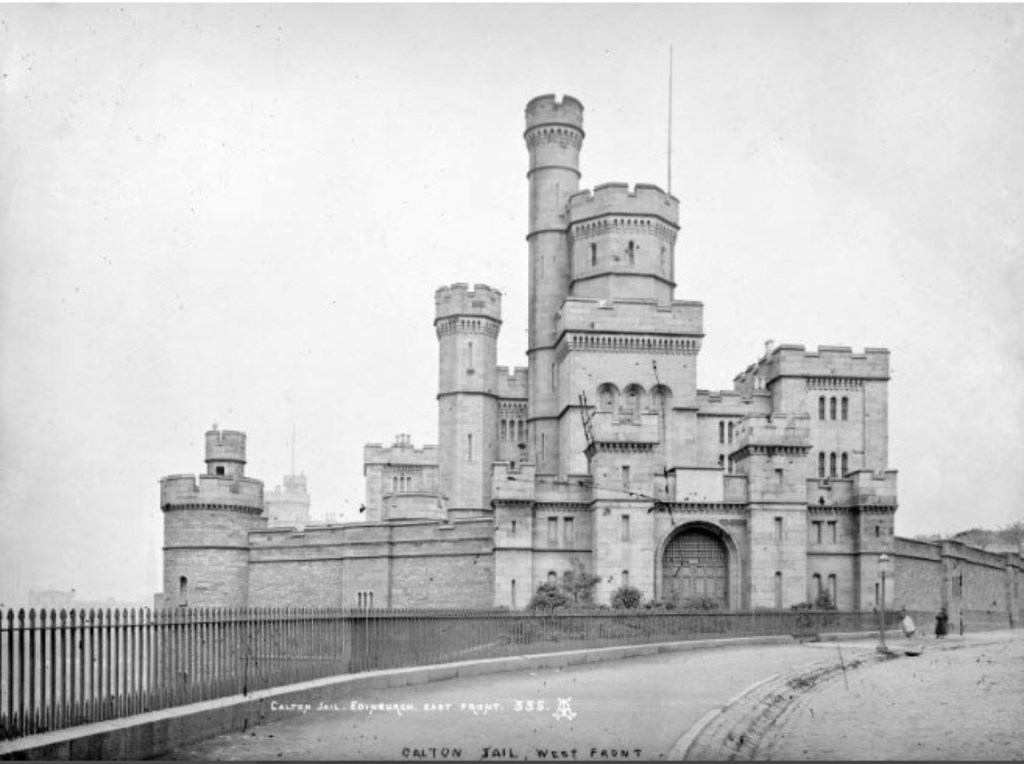
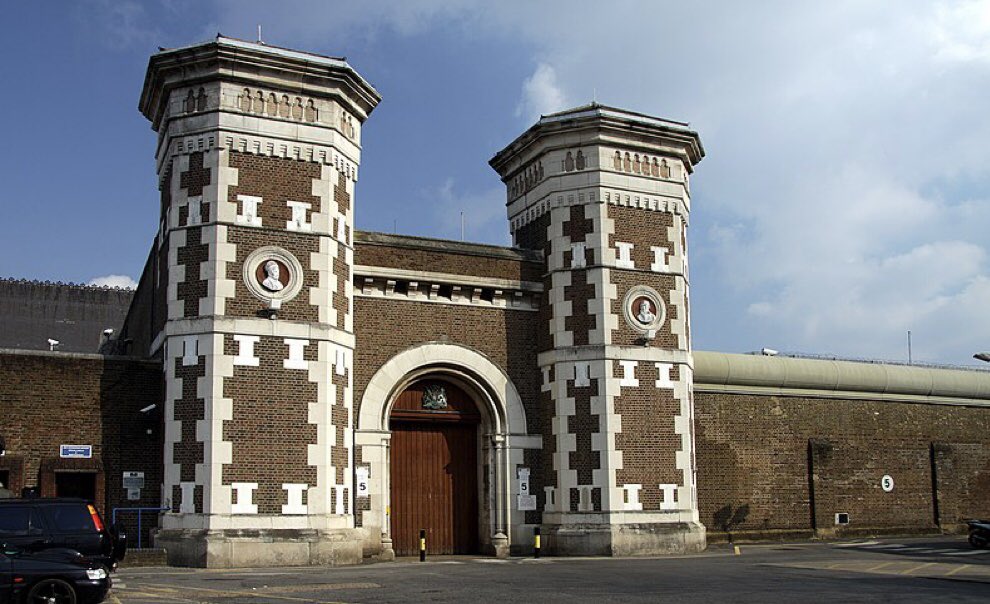
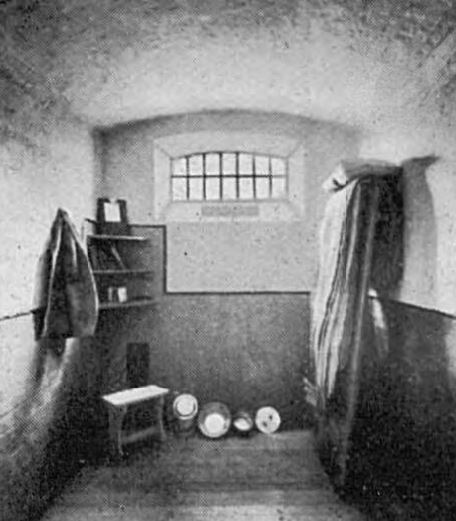

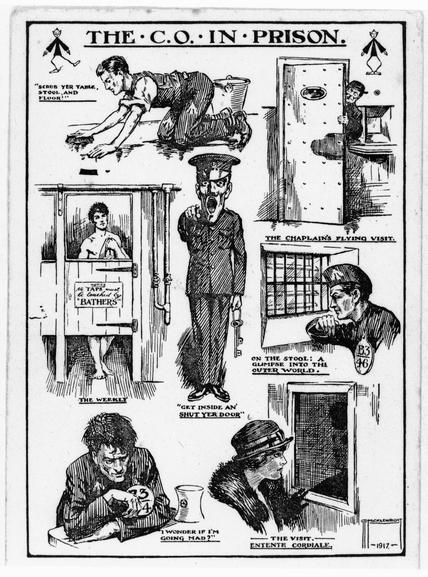
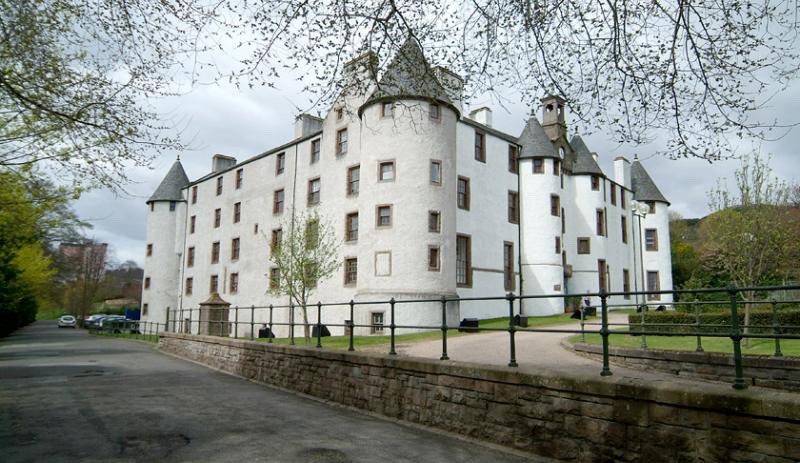


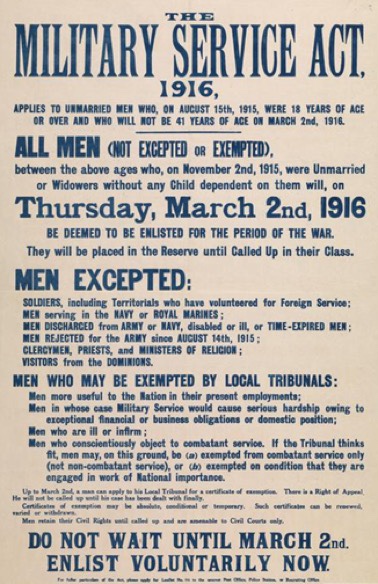

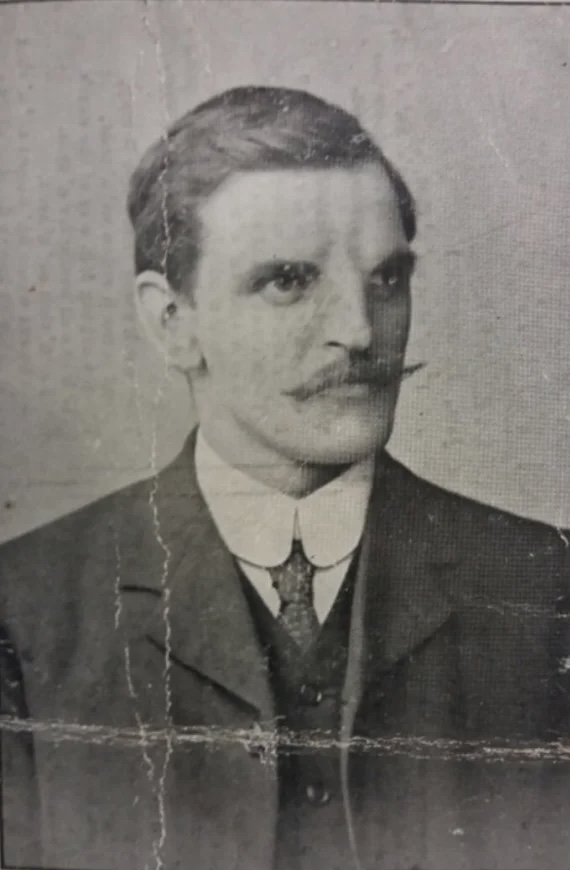

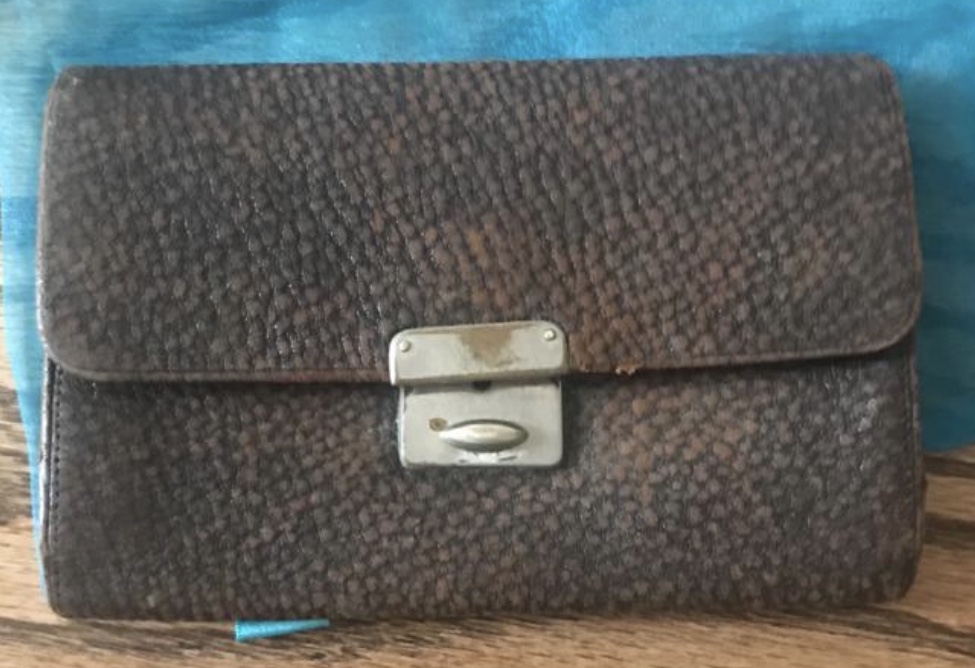
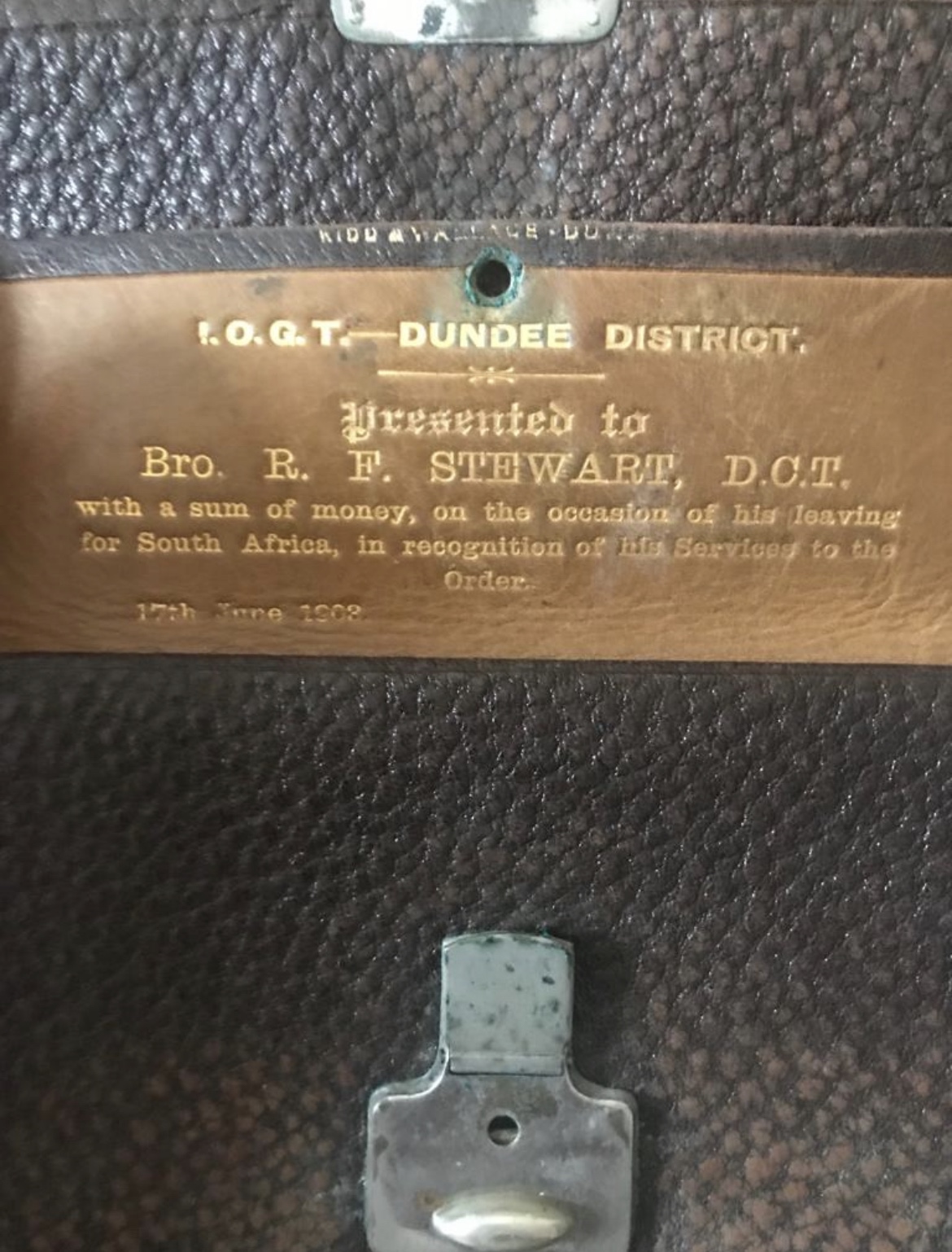


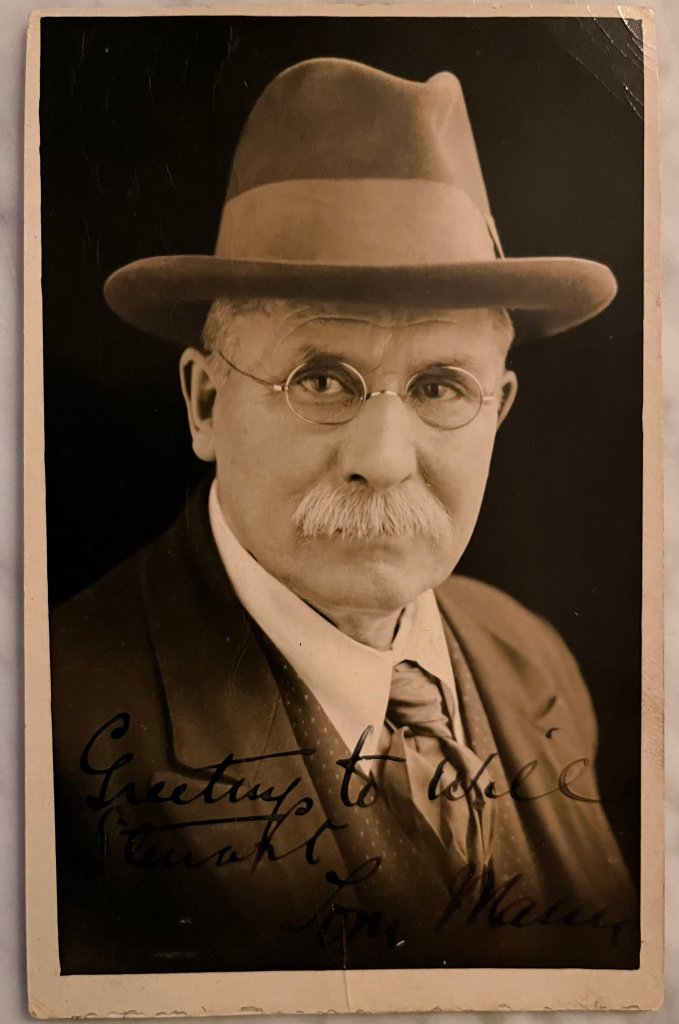
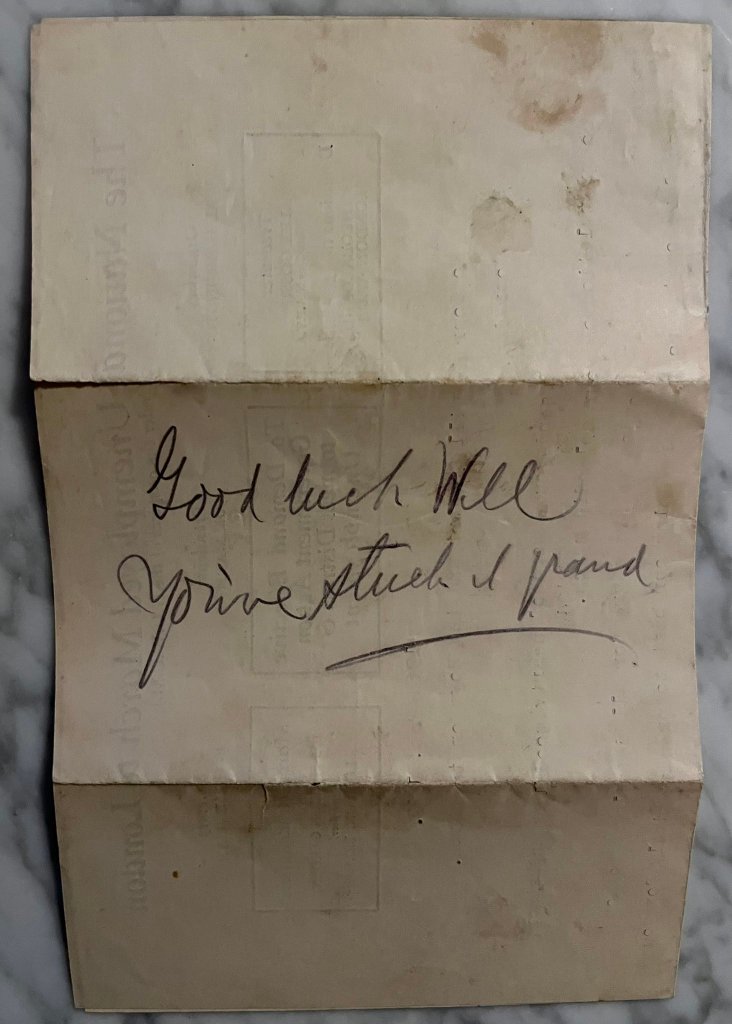
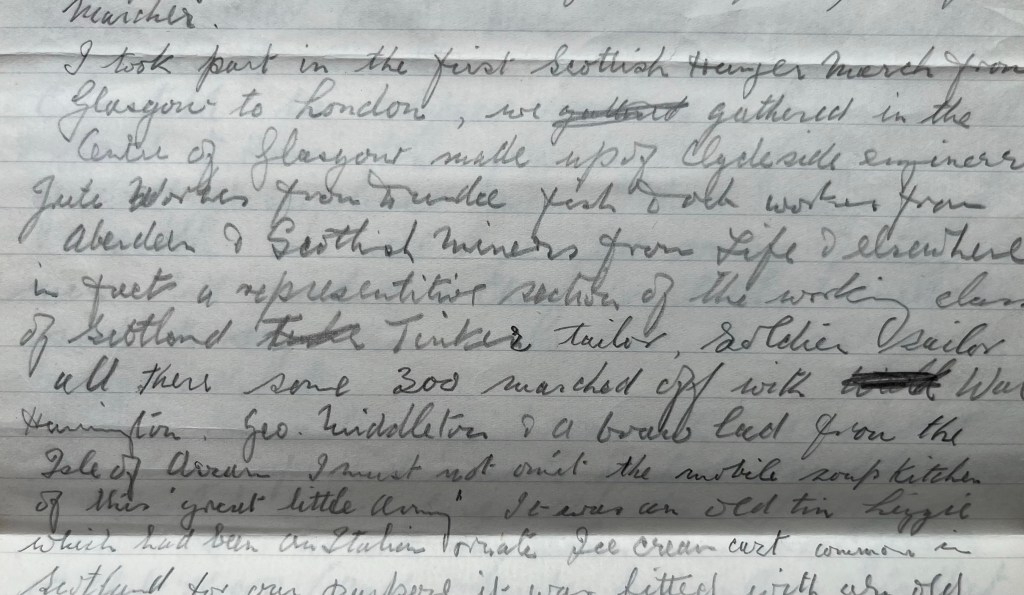
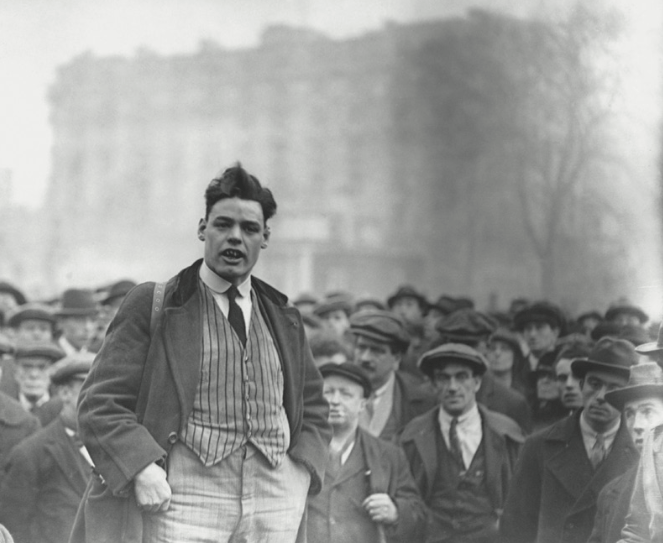



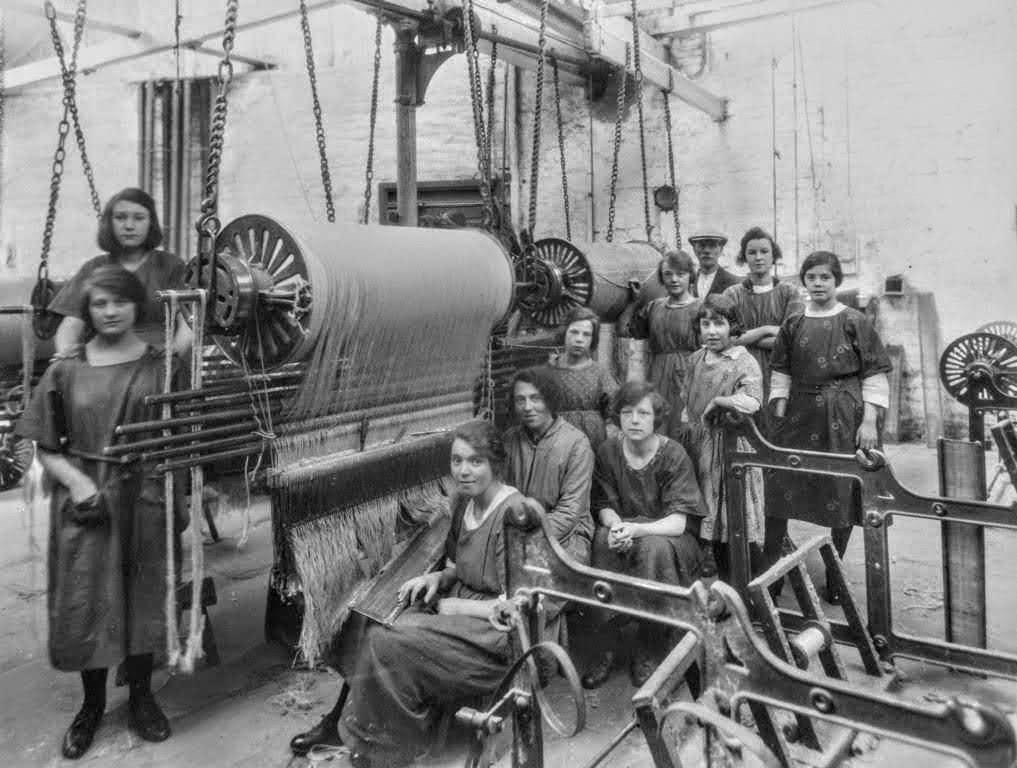

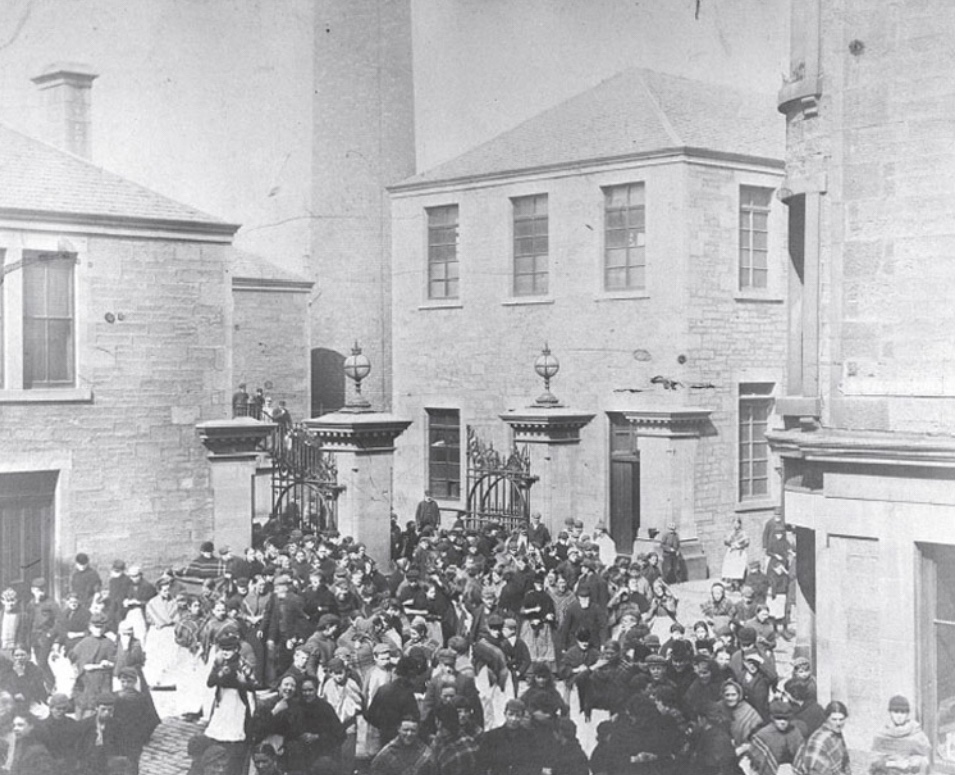


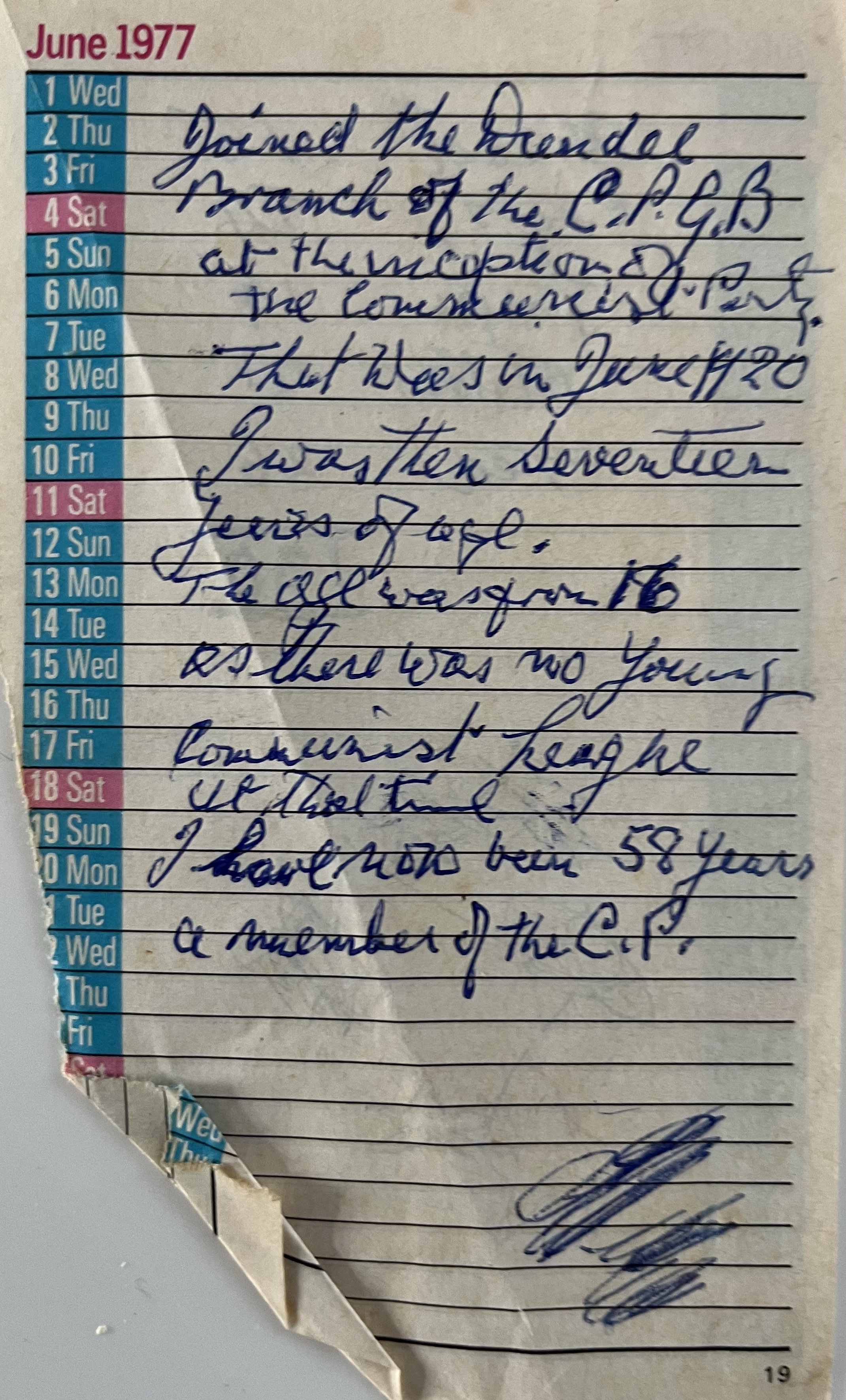
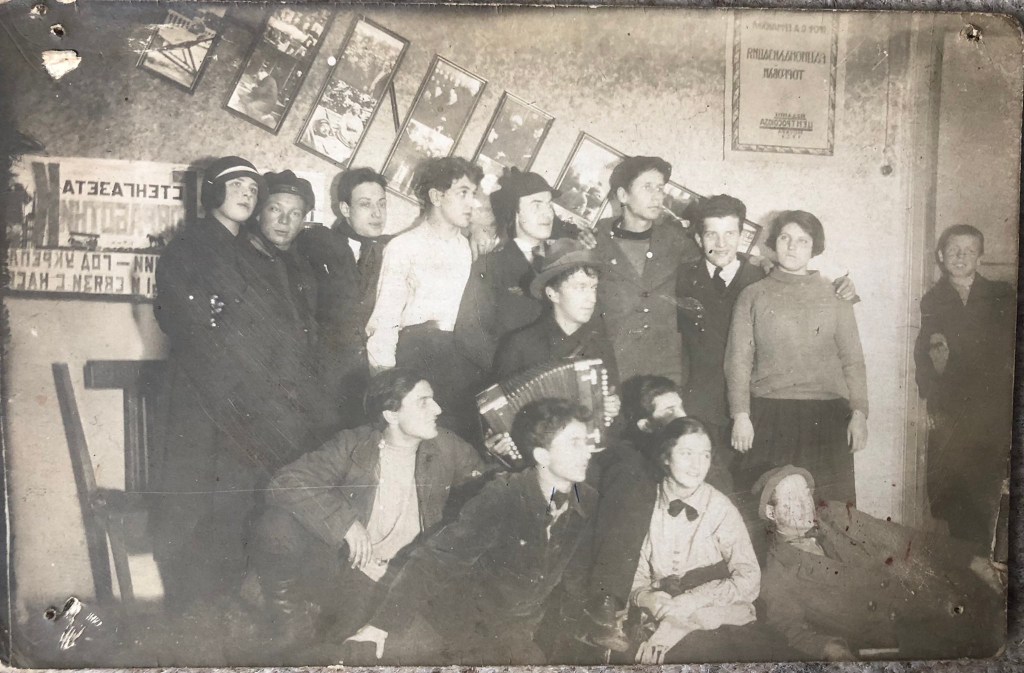



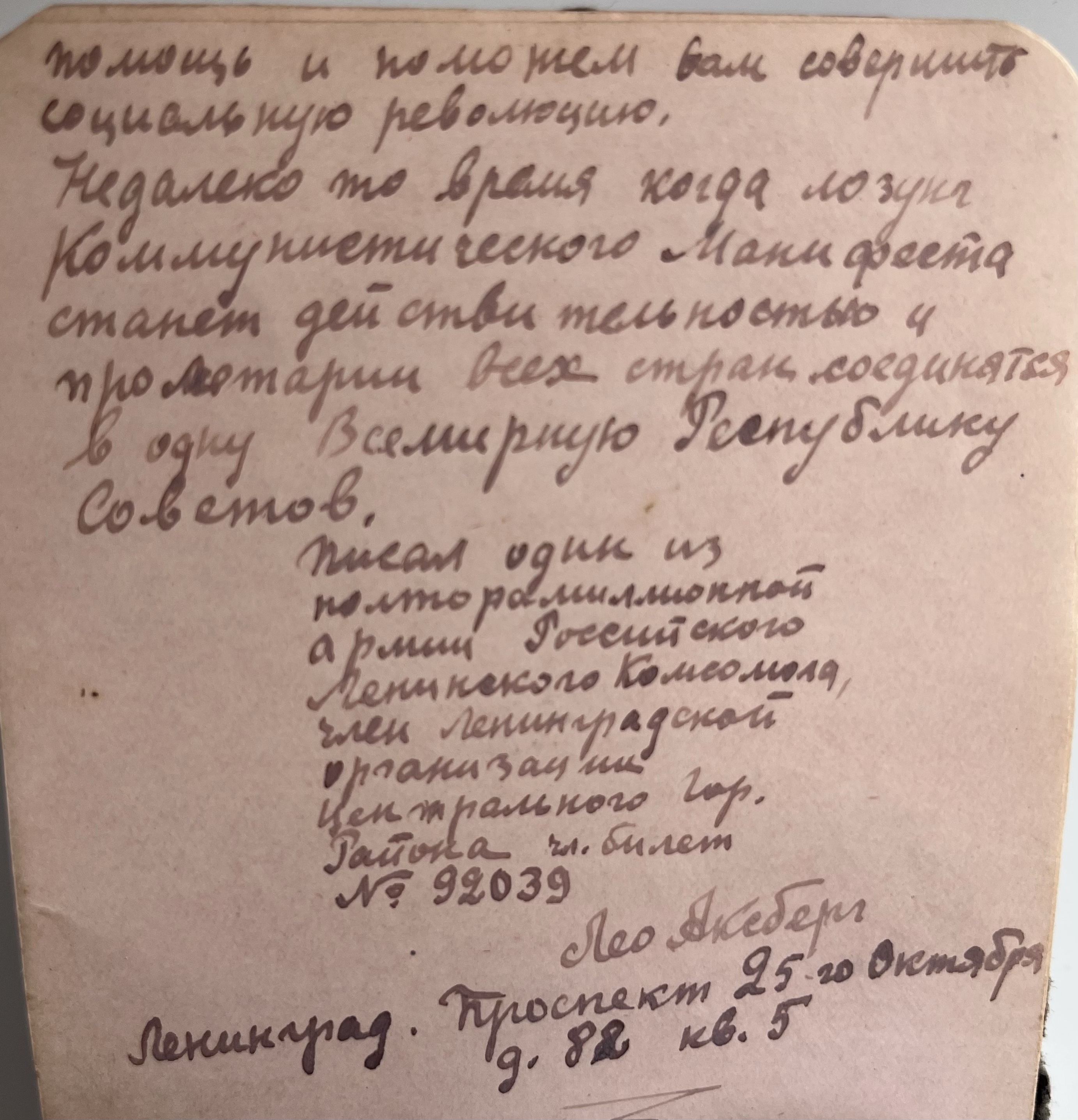

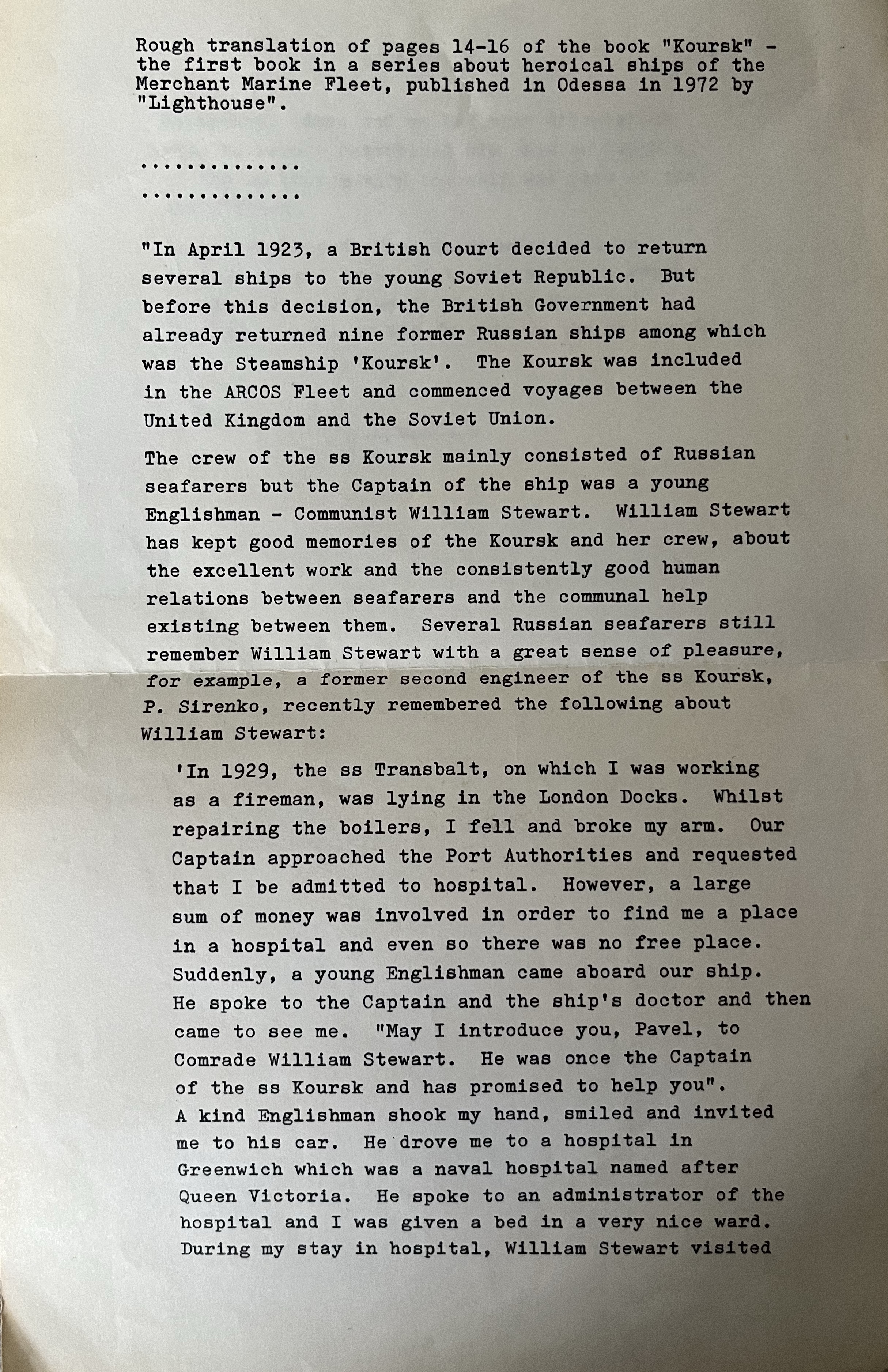
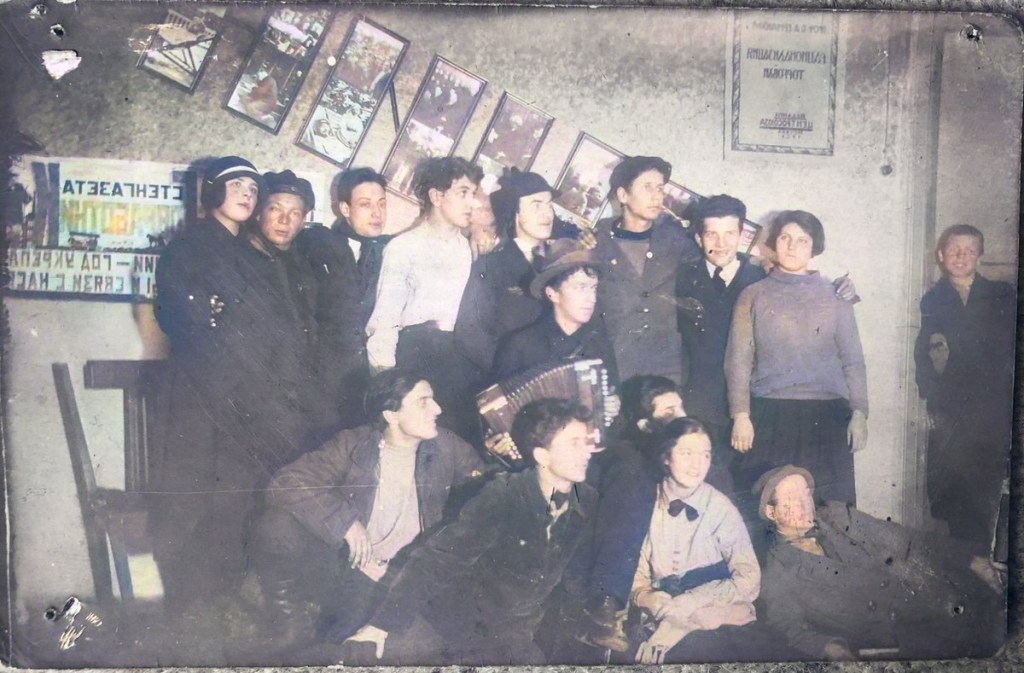

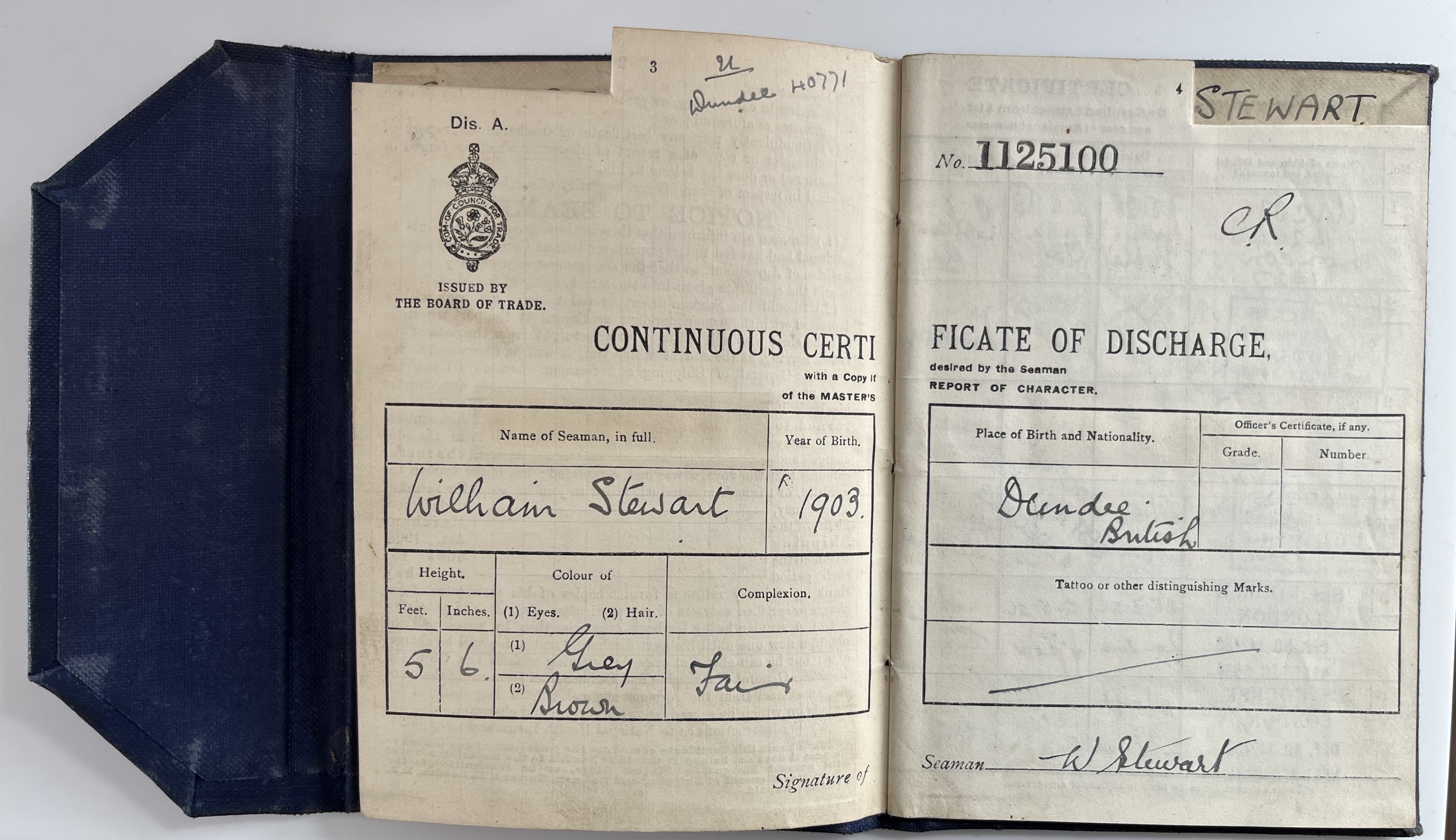


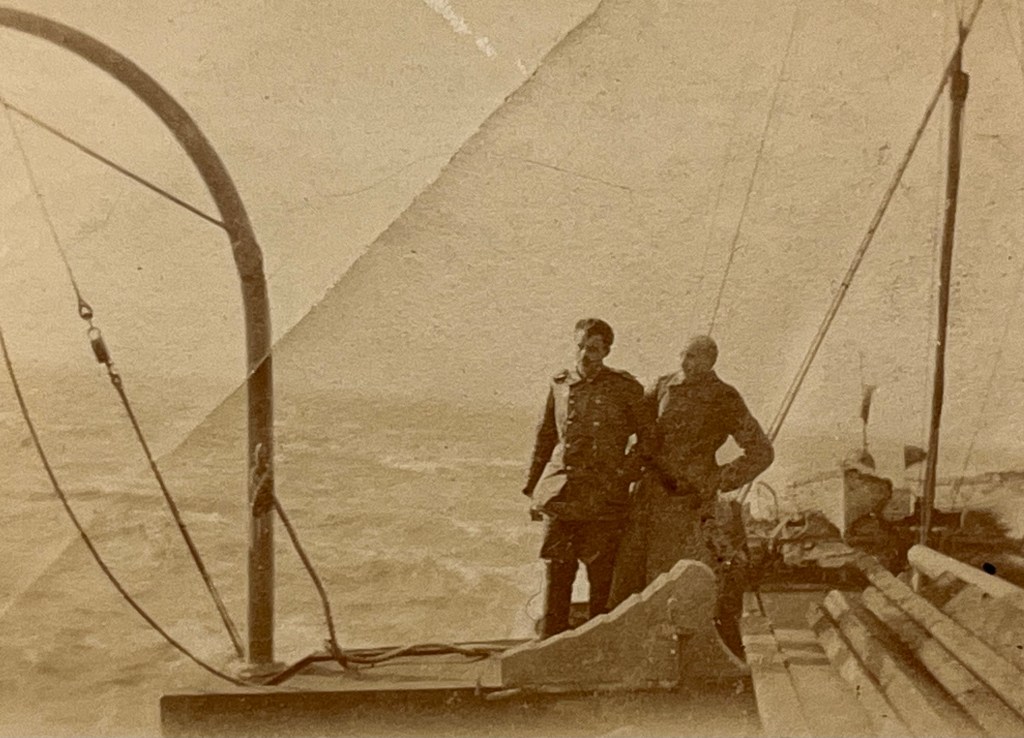
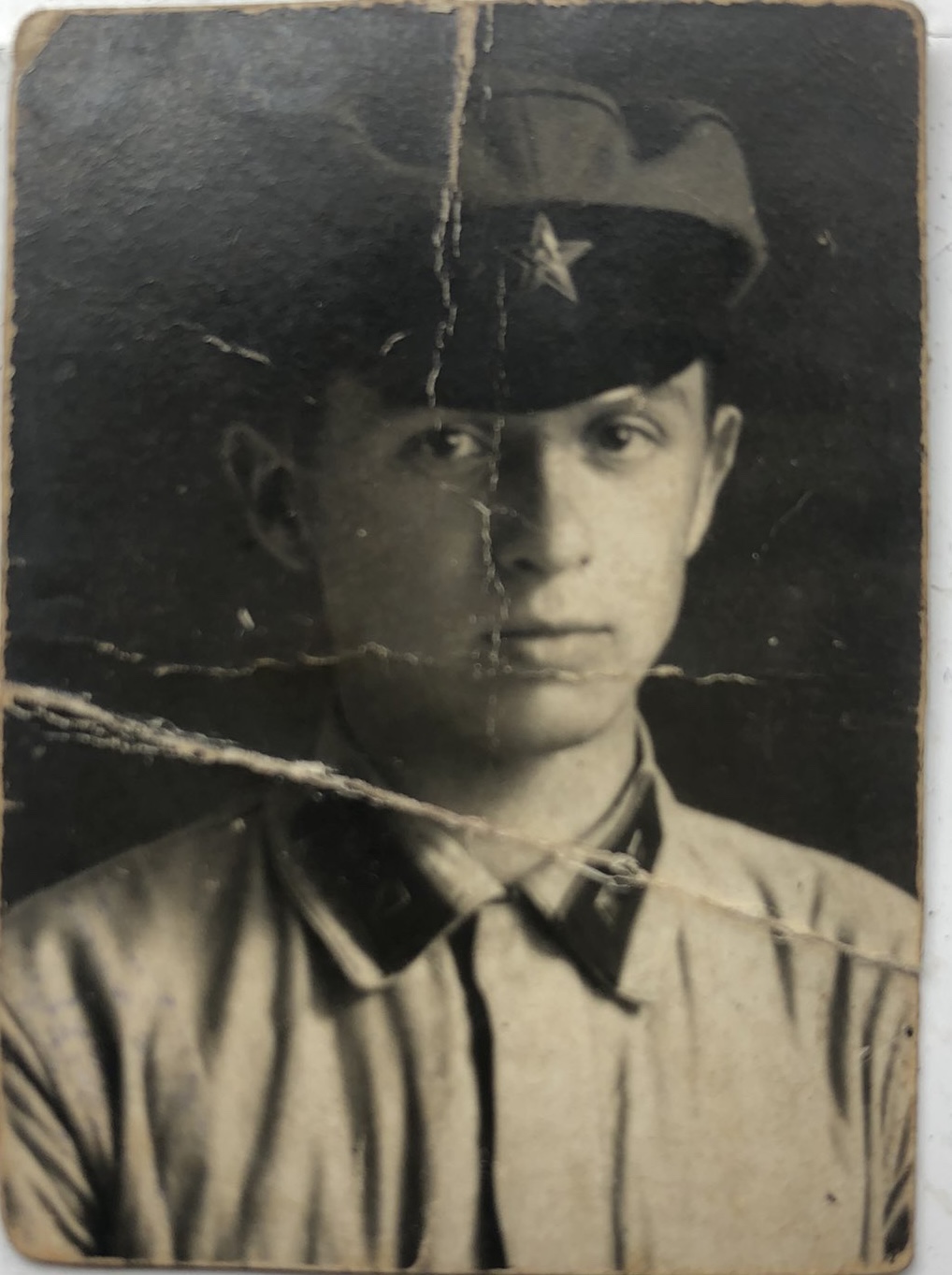

 Breaking the Fetters