After the formation of the British Communist Party at the Leeds Conference, the main task was to build and strengthen the organisation. I was elected as the Scottish organiser, a very tough assignment.
The main political problem then was the beginning of mass unemployment, the fight for work, and the divisions which this creates in the working-class movement. During the war most big factories had established their “factory committees”. But now many of the factory committee members had become unemployed, and factory committees had employed and unemployed workers working together. This, however, gradually ceased and there began the unemployed workers’ committees which led to the National Unemployed Workers’ Movement which was to play such an important role in the working-class struggles of the 1920s. This segregation of employed and unemployed workers was not then and never has been a good thing for workers in struggle. One section is always played off against the other by the boss and inevitably the boss wins.
Naturally our fellows, being the most militant, suffered most and were the first victims in the factories. Many joined the ranks of the unemployed, and while this meant they had time for political campaigning it cut them off from the much more decisive political work in the factory organisation.
In this setting we commenced to gather together the socialist fragments and build the Communist Party in Scotland. We inherited the British Socialist Party branches, the Communist Labor Party branches, and Socialist Prohibition Fellowship Party branches. All rather loose in organisation, and as I very soon found out, very inflated in assumed membership. The Communist Labour Party were supposed to bring over 4,000 members but I doubt if there was half that number. The British Socialist Party claimed to bring over 10,000 members. If they did, there were thousands I never saw and I very much doubt if anyone else ever saw them. Propaganda was our strong point. We had many excellent speakers, and all dead sure of themselves. Tom Bell, for years the editor of The Communist; Willie Gallacher, for fifteen years M.P. for West Fife; Johnnie Campbell, who became editor of the Daily Worker, and Bill Joss, one of the ablest lecturers in the Scottish Labour College. These and many others made up a brilliant team of socialist agitators for the Scottish district of the new party.
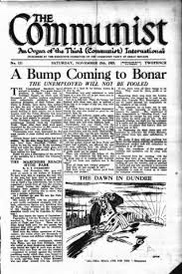
Copies of The Communist- a forerunner of The Daily Worker.
Then there was the selling of our paper, The Communist, an extremely important part of our political work. With self-sacrificing effort of fellows like big Pat Quinlan, Malcolm McFarlane and others the sales rose by thousands. Nothing was a handicap to them. They were out on sales late and early, in snow, sleet and rain, nothing deterred them. At this period I remember one strange incident that came up in the ordinary course of the work. In Glasgow there was a big Irish docker named Jimmy Fearns. He originally came from Newry in Northern Ireland, and I think he was one of the founders of the Irish Citizen Army. Jimmy was out of work and, like most people in his circumstances, living in one of the model lodging houses for which Glasgow was famous-or infamous, depending on which way you look at it. I never knew why the name “model” was given to these dens of human suffering, they were certainly revoltingly original, but never model. One morning Jimmy came to me and said:
“Bob, can’t we do something for the modelers?”
“Have they any grievances?” I asked.
“Sure they got nothing but grievances.”
So we had a meeting with a number of representatives from the models, mostly men living apart from their wives and families and trying to keep two homes going. We got their grievances, published a leaflet and distributed it around the lodging houses. Because of this agitation a number of these places became cleaner and started to provide more up-to-date cooking and washing facilities.
The story was not without sequel. We were amply repaid for our work. For us there was the guarantee that our meetings in Glasgow were conducted in a peaceful atmosphere. The modelers were very handy fellows when the occasion arose. They lived in a society in which “might was right” and if there was any attempt to break up our meetings they soon put an end to that nonsense, saying “they defended those who defended them.”
The Scottish organisation took shape on the basis of our propaganda meetings. We had branches in every big borough from Glasgow to Aberdeen and a lone scout or two in places like Inverness, Dumfries, Perterhead and Fraserburgh. We listed speakers for the meetings, checked that they were advertised- because in those days it was a hit or miss business, sometimes the speaker did not turn up, sometimes the meetings were not advertised and there was no audience. All arrangements had to be checked and re-checked.
This meant money, and sometimes the sums were large, at least large for us. Two members of the Scottish Executive who did a magnificent job on finance for the party were John Inches and George Whitehead. By their work the Scottish Party was entirely self supporting, and with good finances the political and organisation work of the party received most attention. Thus early I already understood that freedom from financial worry is a boon to a Communist Party organiser.
The most distinguishing feature of the Scottish Party then was its solid industrial base. In fact, the party was so working-class that there was a real antipathy to what was termed “the intellectuals”. It was entirely wrong of course and was combated by the Party. At that time we had a number of students; one of them, Phil Canning, later to be elected as a Communist Councillor in Greenock for many years, became an outstanding representative of the working class. Our students became swallowed up in revolutionary thought and began to absent themselves from their university classes, thinking the revolution was round the corner. I had long conversations with them, and patiently explained that just as in the workshop a Communist had to be a capable worker and win the respect of his mates, so in the college and university the students must do the same. If a Communist could not pull his weight then his “preaching” will fall on deaf ears. A student with a degree was a much more valuable political worker than a student without a degree.
Our solid industrial base came largely from the members who had come to the party from the Clyde Workers’ Movements and the militant workers from the mines and the railways who also had an excellent record of militancy during the war. But they also brought a number of problems. Our relations with the Labour Party were not good. This was partly of our own making, in that many of the groups that had preceded the new Communist Party and helped to form it had a very abusive attitude towards the Labour Party. Many of these members were strong political individualists and spent the greater part of their political life calling the Labour Party names. Not that sometimes the abuse was not called for, but nevertheless it was not the right way to go about trying to cement relationships that certainly would have helped us to gain more working-class unity in action.
We also inherited a problem from the Socialist Labour Party, who had laid down that their members would not accept trade union office lest they be corrupted. We naturally had to fight against that principle; corruption in the trade unions was then and still is an occupational hazard for which membership of the Communist Party is a good antidote. This, however, was one of the reasons why many militant trade union leaders in Scotland did not immediately join our party.
Our principal problem in industry was to get a balanced understanding of the political work of the party, engaging in every struggle in the social field and blending this with our industrial work in the fight for wages and better working conditions. This conception was foreign to British politics and therefore the hardest nut to crack for our party. A break had been made during the war in the rent struggles on the Clydeside, which culminated in the pressure on the authorities being so great that a new Rent Act was passed in Parliament. The Clyde Workers’ Movement had played a decisive part in this fight, organising the workers in the factories and combining with the tenants’ organisations. In fact, it can truly be said it was this successful combination of social and industrial struggle that was the main reason for the success gained.
We also had to try and overcome strong syndicalist traditions which still endured in industry. In this there was good and bad. I well remember when the late Jack Tanner came to the party, at that time a strong syndicalist-in fact, he edited a paper called The Syndicalist from somewhere in Fetter Lane, London. But Handsome Jack, as he was called, developed ambitions to become a trade union leader and the Communist label did not make for an easy passage, so Jack changed the label.
Tom Mann in 1920.
Another syndicalist, but one who was quickly shedding his syndicalist ideas and who came to the party, was Tom Mann. A great national and international figure and the first Labour candidate to contest Aberdeen; a fine trade unionist, a first-class politician, a great social mixer, known to everyone left, right and centre, respected by all and one of the best speakers the Communist Party ever had; Tom Mann was a great asset to the British trade union movement and an excellent representative of the Communist Party.
In these early days the party attracted all kinds of industrial do-gooders and the sieve of struggle sorted them out. In Scotland we got our quota, but the vast majority of our members were fine men and women, with the success of the working-class struggles and the achievement of socialism as their main aim. We had leading miners from every coalfeld, engineers like Willie Gallacher and Hugh Hinselwood, Tom Bell and Jim Gardner (later to be the general secretary of the Foundry Workers Union) from the foundry workers, from the railways Jimmy Davidson and Jimmy Figgins who many years later was general secretary of the N.U.R., and George Whitehead from the Clerks. They and many others were held in the very highest esteem in the unions and the factories, enhancing the prestige of our party.
At that time we had not reached the stage of factory organisation, but there is no doubt that the work of our industrial members at the formative stage of the party laid a firm base for party industrial work in Scotland which has endured, expanded and strengthened until the present time. One of the big disappointments when the party was formed in Scotland was that John McLean, one of the foremost members of the British Socialist Party, did not join the new Communist Party.
John McLean.
McLean was undoubtedly one of the greatest British socialists of all time. Lenin spoke of him as a fearless fighter against imperialist war. When the first All Russian Congress of Workers and Soldiers’ Councils met, John McLean and Karl Leibknecht were appointed honorary members of the presidium in recognition of the great international character of their socialist work. Later McLean was appointed as the first consul for Russian affairs in Great Britain. In this job he did a vast amount of work and many Russians then living in Britain thanked him for his assistance.
McLean’s main aim was to have Labour Colleges in every county and city in Scotland and he succeeded in doing so in all the main cities and in many of the counties. These colleges brought many thousands of Scottish workers closer to the understanding of socialist principles. As a school teacher and a mass working-class leader McLean naturally gravitated to this form of mass socialist education. I was an Executive member of the Scottish Labour College, worked with McLean, and came to appreciate his outstanding capabilities in this form of work.
I am many times asked, “Why did McLean not join the Communist Party?’ I have always found some difficulty in answering. John McLean was a Communist. His life and work was that of a dedicated Communist motivated by sincere socialist principles. He was a most energetic man and never at rest, a powerful debater and a skilful propagandist. He could hold a crowd for hours with his oratory. He was a comparatively easy man to work with, but more an individualist worker than a collective one. There can be no doubt that the long spells in His Majesty’s prisons totally undermined his health and that this had an effect on his thinking in his later years, when he became obsessed with the idea that he would be poisoned. He refused to eat in anyone’s house and on occasions refused food even from his wife. I noticed this particularly when he came down to assist me in the Caerphilly by-election in which I stood as the Communist candidate.
He told me he did not like a number of the leading members of the Communist Party, but I think he would not be alone in that, and we had a number of discussions on this question. Yet such things should not detract from the indispensable contribution John McLean made to the advancement of the British working class. He was truly a giant in the British labour movement and an international socialist of whom the British people can be proud.
His early death in 1923 was a great blow to the Scottish working class.
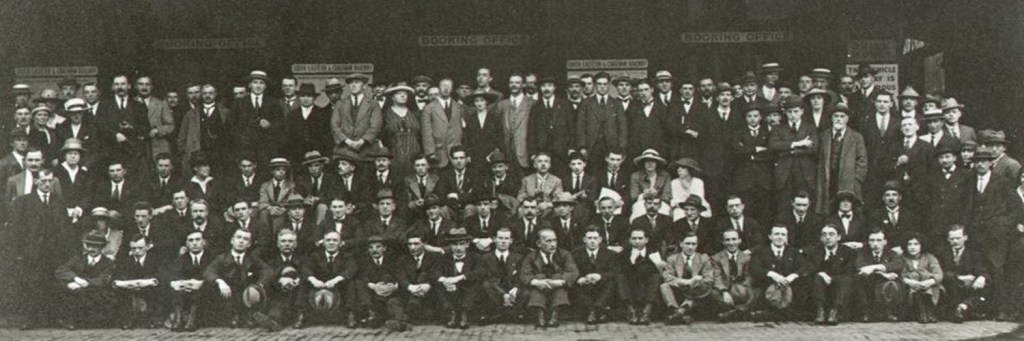
The Unity Conference, 1920. Bob Stewart in the front row seventh from the left.
I came out of gaol in April 1919 and entered an entirely changed world from the one I had left. The heroes had returned from the war to find the golden promises of a land fit for heroes to live in had not materialised. Many were unable to find work. Many, when they found it, got low wages on which they could not adequately provide for their wives and children. The housing shortage became a serious social problem as the soldiers, married during the war, tried to set up house with their war-wives and young children. The landlords, taking advantage of the shortage, found ways and means to raise rents.
Foresters Hall in Dundee.
The Dundee I came back to had all these problems and more. Lack of work, low wages, unemployment, bad housing and a housing shortage, and to add to the confusion, thousands of war disabled demanding work and maintenance. During the war our party had absorbed many facets of socialism into its policy, so we changed the name from the Prohibition and Reform Party to the Socialist Prohibition Fellowship. We ran meetings every Sunday night in the Foresters Hall. They were always packed out, with hundreds left outside. Invariably there was a queue to get in an hour before starting time to make sure of a seat. My Prison Rhymes now became a bestseller. So, with the money from the collections and the booklet we were doing very well financially.
We got a new hall, the Unity Hall we called it, relaid the floor, bought the best seats available and certainly made it one of the finest little halls in the city. Despite this veneer of success, it became evident to those of us who were thinking politically that we were not making any real political advance, and certainly not making the basic political progress towards socialist organisation that the economic conditions warranted.
While in prison I had written to the monthly paper of the Socialist Labour Party, The Socialist, on the question of unity and the necessity for the various social sects and parties to get together. The Russian Revolution had had a profound effect in Britain. In all the left groupings our thinking had changed or was in the process of changing.
In all the left parties the need for, and the road to, unity was being discussed. In fact, in July 1919, only a few weeks after I came out of gaol, meetings seeking to establish unity had been held in London. Members of the British Socialist Party, the Workers’ Socialist Federation, the Socialist Labour Party and the South Wales Socialist Society had taken part. Although our party was not present, I got to know later that while agreement was won on a number of political principles, there was a fundamental division on the question of the attitude to the Labour Party. The B.S.P. members made crystal clear their demand that any new united party must be affiliated to the Labour Party. The W.S.F, and the SouthWales S.S. said it was useless to approach the Labour Party. Thus early, at the very first meeting, battle lines on this supremely important political principle were taken up.
Early in 1920 I was doing a meeting in Aberdeen. When I finished, I returned to the house of Jimmy Gordon to find Tommy Bell and Arthur McManus waiting for me. They were working for a unity conference and, after a discussion, asked me to use my influence to get our party to attend. So, I put it to the party and after due consideration we decided to participate and I was sent as a delegate.
This conference was held in early April 1920, in the William Morris Hall in Nottingham. There were members from the main left parties there. The B.S.P., the W.F., the South Wales S.S. and the Socialist Prohibition Fellowship. The Socialist Labour Party had split on the question of “attitude to the Labour Party” and only a section were represented at Nottingham. Of the people I remember, there was John S. Clarke, Tommy Bell and Arthur McManus from Scotland, Willie Paul who was leading the S.L.P. section, Bill Gee, a perambulating propagandist well known in all parts of the country, Charlie Pentie from Woolwich, Jock McBain, a foundry worker, Bill Hewlitt from Wales who was tragically killed in an accident in Moscow in 1921, Tommy Jackson, and of course others.
We had a day’s discussion, forenoon and afternoon. We hammered things out as best we could, collated the points of agreement and decided to issue a manifesto. We then went for a walk and left Tommy Jackson to draft the document. When we came back, we found a dance band playing in one part of the place and Tommy Jackson sitting with the dance music bellowing all around, a few beer bottles at his elbow, discarded manuscripts littering the floor at his feet, beads of perspiration trickling from his forehead. But he had done the job. The Manifesto of the Communist Unity Group was drafted. We went over it, slight changes being made, and then adopted the document. So, from the Nottingham Conference the call for Communist Unity went out. The Manifesto declared, among other things: “To create this force…by unity of all elements scattered throughout the various groups and Parties as the first essential to the formation of a Communist Party in Britain.” The Manifesto had twenty-two signatories.
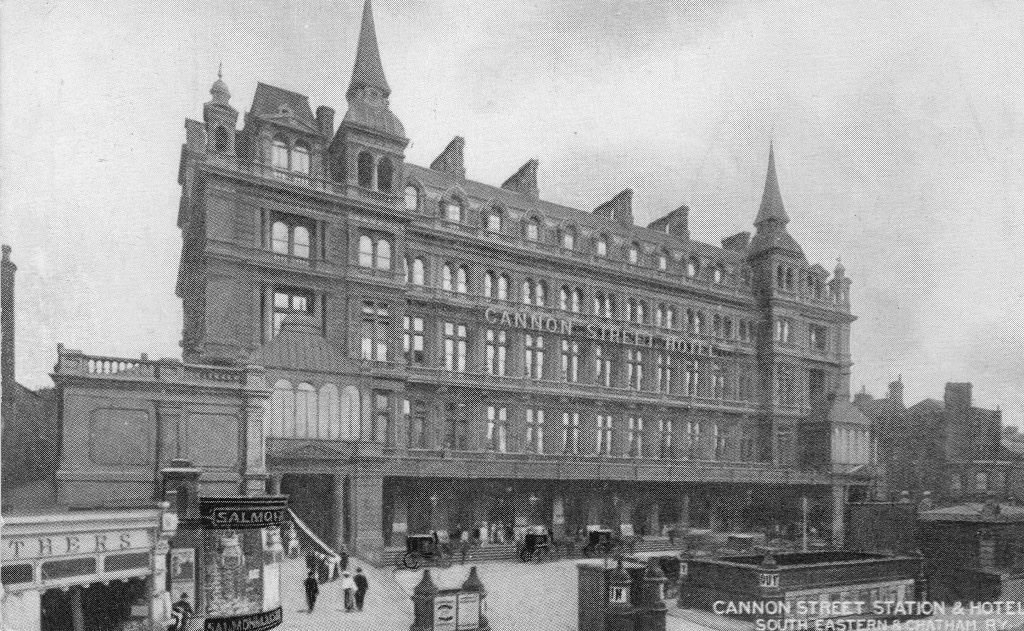
The Manifesto from the Nottingham Conference produced immediate results. It provided the yeast to ferment the unity discussions and drew the left elements closer together. It really paved the way for the next big step forward, the Communist Unity Conference which was held in London on July 31st and August 1st 1920, on Saturday July 31st in the Cannon Street Hotel and the following day in the International Socialist Club, 28 East Road, London E.C.
The Cannon Street Hotel where the Unity Conference took place in 1920.
The conference was summoned by a Joint Provisional Committee of the Communist Unity Conference representing the Communist Unity Group, the B.S.P, and the South Wales Communist Council under the names of Arthur McManus, chairman, and Albert Inkpin, secretary. There were 152 delegates present holding 211 mandates. McManus was unanimously elected to preside.
Up to this time, when any discussions on unity had been held, many groups and individuals continued, after the discussions and decisions, to propagate their former minority viewpoints. Majority decisions were not being accepted. In order to get over this difficulty at the London Conference, it was agreed that “All bodies participating in summoning the conference are pledged to abide by its decisions on points of tactics and to merge their organisation into the new Communist Party. Representation at the Conference will be held to imply that branches, groups and societies represented will also accept its decisions and become branches of the Communist Party.”
This was accepted by the conference-a very big step forward at that time. With this understanding, the conference turned its attention to discussion and agreement on the main points of policy for the new party.
The first resolution covered the main aims of the party:
“The Communists in Conference assembled declare for the Soviet (or Workers’ Councils) system as a means whereby the working class shall achieve power and take control of the forces of production. Declare the dictatorship of the proletariat as a necessary means of combating counter-revolution during the transition period between capitalism and communism and stand for the adoption of these measures as a step towards the establishment of a system of complete communism wherein the means of production shall be communally owned and controlled. This Conference therefore establishes itself the Communist Party on the foregoing basis and declares its adhesion to the Communist International.”
In the discussion on this resolution, a number of speakers kept referring to the “use of the gun” as the real, and, for some, the only way to power. Naturally, after my prison experiences, this kind of talk irked me. In speaking to the resolution I said: “I do not want to stress too much the point being made about ‘men with guns’ but I do hope the sincerity of delegates not ‘gun-minded’ will not be questioned. Even the capitalist, powerful as he may be, will not be able to use guns except in so far as he can persuade the members of our class that our policy is detrimental to working-class interests. Whether guns come soon, late or not at all, there will be times when it is far more revolutionary to refuse to have anything to do with guns. I think the provisional executive which is to be set up by the conference will be far wiser to devote themselves to building up such organisation as will make it possible to win the maximum of our party policy with the minimum of violence.” On the Dictatorship of the Proletariat question I said: “I don’t know much about this, and I don’t think anyone else does here, but we know it is necessary and if the working class is to achieve power and we will require to do as the circumstances determine.”
It may be a strange thing, but I have invariably found that the people who want to “shoot it out’ are the worst stayers in the movement. They do not seem to be able to cope with the hard grind of day-to-day politics. Maybe, of course, that’s why they want to use guns.
This resolution, while causing a fair discussion, was passed unanimously, and then the conference turned to the subjects causing deep divisions in the left forces-attitude to the Labour Party and the advisability of parliamentary political action.
Tom Bell and a number of delegates were against having anything to do with parliament. In an appealing speech, Tom said: “Nothing can be hoped for from the Chamber of Parliament. Can Communist members of Parliament take the oath of allegiance? In all cases, Communists must hold their mandate from the party and not from their constituencies. The only Communist allegiance is to, communist principles not to royalty or decadent capitalism.”
He was followed by delegates who put much the same point of view, but some with harsher words.
I spoke on this resolution and, with several others, put the point of view that we could not divorce ourselves from parliamentary action, that we must use parliament. “Our job is to be where the laws are made.” I remember Ellen Wilkinson delivering a revolutionary speech for parliamentary action, saying: “A revolution must mean discipline and obedience to working-class principles.” Ellen finally landed up as a minister in a Labour government. She certainly used parliament, but I am afraid not for the revolutionary principles she espoused that day.
When the vote was taken, a large majority were for the resolution supporting parliamentary action by the new party.
A fierce, no-punches-pulled debate on the attitude of the new party to the Labour Party concluded the policy debates. The big battle was whether or not the new party should seek affiliation to the Labour Party; or rather, to put it in its correct context, whether to resume the affiliation to the Labour Party already standing in the name of the British Socialist Party which was the biggest section of the new Communist Party.
The conference had two alternatives: (a) to seek affiliation,or (b) not to seek affiliation.
Hodgson moved (a) and Paul moved (b). The B.S.P. speakers in the debate came down heavily for affiliation because they knew by practical experience the value of affiliation to the mass Labour Party. Paul, Bell and others were violently against. In fact, the day before the conference opened Tom Bell had written an article in The Call against affiliation, saying: “Never was the time more opportune for Communists to proclaim their open hostility to the utopian aims of the Labour reformists, and pursue an independent course.”
Many delegates put the point that the last thing the right-wing Labour leaders wanted was the affiliation of the Communist Party. I remember George Dear putting this point in a very skillful way. He referred to a speech made by Jimmy Sexton, secretary of the Docks Trade Union, at the Scarborough Labour Party Conference, where Sexton had said: “Here is the British Socialist Party with 10,000 alleged members, paying £50 a year affiliation fees. They monopolise the conference, get five speakers to the rostrum the first day, demand a bloody revolution and Jim Thomas’s head on a charger, and then foist Colonel Malone on us. What the hell do they want for fifty quid?”
There were no kid gloves used, and the protagonists were nearly equal. This also showed in the vote. One hundred were for affiliation, 85 against. It was then agreed the matter be dealt with by the new Executive and be reported to the next conference.
Arthur McManus- The First Chairman of the CPGB. Albert Inkpin- The First General Secretary of the CPGB.
There were sixteen nominations put forward for the six positions on the Executive Committee. On an exhaustive vote, the following were elected: Fred Shaw 123 votes; I got 117; Dora Montifiore 115; Colonel Malone 106; W. Mellor 100, and George Dear 100. I must add here that Colonel Malone was the man who won some fame for himself by threatening to hang Winston Churchill from a lamp-post, for which he got six months hard labour. Arthur McManus was elected chairman and Albert Inkpin secretary.
The task set the Executive was to win further unity of the left movement and to take charge of the paper Communist, the official organ of the party. The headquarters were at 21a Maiden Lane, Strand, London.
During this conference in London a letter was sent by Lenin to the delegates. Lenin had taken a great interest in the attempts to forge left unity in Britain, in the problems of unity and in the tactics of the left groupings, as the letter from him to the conference shows:
Having received the letter from the Joint Provisional Committee of the Communist Party of Great Britain dated June 1920 I hasten to reply, in accordance with their request, that I am in complete sympathy with their plansfor the immediate organisation of a Communist Party in England. I consider the policy of Sylvia Pankhurst and the S.D.F. in refusing to collaborate in the amalgamation of the B.S. P., the S.L.P and others into one Communist Party, to be wrong. I personally favour participation in Parliament and adhesion to the Labour Party on condition of free and independent Communist activity. This policy I am going to defend at the second congress of the Third International on July igth in Moscow. I consider it most desirable that a Communist Party be speedily organised on the basis of the decisions and principles of the Third International and that the Party be brought into close touch with the industrial workers of the world and bring about their complete union.
N. LENIN July 18th 1920.
In the first edition of the Communist, dated August 5th 1920, I gave my opinion of the London Conference.
“The value of the conference was its evident eagerness and sincerity; its old men were young and its young men did not lack wisdom. The Leftest of the Left and the Rightest of the Right showed an evident anxiety to keep the CPGB free from that ineptitude for action that has hitherto been not an uncommon feature in the debating stage of our growth. Minor differences were relegated to their proper position.”
But the major differences were firmly entrenched. The main one was the affiliation question, and after that, parliamentary action. In the first edition of The Communist, McManus also wrote his impressions of the London Conference, and showed that the deep divisions on affiliation were still dominant. He wrote: “The voting on the Labour Party was such as indicated a strong, evenly divided opinion on the question of affiliation, and while according to the result the minority are honourably expected to acquiesce to the decision, there is also the obligation placed on the majority to fully appreciate the character and strength of the minority.”
At the first meeting of the new Executive held in August, discussion on affiliation brought the motion that an immediate application be made to the Labour Party. An amendment was then moved that the application make clear the objects, methods and policy of the Communist Party as set forth in the resolution passed by the London Conference. Naturally the amendment was accepted, but no doubt the supporters knew where they wanted to be, as time proved. The Executive unanimously accepting that an application be made, the following letter was sent to the Labour Party. As it is now an historic document, I quote it in full.
August 10th 1920
Dear Sir, At a National Convention held in London on Saturday and Sunday, 31st July and 1st August last, the Communist Party of Great Britain was established. The resolutions adopted by the Convention, defining the objects, methods and policy of the Communist Party, read as follows:
(a) The Communists in conference assembled declare for the Soviet (or Workers’ Council) system as a means whereby the working class shall achieve power and take control of the forces of production; declare for the dictatorship of the proletariat as a necessary means of combating the counter-revolution during the transition period between Capitalism and Communism; and stand for the adoption of these means as steps towards the establishment of a system of complete Communism wherein all the means of production shall be communally owned and controlled. This conference therefore establishes itself the Communist Party on the foregoing basis and declares its adherence to the Third International.
(b) The Communist Party repudiates the reformist view that a social revolution can be achieved by ordinary methods of Parliamentary Democracy but regards Parliamentary and electoral action generally as providing a means of propaganda and agitation towards the revolution. The tactics to be employed by representatives of the Party elected to Parliament or local bodies must be laid down by the Party itself, according to national or local circumstances. In all cases such representatives must be considered as holding a mandate from the Party and not from the particular constituency for which they happen to sit. Also, that in the event of any representative violating the decisions of the Party as embodied in the mandate which he or she has accepted, or as an instruction, that he or she be called upon to resign his or her membership of Parliament or municipality and also of the Party.
(c) That the Communist Party shall be affiliated to the Labour Party.
At a meeting of the Provisional Executive Committee held on Sunday last, we were directed to send you the foregoing resolutions, and to make application for the affiliation of the Communist Party to the Labour Party.
Yours faithfully, ARTHUR MCMANUS (chairman) ALBERT INKPIN (secretary).
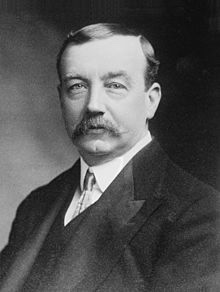
One month later came the reply from Arthur Henderson, then secretary of the Labour Party, saying the application had been considered by the National Executive of the Labour Party and he had been “instructed to inform you (the Communist Party) that the basis of affiliation to the Labour Party is the acceptance of its constitution, principles and programme, with which the objects of the Communist Party do not appear to accord”. This reply led to further correspondence in which the words “do not appear to be in accord with the constitution, principles and programme of the Labour Party” figured prominently. The Communist Party asked: “Does the Labour Party rule that the acceptance of Communism is contrary to the constitution, principles and programme of the Labour Party, or is it the methods of the Communist Party to which exception is taken?”
Arthur Henderson, secretary of the Labour Party. Not too keen on CPGB affiliation. Lenin wrote that he was “as stupid as Kerensky.”
Back came Henderson: “Your letter raises a definite issue-the obvious conflict between the fundamentals of the Labour Party constitution, objects and methods, and those of the Communist Party.” He then went on to quote the following from the article by McManus in the Communist:
“One impression I should like to make definitely clear as gathered from Sunday’s experience (the London Conference), and that is that those arguing for affiliation to the Labour Party did not urge for, nor contemplate working with the Labour Party. The antagonism to the Labour Party was general, but those for affiliation held the opinion that such antagonism would best be waged within their own camp.”
To a man of Henderson’s calibre, this was meat and drink in argument, and he went on to quote part of a previous letter from the Communist Party, which said: “You have made a definite refusal to our request for affiliation on the ground that our objects do not appear to be in accord with those of the Labour Party. To be frank, we never supposed they were. Our worst enemy will not accuse us of ever pretending they were.”
No doubt, looking back, many things were said in the correspondence that, to put it mildly, did not smooth the way to affiliation. Really, the big difference between the parties was one of methods, Henderson and the Labour Party contending that the Communists would use violent methods while the Labour Party would not. Yet the fact was that the Labour Party, and Arthur Henderson in particular, had just supported the most violent war in human history.
After the correspondence, the Labour Executive decided to place the question on the agenda of the next Labour Party Conference. This took place on Tuesday 21st June, at Brighton. The affiliation question came up in the form of a resolution from the Norwood Labour Party, which said:
“That this Conference, whilst appreciating the difficult position of the National Executive Committee when called upon to deal with the application of the Communist Party for affiliation, owing to the various shades of opinion in the Labour Party which they represent, this Conference of the National Labour Party, in the interest of unity of the earning sections of the community who are opposed to the capitalist system, agrees to accept the affiliation of the Communist Party on the condition that the constitution of the Labour Party is accepted and the rules of the Communist Party are in conformity with the same.”
This was moved by W. A. Hodgson and seconded by Duncan Carmichael of the London Trades Council. An amendment “That the request for affiliation be not accepted was moved by Bert McKillop of the Social Democratic Federation and seconded by W. J. Brown of the Clerical Officers Association, Civil Service.
In a debate, A. J. Cook and Herbert Smith of the Miners Federation, and Bob Williams of the Transport Workers supported the resolution, while Manny Shinwell and Fred Bramley of the Furnishing Trades spoke against. The debate was very unreal. It did not deal with policy. The speakers for the resolution did not adequately show the need for affiliation to strengthen the left political forces and to win a more working-class policy. They tended to appeal to the right wing to accept unity. No one spotlighted the glaring evidence that the right wingers were afraid of affiliation because it meant the strengthening of the left wing of the Labour Party.
Naturally the right wingers played on this weakness, talked of “the methods of the Communist Party”, “acceptance of violence by the Communist Party”. Arthur Henderson, who was then Labour Party secretary, gave a most hypocritical performance in summing up for the National Executive. Just before the conference, a by-election had taken place at Woolwich. The Labour candidate was none other than Ramsay McDonald. During this by-election the Communist Party had issued a leaflet, part of which was quoted by Henderson to prove that the Communist Party were not to be trusted and would not support Labour candidates. The leaflet said: “The Communist Party feels it cannot allow the decision to run Ramsay McDonald to pass without comment… While the coalition candidate stands for capitalism in all its manifestations … the Labour Party candidate also stands for capitalism in all its manifestations.” Henderson made use of this in 1921to show that the Communists would betray the Labour Party. Yet ten years later Ramsay McDonald proved the Communists completely correct, when he betrayed the British working class, tried to destroy the Labour Party and deserted to the Tory National Government. Such was the verdict of history.
On the Wednesday morning, after Henderson had spoken, the Previous Question was moved. The voting resulted in 4,115,000 for, 224,000 against. So ended the first round of the question that was going to continue to push its way to the forefront of British politics and is still with us today.
At a meeting of the Communist Party Executive Committee in November, arising from a report on the work of the Third International, the need to further extend the organisation of the Communist Party was agreed upon, and a decision taken to organise a further Unity Conference. Discussion with a number of left groupings who had not been present at the London Conference took place. Among these was the Communist Labour Party. One of the leaders of this Party, Willie Gallacher, had been in Moscow at the time of the London Conference. In discussions with Lenin, Gallacher’s thinking on scientific socialism had changed and Lenin had got him to promise that on his return to Britain he would work for the unity of the working-class movement and for a united Communist Party.
A joint committee to prepare for the conference was formed, to compile the agenda and draw up the basis of representation! A manifesto was produced under the signatures of McManus and Inkpin of the C.P.G.B, J. V: Leckie of the Communist Labour Party, George Peat of the Shop Stewards’ and Workers’ Committees and E. T. Whitchead of the Communist Party B.S. T.I. (British Section Third International). The manifesto read as follows:
Comrades,
We address this statement and appeal to you in the hope of clearing away for all time the differences of opinion which have served to keep us apart in the past, thereby preventing the consolidation of the revolutionary forces in this country.
It is not our purpose to explain or justify those differences but simply to record the fact that our task has been much simplified by the decisions of the recent congress of the Third International. These decisions prescribe for the world movement the basis upon which such efforts as ours should be founded and constitute a clear and definite demand that a united Communist Party shall be established in Britain.
To this end the following organisations have assented to the proposal for the formation of a united Party, and have elected representatives to the above committees: Communist Party of Great Britain, Communist Labour Party, Communist Party (B.S.T.I.), Shop Stewards’ and Workers’ Committee (in a consultative capacity), and the left wing group of the I.L.P. (in an informative capacity).
The Committee has set about its task and has held a preliminary conference. We appreciate that the heartiest co-operation is essential if the united Party is to contain all the features which mark a real live revolutionary organisation. To this end we seek such assistance and urge that all the groups and bodies not in touch with the proceedings should communicate at once with the secretary, when the fullest information will be supplied. In the meantime we would counsel the closest observation of what is being done thus ensuring that when the National Convention takes place about the end of January the results will justify the hopes we place in the Convention.
The Bull and Mouth Hotel in Leeds. Later renamed the Victory Hotel and the location of the the 1921 conference where the CPGB was formalised. Demolished years ago, there’s now a Gregg’s on the site.
This appeal was the forerunner to the Leeds Conference, which was held in the Victory Hotel, Leeds, on the 29th January 1921. Jack Tanner was voted into the chair. There were 170 delegates.
Two resolutions were on the agenda, a unity resolution which was moved by Leckie and seconded by Watkins, and a merging resolution, which was moved by Gallacher and seconded by Paul. There were none of the fierce polemics which had raged at the London Conference, and the proceedings took place in a quiet and orderly atmosphere. A new Executive was appointed which had representatives from the former parties, and there were also representatives selected on a geographical basis. McManus was elected as chairman of the party and Inkpin as secretary.
It can be truly said that from the Leeds Conference the foundation of the British Communist Party was laid. Then the wagon began to roll.
Dundee Jail. Bob Stewart wrote most of the poems in Prison Rhymes here.
In the "Clink"-Edinburgh Castle

On jam and bread and bully beef,
They feed us in the clink,
There's a guard that's got the wind up,
And not a drop to drink.
We are short of fags and matches
And squeezed in very tight,
But we don't go short of scratches
When the flea-bags' come at night.

We are exercised each morning,
Deep down in Castle moat,
We play football and pitch and toss
And get the sergeant's goat.
We throw kisses to the ladies
And curses at the Yanks,
And when they pitch us cigarettes
There's mutiny in the ranks.

When the lovely war is over
And we're back at 'joyful' work,
When we've hypnotised old "Jerry"
And camouflaged the Turk,
When we meet again in "civvies"
What a tale we'll have to tell,
Of the clink up in the Castle,
Good old forty-second Hell.

Bob Stewart's Prison Rhymes
So I did my time in Dundee and with my remission I came up for my fourth court martial. Back to Edinburgh and this time to the Castle, with “Bobby” Moncrieff in charge. “Ha-ha,” they all warned with glee, “wait till Bobby Moncrieff gets hold of you.” But I knew Bobby, he was one of the family from Perth who made their fortune in ink. He was in command of the Dundee-Perth regiment of the Black Watch. I used to watch him march the jute workers through Dundee, men with the lowest wages in the country, hardly a bite in their belly, and Bobby howling at them “Bout turn!” “Forward march!” trying to make them into big brawny soldiers fit to be killed. Oh, I knew him all right, and I had known many of his kind in my time. But he didn’t put the fear of death into me.
However, I arrived at the Castle and got shoved into the guard-room. The sergeant said to the corporal, “Search that man.” “Not necessary,” I replied, “I’ll turn out my pockets.” So I counted my money, took out a box of matches and counted them. “What are you doing?” the sergeant hollered. “The Black Watch has a reputation! “I know,” I answered, “that’s why I’m counting my matches.” Soon I am shoved into another room with all the other delinquents. Like every other place, you soon make friends. First the meal. Beef and potatoes are served. But no fork and knife. “Where’s the tools?” I asked. No answer. So I sit, and the other lads, possibly hungrier than myself, ask, “Aren’t you going to eat it?” “Not without tools.” “Can we eat it?” “Better leave it till we sort this out.”
Back comes the sergeant. “Not eating the food, Stewart?” he says. “No, and I won’t until I get a fork and knife.” “Well, we will get you some sandwiches.” When the sandwiches came there was a rush for the plate of beef and potatoes that certainly did not say much for the culture practised in the British Army.
Into the guard-room came a wee drummer boy. I remember him well because he was so tiny. A jockey of jockeys, you might say. A bit nosey, he starts his own investigations. “What are you in for?” he asked me. “Because I won’t fight.” “Why won’t you go and fight?” “Because it’s not my quarrel.” “Christ, it’s no’ mine either:” Round and round he goes, asking his questions and getting his answers, until he comes to a fellow sitting very despondent and taking no heed of the proceedings. “How long have you been absent?” asks the nipper. No reply. Then he looks into the fellow’s face. “You’re no’ absent, he said, “you’re lost!” The lighter moments come and very often can linger much longer in memory than the tribulations. I did see Bobby Moncrieff but he must have been in a subdued mood. The war weariness was weighing heavily on everyone, even the Top Brass were feeling the weight of the loss of millions of good lives.
So I am again sentenced and returned to Dundee Gaol.
It was in Dundee Gaol I had a real barney with one of the religious mentors. The normal chaplain had gone to the front to administer religion to the soldiers, because you can’t very well preach the old adage “Fix your bayonet and say Be Holy or I’ll make you holy” if you don’t sometimes obey it yourself. Anyway, that honest little chaplain was succeeded by a little guy called McDonald. A little weasel. He and I never got on. Coming through the prison one day while I was whitewashing the walls, he said, “That’s a nice clean job you’re making of the walls, Stewart.” “I’m not cleaning the walls,” I replied, “I’m covering up the dirt.”
But I really detested him because he took advantage of his pulpit every Sunday to have a go at the Bolsheviks. Telling how Lenin ate children, Trotsky shot all the workers, and so on. The microbes eating each other up. I was sorely tempted to have a go at him, but Dave Donaldson was waiting to go out for another court martial, which is always a break, you understand, so I had to bide my time. When Dave went the storm broke.
The Weasel commenced his usual sermon with the evil doings of the Bolsheviks, then got on to his main theme, “They must be crushed like rats, etc., etc.” I could stand it no longer, so I jumped up. “You dirty miserable little coward,” I said, “standing up there in your coward’s castle maligning men who can’t speak back. Well, here’s one that speaks back, you dirty contemptible little rascal! They should put you in a prison cell not a prison pulpit.” During this outburst he sat down too surprised to say a word and he never rose again. It must be the shortest prison service on record in British prisons.
We were all marched out. One of the warders who knew me said, “You must write to the Prison Commissioners, Bob, complaining of the chaplain using his pulpit for political purposes.” “No,” I replied, “I have done what I wanted to do. Let it rest meantime.” Next came the Head Warder. “You’ll have to apologise to the chaplain,” he said. “That’s what I’m waiting for,” I replied. “Send him up here.” But he never came and the matter ended there.
During my stay in Dundee Jail I fancied myself as a poet and wrote a number of prison rhymes. I can make an apology for these because prison is not the best place to practise literary ambitions. However, when I came out of jail, the Prohibition and Reform Party published them in pamphlet form and they were a best-seller. Many thousands of copies were sold, giving a much-needed boost to the party funds.
The library in Dundee Gaol was composed of a few old copies of monthly and quarterly magazines. When I first asked for a book the warder said, “Christ, nobody reads here.” It was at this time that, through questions in Parliament and outside pressure, certain concessions were granted, so that newspapers and books could be sent to friends in prisons. An exception was The Tribune, published with great difficulty by the No-conscription Fellowship, which was the most hounded and persecuted little paper at that time. It was then edited by a group of women, amongst whom was Joan Beauchamp, who became the wife of W. H. Thompson, a famous expert on Compensation Law and Labour Law questions. The Socialist Monthly was also banned. Despite this banning, we still got these papers. I took up the question of supplies of newspapers with the Prison Commissioners, and finally we got a number of daily and weekly newspapers and a number of books as well. In fact, one of the new governors, on occasions, borrowed my books from me.
We got one or two of the warders, particularly the female warders, interested, and were able to circulate rationalist, progressive and socialist literature quietly in prison. Now and again our privileges were threatened when the newspapers turned up where they ought not to be, but we weathered the storms.
News from the outside only adds to the impatience and yearning for release-it was always galling to be divorced from activity as well as from home and friends.
It was while I was doing my term for the fourth court martial that the war finished, but still I was confined to gaol. Month after month was passing and not a word said about my release. One day I was communing with myself. “What am I doing in here? It was in April 1919. I was going with a bucket of water and a brush to clean some windows. “Ach,” I said, “I’m finished.’ So I went back to my cell and the warder hurried after me. “What’s up?” “I’m finished.” “What do you mean, you’re finished? “I’m through. I’m not going to do another damned thing. I’m not going to work, eat or drink in this prison.” Up came the Governor, but I held my ground. “I’m finished,” I said. “There’s neither sense nor reason for my being here. The war ended months ago and to keep me here is sheer malice. I am not going to continue.” That started the ball rolling and in a few days Dave Donaldson and I were out. They called a cab to take us home.
My first reception was from my little daughter, who on seeing us ran to her mother saying there were two dirty- looking soldiers coming into the house. But we had a real party to celebrate the occasion. So many people came that we had to borrow trestle-tables from the co-operative shop next door to accommodate all the guests.
So that was the end of the court martials. More prison sentences were to come, but I didn’t know that then. Left-wing politics in the twenties were not be to a bed of roses after all.
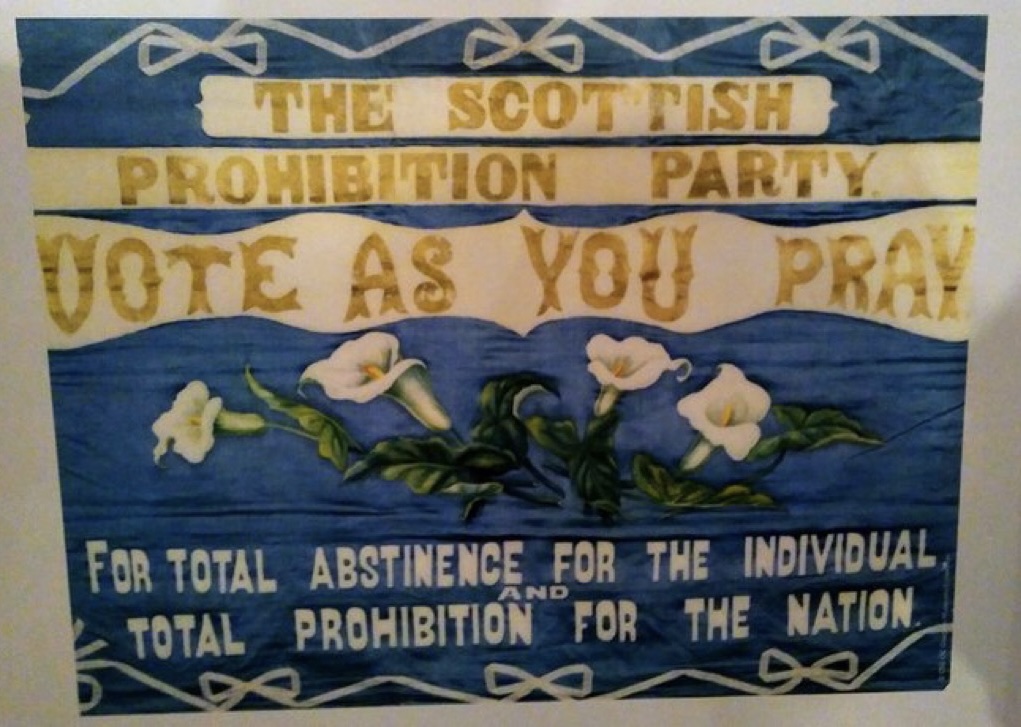
Although committed to temperance, Bob Stewart couldn’t abide the ‘religious prattling’ within the Scottish Prohibition Party.
During all the comings and goings, organising for the trade union and for the Templars, I was always drawn to political affairs. In a way this was natural, because Dundee was a politically radical city and had been so ever since the days of the Jacobins when Palmer, an associate of Thomas Muir, had been banished to the hulks in Botany Bay for his political activities. Dundee was also one of the main centres of Chartist agitation. In the 1880s and 1890s, Dundee was a real stronghold of radical liberalism and the local weekly newspaper, The People’s Journal, published strong radical views. I sold this newspaper on the streets and got fourpence a dozen; even when a boy I was doing a useful job in spreading the message.
In 1892, a political leftward move took place in Dundee when Jimmy McDonald, then secretary of the London Trades Council, stood as a Labour parliamentary candidate and polled 345 votes. In 1895 he again contested, this time as an Independent Labour Party candidate, and polled 1,313 votes. I did some campaigning for McDonald in this election and remember that the elder men thought this was an excellent vote because his candidature did not have the support of the Dundee Trades Council. A resolution which sought to support him in the Council had been defeated and an amendment to support the Liberal candidate had been carried by 19 votes to 16. It was shortly after this that I became a delegate to the Trades Council and very soon began to take part in the debates.
The Scottish Labour Party had been formed on July 23rd 1892. Many of the temperance men left the Liberal Party and joined the new party, taking their temperance views with them. But at this time I was still singularly obsessed with the struggle to stop the sale of strong drink and remained uncommitted to any political party. However, I read avidly-topical pamphlets, books theoretical and otherwise- I particularly remember several by Karl Kautsky. American temperance books and socialist pamphlets held a particular appeal, and I was always drawn to the Chartist books because they had a positive political programme.
Up to just after the turn of the century, therefore, my life consisted of finding a job, trying to keep it, trade union work, organising in the temperance movement, speaking and debating on radical platforms and reading and trying to assimilate the new revolutionary socialist ideas.
On my return from South Africa I was soon back again in the organising and political groove. I became full-time organiser for the Scottish Prohibition Party with a wage of 27s. a week; this was much less than I could have earned in the yards, but political idealism was taking a hold of me and political principle was more important than money. The Prohibition Party was committed to a reformist labour programme but was semi-religious. I travelled up and down Scotland in all the big cities and in many of the villages doing propaganda meetings. We had a small newspaper called The Prohibitionist, and I helped to edit this as well.
This was the period of great political struggle to break Liberal-Labour coalition politics and for independent working-class action. In the General Election of January 1906 fifty-one Labour candidates were returned as Members of Parliament, including some fine leaders for independent working-class action such as Keir Hardie. One month later, on February 15th at the Memorial Hall in Farringdon Street, London, the Labour Representation Committee transformed itself into the Labour Party and thus started the final break with Liberal-Labour unity and the birth of organised independent working-class political action. One of the first demands of the independent Labour M.Ps was the passing of the Trades Disputes Act, a very progressive piece of legislation that stood the test of time for over half a century.
In the 1906 Parliamentary General Election, Alex Wilkie, general secretary of the shipwrights’ union and one of the original Labor Representation Committee of 1900-6, stood on the Labour ticket in Dundee and won. He was, however, very much a Lib-Lab politician, and, while campaigning for him, I and a number of others tried to change his ideas. Dundee was then a double-barrelled constituency, that is, there were two votes for two parliamentary seats. Wilkie was returned to Parliament together with a Liberal named Robertson.
The year 1908 was one of heavy trade depression and high unemployment, but politically it was a vintage year for me. I stood for the Dundee Town Council and won. The full-time secretary of the Prohibition Party, Scrymgeour, was also on the Council so this made a mover and seconder for any motion we desired to put. We certainly enlivened the Council meetings. The first night I took my seat we were both suspended for being “‘offenders against decorum”. I had called another councillor a liar and the Lord Provost interrupted me to warn against the use of such language. The Provost was Jimmy Urquhart and I knew he had a university education, so I asked him to tell me how I could call a man a liar without actually saying so. “See me after the meeting,” he replied, “but don’t use that word here.”
There was a Baillie on the Council called Robertson who was, among other things, a director of the Dundee Football Club. Some material had disappeared from the Council Stores and found its way to the Dundee Football Club. I called Robertson a thief. This was a bit too much for a mere reprimand. I was taken to Court and fined £5 and £8 costs, but it put a stop to a number of things that were going on. A friend of mine, Adam Piggot, a butcher, paid the fine or I would have been “inside” again, because £13 was a small fortune to me in those days.
All this was good political campaigning, because it was all official Town Council business, and the local press gave it great publicity. Dundee in 1908 was in a desperate position. Unemployment was rampant, so bad that relief work had to be arranged. Soup kitchens were erected in the wards. Farmers from the surrounding area brought in vegetables free, and local butchers donated beef and bones. Door-to- door collections for money were organised and food was distributed to the needy- over half of the town were needy. I did an immense amount of work on relief both for the Prohibition Party and as a councillor. One helper I remember, who worked like a Trojan, was a Roman Catholic priest called Turner. He was out day and night working; and never a needy case was turned away. He was a kindly, hard-working man, which was more than could be said for many of those who did nothing but were always on hand to give advice on how the relief should be distributed.
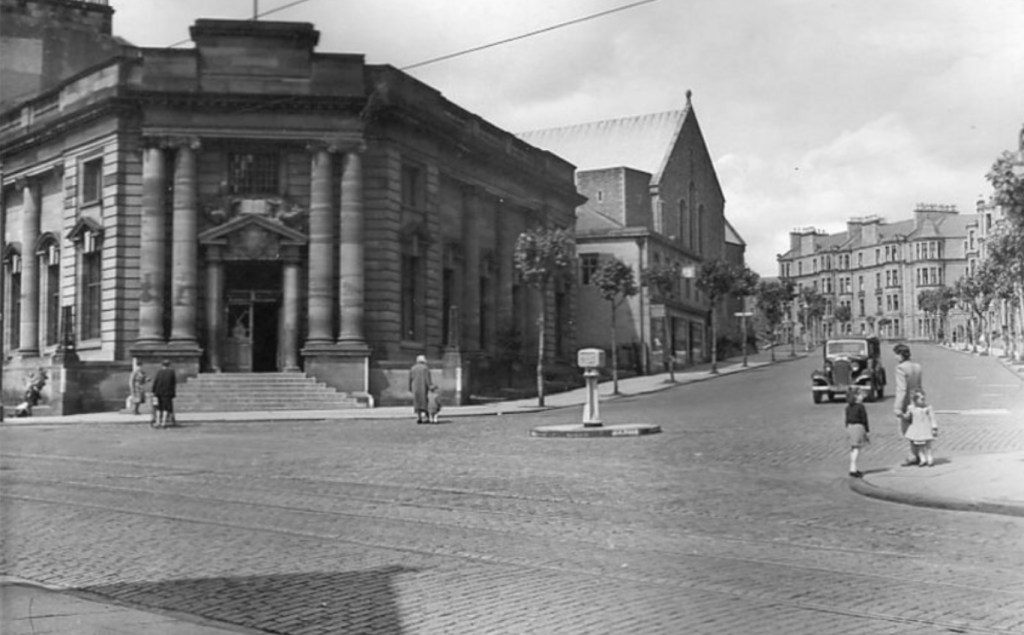
The employment position was so bad that I moved in the Council that we provide some work for the unemployed. I suggested that to provide work trees be planted in the Blackness Road to beautify the street. Many were against it because it was spending the town’s money needlessly. However, I won; the trees were planted and are still there today. Blackness Road, lined with trees, is one of the prettiest in the city.
Blackness Road, Dundee. Early 20th century.
During the Council term I was elected as a representative to the Blind Institution Committee. Usually the meetings of the Committee lasted fifteen minutes. Minutes would be read and approved, a lot of nice things said and then everyone would go home. The Committee consisted of one or two mill owners, a few business men and representatives of the Town and Parish Councils. At my first meeting the minutes were read and approved and then I started to ask questions. There was consternation, but I knew many of the blind people living in their own homes were weaving baskets, making mattresses and the like, and were being very poorly paid. So I continued to press my questions and to get answers, which when followed up made it clear that the manager was making absurdly high profits out of the blind people’s work. On leaving the meeting, one of the mill masters, a great county cricketer, Sharp by name, said to me, ” Stewart I did not know anything like that was going on. I think it’s a scandal.” “So do I,” I replied, “but the living standard of the working class is a scandal.” He nodded his head and went away. No doubt next morning he would be demanding more effort from his jute workers to provide more profit for himself.
After a year in the Council I had to stand for re-election. A campaign was waged, in which the local press took a hand, to get Councillor Stewart, that spendthrift agitator, out of the Council. Naturally, with the expenses for relief work the rates had gone up -32d. in fact- -and I got the full blame for this. Of course I defended the relief work, but the forces against me were too strong, and I was defeated at the poll.
The year 1908 saw another famous election in Dundee. It was a Parliamentary by-election in which Winston Churchill stood as a Liberal candidate.
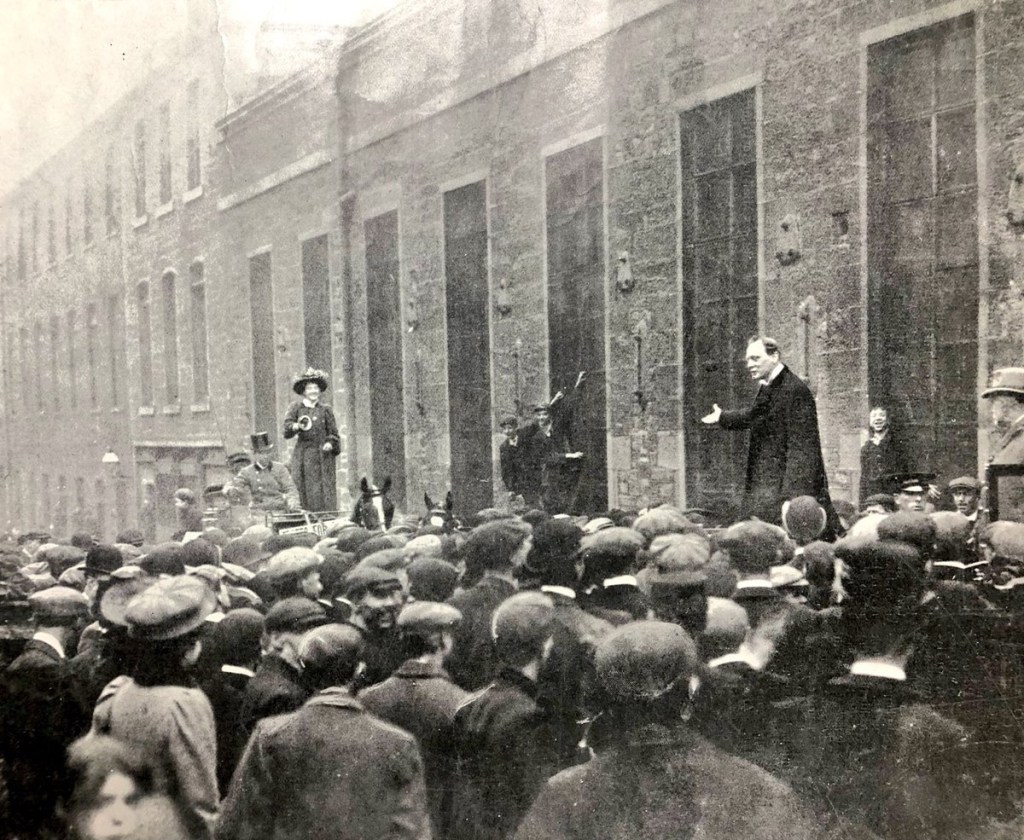
Winston Churchill campaigning in Dundee, 1908.
Churchill had started his parliamentary career as a Tory and won the seat at Oldham in October, 1900. In the fight for tariff reform at the beginning of the century he changed his coat and became a Liberal, contesting the North-West Manchester constituency. In the general election of 1906 he defeated Joynson Hicks in what was accepted as a safe Tory seat. In 1908 he succeeded Lloyd George as President of the Board of Trade and this necessitated a by-election. (This was the parliamentary procedure of the period: when an M.P. became a cabinet minister he had to face the electorate again.) On the 24th of April, 1908, in the by-election at North-West Manchester Jonson Hicks got his revenge and defeated Churchill, largely because of the intervention of Dan Irving, a Socialist candidate. The date is important because, while, Churchill was contesting this by-election, the Dundee Liberal Party were meeting to choose their candidate for the Dundee by-election. After a few stormy meetings the decision was postponed. There was a terrible row at the time, with the local press giving pages of publicity to the rumours that some Liberal leaders in Dundee were keeping the candidature warm for Churchill should he be defeated at Manchester. So it came about that Churchill, who was defeated as a sitting M.P. on April 24, packed his bags and was campaigning in Dundee three days later. On May 10, sixteen days after his defeat, the Dundee result was announced and Churchill was returned to Parliament and became President of the Board of Trade, but as M.P. for Dundee and not for Manchester. In this by-election I was election agent for Scrymgeour. The Prohibition Party had decided not to support the candidature of Stuart, the Labour candidate, but to put up our own candidate. It was a short but lively campaign. With four candidates in the field, the meetings were all packed out. I remember one meeting in the Drill Hall at which Churchill spoke. He shouted to the crowd: “Britain has great imperial strength. We have belted the world with free institutions.” He was speaking in Bell Street, next door to the Sheriff Court, across the road from the Salvation Home for fallen women; next door to that was the Parish Council Lunatic Department, nearby the Curr Night Refuge for homeless people to get a cup of tea and a bed, before they started their wanderings the next day. The gulf between Churchill’s oratory and the living reality was there in the street where the meeting was held. This was a good propaganda point I certainly did not miss.
During the counting of the votes I noticed Churchill standing alone in a corner twisting little rubber bands around his fingers, and as each one broke he threw it away. He was obviously in a very agitated condition.
I went over and started a conversation with him about stopping the sale of strong drink, asking what he would do in Parliament to bring this into law. It was obvious he was only interested in one thing-the result. In retrospect he was right; another defeat in Dundee after Manchester would have ruined his political career. “How do you think it’s going?” he asked me. “You’re in by a mile, worse luck,” I said. You didn’t have to look at the vote-counting very long to see that. However, our little discussion on prohibition had not gone entirely unnoticed. Later, the Provost, Jimmy Urquhart, came over to me and said: “I understand you’ve been trying to convert Winnie to prohibition. By Christ! Bob, you never give up!” He said it in a voice of admiration for my courage and with the certainty that I was on a forlorn quest. As later years proved, Churchill and the prohibition of strong drink were poles apart.
Edwin Scrymgeour.
Scrymgeour and I had many differences in the election campaign. He dwelt too much on religion. He had a great advantage over all the other candidates because he had a mandate from God. His speech to the crowd after the announcement of the result was really heavenly: “I feel deeply grateful to the Almighty God that has enabled the Prohibition Party to put me forward as the first British Prohibition candidate and look forward to another day when success will attend our efforts.” That speech was the beginning of the break in the Prohibition Party.
Winston Churchill was Member of Parliament for Dundee until the general election of 1922, when Willie Gallacher stood for Dundee as a Communist candidate. But in 1908 he was the hero. When the result was declared that May night, the Dundee workers not only lifted Churchill shoulder high, they lifted his motor car with him inside it and carried him down Bell Street.
A year or so after the election the inevitable split came in the Prohibition Party. I could no longer stomach the religious prattlings of Scrymgeour and some of his adherents. A number of us broke away and formed the Prohibition and Reform Party. It was at this period that I wrote the pamphlets, En Route To The Sober Commonwealth and Socialism, which were laced with good socialist principles. Apart from the aim of achieving complete National Prohibition its aims were:
SOCIALISM The abolition of private ownership of the land and the means of manufacture, production and exchange, and the substitution of public or social ownership without compensation.
COMPLETE DEMOCRATIC RULE Abolition of the hereditary principle in government, adult suffrage, initiative and referendum, devolution on separate Parliaments of domestic legislation.
INTERNATIONALISM Recognition of the common interests of mankind. The establishment of international arbitration courts for the settlement of all disputes between nations, leading up to world-wide government elected by the citizens of all nations.






 Breaking the Fetters